

You're staring at a closet of mismatched robes three weeks before Easter, two singers have just joined, and the purple stoles from last year don't match the purple you ordered this year. That's the moment church uniforms stop being a simple shopping task. I treat them as three decisions at once: liturgical color, fire-safe fabric, and inclusive fit. Get those right first, and ordering, care, and replacement get much easier.
Church Uniform Options at a Glance
| Uniform | Who Wears It | Typical Pieces | Best Fit |
|---|---|---|---|
| Choir robe or gown | Adult and mixed-age choir singers | Full-length robe with optional stole | Concerts and seasonal services |
| Cassock and surplice | Clergy and liturgical teams | Black cassock under white surplice | Traditional liturgical services |
| Choir stole | Any choir member | Stole in a liturgical or choir color | Adding seasonal color to a plain robe |
| Usher or greeter attire | Ushers and greeters | Matching blazer or vest with tie | Clear identity at entrances |
| Youth or children's robe | Youth and children's choirs | Smaller-cut robe in the adult choir color | Youth groups that match the adult ensemble |
Choir Robes and Gowns
A full-length choir robe or gown is the most flexible starting point for adult and mixed-age singers. It covers everyday clothing, photographs well, and works for concerts, seasonal services, and combined choirs. I recommend a plain robe when your choir sings across the full church year, because you can change the stole instead of replacing the robe. Decorative panels look sharp, but they lock you into one color story.
Cassock and Surplice
A black cassock under a white surplice carries a more traditional, explicitly liturgical look. It suits clergy, acolytes, and liturgical teams in services where that clerical connection matters most. The trade-off is layering: it's warmer, needs more storage space, and asks more of singers with mobility limits.
A cincture or sash finishes the ensemble. Solid colors and patterned weaves both work, and custom embroidery can carry a cross or parish emblem to match the rest of the vestments.
Stoles, Ushers, and Youth Robes
A choir stole is the cheapest way to change the whole ensemble's appearance. It adds seasonal color to a plain robe without another full garment purchase. For ushers and greeters, matching blazers or vests with ties beat robes on the door: visitors recognize them instantly at entrances, and the wearer can move, carry, and seat people freely.
For youth and children's choirs, order smaller-cut robes in the adult choir color. Handing down adult robes and pinning the hems creates trip hazards and looks it. Children fidget and outgrow sizes quickly, so shorter hems and simpler closures serve them better than exact adult construction. Matching the color and fabric family keeps the ensemble unified; the construction details can differ.
Practical rule: Pick the uniform type for the job the wearer does during the service.
Matching Robe Colors to the Church Calendar
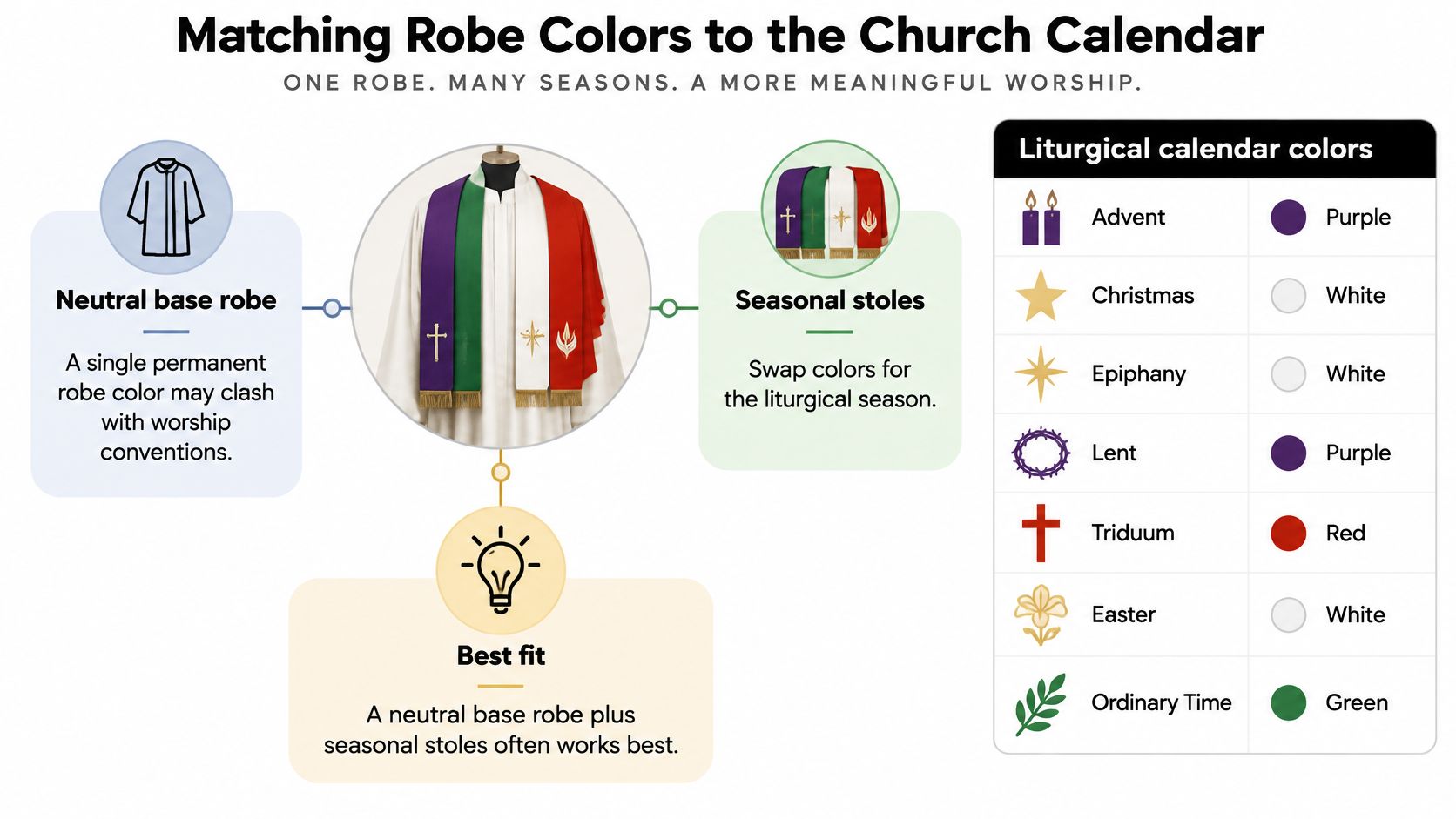
A single permanent robe color can clash with worship conventions for half the year. I start most churches with a neutral base robe plus interchangeable stoles: buy the expensive garment once, then handle seasonal signaling with the cheaper accessory. A black or white matte gown can serve the full church year when the stoles rotate with the calendar.
The diagram below shows how that neutral base and seasonal stole system works across the year.
| Season or Occasion | Catholic Color | Presbyterian Color | Stole Approach |
|---|---|---|---|
| Advent | Violet | Purple or blue | Violet or blue stole over base robe |
| Christmas Time | White | White and gold | White or gold stole |
| Ordinary Time | Green | Green | Green stole |
| Lent | Violet | Purple from Ash Wednesday through the first five weeks | Purple stole |
| Palm or Passion Sunday | Red | Red and/or purple | Red or purple stole by tradition |
| Good Friday | Red | No color | Plain base robe with no stole |
| Easter Time | White | White and gold | White or gold stole |
| Pentecost | Red | Red | Red stole |
Where Traditions Differ
The U.S. Conference of Catholic Bishops liturgical colors guide assigns white to Christmas Time and Easter Time, red to Palm Sunday, Good Friday, and Pentecost Sunday, green to Ordinary Time, and violet to Advent and Lent. The Presbyterian Mission Agency worship schedule assigns purple or blue to Advent, white and gold from Christmas through Epiphany on January 6, no color on Good Friday, and red on Pentecost.
The Good Friday split is the clearest example: Catholic ensembles wear red stoles that day while Presbyterian choirs wear no color at all, so each church builds its color plan from its own calendar. The Presbyterian schedule also lists exceptions such as the Baptism of the Lord, Transfiguration, Trinity Sunday, All Saints' Day, and Christ the King, which can justify keeping extra stole colors on hand. A white stole does a lot of work in both traditions, and the White Traditional Choir Stole lists at $9.95 in two variants. Beyond white, custom stoles run solid or two-tone across 17 color options, with embroidery for crosses, logos, or scripture. For a deeper breakdown of shade choices, see our choir robes color guide.
The short video below walks through how seasonal colors read on a full ensemble in a sanctuary setting.
Three Steps Before You Order Color
- Document your governing tradition: Write down the liturgical calendar your church follows, since catalog defaults differ between denominations.
- Map colors to your calendar: List only the seasons and feasts your choir will cover this year.
- Approve one standard shade under sanctuary lighting: Daylight swatches lie under warm sanctuary bulbs, so check the fabric where singers will stand.
White earns its shelf space first because it covers Christmas, Easter, weddings, and most of the special feasts on either calendar. Purple and red follow close behind for Advent, Lent, and Pentecost. A spare stole for a one-off feast costs a fraction of a robe, so keeping backup colors in the closet stays a small line item year after year.
Fabric Safety Rules for Church Robes
Robes spend their working life near candles, sanctuary heaters, and stage lighting, and flammability is the specification buyers most often skip. Two robes cut from the same fiber can burn very differently, because weave, finish, and surface texture drive how a fabric behaves near flame.
| Class | Meaning | Purchasing Rule |
|---|---|---|
| Class 1 | Normally flammable and acceptable for apparel | Specify this for robes and layered accessories |
| Class 2 | Intermediate flammability, requires caution | Avoid unless you have a documented reason and controls |
| Class 3 | Dangerously flammable and prohibited for apparel use | Reject for any church uniform |
What the Federal Rule Covers
Under federal 16 CFR Part 1610, clothing textiles are sorted into three classes by burning behavior, and the rule covers single- and multilayer textiles alike. The multilayer coverage is what matters for robes, because linings, overlays, detachable stoles, and dense decorative panels all count as part of the garment being evaluated. The U.S. Consumer Product Safety Commission also flags raised-surface fabrics for particular attention, since loose surface fibers can support rapid flame spread. A plush or fuzzy trim that looks harmless on a hanger can behave very differently near an Advent candle.
Turning the Rule Into a Purchase Specification
I would write one line into every robe order: require Class 1 apparel textiles, documented. Then ask the supplier for compliance documentation covering each fabric and construction in the garment, because polyester in one weave and finish isn't the same product as polyester in another.
- Evaluate the complete garment system: Check linings, overlays, stoles, and dense decorative panels alongside the base fabric.
- Treat trims as part of the garment: Layered accessories can change burning behavior even when the robe itself passes.
- Flag high-risk settings: Name candlelight services, heaters, stage lighting, and electrical equipment when you request documentation, so the supplier knows the environment the robe will work in.
- Keep the paperwork with the inventory record: You want it findable when a new music director asks why this fabric was chosen.
A robe that passes as a single layer can fail your expectations once you add a lined stole and a decorative panel. Test the outfit singers wear.
Treat this as one safety control for adult and youth ensembles, working alongside your venue's fire policies and supervised candle procedures. The point is a garment that adds no avoidable risk to a service already involving candles and hot lights.
Fitting Every Singer With Inclusive Options
Strict visual uniformity can keep people out of the choir. A singer who can't manage small buttons, can't sit comfortably in a full-length robe in a wheelchair, or can't wear the only cut you bought doesn't file a complaint. They just stop showing up.
That risk isn't theoretical. A 2025 study of cathedral music and choral outreach reported that cathedral music activity primarily attracted older, White, Christian, middle-class participants, while broader outreach was more age- and religion-diverse, and its choral outreach sample was 73% women. Participation already skews, so a rigid uniform policy can narrow it further.
Questions to Answer Before Ordering
- Alterations: Can a robe be shortened, opened at the back, or adapted for a wheelchair without changing how the choir looks from the pews?
- Closures: Which option works for limited dexterity, a front zipper, large snaps, or hook-and-loop under a false placket?
- Head coverings and adaptive clothing: How will you handle coverings, medical devices, and sensory sensitivities to stiff collars or scratchy linings?
- Gender expression: Can nonbinary singers choose between equivalent cuts without being singled out?
- Children's construction: Should youth robes share adult construction, or use simpler closures and shorter hems?
Equivalent Options, Not Exceptions
I recommend a documented range of equivalent options, such as two closure styles or two cut lengths in the same color and fabric. From the congregation, the choir reads as one ensemble. For the singer, the garment is wearable for a full service. Our guidance on plus size robes and inclusive sizing covers the sizing side of that approach.
Measure each singer privately, record the result on one shared sheet, and allow a second fitting before robes are assigned. Nobody should have to announce a size or an accommodation need in front of the choir room.
Put the exception policy in writing and apply it the same way every time. Informal, case-by-case decisions feel kind in the moment and breed resentment later, because the next singer has to ask a different person and hope for the same answer.
Measure, Order and Receive the Choir Uniforms
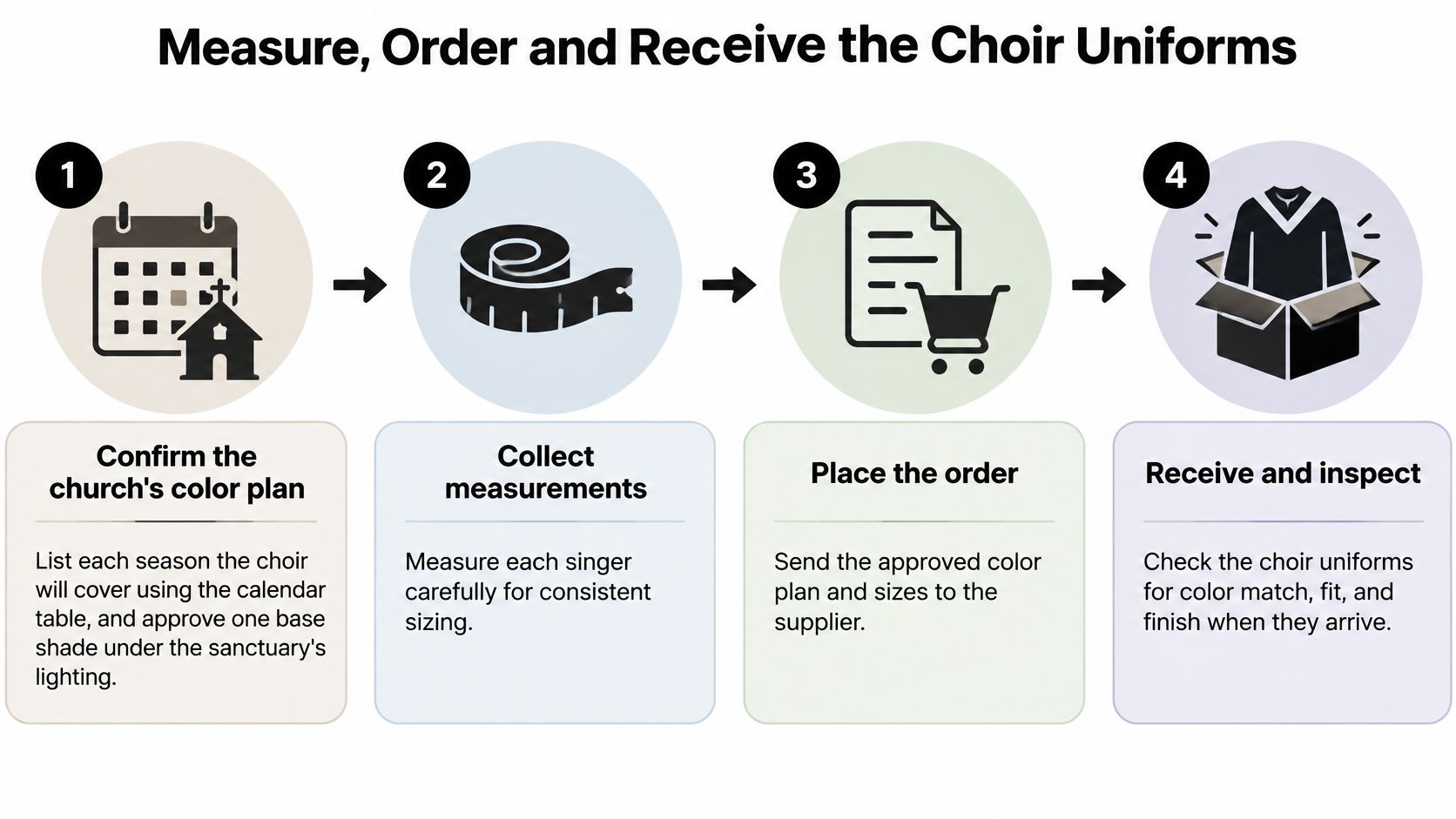
Good group orders fail in predictable places: colors approved too late, measurements collected too loosely, and deadlines that ignore processing time. Work through these eight steps in order and you will avoid most of them.
The flowchart below summarizes the sequence from color plan to final inspection.
The Eight Steps
- Confirm the color plan. Lock in the seasonal palette and base shade approved under sanctuary lighting in Matching Robe Colors to the Church Calendar before anyone takes a single measurement.
- Collect measurements privately. We need each member's height with shoes on and weight to select a robe size, recorded on one shared sheet with alteration needs. Allow a second fitting, because guessed weights produce returned robes.
- Choose the base robe. Pick the cut your ensemble needs and hold it to the Class 1 fabric specification set in Fabric Safety Rules for Church Robes.
- Decide which accessories vary by season. Stoles usually carry the seasonal color, so settle embroidery details here while quantities are still flexible. On our Custom Traditional Choir Stoles, personalization runs $5.00 for text or Greek letters, $9.00 for images, and $9.95 for a class year or flag, across 17 color options for the stole and trim. For cassock ensembles, add the clergy band cincture with gold piping when sizes match the wearers. The common mistake here is ordering stoles before the approved shade is fixed.
- Total quantities by size and add a buffer. A small buffer for late joiners costs far less than a rushed second order in a slightly different dye lot. Since only stoles change between seasons, spare robes can be few and spare stoles can sit flat in a drawer.
- Ask about group pricing and send your deadline. We offer special discounted pricing for churches, schools, and organizations ordering choir robes in bulk, including custom packages bundling robes, stoles, and accessories. Send the deadline with the order, not after it. Our overview of wholesale choir robes explains how bulk pricing is structured.
- Plan processing and shipping as two separate periods. A delivery date depends on both, and forgetting that shipping time is separate from processing time is the most expensive scheduling mistake churches make.
- Inspect the first delivery before distributing. Check garments against the approved shade sample and the size record while everything is still in its packaging. A robe that fits wrong is cheap to swap now and painful to swap after the first service.
Common failure point: The order is right and the calendar is wrong. Count backward from the service date through shipping, then processing, then your own fitting session.
A Quick Worked Example
Say your choir sings Easter, Pentecost, and a December concert. You would order one neutral base robe per singer, a white or gold stole set for Easter, a red set for Pentecost, and nothing new for December if white already covers Christmas. Three looks from one robe inventory, and your buffer stock stays small because only stoles multiply.
That is the payoff of separating the base robe from the seasonal layer. When the calendar turns, you reorder a box of stoles rather than a rack of robes.
Caring for Robes and Retiring Them Responsibly
Many order guides end when the box arrives. Your budget lives in the years after that, in cleaning, storage, repairs, and the moment a color change leaves you with a closet of wearable robes nobody needs.
A Simple Assignment and Care Policy
Assign each robe to a named singer who stores it, keeps it clean, and transports it in a garment bag. Central storage sounds tidy, but shared closets are where robes get crushed, borrowed, and lost. The Chowan University gospel choir handbook shows how enforceable this can be, requiring each member's performance attire to be checked within two weeks of the first practice and robes to remain clean and damage-free.
Inspect robes at the start of each season rather than the week of a concert. A loose hem found in September is a cheap repair. The same hem found on Easter weekend is a problem.
Keep a small repair kit with the robes: matching thread, spare buttons or clasps, and fusible hem tape cover most of what fails in practice.
Repair, Donate, or Retire
End-of-life planning matters because textile disposal is a poor safety net. A 2025 report on religious garments noted that only about 15% of U.S. textiles were recycled and that Americans generate up to 34 billion pounds of textile waste annually, citing Environmental Protection Agency figures. The same report described a religious-garment recycling initiative that sends cotton, polyester, and nylon garments to cement kilns for energy recovery, where the material is burned as fuel to power the kilns.
- Repair when damage is minor, a hem, zipper, or seam, and the fabric still meets your safety specification.
- Donate or resell when the robe is clean and sound but your choir no longer uses the color.
- Remove embroidered names and sacred symbols before any garment leaves your church for disposal or reuse.
Judge a robe by durability, laundering frequency, and repairability, along with shipping distance and whatever end-of-life options exist near you. A robe worn for a decade and repaired twice beats a fragile robe replaced three times, whatever the fiber content says.
Why Choir Robes Look the Way They Do
The robe in your closet is a compromise between three different traditions, and knowing that frees you from hunting for one supposedly correct design.
Coordinated dress for singers is old. A history of choir robes notes that a fragment of Greek pottery dated around 425 BCE depicts singers and musicians wearing similar flowing garments. The church version took shape alongside the institutional growth of choirs in medieval Christian Europe, and what those singers wore was borrowed clerical dress, the same cassock and surplice their clergy already used.
From Cassock to Geneva Gown
Medieval singers commonly wore clothing modeled on clerical dress, a white, loose-fitting surplice over a long black cassock. That combination set the choir apart from the congregation and tied the singers visually to the clergy and the formal worship service. Nothing was standardized. Regional custom, church wealth, and ecclesiastical tradition shaped color, cut, and decoration, so wealthy and poor churches dressed very differently while meaning the same thing.
The Renaissance brought more composed church music and a more deliberate approach to how choirs presented themselves. The Reformation then introduced the Geneva-style gown, derived from academic doctoral regalia, which is why so many robes still look like graduation gowns. We trace that academic lineage in more detail in our overview of the robe's academic roots.
The image below shows a traditional white stole of the kind layered over those gown-style robes today.

A Recent Invention, Not an Ancient Rule
Here the timeline needs care, because two different things get lumped together. Robing singers in clerical dress is medieval. Robed parish choirs as a standard feature of congregational worship are an invention of the nineteenth century. Both facts are true at once, and keeping them separate ends most arguments about which period a church is supposed to copy. It also lowers the temperature of robe debates in committee meetings, since the "traditional" option is usually younger than the building it happens in.
Modern church uniforms combine clerical garments such as cassocks and surplices, academic-style gowns, and later ensemble-specific colors and trims. No single fixed design exists to copy, so decide which elements you will hold constant for tradition, perhaps the cassock and surplice for major feasts, and which you will vary for your group's identity. Stole colors and trims are the cheap variable. A neutral base robe with interchangeable stoles lets one inventory serve Christmas, Easter, and ordinary Sundays, and when your color plan changes you replace a set of stoles rather than the whole robe stock. A choir that makes that choice deliberately looks intentional. One that inherits it by accident just looks dated.
If you're ready to turn your color plan, measurements, and size sheet into an order, we stock robes, stoles, cassocks, surplices, and accessories for adult, youth, and liturgical ensembles, with group pricing for churches and schools. Bring us your approved shade, your deadline, and your singer list, and visit ChoirBuy to start your order.