

When you picture a choir, what comes to mind? For most of us, it’s the powerful image of voices rising in perfect harmony, with singers presented as a unified sea of color and fabric. That visual is no accident. It’s part of a rich history of choir robes that weaves together faith, music, and community.
The journey of the choir robe is a fascinating one, tracing a path from the simple, functional tunics of medieval monks all the way to the diverse and symbolic garments we see in churches, schools, and concert halls today.
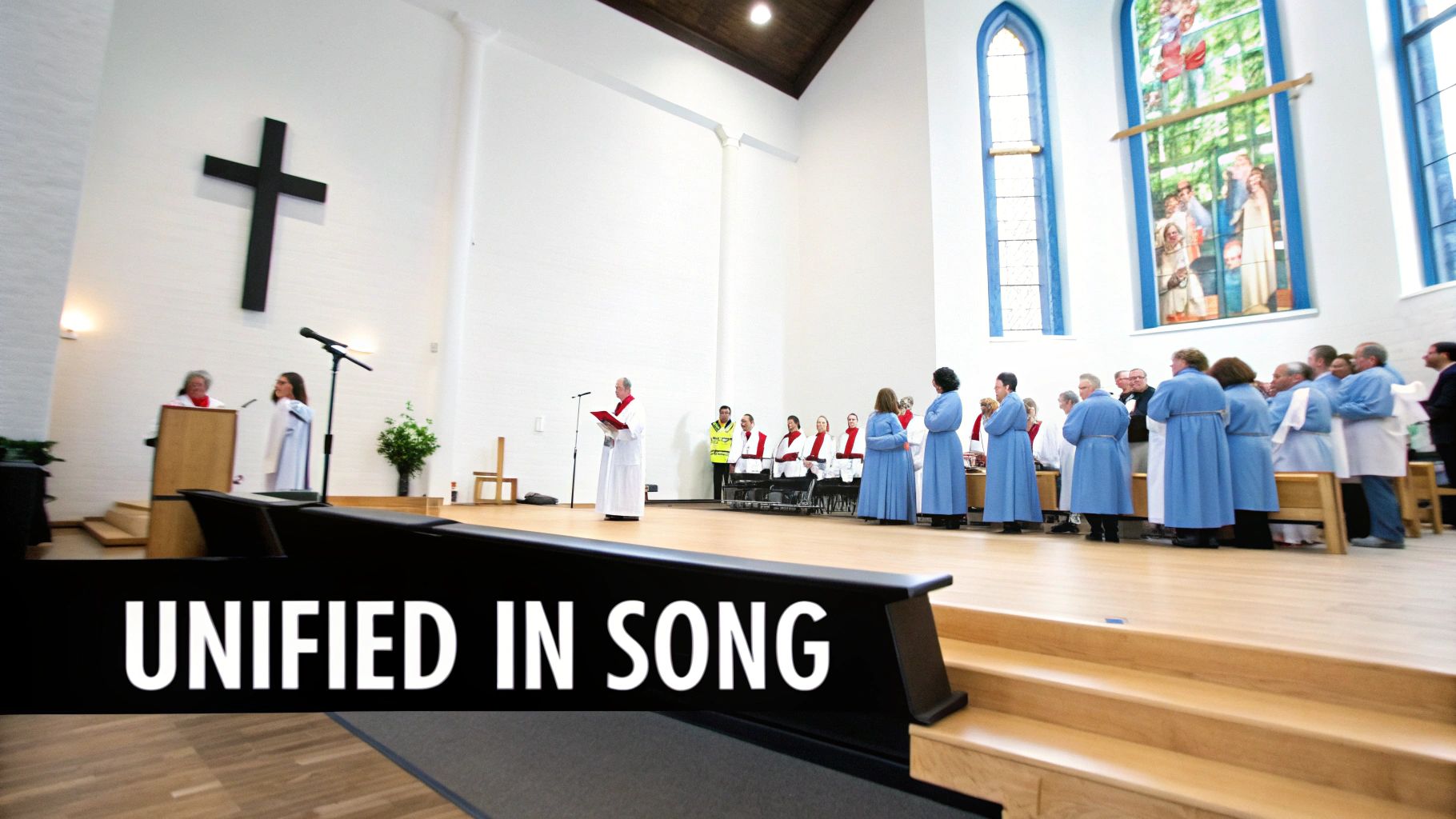
More than just a uniform, a choir robe is a thread connecting generations of singers. Digging into this story can enrich a choir’s own identity and bring deeper meaning to the act of choosing the apparel that will represent its unique voice.
The Purpose Behind the Robe
From their earliest days, choir robes have served several crucial functions that remain just as relevant now. These garments were never just for show; they are intentional tools designed to enhance the musical and spiritual experience for everyone involved.
At its core, the tradition boils down to a few key ideas:
- Creating Visual Unity: Robes create a cohesive look that minimizes the distraction of individual street clothes. This simple act helps the congregation or audience focus on what truly matters—the collective sound and the message within the music.
- Fostering a Sense of Community: When every singer dons the same attire, it smooths over personal differences. It builds a powerful sense of equality and shared purpose, reminding everyone that they are part of a single entity.
- Upholding Tradition and Reverence: Especially in liturgical settings, robes are a visible link to centuries of church history. They add a layer of solemnity and reverence to a worship service that is immediately felt.
A Deeper Layer of Meaning
Beyond these practical benefits, the specific styles and colors of choir robes carry a lot of symbolic weight. Almost every element, from the cut of a sleeve to the hue of the fabric, can communicate a particular message or align with a specific liturgical season.
The use of certain colors, for example, is a time-honored practice for visually reinforcing theological themes. It’s a subtle but powerful way to add depth to any performance.
Understanding the symbolism behind different robe colors is a key part of honoring tradition. It allows a choir to visually align with the liturgical calendar, adding another layer of meaning to their musical ministry.
This deep connection between color and meaning is a crucial piece of the history of choir robes. As you start exploring options for your own ensemble, learning more about the meaning behind choir robe colors in our detailed guide can help you make a choice that is both beautiful and deeply significant.
The Medieval Origins of Choral Attire
The story of the choir robe doesn't start in a grand concert hall. It begins in the cold, stone corridors of medieval European monasteries. Long before they became a symbol of performance, the very first choral garments were born from a blend of practicality and deep devotion. This foundational chapter wasn't about fashion; it was about creating an essential tool for worship.
These early robes were designed to solve a very real, very human problem: the biting cold of unheated cathedrals and chapels. Monks and clergy spent hours each day in prayer and song, and they needed something to keep them from freezing. The solution was simple—long, flowing robes made from humble, readily available materials like wool and linen.
But functionality was only half the story. The robes also served a profound spiritual purpose. By dressing in identical, simple garments, the individual melted away, and a unified spiritual body emerged. This visual uniformity was a powerful statement of humility and a deliberate rejection of worldly vanity.
The First Foundational Garments
Two key garments emerged from this era that set the stage for everything to come: the cassock and the surplice.
Think of the cassock as the base layer. It’s a long, close-fitting robe, often black, that reaches the ankles. This was the standard daily wear for clergy, providing the primary layer of warmth and modesty.
Over this, singers would wear a surplice. The surplice was a shorter, wide-sleeved tunic, typically made of white linen or cotton. Its loose fit allowed for freedom of movement while singing, and its white color was packed with symbolism, representing purity and new life in Christ. This classic combination of a dark cassock and a white surplice established a visual standard that has endured for centuries.
This pairing wasn't just a uniform; it was a visual representation of a spiritual ideal. The dark cassock symbolized a turning away from the world, while the bright white surplice signified the purity and joy of serving God through music.
Exploring our collection of traditional choir cassocks available for purchase offers a direct link to this foundational period, showcasing styles that have remained true to their medieval roots. These garments carry a weight of history that continues to add a sense of reverence to modern worship services.
From Monastic Necessity to Liturgical Standard
The adoption of these robes wasn't an overnight change; it happened gradually. The history of choir robes points specifically to the 13th century, when monasteries began to formalize these simple tunics for both clergy and choir members. It was a visible sign of modesty and a renunciation of worldly pride.
The combination of a white surplice over a black cassock became the widespread standard across Europe, deeply influencing the choir attire we see today. As choral music's importance exploded through the Renaissance and Baroque periods, the garments became more ornate, but their fundamental form remained. Discover more about the sacred traditions woven into choral wear to see how these early practices evolved.
The medieval period truly laid the groundwork for everything that followed. It established the core principles that still define the purpose of a choir robe:
- Unity Over Individuality: Creating a single, cohesive visual identity for the choir.
- Practicality and Comfort: Making sure singers can perform without distraction.
- Symbolic Meaning: Connecting the act of singing to a deeper spiritual purpose.
The simple, functional garments created out of necessity in drafty monasteries became the blueprint for centuries of choral tradition, setting the stage for the stylistic divergences and colorful explosions that were yet to come.
How The Reformation Shaped Choir Robe Styles
The seismic shifts of the Protestant Reformation in the 16th century didn't just reshape theology—they completely redrew the map for religious practice. Naturally, this included the visual identity of the choir. This historic schism created a clear and lasting split in the history of choir robes, steering away from a single, unified tradition into distinct styles that broadcasted new ways of thinking.
Before this point, the Catholic church's powerful influence meant vestments were often incredibly ornate, rich with symbolic embroidery and made from luxurious fabrics. But as new denominations found their footing, their leaders wanted to create a deliberate visual break from what they saw as Catholic excess. This wasn't just a matter of taste; it was a theological statement put into fabric and thread.
The Rise of the Geneva Robe
For many in the Reformed traditions, the goal was radical simplicity. They wanted to strip away the layers of ritual and bring the focus back squarely onto scripture. This philosophy bled directly into their choice of attire. Instead of elaborate, priestly vestments, they adopted something far more sober and academic: the Geneva Robe.
Inspired by the gowns worn by scholars and doctors at universities, the Geneva Robe was a statement in itself. It was typically black, with a full cut, a pleated front, and broad, flowing sleeves. Its design was meant to communicate seriousness, learning, and modesty—a far cry from the visual language of ecclesiastical hierarchy.
This shift was profound. The Geneva Robe symbolized a move away from the priestly role of the clergy toward the role of the teacher and scholar. For choirs, it established a look of dignified uniformity that felt more academic than liturgical, a tradition that remains incredibly popular in Protestant churches and educational institutions to this day.
This timeline shows how the austere robes of early monks evolved through the Renaissance before the Reformation introduced a new, academic standard with the Geneva Robe.
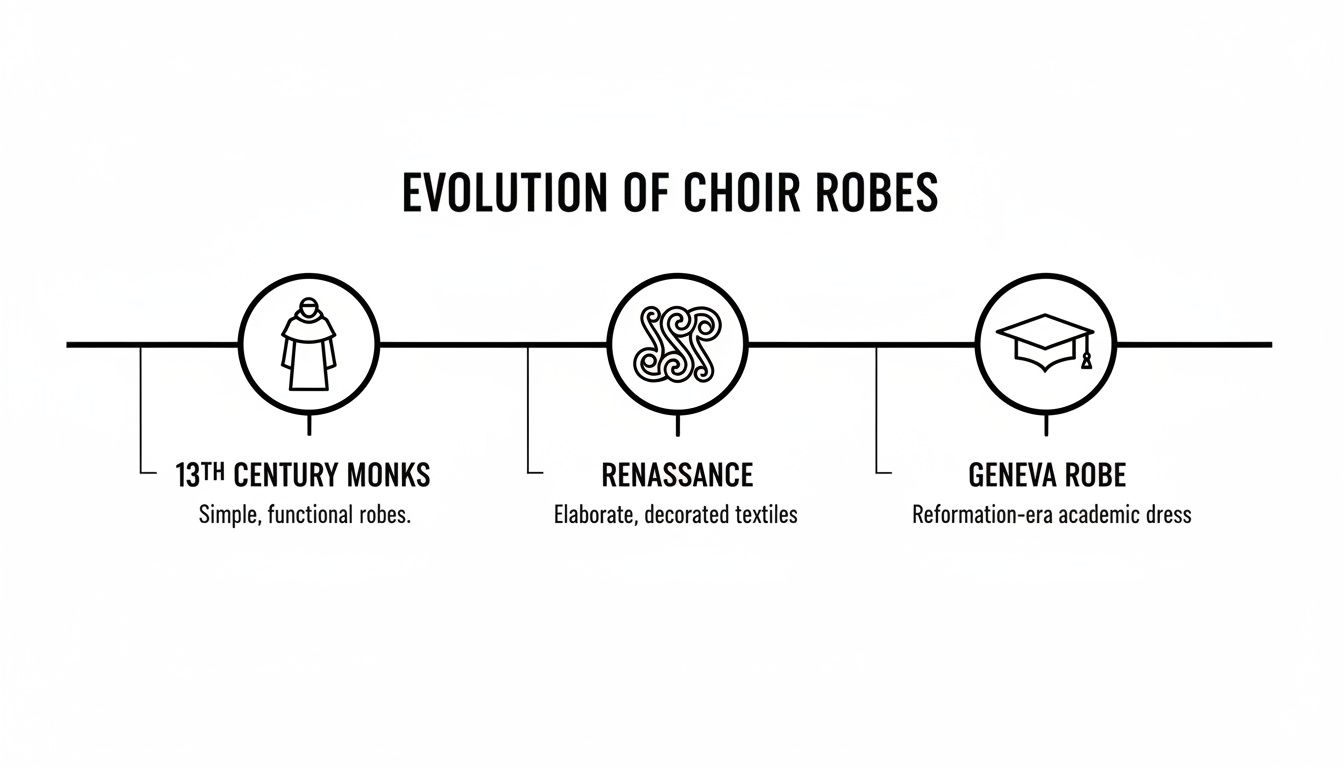
The visualization highlights the major pivot from ornate, church-specific attire to a simpler, scholarly style that would dominate many denominations for centuries.
The Enduring Roles of Traditional Garments
While the reformers were embracing simplicity, other traditions—most notably the Anglican and Catholic churches—held fast to the foundational garments from the medieval era. The cassock and surplice continued as the standard, but their symbolic meanings became even more defined in contrast to the new Protestant styles.
Each piece plays a specific role, working together to create a layered, traditional look:
- Cassocks: Think of these as the base layer. A cassock is an ankle-length, close-fitting robe, often black to symbolize service and solemnity. However, other colors can denote specific roles or ranks within the clergy. Explore our collection of timeless choir cassocks that honor this long-standing tradition.
- Surplices and Cottas: Worn over the cassock, these crisp white garments are meant to represent purity and baptism. The surplice is the longer of the two with flowing sleeves, while the cotta is a shorter, often squared-sleeve version.
- Stoles: These long, narrow strips of cloth draped over the shoulders are perhaps the most symbolically rich accessory. Their colors change with the liturgical calendar, visually signaling seasons like Advent (purple), Pentecost (red), and Easter (white or gold). They serve as a constant, beautiful reminder of the spiritual focus of the time.
To better understand this evolution, the table below provides a quick overview of how styles, materials, and their meanings have shifted over the centuries.
Evolution of Choir Robe Styles Through Key Historical Eras
| Era | Dominant Style | Common Materials | Primary Symbolism |
|---|---|---|---|
| Medieval | Alb, Cassock, Surplice | Linen, Wool | Purity, Humility, Service to God |
| Renaissance | More Ornate Vestments | Silk, Brocade, Velvet | Wealth of the Church, Glory to God, Hierarchy |
| Reformation | Geneva Robe (Protestant) | Heavy Cotton, Wool | Scholarship, Sobriety, Simplicity, Authority of Scripture |
| Post-Reformation | Cassock & Surplice (Liturgical) | Linen, Cotton, Modern Blends | Continuity, Tradition, Purity, Liturgical Roles |
This progression from simple linen to ornate brocades, and then to the academic black of the Geneva Robe, tells a story not just of fashion, but of faith itself.
A Lasting Division in Style
At its core, the Reformation created the two main branches of choir apparel we still see today. On one side, you have the academic-influenced Geneva Robe, which remains popular in denominations that emphasize preaching and scholarship. On the other, you have the liturgical tradition of cassocks, surplices, and stoles, which retains a powerful, visual connection to ancient church rites.
This split is exactly why the world of choir robes is so diverse. A Presbyterian church might seek out a simple, elegant black gown, while an Episcopal choir will need a full set of cassocks and cottas. Both choices are deeply rooted in theological decisions made centuries ago, making the robe a choir wears an affirmation of its unique heritage and identity.
The Modern Explosion of Color and Style
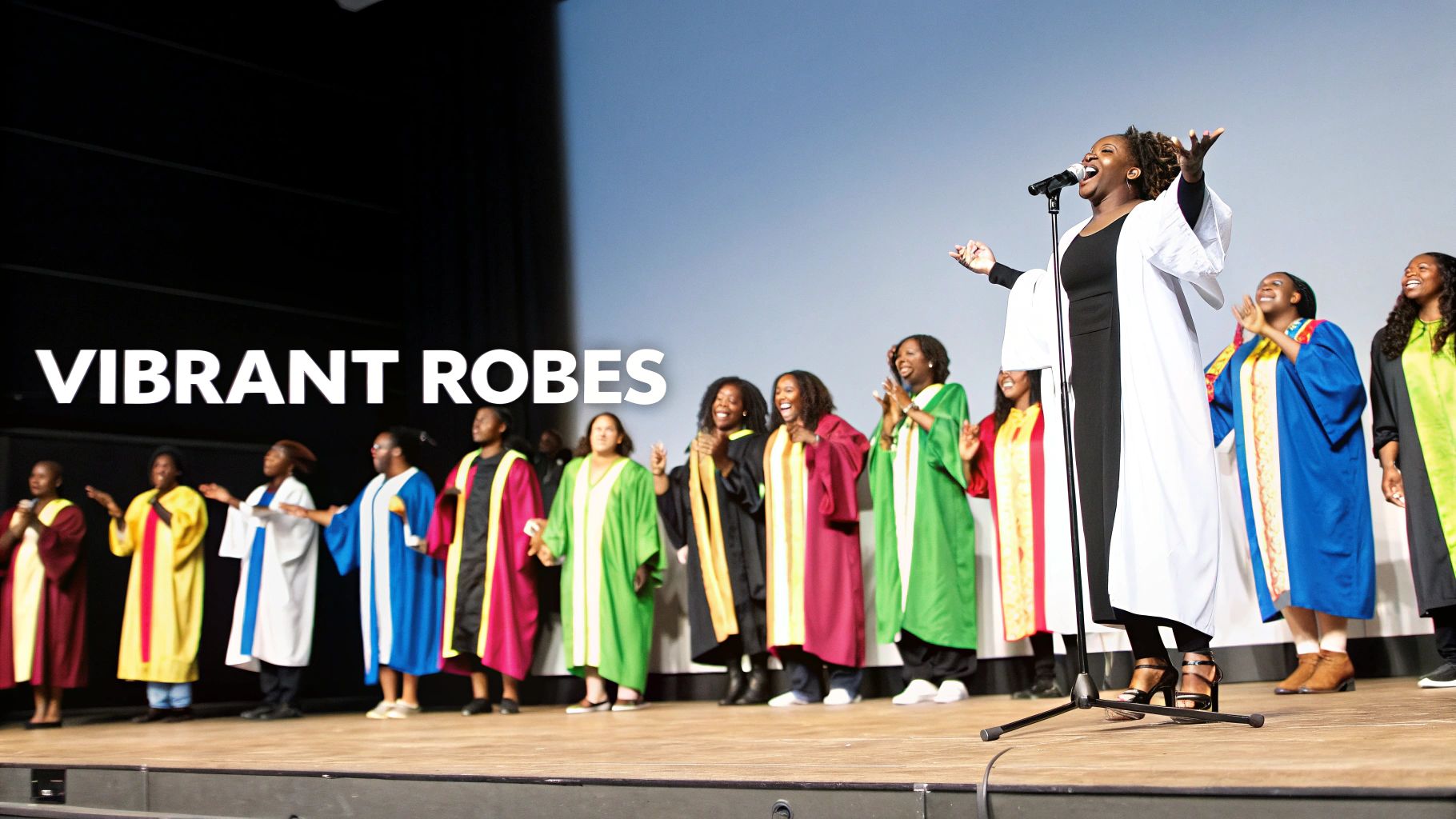
For centuries, the story of the choir robe was one of slow, subtle evolution. But the 20th century hit like a lightning bolt, shaking up tradition and splashing the choral world with a brilliant array of new colors and styles. This wasn't just a minor update; it was a complete reinvention, and the spark that lit the fuse was the American gospel music movement.
Gospel music, with its raw energy and soul-stirring power, just couldn't be contained by the somber black, white, and navy robes of old. The music was joyful, and the look had to match. Choirs began searching for robes in rich reds, shimmering golds, and deep purples—often in bold, two-toned designs that visually captured the sound of their worship.
This was more than a fashion choice. It was a powerful statement about faith, culture, and community. This explosion of color signaled a shift toward a more celebratory and approachable form of worship, where what the audience saw was just as important as what they heard.
From Local Tailors to Global Catalogs
Before this modern era, getting a set of choir robes was a hyper-local affair. You'd find the best tailor in town or rely on a skilled member of your own congregation to sew the garments. While this process was personal, it also meant options were severely limited by whatever fabrics and patterns were available locally.
The 20th century changed all of that with the dawn of mass marketing and large-scale manufacturing. Suddenly, choirs of any size or budget could flip through catalogs filled with an incredible variety of choices. This commercial boom made exciting new styles accessible to groups well beyond the big city churches.
As choral music became more popular in schools, churches, and community groups, the demand for expressive, well-made robes skyrocketed. Retailers jumped in to meet this need, offering a dizzying array of fabrics, accessories, and customizations. Some catalogs even boasted over a hundred different styles to choose from.
A New World of Choice and Customization
It's hard to overstate just how much this manufacturing boom changed things. It put the power of choice directly into the hands of choir directors, allowing them to create a unique visual identity that truly reflected their group's mission and sound.
This new wave of accessibility brought several key changes:
- An Explosion of Color: Today, the average retailer offers at least 50 different color options, a world away from the handful of traditional liturgical shades.
- A Variety of Fabrics: Choirs can now pick from easy-care, wrinkle-resistant polyesters, glamorous shiny satins, or classic matte finishes for a more understated look.
- Customization is King: Adding custom embroidery, contrasting stoles, or unique yoke designs became the new standard. Choirs could finally add their logo, name, or important symbols right onto their robes.
The modern era turned the choir robe from a simple uniform into a dynamic canvas. It gave choirs the tools to visually express their identity, whether it was the quiet reverence of a cathedral choir or the boundless joy of a gospel ensemble.
This freedom to personalize is now a fundamental part of the choral experience. For a deeper dive into how these trends play out today, take a look at our guide to modern choir robes and their styling options.
Ultimately, the 20th century took the deep-rooted traditions of the choir robe and breathed new life, color, and personality into them. Thanks to this explosion of style, every choir today can find attire that helps their unique voice be not only heard, but powerfully seen.
Choosing Robes That Reflect Your Choir's Identity
We've traveled through centuries of choir robe history, from the quiet simplicity of monasteries to the vibrant energy of gospel choirs. Now comes the exciting part: using that rich legacy to choose the perfect robes for your own group. This isn't just about picking a color from a catalog. It's about finding a garment that tells your choir's story, honors your traditions, and works for you in the real world of rehearsals and performances.
The symbolism baked into different styles and colors is a great place to start. If your choir has deep liturgical roots, the classic cassock and surplice combination instantly connects your singers to a long, unbroken line of sacred music. On the other hand, a contemporary gospel choir can look to the 20th-century movement that used bold, joyful colors as a powerful expression of faith.
When you understand the history behind a style, your choice becomes authentic. The robe stops being just a uniform and transforms into a statement of who you are. It tells the audience your story before you even sing a single note.
Aligning Tradition with Modern Needs
Honoring history doesn't mean being trapped by it. Thankfully, we're not stuck with the heavy, scratchy wools of the Middle Ages. Modern fabrics and clever design let you have the best of both worlds—a traditional look with all the benefits of contemporary materials.
When you're browsing options, think about these practical points:
- Fabric and Comfort: Modern polyester blends are a game-changer. They resist wrinkles, breathe well under hot stage lights, and feel comfortable. A matte finish gives you that classic, dignified look, while a shinier satin can add a bit of sparkle for holidays or special concerts.
- Maintenance and Durability: Let's be realistic—nobody has time for high-maintenance uniforms. Look for machine-washable robes that will keep their color and shape for years. It’s a practical investment that keeps your choir looking sharp with minimal effort.
- Visual Impact: Picture your choir in its performance space. The colors you choose should work with the backdrop of your sanctuary or stage, not fight against it. The goal is to create a beautiful, cohesive picture.
This smart blend of old and new means you can choose robes that are both meaningful and manageable, respecting your heritage without giving up modern comfort and convenience.
Creating a Unique Identity Through Customization
Today, making your choir's look truly your own is easier than ever. Customization is where you get to add those final touches that build a real sense of pride and unity among your singers.
Even small additions can make a huge difference. Think about custom embroidery—a church logo, a school crest, or a simple, meaningful symbol like a cross or a dove. This single detail instantly sets your group apart and gives it a distinct identity.
Accessories like stoles and overlays are another fantastic tool. A contrasting stole can bring in a second color, which is perfect for marking different liturgical seasons or just adding a pop of visual interest. A rich gold stole over a deep purple robe, for instance, immediately feels special and celebratory. The right styling choices help your choir create a memorable presence that's just as powerful as its music. To see how these elements can work together, you might find our guide on selecting the best church choir robes helpful.
Common Questions About Choir Robe History
The long and fascinating history of choir robes always brings up some great questions. Now that we’ve walked through their evolution from medieval monasteries to modern stages, let’s tackle some of the most common ones. Getting a handle on these details really deepens the appreciation for why choirs look the way they do.
It’s about more than just a uniform. Understanding the "why" connects every singer to centuries of faith, music, and shared community.
Why Do Choirs Wear Robes?
At its heart, the tradition of wearing choir robes comes down to a powerful blend of history and practicality. It all started with the simple, uniform attire of medieval monks, and that core idea—creating a unified look—is still the main reason today. Robes instantly strip away the distraction of individual street clothes, helping the audience focus on the music and the collective message.
But that uniformity does more than just look sharp. It builds a real sense of community and equality among the singers. When everyone is dressed as one, personal differences fade, and what emerges is a single, cohesive voice. In a church setting, robes also carry the weight of liturgical tradition, adding a layer of reverence and solemnity to the act of worship.
What Is The Difference Between a Cassock and a Surplice?
Grasping the difference between a cassock and a surplice is fundamental to understanding traditional choral wear. The easiest way to think about it is as two layers that work together to create that classic, time-honored look.
The cassock is the foundation. It's the long, close-fitting, ankle-length garment, usually black, that serves as the base layer. Its form is meant to symbolize service and a turning away from worldly, distracting fashion.
Worn over the cassock is the surplice—a shorter, wide-sleeved white tunic typically made of linen or cotton. The white fabric is rich with symbolism, representing purity, baptism, and joy. This pairing of a dark cassock and a bright white surplice is a cornerstone of Anglican, Catholic, and Lutheran traditions. It's a look steeped in history, and you can see that heritage reflected in our traditional choir cassocks available for purchase.
How Did Different Colors Become Popular for Choir Robes?
For most of their history, choir robes stuck to a very simple palette—mostly just black and white. This wasn't a fashion choice; it was a statement about humility, simplicity, and liturgical purity. The explosion of color we see today is a fairly recent phenomenon, really taking off in the 20th century.
The American gospel music movement was a huge driver of this change. This was a vibrant, deeply expressive form of worship, and it demanded a visual presence to match. Suddenly, rich reds, royal purples, and shining golds became part of the choir's identity.
This shift was a game-changer. It transformed the choir robe from a symbol of solemn uniformity into a canvas for joyful expression, visually capturing the energy of the music itself.
At the same time, choirs were becoming more common in schools and secular groups, which created a demand for robes in institutional colors or thematic palettes. As explained in this historical overview of choral wear, breakthroughs in fabric dyeing technology and mass production made a whole spectrum of colors affordable and accessible for every kind of choir.
Are There Regional Differences in Choir Robe Styles?
Absolutely. You can see significant differences in choir robe styles from one region or denomination to another, with each variation telling a unique part of the history of choir robes.
- European Liturgical Traditions: In many Anglican and Catholic churches across Europe, the classic cassock-and-surplice duo is still the gold standard. It’s all about maintaining continuity with ancient ritual.
- Reformed Traditions Globally: The Geneva robe, with its more academic and sober feel, is the go-to for Reformed, Presbyterian, and Baptist churches worldwide.
- The United States: America is where you'll find the most diversity. Gospel and non-denominational churches, in particular, often embrace bold, two-tone designs, intricate yokes, and shimmering fabrics that pop.
- American School Choirs: Many U.S. school choirs wear robes that look a lot like academic gowns. This reflects a more secular purpose focused on formal performance rather than worship.
This incredible variety shows how a single tradition, born out of monastic practicality, has been shaped and adapted to fit the unique cultural and spiritual needs of choirs all over the world.
At ChoirBuy, we're proud to be part of this long and meaningful history, outfitting choirs with high-quality apparel that honors their unique traditions. From timeless cassocks to vibrant, modern gowns, we have everything you need to create a look as powerful as your music. Explore our full collection and discover the perfect robes for your ensemble at https://www.choirbuy.com.