

It's Friday evening before Easter, and you're looking at a choir closet full of mismatched colors, missing sizes, and robes nobody remembers ordering. The music is ready. The clothing isn't. Before you spend the remaining budget on rush delivery, treat wholesale choir robes as an inventory investment, not a last-minute catalog purchase.
The Moment Every Choir Director Eventually Faces
A director in that situation has an immediate choice: borrow garments, accept a temporary mismatch, or chase whatever a supplier can dispatch. None of those choices replaces a proper purchasing plan. For the next season, start with the roster, the performance calendar, and the robes already in circulation.
Buying for the whole ensemble gives you a chance to negotiate quantity pricing, coordinate specifications, and assign garments deliberately. Piecemeal orders make those decisions separately every time someone joins or outgrows a robe. Wholesale pricing is useful only when the garments you buy serve the choir.
The scale of organized singing explains why institutional planning matters. A summary of Chorus America research estimated 32.5 million adult choral singers, compared with 23.5 million in 2003, an increase of roughly 38%, and identified approximately 270,000 U.S. choruses. Those figures measure participation, not robe purchases, but they establish the breadth of organizations managing ensemble clothing.
Buy for the Season, Not Just the Performance
Start with a purchasing discussion before anyone selects a favorite catalog photograph. Ask who will wear the garments, who will clean them, where they'll be stored, and whether the same inventory must serve different groups.
- Fabric and construction: Match the garment to movement, room conditions, and your actual care routine.
- Style and color: Agree on the choir's visual identity before comparing quotes.
- Sizing strategy: Decide how you'll accommodate children, larger bodies, and changing membership.
- Customization and timing: Separate necessary identity details from optional decoration.
- Return terms: Establish what happens when a garment doesn't fit or doesn't match the approved specification.
Buying principle: A low unit price isn't a saving if you have to replace, alter, or rush-ship the garment before anyone can wear it.
My recommendation is to plan a season ahead whenever possible. A confident buyer knows the complete cost of outfitting the choir, including the work required after the boxes arrive, and can defend the purchase without relying on a discount banner.
Understanding the Main Types of Choir Apparel
Choose the garment family before discussing price. A gown order and a cassock-and-surplice order create different fitting, cleaning, and inventory requirements. They also express different traditions, so get the music director and liturgical leadership to agree on the silhouette first.
The history helps explain the distinction. In medieval England, choirs wore a white, loose-fitting surplice over a plain, black, ankle-length cassock or tunic, establishing a symbolic distinction between choir and congregation. The Bledlow Parish history of choir robes also describes the Renaissance expansion of church choirs and the later Reformation influence of academic dress.
Identify the Garment Before You Quote It
Use these categories when requesting wholesale choir apparel:
- Choir robes or gowns: Consider the academic or Geneva-style silhouette for Protestant, school, and community ensembles that want a single outer garment.
- Cassocks: Specify the long foundation garment separately when building a layered liturgical outfit.
- Surplices: Confirm the white overgarment's finished length, sleeve shape, and compatibility with the cassock.
- Choir cottas: Ask for a photograph and dimensions rather than assuming the supplier uses “cotta” and “surplice” identically.
- Stoles and caps: Treat these as accessories with separate quantities, sizes where applicable, and storage needs.
Think of the gown as the suit and the stole as the tie. The foundation establishes the ensemble's appearance; an accessory adds identity without requiring a completely different wardrobe. For layered clothing, this guide to choir surplices provides a useful starting point for reviewing the overgarment.
Keep Tradition and Administration Together
For Catholic and Anglican liturgical teams, confirm the local clothing convention rather than assuming every parish wants the same combination. For schools, make sure the chosen silhouette works across age groups and concert settings.
Assign someone to approve style, someone to approve spending, and someone to maintain inventory. HolyJot's practical church administration guide is a useful companion resource when those responsibilities aren't clearly assigned.
Sizing Your Roster the Right Way
Don't buy children's choir robes by age alone. Measure the singer, compare those measurements with the specific manufacturer's chart, and test the garment over performance clothing. An age label won't tell you whether a child needs more chest room, a shorter sleeve, or a different hem length.

Run a Measurement Session, Not a Guessing Session
Schedule a 30-minute measuring session as a practical starting point, with a parent volunteer recording results while another person handles the tape. Extend the session if your roster requires it. Use the supplier's measurement instructions consistently.
- Chest: Measure around the fullest part over the clothing the singer expects to wear underneath.
- Height: Record standing height and note the intended performance shoes.
- Sleeve length: Follow the supplier's stated starting point and cuff position.
- Total robe length: Measure from the specified shoulder point to the intended hem.
Record the date, selected size, fit notes, and garment assignment in a private roster spreadsheet. Robosize's clothing size comparison guide can help coordinators think about chart differences, but the robe supplier's actual dimensions should determine the purchase.
Give Every Singer a Wearable Garment
A technical guide to children's choir robes emphasizes body measurements and notes that a well-cut robe can let students wear comfortable clothing underneath without judgment. That's a strong reason to prioritize ease and layering, not close tailoring.
Request plus-size or fuller-width options without automatically adding length. “Unisex” describes a category, not a guarantee of comfortable fit. Check shoulder movement, closure access, seated comfort, and any individual accessibility needs discreetly.
For growing children, reserve growth room only where the sample remains safe. There's no universal extra-length allowance: the hem must clear the floor and footwear during walking, turns, and riser use.
A robe that supports next season's growth is useful. A robe that catches under a child's shoe is the wrong size today.
Use this youth choir robes buying guide when evaluating reusable inventory. Budget for alterations and reassignment alongside replacement, rather than assuming the largest available size offers the best value.
Choosing Fabrics That Match How You Actually Use Them
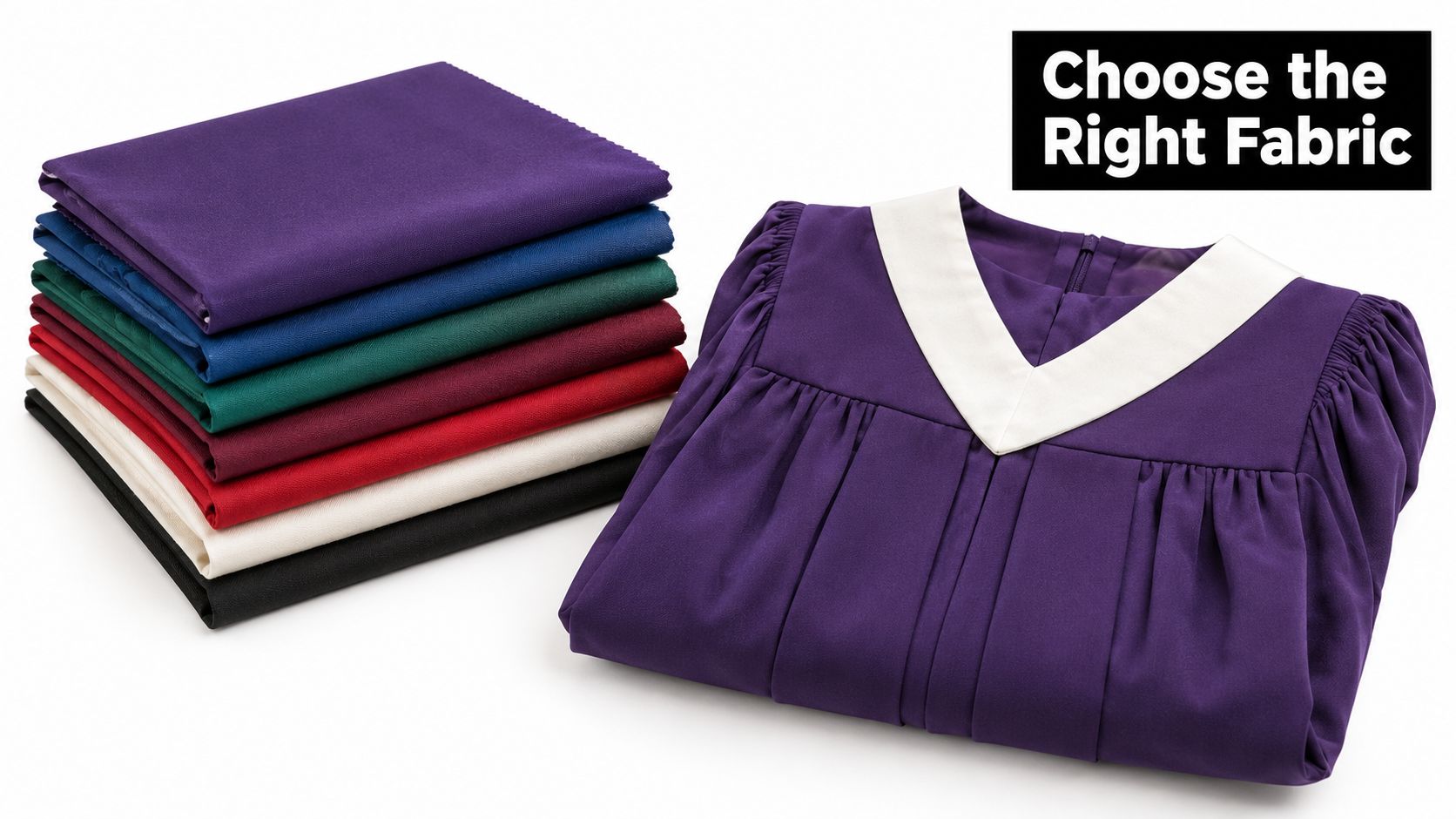
“Premium polyester” isn't a specification. Ask for fiber composition, fabric mass per square meter, finish, lining, and care instructions. Then test the finished robe, because a swatch can't show how the yoke, sleeves, and pleats feel during rehearsal.
Compare Samples Against Your Working Conditions
My preference is the fabric your volunteers can maintain consistently, not the fabric with the most impressive description. For a moving gospel choir, test heat, arm movement, and opacity. For a chapel ensemble, judge drape and appearance while seated; for a children's holiday program, prioritize manageable weight and straightforward care.
The table below is a sample-evaluation guide, not a universal promise about any fiber. Construction and finishing can change the result, and the garment label must govern cleaning.
Wholesale Choir Robe Fabrics Compared
| Fabric | Feel & Drape | Care | Best Fit For |
|---|---|---|---|
| Polyester | Check whether the sample feels smooth, stiff, or overly warm; compare matte and shiny finishes | Request the actual wash and drying instructions; inspect wrinkles after the approved routine | Frequent-use church and school choirs if the sample passes movement and cleaning checks |
| Polyester-viscose blend | Assess whether the blend delivers the softer feel or flowing drape you want | Confirm whether gentler handling or professional cleaning is required | Formal ensembles able to support the specified care |
| Cotton | Compare structure, softness, and opacity under performance lighting | Check dimensional change and pressing needs using the approved care process | Choirs that prioritize cotton's feel and can maintain the garment |
| Cotton-polyester blend | Evaluate the balance of shape, comfort, and movement in the finished robe | Don't assume the blend removes shrinkage or ironing concerns | Mixed-use programs after a successful wear-and-wash trial |
Separate Fabric Weight From Safety Claims
For relevant textile testing, NFPA 701:2023 assigns Test Method 1 to materials up to 700 g/m², approximately 21 oz/yd², with heavier materials falling under Test Method 2. Request areal density and any applicable flame-propagation report when a supplier makes a testing claim.
NFPA 701 primarily addresses architectural and decorative textiles. It isn't a blanket garment-safety certification, and passing a flame-propagation test doesn't make a robe fireproof. Ask your institution's safety lead which requirements apply to the actual use.
If claimed performance survives repeated cleaning, request documentation covering that cleaning procedure. Approve the production sample's specification and require replacement lots to meet it. Don't accept a generic certificate that doesn't identify the material you're buying.
Decoding Customization, Colors, and Bulk Pricing
A wholesale quote should describe an outfit you can use, not merely a discounted gown. Ask suppliers to separate garment cost, decoration, accessories, delivery, and any other charges. Otherwise, a cheap base robe can become an expensive purchase order.
Color deserves physical approval. Review the sample in the sanctuary or auditorium, alongside existing garments and school or church branding. A screen image is useful for narrowing choices, not signing off on a match.
Pay for Identity Without Restricting Reuse
Embroidered choir crests, contrast piping, custom colors, and monogrammed linings can all belong in the discussion. My advice is to favor ensemble identification over individual personalization when robes will be reassigned. Ask whether non-stock dyes require a minimum order and whether future additions can use the same specification.
Use this guide to custom choir robes with a logo to develop a clear decoration request. Specify artwork, placement, thread colors, and approval responsibility rather than asking vaguely for “our logo on the robe.”
- Tiered unit prices: Ask which quantity determines the price and whether mixed sizes count together.
- Package deals: Compare the complete robe-and-accessory package with separate item pricing.
- Shipping thresholds: Don't add unwanted garments merely to qualify for free delivery.
- Guarantees: Confirm whether customization, samples, and size exchanges receive different treatment.
Check What the Label Actually Says
For most U.S. garments, FTC textile-labeling guidance requires fiber names and percentages by weight, manufacturer or marketer identity, and country of origin. It also allows a 3% fiber-content tolerance: a label stating 40% cotton may represent 37% to 43% cotton.
Check the sample label against the written quote. A marketing description shouldn't substitute for disclosed composition.
Sample-first rule: Spend a small, controlled amount to inspect the garment before committing the institution's full clothing budget.
Ask about sample cost and return conditions before ordering; don't assume the sample is refundable. Build the final budget from the approved fabric, complete size run, decoration, accessories, shipping, taxes, and anticipated alteration work. That's the figure your committee should compare.
Ordering, Sampling, Shipping, and Returns That Actually Work
The order isn't ready because everyone likes the sample. It's ready when the sample approval, written specification, quantity list, artwork, and delivery agreement all describe the same garments.

Document the Handoff to Production
Keep an approval record with photographs, fabric details, sample measurements, color reference, and the authorized artwork. Ask the supplier to acknowledge the final specification in writing before production or allocation begins. Store the quote and correspondence where the next coordinator can find them.
This guide to choosing where to buy choir robes offers a starting point for supplier evaluation. Your decisive test should be whether the supplier can answer operational questions clearly, including what happens if production differs from approval.
Treat Transit Estimates as Estimates
USPS business shipping guidance lists Priority Mail at approximately 2–3 business days domestically and describes Priority Mail Express as its fastest domestic service, delivering 7 days a week, 365 days a year, subject to limited exceptions. Expected arrival depends on origin, destination, and acceptance time.
Other USPS delivery guidance lists First-Class Mail at 1–5 business days and USPS Ground Advantage at 2–5 business days, with longer ranges for certain destinations, including Alaska, Hawaii, and Puerto Rico. These ranges aren't a substitute for checking the actual service available for your shipment.
The USPS service-standard explanation explains weekend and holiday counting, including a three-day standard mailed Friday with an expected Monday delivery. Add seller processing, inspection, and exchange time separately.
- Dispatch commitment: Request the seller's ship date, not just the carrier's transit window.
- Deadline protection: Identify a fallback outfit before relying on urgent shipping.
- Return mechanics: Record the return window, authorization process, condition requirements, and who pays freight.
- Defect resolution: Distinguish an incorrect garment from a customer-requested size change.
Use overnight service when the event justifies it, not to conceal an unresolved production schedule. Consolidate shipments when timing permits, and inspect deliveries immediately while there's still time to correct problems.
The Sustainability Question Most Buyers Skip
An eco-friendly label isn't enough to make a responsible purchasing decision. Ask what material the garment contains, how long you expect to use it, and whether your institution can keep it in service. A robe that must be replaced prematurely deserves scrutiny regardless of its marketing.
Choir-robe market coverage reports polyester at roughly 48.1% share, citing durability, wrinkle resistance, and cost. It reports recycled or other emerging sustainable materials at 4.0%, with a projected 8.5% compound annual growth rate. Those figures describe market categories, not the environmental footprint of an individual robe.
Use a Lifecycle Scorecard
Don't declare virgin polyester, recycled polyester, cotton, or a blend the universal winner. Compare documented material claims and the practical conditions under which your choir will use each garment.
- Service life: Ask what evidence supports durability claims and inspect likely wear points.
- Laundering: Evaluate the care process your institution can sustain, including drying and pressing.
- Color retention: Request relevant colorfastness information and assess whether replacements can remain visually compatible.
- Repairability: Check access to replacement closures, usable seam allowances, and repair support.
- Packaging and minimums: Ask whether packaging can be reduced without damage and whether order constraints create unwanted stock.
- End-of-life handling: Identify a realistic reuse, donation, or textile-recovery route before disposal becomes urgent.
Write Down the Trade-Offs
My recommendation is durability-first procurement, with verified recycled content considered alongside care, repair, and reuse. That's a purchasing approach, not a claim that any particular robe has a lower measured environmental impact.
Weigh overnight shipping against consolidated freight when the calendar allows. Record the reasons for your choice in a reusable purchasing policy so the next committee doesn't have to reconstruct the decision.
Your 30-Day Choir Outfitting Checklist
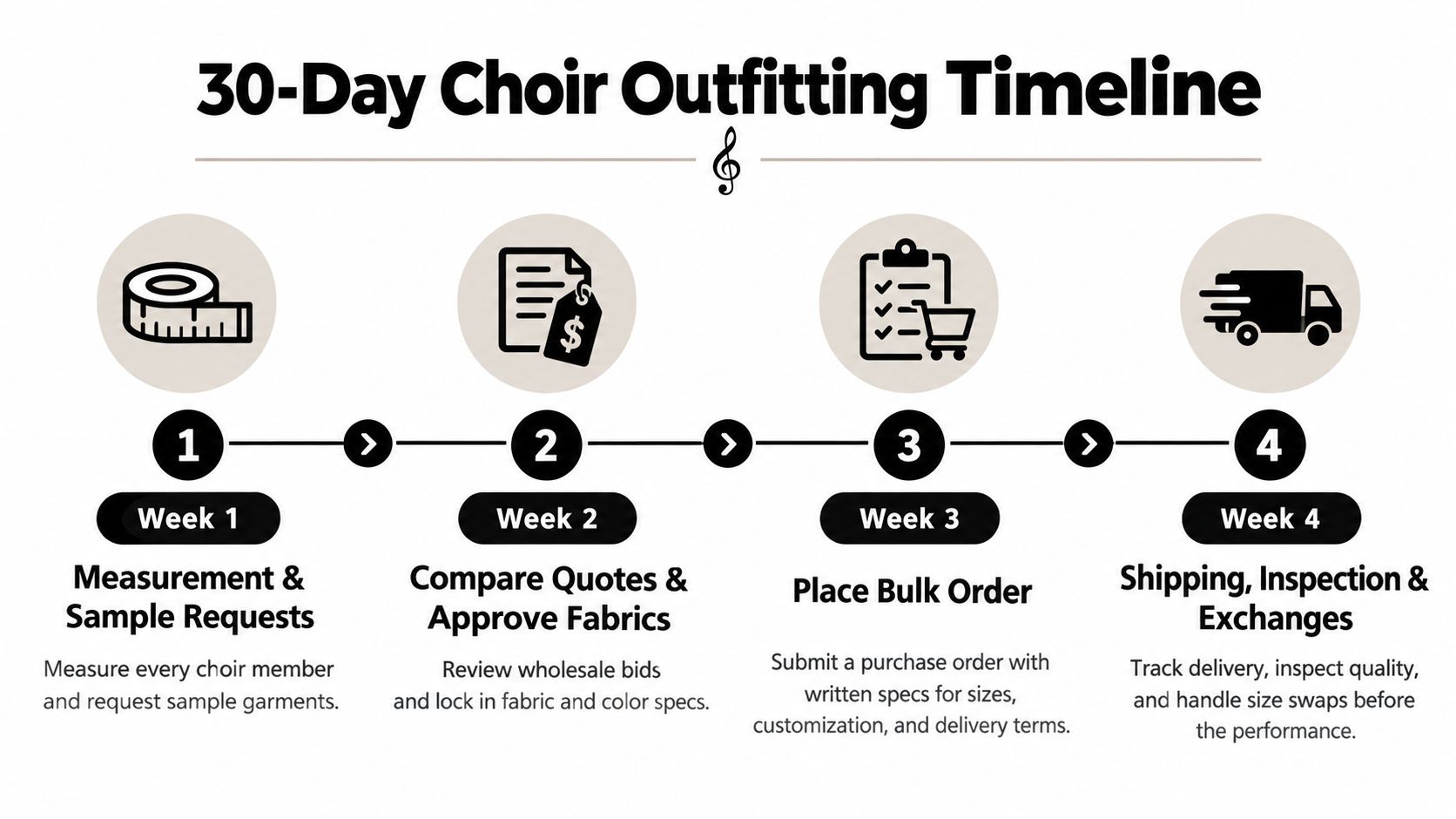
Use this 30-day planning calendar only after the supplier confirms that inventory, production, and delivery can fit the schedule. It's an organizing tool, not a promise that custom wholesale choir robes will arrive within that window. If the confirmed lead time is longer, move the purchasing start date earlier.
Assign an Owner to Every Weekly Phase
| Phase | Committee actions | Required decision |
|---|---|---|
| Week 1 | Measure the roster, audit existing garments, and request samples | Approve the garment family and complete the fit record |
| Week 2 | Compare itemized quotes and evaluate samples | Lock fabric, color, size options, and customization |
| Week 3 | Submit the bulk purchase order with approved specifications | Confirm quantities, dispatch commitment, and return terms |
| Week 4 | Track delivery, inspect garments, and arrange permitted exchanges | Accept the order and distribute wearable outfits |
Have the coordinator mark each task complete and retain the supporting document. “Discussed at rehearsal” isn't an approval record. A purchasing committee should be able to identify the chosen specification without asking the director to remember every conversation.
Close the Order Properly
Before acceptance, reconcile delivered quantities with the purchase order and check garments against the approved sample. Record defects separately from fit adjustments so the supplier receives a clear correction request.
- Inventory owner: Assign responsibility for garment numbers, distribution, and returns after performances.
- Care owner: Keep approved cleaning instructions with the inventory.
- Budget owner: Reconcile the invoice, freight, and any credits.
- Next-season owner: Save fit feedback and note gaps before another purchase becomes urgent.
Keep the supplier's responses and correction history with the inventory file. Outfitting a choir is a relationship, not a transaction: a dependable wholesale partner should make replenishment easier because both sides already understand the approved garments.
Visit ChoirBuy to compare wholesale choir robes, custom gowns, and coordinated choir accessories for your ensemble. Bring your measured roster and performance deadline, then ask about samples, bulk pricing, inclusive sizes, and the delivery and return terms for your order.