

The morning before Easter, the boxes finally arrive. Your singers are asking which robe belongs to whom, someone notices that the stoles are a different shade from last year's set, and the service schedule calls for colors you didn't order. That's how a seemingly simple purchase of choir robes with stoles becomes an expensive scramble.
The right system starts with one decision: treat the robe and stole as related but separate garments. The robe creates a unified ensemble. The stole adds liturgical, ceremonial, or institutional meaning. If you coordinate color, fit, fabric, laundering, and ordering logistics from the beginning, your choir will look consistent without forcing every future purchase into the same pattern.
What Are Choir Robes with Stoles and Why They Matter
Order the robe and stole as one system, or you will pay for the mismatch later. Directors who buy a robe for appearance and a stole as an afterthought usually end up with clashing colors, uneven drape after laundering, and replacement orders that never quite match the first shipment. Choir robes with stoles work best when the robe serves as the stable uniform and the stole carries the changing message.
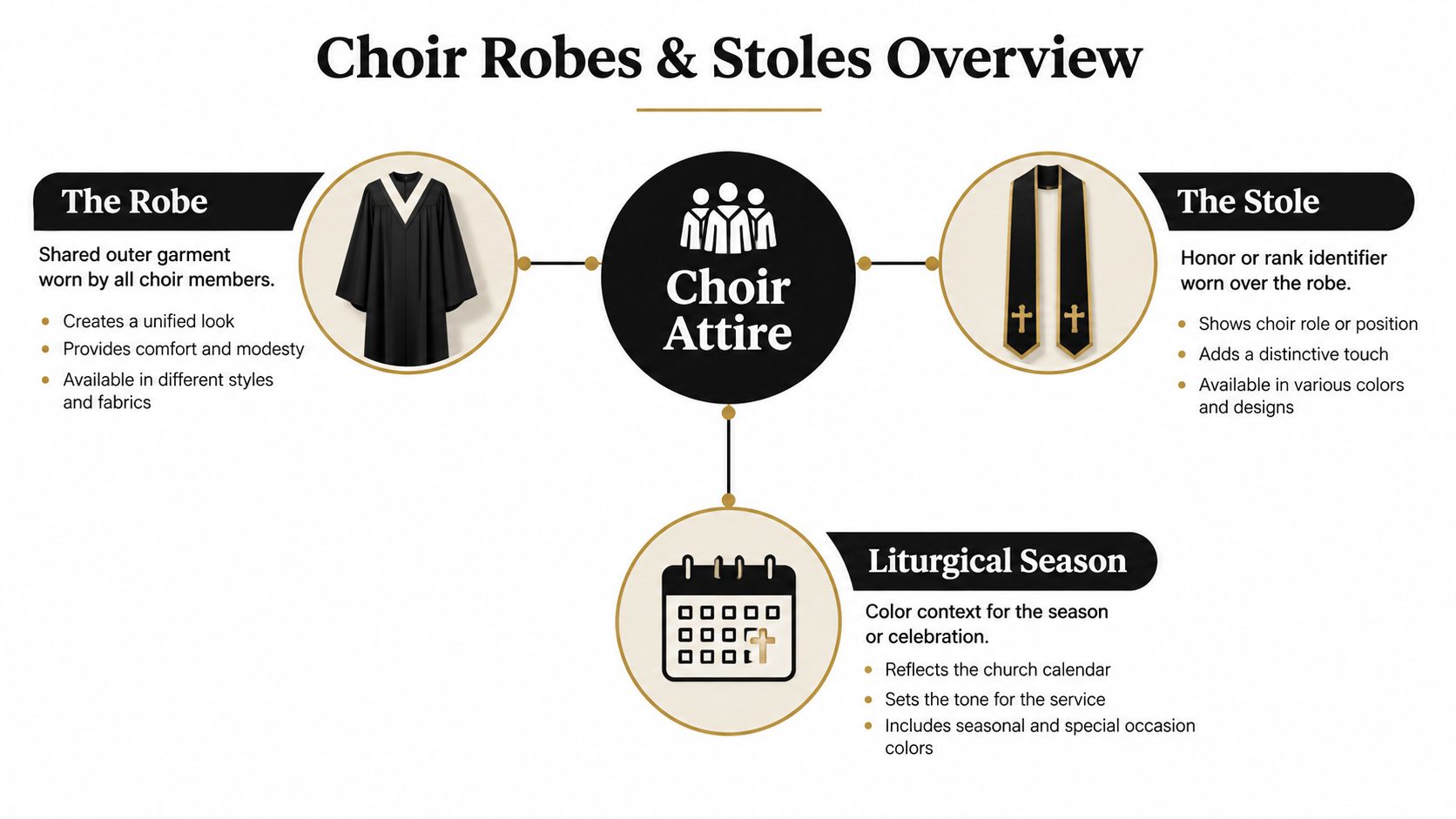
A choir robe is the shared outer garment that gives the ensemble one clear visual line. It reduces distractions from street clothes and keeps the group consistent in worship, concerts, processions, and ceremonies. The stole sits on top of that base and signals season, role, tradition, or occasion.
That division matters in real purchasing decisions. A black robe can stay in rotation year-round, while white, green, red, or violet stoles change with the church calendar. A school or community choir may keep one robe style and switch to a school-color stole for formal performances. A church choir may follow liturgical color practice more closely. Either way, do not treat every scarf-like accessory as a true stole, because the visual effect and the meaning are not always the same.
The robe creates the visual baseline
Modern choir robes came out of medieval clerical dress, Protestant academic regalia, and university traditions, a history summarized in this overview of choir robe history. That background explains why current gowns still read as formal, ceremonial, and slightly academic, even outside church or campus settings.
For directors buying in quantity, that history has a practical lesson. The robe should be the durable constant, because it takes the wear, the cleaning cycles, and the fit demands of the full ensemble. The stole gives you room to coordinate liturgical color without replacing the whole wardrobe every season.
The stole adds information
A stole can mark a liturgical season, identify a ceremonial office, or give the ensemble a deliberate accent color. It also makes bulk ordering smarter. You can add or replace stoles as needs change, provided the length, fabric weight, neckline shape, and color are chosen to work with the robe you already own.
Practical rule: Buy the robe as the long-term uniform. Buy the stole as the changeable layer that communicates context.
Understanding the Distinct Roles of Robes and Stoles
A first-time robe order often goes wrong at one decision point. The director treats the robe and stole as one matched costume instead of two garments with different jobs, different meanings, and different replacement cycles.
Keep the distinction clear. The robe is the choir's shared outer garment. It creates visual unity, takes the wear of repeated use, and has to survive institutional cleaning. The stole carries a separate church history and may communicate rank, sacramental function, or liturgical season. If you confuse those roles, you risk ordering a set that looks coordinated in the catalog but works poorly in the service and wears out too fast in rotation.
The stole's background is older and more specific than many buyers assume. A practical guide to church stoles and their uses explains why it is not just an accent strip added for color. A scholarly account of the stole's history traces its use by Roman Catholic priests in western Europe to the sixth and seventh centuries. By the Middle Ages, the way it was worn signaled clerical status. Deacons wore it over the left shoulder and tied it at the right side. Priests generally wore it around the neck, with the ends crossing over the chest or hanging down over a surplice.

A stole isn't just a decorative scarf
By the twelfth century, the stole had developed the long, narrow form buyers recognize now, often finished with fringed ends, embroidery, and crosses. Its probable predecessor was the Roman sudarium, a cloth carried around the neck, while the term stola became associated with the garment from approximately the ninth century onward.
That history matters when you are buying in volume. A stole is not interchangeable with a choir scarf or tippet, even if a supplier groups them together. In Anglican practice, for example, choir dress traditionally uses a surplice over a cassock. Clergy may also wear a hood and tippet or scarf. The stole is tied to sacramental use, liturgical color, and clerical order, as explained in this account of Anglican choir dress.
Order according to the service context
Ask three questions before you add stoles to any bulk order.
- Who will wear the stole? The whole choir, clergy, section leaders, or servers may need different cuts, lengths, and fabric handling.
- What does the stole signify? It may mark a season, identify an office, or finish the ensemble visually.
- Does local practice permit the combination? Custom varies by tradition, and the 1552 Book of Common Prayer shows why robe-and-stole use must be judged inside that tradition.
Treat the robe as the durable base purchase. Treat the stole as the meaning-bearing layer. That approach keeps your order visually coherent, liturgically appropriate, and much easier to maintain over time.
Matching Stole Colors to the Liturgical Calendar
Color should follow the worship calendar before it follows branding. A coordinated choir needs visual unity, but a liturgical stole also communicates the character of the service. If you order one universal color for every season, you may create a polished appearance that still conflicts with local practice.
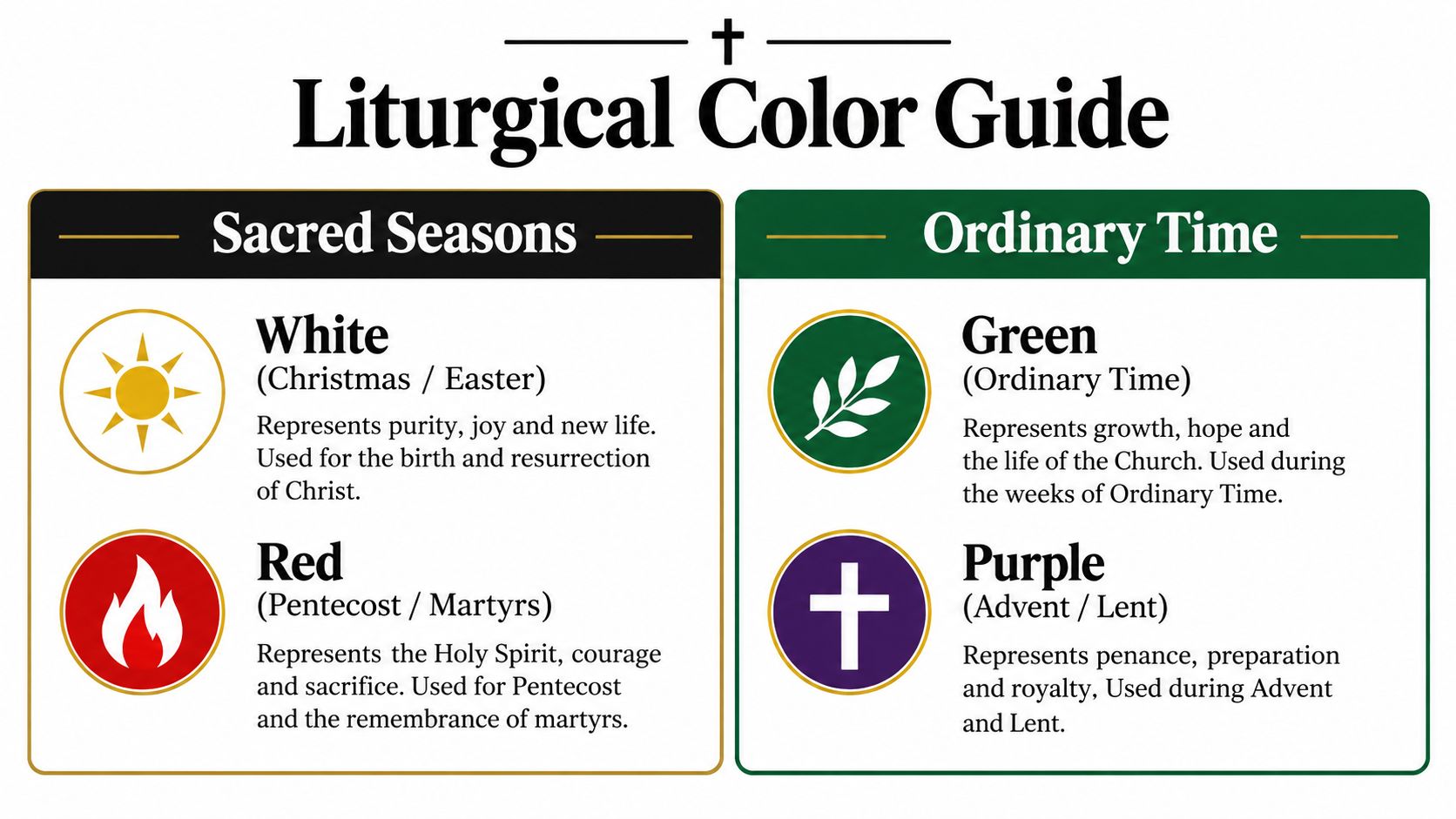
For churches using the Roman rite as a framework, the basic color assignments are straightforward:
- White: Easter, Christmas, and celebrations emphasizing joy or glory.
- Green: Ordinary Time.
- Red: Pentecost, martyr feasts, and the Lord's Passion.
- Violet or purple: Advent and Lent.
- Rose: Optional for Gaudete and Laetare Sundays.
Build the purchase around seasons
Start with the service calendar, not the supplier's color menu. List the seasons and celebrations your choir observes, then decide whether each requires a dedicated stole set. A church with formal liturgical practice should usually maintain coordinated seasonal replacements instead of relying on one all-purpose stole.
The Roman Catholic tradition treats the stole as one of the garments governed by liturgical-color rules, alongside garments such as the chasuble, cope, maniple, tunic, and dalmatic. The applicable color corresponds to the Office or celebration of the day, beginning with First Vespers when the relevant Office has First Vespers, or with Matins when it doesn't, as described in this reference on Roman Catholic liturgical colors.
Use the choir stoles color guide as a planning aid, then confirm the final palette with your priest, worship leader, or denominational authority.
Approve physical samples before production
Digital color previews aren't enough for a bulk order. A saturated red can appear different on matte polyester than on satin. Sanctuary lighting can shift the apparent depth of green or violet. Metallic embroidery can also change how the base fabric looks from the audience.
Put these fields on your specification sheet:
- Base robe fabric and color
- Stole fabric and liturgical color
- Trim color
- Emblem or text thread
- Services or seasons for use
- Care requirements for the complete set
Order physical color samples and inspect them beside the robes, under the lighting used for services. This simple check prevents mismatched reorders when robes and stoles are purchased at different times.
Choosing Fabrics, Sizing, and Inclusive Fit Options
A robe can look perfect in a catalog and fail within one school year. That usually happens when directors choose fabric by color and shine, then discover the set has to survive frequent laundering, storage, and reordering. Start with the actual use case. Weekly services, seasonal concerts, youth rotation, and shared wardrobes all put different stress on choir robes with stoles.
For institutional use, fabric and color planning belong together. Liturgical colors have to read clearly from the chancel, but the base robe and stole also have to keep their shape after repeated cleaning. A matte fabric may present one church season beautifully yet make replacement stoles harder to match later if the robe body fades unevenly. A glossier stole fabric may show the liturgical color well, but only if it can be cleaned under the same care routine as the robe. This is why many directors start with practical church choir robe options before approving trims, emblems, or decorative fabric.
Compare the trade-offs
| Option | Strength | Watch carefully |
|---|---|---|
| Polyester blend | Practical for repeated use and straightforward maintenance | Heat, dye transfer, and shade variation |
| Cotton drill | Structured feel and durable appearance | Shrinkage, wrinkles, and care requirements |
| Heavier damask | Formal texture and visual presence | Weight, storage, and laundering tolerance |
Choose polyester blends if your robes will be washed often and reissued across seasons. Choose cotton drill if you want a firmer, structured look and have a clear care routine. Use damask or heavier decorative fabrics only when the visual effect justifies the extra handling. In every case, ask one blunt question before you buy: will the robe, stole, trim, and any embroidery survive the same cleaning method without distortion?
Sizing mistakes cost more than fabric upgrades. Height and chest alone do not produce a good choir fit, especially in mixed ensembles. Measure singers in the shoes and clothing they will wear for performance, then record the numbers in one controlled spreadsheet. This expert guide to accurate fit is a useful standard for collecting measurements consistently before you request pricing or samples.
Design for movement, not only standing photos
Choirs do not perform as a line of mannequins. Children shift, seated singers need extra drape control, wheelchair users need clear wheel and hand access, and plus-size members often need different proportions, not just more width. A robe that hangs well while standing can pool dangerously when seated. Sleeves can catch on rims, walkers, folders, or railings. Tight necklines also make stoles harder to fasten and harder to wear comfortably through a full service.
Ask suppliers about:
- Seated length: Measure wheelchair users and seated performers in their normal performance position.
- Sleeve clearance: Check that cuffs don't catch on wheels, walkers, instruments, or folders.
- Fastening: Specify whether a stole can be secured without pressure around the neck.
- Sensory comfort: Request tag-free interiors, quiet closures, and soft contact points where available.
- Dressing independence: Consider whether singers can put on and remove garments without assistance.
- Alteration allowance: Leave enough hem and sleeve room for reassignment or future growth.
- Labeling: Use clear, privacy-conscious labels so singers can find the correct garment quickly.
Inclusive sizing is a purchasing standard, not an afterthought. A usable robe has to support movement, seated drape, dressing time, sensory needs, and safe navigation. Put those requirements in writing before production starts. That step prevents expensive reorders and avoids a fitting-day mess.
Bulk Ordering Tips for Choir Directors
Bulk ordering succeeds when you treat it like a small production project. Start with the event date, then work backward through measurement, sample approval, customization, production, delivery, and fitting. Don't place the order until one person owns the final spreadsheet and another person checks it.
Ask suppliers specific questions
A supplier should answer these questions clearly:
- Sample policy: Can you inspect a robe, stole, or fabric swatch before committing to the full quantity?
- Size availability: Are adult, youth, and plus-size options available in the selected style?
- Customization: Can the supplier embroider a crest, cross, text, or monogram, and will you receive a proof?
- Color control: Will replacement stoles match the original dye lot or approved sample?
- Fulfillment: Which items are ready to ship, and which require production?
- Support: Who handles measurement questions, substitutions, and order changes?
- Commercial terms: Are wholesale pricing, package deals, or volume discounts available for the quantity you need?
ChoirBuy offers wholesale choir robes, custom choir robes, choir stoles, cassocks, surplices, cottas, and caps, with inclusive sizing, customization, package deals, and customer support options. Evaluate those features against your own requirements rather than assuming every listed option suits your denomination or laundering system.
Place one complete order where possible. Splitting the purchase across seasons can create subtle differences in color, trim, and fabric finish. If you must order replacements later, retain an original sample and record the supplier's style, color, trim, and embroidery specifications.
Keep changes under control
Set a cutoff for measurements and design approvals. After the proof is approved, changes to text, thread colors, quantities, or sizes may affect production and delivery. Ask for the change policy in writing, especially if the service date is fixed.
Use this short internal sequence:
- Confirm services and colors.
- Measure every singer.
- Approve the robe and stole sample.
- Review the embroidery proof.
- Check quantities by size and color.
- Confirm shipping and contingency arrangements.
- Inspect the delivery before distributing garments.
The supplier's own product details and policies can change, so confirm current pricing, availability, fulfillment, and support terms directly before placing a purchase.
Care, Durability, and Total Cost of Ownership
The lowest purchase price can produce the highest institutional cost. Choir robes move through seasonal storage, repeated dressing, alterations, spot cleaning, and laundering by people who may not know the fabric's limits. A robe that can be repaired, resized, and safely washed often serves a choir longer than one selected only for its initial appearance.
Use AATCC TM61 as a useful benchmark when evaluating color stability. Its 1A option uses a 45-minute test designed to approximate five low-temperature hand launderings, while other options simulate repeated home laundering under different temperature and agitation conditions, according to the AATCC TM61 laundering method.
Request evidence instead of guessing
Ask for care instructions that state:
- Washing temperature: Identify the approved temperature rather than accepting “machine washable.”
- Detergent restrictions: Confirm whether mild detergent is required.
- Bleach limits: Check whether chlorine or oxygen bleach is prohibited.
- Drying method: Determine whether garments must air dry or use low heat.
- Embroidery care: Ask how metallic thread, appliqué, and attached crosses should be protected.
- Colorfastness: Request test results or a documented care standard where available.
Keep a retained sample and wash it with the production garments. Inspect color change, dye transfer, seam distortion, interfacing adhesion, and embroidery lift. This small control sample gives your institution a practical basis for approving future reorders.
Build repair into the specification
European Repair Cafés recorded 3,157 textile repairs across 168 locations in eight countries in 2025, and 95% of the items were successfully repaired, according to the European Environment Agency's repairability overview. By contrast, research tracking 3,211 clothing and household-textile items in 28 Norwegian households found that only 107 items, or 3.3%, were repaired or altered before disposal, from the same source.
The lesson for choir directors is direct: repair is feasible, but your organization has to plan for it. Specify reinforced seams, replaceable closures, generous hems, repairable stole attachments, and fabrics that won't become visibly mismatched after a small alteration.
Budget test: Compare the full ownership path, not just the invoice. Include laundering, storage, alterations, replacement stoles, repairs, and reassignment across singers.
Create a maintenance calendar with post-service inspection, stain treatment, seasonal washing, inventory checks, and repair review. That routine protects color consistency and keeps a damaged garment from becoming an emergency replacement.
FAQs for Choir Robes with Stoles Buyers
Can a stole work with a non-liturgical choir robe?
Yes, but describe its purpose accurately. A school or community choir can use a stole for institutional colors, honors, or a concert theme. A church should confirm whether the stole's color, placement, and wearer are appropriate for the denomination and service.
Can plus-size singers use every robe style?
Not necessarily. Request the size chart for the exact style, not just the supplier's general range. Check sleeve width, chest ease, hem length, and whether alterations can be made without disrupting the robe's drape or attached stole.
What should we do if members change sizes after ordering?
Keep measurement records, retain a sample, and ask about alteration allowances before production. For children and mixed-age groups, order proportions that allow safe movement and reassignment rather than choosing one oversized garment for everyone.
How do we approve color before a bulk purchase?
Request a physical robe or stole sample, then inspect it beside your existing garments under service lighting. Check the base fabric, trim, embroidery thread, and stole color together. Don't approve from a screen alone.
Can we change an order at the last minute?
Ask for the supplier's change and cancellation policy before payment. Once customization or production begins, quantity, size, color, and embroidery changes may affect fulfillment. Confirm every revision in writing and keep the event date visible on the order.
Use this final checklist before approval: correct liturgical colors, verified local practice, inclusive fit, compatible care instructions, tested color stability, repairable construction, approved samples, checked embroidery, and a documented delivery plan.
ChoirBuy offers wholesale and custom choir robes, choir stoles, inclusive sizing, package deals, embroidery options, and support for adult, youth, and liturgical ensembles. Review the available ChoirBuy options with your service calendar, fit requirements, and laundering plan in hand, then request samples before committing to a bulk order.