

A cart full of choir stoles can come to a sudden stop at the color dropdown. You know the choir needs something for Easter, Advent, Pentecost, and ordinary services, but the product page doesn't tell you whether burgundy fits Pentecost or whether white is the safer choice for Easter.
Use this order of decisions: symbolism first, calendar placement second, robe pairing third, and purchasing logistics last. That sequence keeps attractive but unsuitable colors from taking over your budget. It also gives you a defensible answer when a pastor, worship leader, or purchasing committee asks why the choir is wearing purple in Advent or green during the long stretch of Ordinary Time.
Most first-time buyers make one of three mistakes. They order one of every color without checking the church calendar, choose school colors that compete with the sanctuary palette, or ignore the robe color already hanging in storage. Before you place an order, check the choir stole size and color charts, then make the stole work with the robes you already own.
Why the Right Stole Color Matters Before You Order
A choir stole isn't just a decorative sash. In a liturgical setting, it helps the congregation read the service before the choir sings a note. The color supports the season, reinforces the mood of worship, and gives the ensemble a unified appearance from the front pews to the back of the sanctuary.
Start by identifying the services your choir leads. A Catholic choir with a full liturgical calendar needs a different inventory from a school choir that performs concerts, pageants, and graduation ceremonies. An Anglican or Lutheran choir may follow a seasonal color system closely, while a Methodist, Presbyterian, or non-denominational choir may use only a few colors for special occasions.
Practical rule: Buy for your real calendar, not for an imaginary one.
Then inspect the robes. White stoles may disappear against white or ivory robes, while green can look dull against some dark green gowns. A black robe creates a strong base for white, red, purple, and gold, but a colored robe may need a contrasting stole or trim to remain visible under warm sanctuary lighting.
Avoid treating school or church branding as the only design rule. A burgundy stole may match a logo beautifully yet communicate something different from the red traditionally used for Pentecost or martyr commemorations. If branding matters, use embroidery, trim, or a small emblem rather than forcing the entire stole into a color that doesn't suit the service.
The best first order is usually compact and deliberate. Choose the core seasonal colors, verify the robe pairing, confirm sizing, and only then consider a rare accent. That process produces a useful choir stole wardrobe instead of a rack of colors that sit untouched.
Where Liturgical Stole Colors Actually Come From
Liturgical colors developed gradually rather than appearing as a single modern branding system. The Roman Rite used color in varied ways across local churches, and the palette became more consistent over time. Pope Innocent III, whose papacy ran from 1198 to 1216, is commonly credited with systematizing four colors, white, red, black, and green. The later Roman sequence associated with Pope Pius V in 1570 added violet to the commonly recognized palette. The historical overview from Catholic Encyclopedia places these milestones in the development of the Roman system.
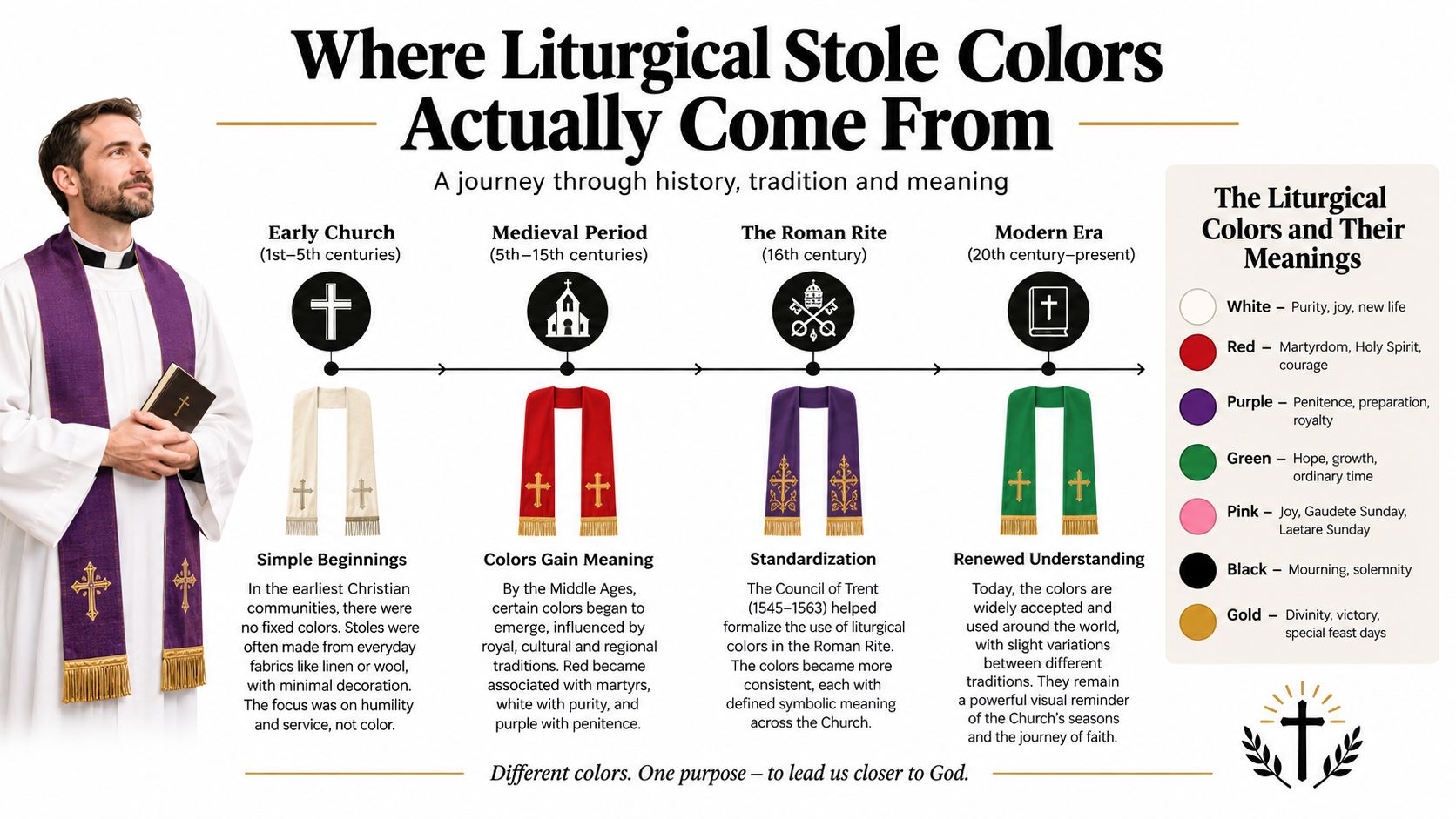
That history matters because a choir director can explain the palette as a living liturgical language, not a random set of fashion choices. White communicates celebration and purity. Red carries associations with Pentecost and martyrdom. Green belongs to Ordinary Time, while violet signals preparation and penitence. Black serves mourning or penitential observances.
The system also shaped other Western traditions, although each tradition adapted it differently. Catholic, Anglican, Lutheran, and other Western churches often connect choir apparel with the same seasonal calendar used for vestments. A director choosing a choir stole can therefore use the church's established visual language while still checking local rules.
A stole's role also depends on who wears it and how it is worn. Clergy vestments have their own distinctions, so directors outfitting a choir should keep ensemble stoles visually appropriate rather than copying a priest's or deacon's vestment design without checking the tradition. The clergy vestment guide from ChoirBuy offers useful context for that distinction.
The authority of the colors comes from sustained use and formal liturgical development. That makes the ordering decision easier to defend. Purple belongs to Advent and Lent because the color has a recognized place in the calendar, not because a retailer happened to print it on a chart.
The Five Core Stole Colors and When to Wear Them
A practical choir stoles color guide should start with five core colors: white or gold, red, green, purple or violet, and black. These colors cover the main seasonal and service requirements in traditions that follow a Western liturgical calendar.
White or gold
White and gold signal celebration, purity, glory, and major feasts. Use them for Christmas, Easter, baptisms, weddings, and other high celebrations where the local tradition permits white or gold. The ChoirBuy guide to choir stoles connects white and gold with Christmas and Easter, while the USCCB assigns white to Christmas, Easter Time, major feasts of the Lord except the Passion, Mary, angels, and non-martyred saints.
Don't assume white works for every solemn service. Some traditions use white for funerals because it points to resurrection hope, while others prefer black or violet. Confirm the local practice before ordering a large funeral-service inventory.
Red
Red is the color of the Holy Spirit, fire, passion, and martyrdom. It earns a place in the wardrobe for Pentecost, Palm Sunday, Good Friday in applicable traditions, apostles, evangelists, martyrs, and ordinations. The USCCB also lists red for Pentecost Sunday and these major commemorations.
The common mistake is ordering a red that looks like burgundy, maroon, or school crimson without checking the sample. Red has to read clearly against the robe and sanctuary lighting. If the stole is intended for Pentecost, choose a strong, visible red and make sure the trim doesn't shift the overall appearance toward another color.
Green
Green represents life, hope, growth, and the continuing work of the church. It is used during Ordinary Time, which makes it essential for a choir that sings regularly throughout the year.
Green is often under-ordered because it lacks the drama of Christmas white or Pentecost red. That's backwards. A choir that serves week after week will usually wear green more often than any rare accent. Choose a shade that contrasts with the robe. Green on ivory can look refined, while green on a similar green robe may disappear.
Purple or violet
Purple or violet belongs to Advent and Lent, seasons associated with preparation, repentance, and solemn reflection. It shouldn't automatically replace black for every funeral or mourning service, and it shouldn't be treated as a generic color for any service with a serious tone.
The main stockroom mistake is buying a bright fashion purple instead of a restrained liturgical violet. Before ordering, compare the fabric swatch with the church's paraments and clergy vestments. A purple stole that looks appropriate online may appear too blue, too red, or too glossy in the sanctuary.
Black
Black communicates mourning, grief, or penitence. It may be used for funeral services, All Souls' Day, and Good Friday, depending on the denomination and local custom. It is a specialist color, not a substitute for purple.
| Color | Meaning | Primary Use | Common Mistake |
|---|---|---|---|
| White or gold | Celebration, purity, glory | Christmas, Easter, baptisms, weddings, major feasts | Assuming every funeral uses white |
| Red | Holy Spirit, fire, martyrdom | Pentecost, Palm Sunday, apostles, martyrs, ordinations | Ordering burgundy without checking the tone |
| Green | Life, hope, growth | Ordinary Time | Buying too little for regular services |
| Purple or violet | Preparation, repentance, solemnity | Advent and Lent | Using bright purple for every solemn occasion |
| Black | Mourning and penitence | Funerals, All Souls' Day, Good Friday where permitted | Treating black as a universal seasonal color |
For a closer look at how these choices apply to clergy and liturgical apparel, consult the Catholic priest stole guide and then confirm your own denomination's calendar.
Rare and Seasonal Colors Worth Knowing
Rare colors deserve a separate purchasing decision. They can add precision to the wardrobe, but they shouldn't displace the five core colors unless your choir regularly serves the occasions that require them.
Rose is used on the Third Sunday of Advent, Gaudete Sunday, and the Fourth Sunday of Lent, Laetare Sunday. A Catholic calendar guide identifies these as the two specific annual uses for rose. Buy it if your choir serves those Sundays with formal vesture and wants a complete seasonal presentation. Otherwise, borrowing or renting is sensible.
Black may be used for Good Friday, funerals, and All Souls' Day, November 2, depending on local practice. It is more useful than rose for a choir that sings at funerals, but it still shouldn't be the first color added after the core palette.
Blue appears in some Anglican traditions for Advent and may also be associated with Marian or Sarum use. It isn't a universal Advent replacement. The liturgical color resources from Catholic G33K emphasize that calendars and norms vary by denomination, rite, and local authority.
Gold or ecru works for weddings, anniversaries, Christmas concerts, and other celebratory services where the choir wants a warm, refined look. Treat gold as a flexible accent, not as a replacement for white where the church has a specific rule.
| Color | Specific Dates | Best For | Stock or Rent |
|---|---|---|---|
| Rose | Third Sunday of Advent and Fourth Sunday of Lent | Catholic and closely observing liturgical choirs | Rent or add after regular demand is proven |
| Black | Good Friday, funerals, and All Souls' Day on November 2 | Choirs serving funerals or penitential observances | Stock when funeral ministry is regular |
| Blue | Advent in some Anglican traditions, Marian or Sarum use in some settings | Anglican choirs and churches with approved local custom | Stock only after confirming tradition |
| Gold or ecru | Weddings, anniversaries, Christmas programs, celebratory services | Mixed-use church and event choirs | Useful flexible accent |
A rare color should solve a recurring programming need. If it only answers a possibility, don't let it crowd out green, purple, red, or white.
Matching Stole Color to Your Denomination or Choir Type
A Catholic choir should begin with the full core palette and follow the parish calendar. Anglican and Lutheran choirs often use a similar seasonal framework, but local practice can change the details. Anglican churches may use blue during Advent, while Lutheran churches commonly follow the major seasonal pattern with local variation.
Methodist and Presbyterian choirs often work with a reduced palette, especially when the choir supports worship without wearing stoles at every service. Non-liturgical Protestant programs have more freedom, but they still benefit from a consistent visual system. A school or youth choir can prioritize visibility, school identity, and event themes over strict seasonal symbolism.
| Choir Type | Core Colors to Stock | Optional Additions | Most Over-Ordered Color |
|---|---|---|---|
| Catholic | White or gold, red, green, purple or violet, black | Rose, blue where locally approved | Black |
| Anglican | White or gold, red, green, purple or violet | Blue, rose, black | Rose |
| Lutheran | White or gold, red, green, purple or violet | Black, rose where locally used | Rose |
| Methodist | White, red, green, purple or violet | Gold or ecru | Black |
| Presbyterian | White, red, green, purple or violet | Gold or seasonal accents | Black |
| Non-liturgical Protestant | White, red, green, purple or violet | Gold, blue, school colors | Black |
| School choir | White, school color, one contrasting accent | Gold, red, custom colors | Black |
| Youth or children's choir | White, red, green, purple or violet | Bright accent colors, custom trim | Black |
The most important exception is authority. A generic chart cannot override the Roman Missal, an Anglican ordo, a denominational ceremonial book, or approved local norms. Ask the pastor, priest, worship director, or diocesan office before you commit to blue, rose, black, or any non-core color.
For school and youth ensembles, contrast matters more than strict symbolism. A contrasting stole can separate adult singers from children or youth and help frame the face, a point also raised in industry guidance on choir robes and liturgical vestments. Keep the palette disciplined. Freedom doesn't require visual clutter.
Pairing Stole Colors With Robes and Fabrics Onstage
The robe is the background, and the stole is the foreground. Choose the combination from a distance, not from a product thumbnail. A stole that looks attractive in a close-up may disappear when thirty singers stand together under sanctuary lighting.
Use strong contrast for seasonal services:
- White on black gives the cleanest formal contrast.
- Red on white creates a vivid Pentecost or ordination presentation.
- Purple on charcoal looks restrained without becoming muddy.
- Green on ivory feels warm and readable during Ordinary Time.
- Gold on black or deep navy creates a ceremonial finish for weddings and anniversaries.
Tone-on-tone combinations can look elegant, but they need careful fabric selection. Purple on dark blue, green on dark green, or white on ivory may wash out from the back pews. If you prefer a subtle pairing, add contrasting piping, a metallic band, or a visible embroidered motif.
Fabric changes the message. Lightweight satin suits school and youth choirs that travel because it packs easily and catches light. Matte polyester gives adult ensembles a dependable drape and practical durability. Dupioni adds texture and ceremony, but its surface can make embroidery and trim look more formal.
Trim controls the finish. A narrow piped edge keeps a stole simple. Fringe adds movement and ceremony. A contrasting band makes the color easier to identify from a distance and can tie the stole to the robe. Review the choir robe color guide before matching fabrics and robe shades.
Avoid black on dark navy, green on dark green, purple on a similar wine-colored robe, and white on pale ivory without contrasting trim. These pairings may look polished in a fitting room, but they lose definition across the sanctuary.
Ordering Custom Stoles Without the Common Mistakes
Custom ordering works best when you make decisions in the same order the garment is built. Start with fabric weight, not embroidery. A traveling youth choir needs a different stole from an adult ensemble that performs formal liturgy every week. Lightweight satin is practical for frequent transport, while dupioni or matte polyester suits buyers who want more structure and durability.
Next, choose the trim. A piped edge, fringe, or contrasting band changes how the color photographs and how clearly the stole separates from the robe. Then decide where the embroidery belongs. Left-side or center-front placement usually reads better than a chest-area logo that competes with the robe neckline or closure.
Don't approve artwork until you have checked the thread color against the actual stole fabric. Confirm the church name's capitalization, spelling, font case, and symbol placement. A digital proof can't always show how metallic or bright thread will appear under stage lights.
The ordering calendar also matters. Plain stock and custom embroidery have different production schedules, so ask the supplier for the current estimate before paying. For Easter, Christmas, ordinations, and major concerts, order early enough to allow proof approval, production, shipping, and corrections. Don't build a seasonal purchase around an optimistic delivery assumption.
| Factor | Plain Stock | Custom Embroidered |
|---|---|---|
| Fabric choice | Select from available stock options | Confirm fabric before artwork |
| Trim | Usually preconfigured | Choose edge, fringe, or contrasting band |
| Personalization | None or limited | Add church name, choir name, symbol, or event text |
| Proofing | Usually not required | Review thread colors, spelling, placement, and font case |
| Timing | Based on current inventory | Includes artwork approval and production |
| Best use | Immediate seasonal or replacement needs | Permanent ensemble identity and formal programs |
Ask about minimum quantities, setup charges, and whether combining colors with the same embroidery reduces the total cost. Don't assume a bulk quote is automatically favorable. Request the complete calculation, including artwork, setup, shipping, and any rush service.
Keep one approved sample in the choir office. It becomes the reference for future orders, replacement pieces, robe matching, and color consistency.
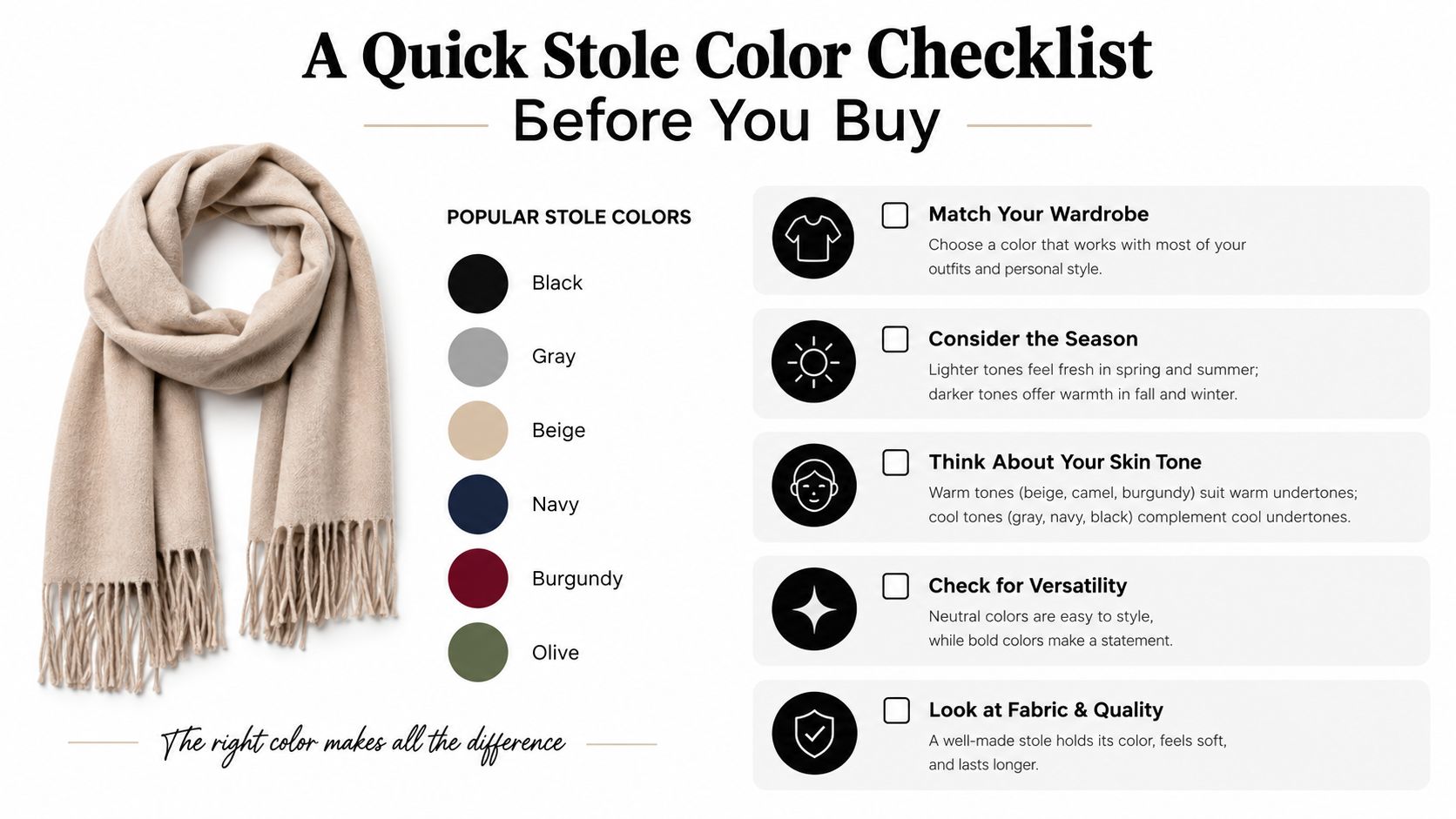
A Quick Stole Color Checklist Before You Buy
Lock down these seven decisions before checkout:
- Confirm denomination rules: Check the parish, congregation, or denominational calendar.
- Identify the four most-used seasons: Note which services your choir supports.
- Choose robe pairing: Decide whether the stole should contrast with or coordinate with the robe.
- Select fabric weight: Match satin, polyester, or dupioni to travel, frequency, and formality.
- Verify embroidery timing: Compare production timing with the first service or concert.
- Confirm bulk requirements: Ask about minimum quantities, setup charges, and package pricing.
- Request a thread swatch: Approve the thread against the stole fabric, not a screen image.
For a first purchase, choose white, purple, green, red, and one seasonal accent, usually rose or gold. That five-color palette covers the dominant needs of many Protestant and Catholic choir programs without tying money up in rarely used pieces. Don't order more than five colors at the beginning. Most ensembles need a full cycle of wearing data before they know whether their fourth and fifth colors deserve expansion.
ChoirBuy offers choir stoles with selectable colors, trims, sizes, stole tips, and printed or embroidered text, along with choir robes and other ensemble apparel for adult, school, and youth groups. Visit ChoirBuy to compare your starter palette, check sizing, and place an order that matches your calendar and robe inventory.