

What if the neatest-looking choir is the one that overheats, fades after two seasons, and tells half the singers they do not quite belong? Most worship attire advice stops at tradition or "Sunday best." A workable plan has to do more. It has to name who is serving, match color to the church year, stay wearable in a hot sanctuary or a cold hall, survive repeated washing, and leave room for different bodies, faiths, and incomes.
The order below follows that sequence. Role comes first, because a garment should tell the congregation what a person is doing before anyone speaks. Color comes next, because a stole or robe that ignores the calendar fights the liturgy. Fabric, care, and written policy come after that, because a beautiful set that cannot be worn, washed, or shared is a poor purchase.
Who Wears What in Worship at a Glance
Worship attire follows role first, tradition second, and climate third. The table is the quick reference. Use it before you debate fabric or budget.
| Role | Typical garments | Visual purpose | Notes |
|---|---|---|---|
| Presiding clergy | Cassock or alb, stole, chasuble in many traditions | Shows who leads the rite | Cut and color follow tradition and calendar |
| Preachers and lay readers | Academic or preaching gown, or formal clothing | Signals the teaching role | Many use formal dress rather than robes |
| Choir singers | Cassock with white surplice, or matching choir robe | Creates visual unity and modesty | Fabric and trim set the look |
| Choir director and musicians | Robe, gown or formal black | Sets the leader apart from singers | Often dress more casually than singers |
| Acolytes and ushers | Alb, cassock or plain ministry shirt | Shows a defined service role | Plain colors keep focus on the rite |
| Youth choir members | Youth-sized robe, often with cap | Keeps young singers uniform | Ease of movement matters most |
| Congregation volunteers | Modest everyday dress, sometimes a ministry shirt | Shows group identity without robes | Needs a written dress guideline |
Two ways to read the table
Garments identify a function. A chasuble marks the person presiding. A stole can mark ordained ministry or, in some choirs, a seasonal accent. A plain ministry shirt tells an usher from a guest. If two people wear the same full robe, visitors will assume they share the same job.
Uniformity serves the group, not every person in the building. Singers benefit from one silhouette. A preacher may not. Directors and musicians often stand apart on purpose, so a gown or formal black is enough when the choir is fully robed. Youth sizes need room to process and sit. Volunteers usually need a badge or shirt, not a vestment.
The same logic shows up outside church. People planning a ceremony already sort participants by duty, the way choosing your wedding party separates attendants from guests so the photograph reads clearly. Worship works the same way. Match each ministry to a garment type, then decide whether that role needs a full robe or a simpler marker. Anglican communities often keep cassock, surplice, and stole in a fixed order. Our guide to Anglican vestments is a useful check if that is your tradition.
Liturgical Colors and the Church Calendar
In Roman Catholic practice, the vestment color follows the liturgical calendar, not the celebrant's personal preference. A choir or altar team should plan robes, stoles, and accessories by season before anyone picks a favorite shade.
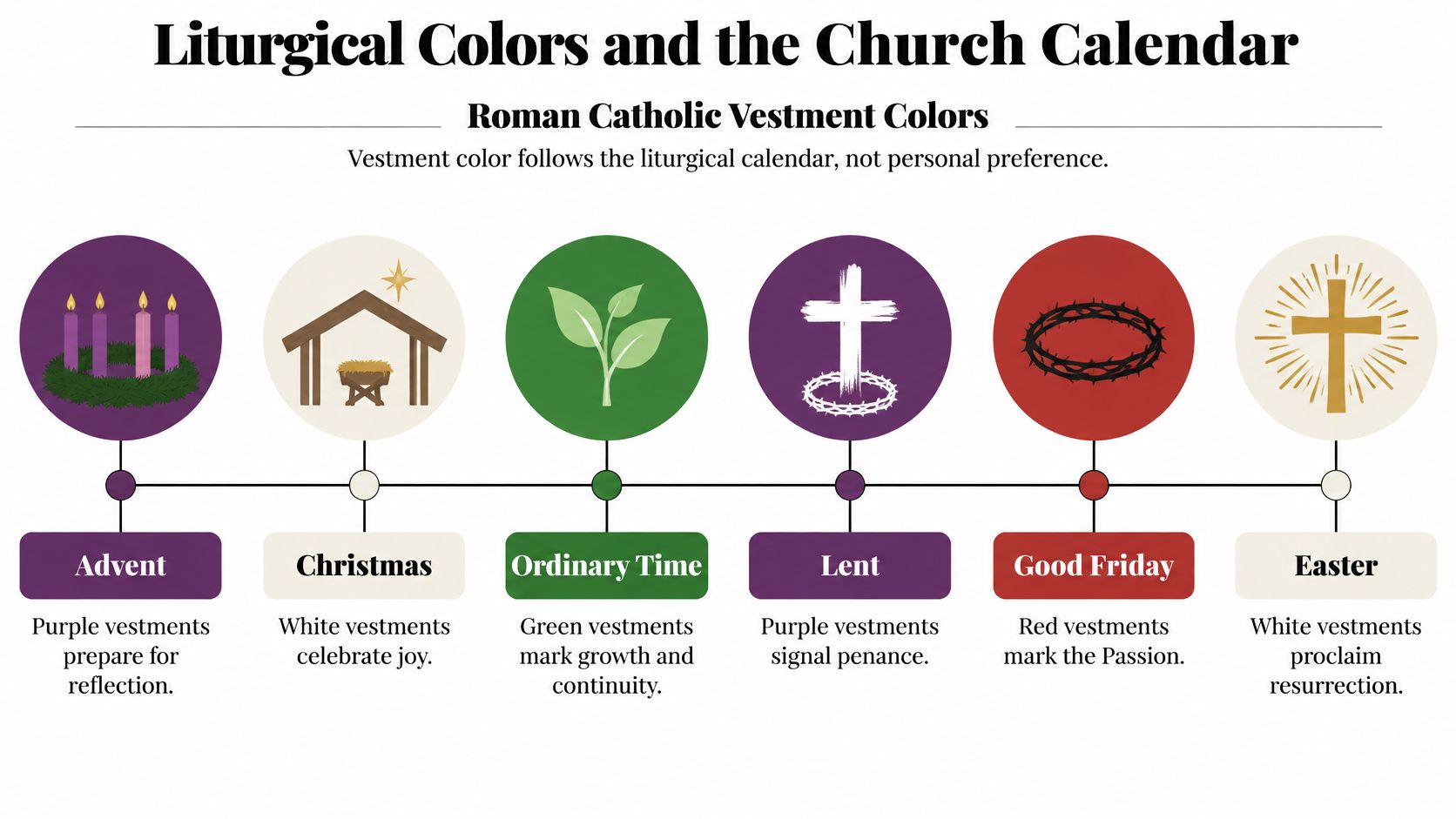
The Dominican guide to Mass vestments sets the map this way. Green is used in Ordinary Time. Violet or purple is used in Advent and Lent for penance, sacrifice, and preparation. White or gold is used for Christmas, Easter, celebrations of Christ apart from his Passion, Marian feasts, angels, and non-martyr saints. Red is used for Palm Sunday, Good Friday, Pentecost, Confirmation, and celebrations of martyrs.
| Season or feast | Color | Meaning |
|---|---|---|
| Ordinary Time | Green | Growth and daily faith |
| Advent and Lent | Violet or purple | Penance, sacrifice and preparation |
| Christmas and Easter | White or gold | Joy and celebration |
| Marian feasts, angels and non-martyr saints | White or gold | Honor for holy figures |
| Palm Sunday and Good Friday | Red | The Passion of Christ |
| Pentecost and Confirmation | Red | The Holy Spirit and witness |
| Feasts of martyrs | Red | Faithfulness unto death |
Walk the year before you buy
Start with Advent. Violet or purple signals preparation, so a purple stole over a neutral robe reads as waiting, not as a feast. Christmas switches to white or gold. Joy is the point, and gold is an alternate, not a second season.
Ordinary Time returns to green for the long stretch of daily faith. Do not treat green as a leftover color. It is the color most Sundays will use. Lent brings violet or purple back, this time for penance. Keep Advent and Lent accessories in the same family if your budget is tight, but do not assume one purple stole has to cover every penitential Sunday if your church distinguishes them.
Palm Sunday and Good Friday use red for the Passion. Easter returns to white or gold. Pentecost and Confirmation use red again, now for the Spirit and public witness. Martyrs' feasts stay red for faithfulness unto death. Feast-day red and ordinary green should never share one unmarked drawer.
Practical rule: Label every stole and robe hanger with the season, not only the color name, so a substitute sacristan does not hang Passion red on an Ordinary Time Sunday.
This table is Roman Catholic usage. Anglican, Lutheran, and Orthodox communities keep their own calendars, so check your church's ordo before you order. We spend our days on liturgical colors and what those colors mean in actual practice, which is why a choir should separate seasonal sets from one all-purpose set. If you are choosing among several reds and greens, our notes on choir robe color meaning walk through how a palette reads from the nave.
The cycle is predictable. Advent violet, Christmas white, a return toward Ordinary Time green, Lent violet, Passion red, Easter white, then Pentecost red, and green again. Buy the color you will wear for months before you buy the color you will wear for a week.
Choir Robes, Stoles and Concert Dress Compared
Choir robes grew out of clerical dress and academic regalia, not out of stage costume. In medieval Western Christianity a common ensemble was a white, loose-fitting surplice over a plain black ankle-length cassock, which linked singers to the clergy while setting them apart from the congregation, as parish choir robe notes describe. Later, the Geneva-style robe developed from doctoral academic gowns and became its own category of choral clothing.
| Garment | Best setting | Look and finish | Main trade-off |
|---|---|---|---|
| Cassock and surplice | Liturgical services | Black or colored cassock with white surplice | Layered and warm in summer |
| Choir robe, graduation style | Services and concerts | Matte, shiny or deluxe fluting | Heavier than a surplice |
| Stole | Clergy and choir accent | Solid, two-tone or embroidered | Adds color without a full robe |
| Cotta | Youth and busy services | Short surplice | Less coverage than a full surplice |
| Choir cap | Processions and concerts | Matches robe color | Needs fitting to head size |
| Concert dress | Secular concerts and pageants | Formal black | Less group identity, more personal fit |
Service dress versus concert black
A liturgical choir usually wears a cassock and surplice, or a robe with a stole, because the point is service. The white layer says the group is set apart for worship. A stole then carries the season without forcing a second full robe for every feast. A cotta, the shorter surplice, suits youth choirs and services with a lot of sitting, standing, and quick turns. A choir cap finishes a procession, but only if it fits. A cap that slides becomes a distraction.
Concert dress answers a different brief. Formal black can look polished in a secular hall or a community pageant without claiming a church office. The trade-off is real. Each singer's own suit or dress fits one body well and the group less well. You lose the shared silhouette that a robe gives you in one glance.
Say a children's choir sings a pageant in the sanctuary, then joins a community concert the next weekend. For the pageant, a youth robe or cotta in the day's liturgical color keeps them visually inside the service. For the concert, matching black formalwear keeps the religious symbol off a civic stage. Mixing a Geneva robe, a cassock and surplice, and street concert dress inside one section makes the choir look unfinished, even when every piece is good on its own.
Match the setting to the garment, and do not mix robe styles within one section of the choir.
If you are weighing a robed service against a black-tie concert, our comparison of choir concert attire spells out when formalwear replaces vestments and when it should not.
Fabric, Climate and Comfort in Worship Attire
A choir stands through a two-hour service in a warm sanctuary, hymnals up, robes closed from shoulder to hem. The room feels only moderately warm. Under the robe it does not. The silhouette blocks the moving air that a shirt would catch, so fabric weight and breathability decide whether singers stay focused through the last verse.
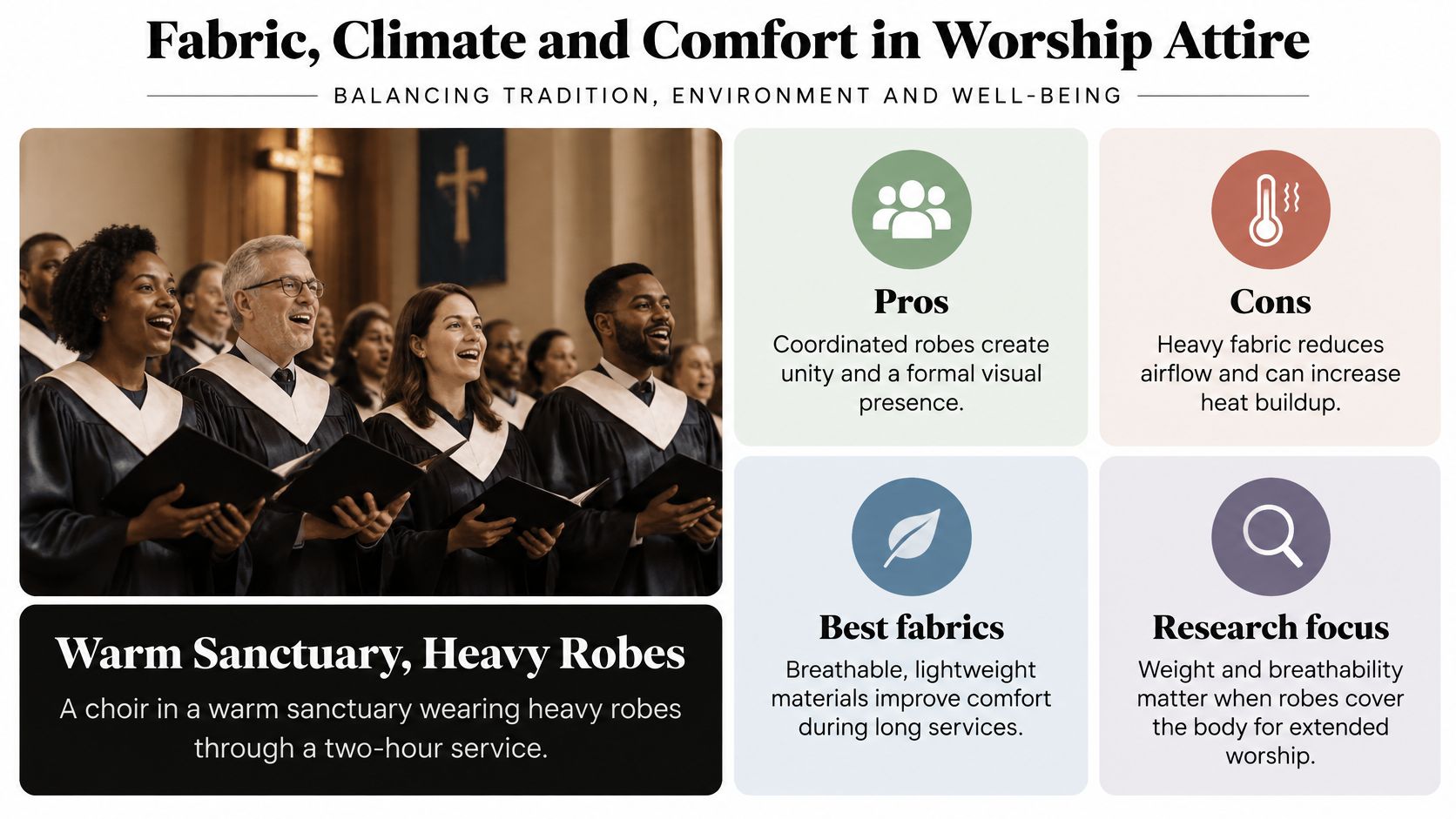
Textile comfort turns on air permeability, water-vapor transmission, moisture regain, drying time, thermal conductivity, and thickness. A textile comfort study indexed by PubMed links higher moisture transmission and appropriate air permeability with less perceived wetness, while higher wool content generally improves insulation and finer yarns improve air and vapor movement. In plain terms, cloth that lets air and vapor pass feels drier against the skin, and denser cloth holds heat.
Which cloth for which building
| Fabric | Best for | Trade-off |
|---|---|---|
| Matte polyester | Warm sanctuaries and long services | Looks dull under bright stage lights |
| Shiny satin | Concerts and bright performance lighting | Shows creases and wear more easily |
| Deluxe matte with fluting | Showcase concerts | Heavier, can run warm |
| Lightweight blend | Hot climates and youth choirs | Less structure, may wrinkle |
| Wool-rich fabric | Cold buildings | Traps heat in summer |
Treat the table as a starting point, then adjust for your room. A robe that feels fine in a ten-minute fitting behaves differently at the forty-minute mark, once body heat and moisture have had time to build. Movement changes the equation as well. A choir that processes, stands, and sits repeatedly pumps warm air through the garment, which is why sleeves that bind at the elbow and a torso cut too close make a warm robe feel worse.
Before you approve a swatch, ask the supplier for fabric weight, fiber composition, and, where they have it, air-permeability or moisture-management data. Match that sheet to climate, choir age, service length, and how much people move. When you collect sizes, take each singer's height with shoes on plus their weight, since robe sizing runs on those two numbers and a correct fit wears cooler than one that hangs heavy or pulls tight.
Children overheat faster than adults, and a large choir builds heat even when the thermostat looks fine. Prioritize breathable panels and generous ease through the torso. A 2025 review of Arbaeen pilgrims found that temperatures above 40°C, high humidity, and heavy or non-breathable layers raise heat-stress risk, and that layered clothing can trap heat (Arbaeen and worship-climate review). Good ventilation helps a hot room. A garment that seals warmth against the skin still works against you.
Our notes on lightweight choir robes are the place to start if your building runs hot from May through September.
Copy this into a purchase request. "Please quote a lightweight polyester or polyester-blend robe, state the fabric weight and fiber content, and include any air-permeability or moisture-management data. We need generous ease and nonrestrictive sleeves for adult and youth singers in services of about two hours, and we will supply each singer's height with shoes on and weight for sizing."
Caring for Coordinated Robes Over Many Seasons
Replacement robes that have faded no longer match the set you bought three years ago. Dye that migrates in the wash can stain a white surplice or a stole that shared the machine. Color is part of the uniform. Once it drifts, the choir looks uneven even when every singer is present.
ISO 105-C06 is the laundering test to name in a bid. The ISO 105-C06 standard evaluates color fastness to domestic and commercial laundering with a reference detergent. Its single-test procedure approximates one commercial or domestic wash. A multiple-test procedure can, in some cases, approximate up to five household launderings at temperatures not exceeding 70 °C. The standard separates color loss from staining of adjacent cloth. You need both results. Fading makes a reorder look like a different garment. Transfer ruins whites washed in the same load.
What to ask before you purchase
Require the supplier to name the tested method, the washing temperature, the detergent assumptions, and whether the report covers color change and staining. If they can only say "colorfast," you do not yet have a specification.
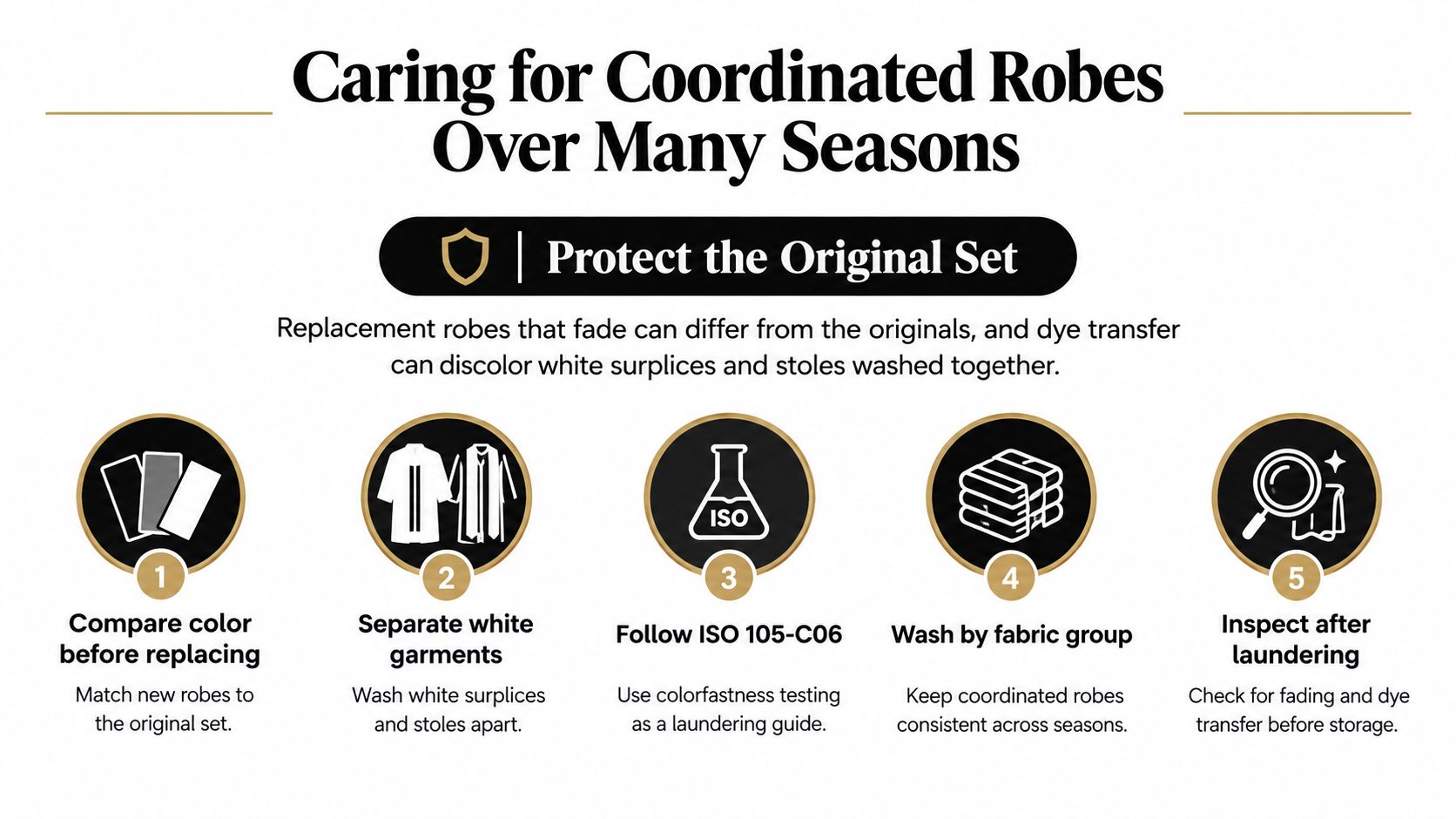
For a church or school closet that turns over every week, set the care protocol before the first invoice.
- Separate strong colors from white garments. Surplices, collars, and light stoles get their own load.
- Wash at the recommended temperature. Hotter is not cleaner if it breaks the dye.
- Avoid chlorine bleach unless the supplier approves it. Bleach is a common reason a red or purple set goes patchy.
- Record the original color standard for replenishment. Keep a swatch and the style name with the inventory list.
- Store robes on hangers in a covered bag between services. Dust and sunlight fade a shoulder long before the hem.
Those five controls keep a large order looking like one ensemble after many seasons of worship, concerts, and processions. A new singer should not be obvious because their robe is the only one that still matches the catalog photo.
Attire Policies That Show Role and Belonging
Polished worship does not require one social dress code. That assumption, that unity means identical street clothes, is where many policies go wrong. Attire works more like a name badge. It shows who leads, who serves, and which group a person belongs to before the first word.

It does two jobs at once. Solemnity supports reverence during the rite. Shared identity lets a choir read as one body. Everyday religious dress already does part of this work outside the chancel. In a Pew Research Center survey of 18,710 adults across 18 countries, published in 2021, 61% of Christians, 52% of Hindus, and 50% of Muslims generally wear a religious pendant, according to Pew's study of religious clothing. Pendants are not choir robes. The scale still shows that visible religious dress is widespread, and not only a Western clergy custom.
What the garments have always signaled
Ecclesiastical vestments have long done practical identification work. As Britannica's article on vestments notes, they can distinguish clergy from laity, indicate rank within the priesthood, and identify monastic groups. Cut and accessory should follow the wearer's liturgical role and local usage, not only a wish for matching color.
Current practice is already varied. A 2025 Presbyterian Church (U.S.A.) worship-practices report found that 54% of clergy wore stoles, 46% wore academic or preaching gowns, 46% wore formal clothing, and 24% also wore informal street clothing. Musical leaders were more casual, with 90% in informal street clothes and 20% in robes, according to the Presbyterian worship-practices report. Robes earn their place when a choir needs one silhouette, when a procession should read clearly from the back pew, or when you want to avoid ranking singers by who owns a better suit. Individual dress is better for many preachers, for guest musicians, and for visitors who should not be handed a costume at the door.
A short video on how communities talk about dress in worship is worth watching with your worship committee before you draft a policy.
A policy that unifies without shaming
- Treat religious symbols and traditional garments as standard, not as exceptions. A pendant, a head covering, or a cultural garment belongs in the plan.
- Allow culturally appropriate base clothing under robes. The robe supplies the shared look. The layer underneath can follow the wearer's own community.
- Offer adaptive closures for members with disabilities. Buttons down the back fail some singers. Front closures and generous openings do not.
- Respect modesty preferences. Coverage rules should be specific, the way a basilica states knees and shoulders, rather than a vague order to "look respectable."
- Consider income when you specify garments. If concert black is required, say whether the church provides it.
Say a soprano wears a head covering for her faith. She keeps it on under the robe. The written policy says that in one sentence, so a new director does not treat it as a special request. Run every garment through one test. Does it communicate role, unity, or both? If it only communicates who can afford the outfit, it is the wrong garment.
Confirm Your Choir's Attire Plan Before You Order
A robe order goes wrong at the form, not at the checkout. One missed color call, or one singer measured barefoot, and the front row looks off on Sunday morning.
Before anyone clicks a size, confirm five things in writing. Name the role each garment serves. Lock the liturgical color for the season you are in, whether that is white, red, green, purple, or gold. Match climate to fabric finish: matte reads subdued under bright sanctuary lights, shiny reads festive, and deluxe adds fluting on the arms and back. Record the laundering standard the cloth was tested against, so the set still matches after a full year of washing. Write down the inclusion rules your dress policy already sets, so every singer knows what is covered before the boxes arrive.
Then measure. Each singer's height with shoes on and weight belongs on the form, because robe sizing depends on those two numbers. The range for ministries covers choir robes, custom choir robes, children's choir robes, choir stoles, choir cassocks, choir surplices and cottas, and choir caps. Custom choir stoles come in solid and two-tone options, and embroidery can carry crosses, logos, or scripture. For a working budget, matte choir robes in white, black, royal blue, or red list at $29.95 each and can run as low as $23.96, which keeps a mid-size ensemble's total manageable.
Ordering for several campuses is easier when one person owns the spec sheet, the same way brand-safe merchandise programs for distributed teams keep a shared look from splintering across sites. Browse ChoirBuy and ask for size guidance before a bulk order. Choose the garment set that matches the role, the season, and the climate, then confirm sizes and care before you buy.
ChoirBuy carries choir robes, cassocks, surplices, cottas, stoles, and caps in liturgical colors, with fabric and fit choices for adult choirs, youth ensembles, and liturgical teams. If you are matching worship attire to role, season, and climate, start with the palette and size tools on ChoirBuy and send us your roster measurements before you place the order.