

You're three weeks from the concert, the music's nearly ready, and someone finally asks what everyone's wearing. That's too late. Choir concert attire shapes how an audience reads your ensemble before the first note, and it affects whether singers can breathe, move, climb risers, and afford to show up dressed correctly.
Choosing Attire That Fits the Performance
A director I know runs an adult church choir on Sunday, a youth ensemble on Wednesday, and a community chorus that rehearses in a school cafeteria. One season she sent all three groups the same instruction, wear concert black, and got three different disasters. The church choir looked underdressed next to clergy vestments, several teenagers arrived in black jeans and sneakers, and the community singers, who owned no formalwear, panicked about cost.
The lesson is simple. Don't start with a favorite garment. Start with the performance. If you're sorting out how formal a setting really is, it helps to find the right dress code look for the occasion first, then translate that formality into choir terms your singers can follow.
Four Questions That Settle Most Disputes
- What's the venue and tradition: A sanctuary, a concert hall, and a gymnasium send different signals, and your attire should belong in that room.
- Who supplies the clothing: Robes the organization owns and stores solve consistency problems, while personal clothing shifts cost and laundry to each singer.
- What must singers physically do: Process, climb risers, sit for long stretches, bow, or move quickly between pieces all change what footwear and hemlines are safe.
- What can people afford and understand: A standard nobody can pay for, or a rule written so vaguely that members guess, will fail on concert night no matter how good it looks on paper.
My recommendation is blunt. Answer those four questions in writing before you look at a single catalog. Directors who skip this step end up shopping for garments when they should be defining a standard. Polished appearance, institutional identity, singer participation, and administrative feasibility all have to hold at once. If one of them collapses, the whole plan collapses with it, usually about ten minutes before the downbeat.
Understanding Visual Unity in Choir Attire
Here's the idea that makes everything else easier. Visual unity is not uniformity. Uniformity means everyone wears the identical garment. Unity means everyone looks like they belong in the same picture. Think of a frame around a painting. The frame doesn't repaint the canvas. It gives the eye a consistent border so the artwork reads as one intentional object.
Your attire policy is that frame. Coordinated color, consistent coverage, footwear at the same level of formality, and neat grooming tell an audience this ensemble prepared together. A singer in a black dress and a singer in black trousers and a black shirt can sit side by side and read as one choir, because the palette, coverage, and formality match even though the garments differ.

What Audiences Actually Notice
Audiences don't inspect seams. They register consistency, suitability, and the absence of distraction. One white sneaker, one bright logo, or one singer in a short skirt among floor length hems pulls every eye in the room. Remove the outliers and the group reads as formal even when individual pieces vary.
If every component looks intentional and belongs to the same visual world, the ensemble appears unified. That's the test. Apply it before you compare products.
One caution matters here. Liturgical vesture isn't the same thing as ensemble styling. A cassock, surplice, or stole can carry religious or clerical meaning tied to a role in worship, not just a color scheme. Don't borrow vestments as decoration to make a secular concert look serious. In worship settings, confirm what garments signify with your clergy. In concert settings, use robes and coordinated clothing as presentation tools, and respect the difference. That distinction protects both your credibility and the tradition you're borrowing from.
Matching Attire to Choir Settings
The image below shows the liturgical end of the spectrum, where robes and stoles signal a role inside a service rather than a stage costume.

Liturgical Ensembles
For church choirs, attire connects to the act of worship itself. That history runs deep. Medieval Christian choirs wore a white, loose fitting surplice over a plain black, ankle length cassock, a combination that set the choir apart from the congregation, and later Reformation era dress drew on academic regalia to produce the Geneva style robe, as traced in Academic Apparel's history of choir robes from ancient depictions to modern gowns. Confirm expectations with your clergy or worship committee before ordering anything. Layering under the robe, stole colors by season, and whether singers process all belong in that conversation.
Classical and Community Choirs
On a concert stage, you have three proven routes. Robes give you total control over color and silhouette. Tuxedos and formal black borrow orchestral formality. Standardized concert black from personal wardrobes costs the organization nothing. Each can look excellent. The right choice depends on your hall, your repertoire, and whether your singers already own formalwear. Watch how a robed ensemble reads from the audience's distance in the performance below before you decide robes feel too formal for your group.
Contemporary and Show Choirs
Contemporary groups often perform in coordinated street clothes, and that's legitimate when the artistic identity is informal. It still needs a defined palette and a presentation standard, or coordinated becomes random. Movement heavy ensembles need even more precision about stretch, footwear, and quick changes, which is why it's worth studying how show choir attire balances choreography, costume changes, and stage presentation before writing your own rules.
School and Youth Choirs
With young singers, prioritize durable, affordable, movement ready clothing and rules a twelve year old can follow without a parent translating. Growth spurts make expensive identical garments a poor investment. A short list of approved black options, checked at a dress rehearsal, beats a strict uniform that half the choir outgrows by spring.
Choosing Robes or Coordinated Clothing
This is the central decision, so make it once and make it on evidence. Cost structure alone should give you pause. Chorus America reports that more than 90% of adult choruses responding to its most recent Chorus Operations Survey required singers to pay for their own apparel, according to Chorus America's guidance on dressing your chorus. That means personal clothing isn't free. You're spending your singers' money instead of the organization's, and you should treat that responsibility seriously.
Robes and Coordinated Clothing Compared
| Consideration | Shared Robes | Coordinated Street Clothes |
|---|---|---|
| Visual impact | Identical color and silhouette, strongest institutional identity | Cohesive when palette and coverage are defined tightly |
| Who pays | Organization buys, stores, and replaces | Each singer buys and maintains personal garments |
| Member choice | Limited, though fit and underlayers vary | High, within the written standard |
| Maintenance | Centralized cleaning, repair, and storage space required | Distributed to singers, quality varies |
| Sizing | You must stock a full size run and refit as membership changes | Singers solve their own fit, within your rules |
| Layering | Robe worn over clothing, adds warmth | The outfit is the outfit, easier in hot venues |
| Best fit | Church, school, and traditional ensembles | Community, contemporary, and touring groups |
Choose robes when tradition and tight visual control matter most. A church choir that processes every week, or a school program that wants one recognizable silhouette across grades, gets real value from shared wholesale choir robes or custom choir robes in a consistent color. Robes also erase visible income differences between singers, which matters more than most directors admit. Nobody can tell whose trousers came from where under a gown.
The robe family is broader than one garment. Traditional programs may pair choir cassocks with choir surplices or shorter choir cottas, then add choir caps where local custom calls for them. Stoles deserve their own decision, since color and embroidery carry meaning and cost. Read up on choir stoles, their styles, colors, and liturgical uses before you treat them as a decorative add on.
Choose coordinated clothing when singers already own suitable black formalwear, when membership turns over fast, or when your venue runs hot and an extra layer would punish people. It's also the pragmatic choice for community choirs with no storage closet and no laundry budget.
My rule: If you can't store it, clean it, and size it, don't buy it. A robe program you can't maintain looks worse within two seasons than well defined concert black.
Don't split the difference with a vague hybrid. Half robes because you ran out of sizes looks like a mistake, because it is one. Commit to one system, fund it properly, and write down how replacements and new members get handled.
Coordinating Colors and Accessories
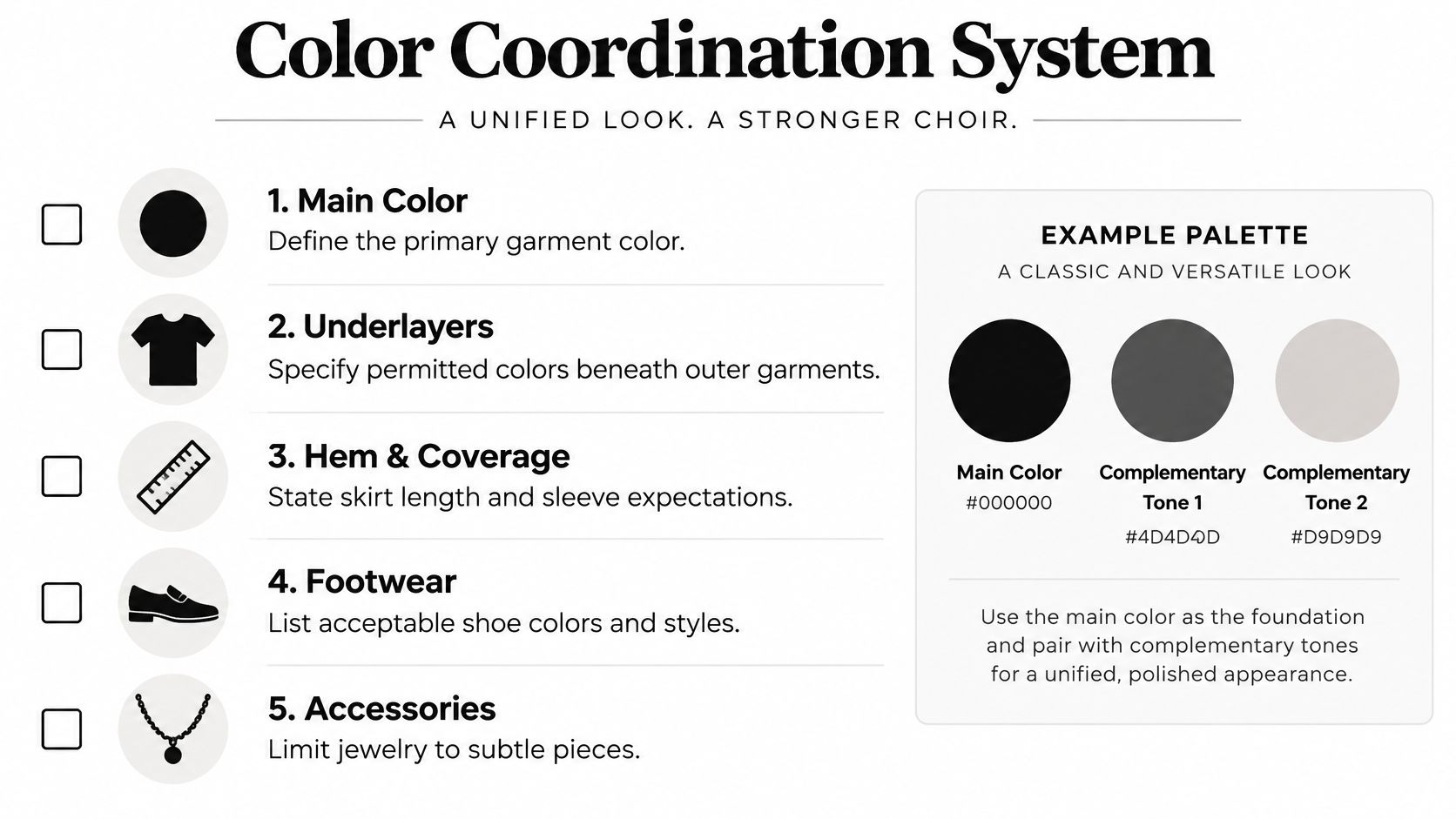
Vague instructions produce varied results. Dress nicely means something different to every singer you have. Replace it with a visible standard, a written spec for everything the audience can see. Define the main color, permitted underlayers, hem and coverage expectations, hosiery, shoes, accessories, grooming, and fragrance limits. Then nobody has to guess, and nobody gets corrected at the stage door.
A Concert Black Spec That Actually Works
Hilliard City Schools gives singers three approved options, a long sleeved black dress shirt with black dress pants, socks, belt, and shoes, a black sleeved shirt with a knee length black skirt, opaque black tights, and black dress shoes, or a plain knee length black dress with opaque black tights and black dress shoes, with all shoes black and closed toe, as set out in the Hilliard City Schools 2024 to 2025 choir handbook. Steal that structure. Options inside a fixed palette give singers choice without breaking unity.
Robes need the same precision about what's underneath. The Freeport Area School District handbook states that jeans, white socks, and tennis shoes may not be visible while robes are worn, and it specifies a complete black tuxedo with black bow tie, black cummerbund, and a white lay down collar shirt for its formal option, per the Freeport Area School District 2024 to 2025 choral handbook. If your men wear that combination, point them to Kilts4Less bow tie and cummerbund help so the pieces match instead of arriving in four shades of black.
Color choice for robes and stoles carries tradition too, so research choir robe color meaning across liturgical seasons and occasions before picking a shade because it photographs well. On accessories, be direct. Jewelry, logos, patterns, and fragrance either serve the ensemble picture or distract from it. State your limits early, state the exceptions, and state the deadline for questions. Last minute corrections humiliate singers and rarely fix the problem.
Selecting Comfortable and Inclusive Attire
Comfort isn't a luxury preference. It's a performance requirement. A singer who's overheating, tugging at a collar, or worried about tripping on a hem is not watching you. Start with fabric, and be skeptical of fiber labels. Research using standardized methods including JIS L 1099A-1 and ISO 11092 found that fabric pore size strongly governs moisture resistance and thermal conductivity, so a dense, tightly woven robe can feel hot even when the fiber is marketed as breathable, according to peer reviewed research on fabric pore size, moisture resistance, and thermal comfort.

The differences between fabrics are measurable, not marketing. Comparative testing measured water vapor permeability of 0.29 g/m²·Pa·h in one sample against 0.097 g/m²·Pa·h in the least permeable, and drying times of roughly 13.6 minutes against 16 to 18.7 minutes for less favorable samples, in comparative textile testing of water vapor permeability and drying time. So ask suppliers for air permeability, water vapor resistance, fabric weight, and drying behavior. Check whether linings and embroidered stoles block the breathable zones. Then test the finished garment over concert clothing, in your actual venue, during a rehearsal. Use a robe sizing chart based on height and chest measurements rather than guessing sizes from a sign up sheet.
Fit Tests and Identity Affirming Choice
Run every candidate garment through physical tests. Can the singer sit, stand, bow, climb risers, move quickly, use a wheelchair or mobility aid, and hold a microphone without fighting the clothing. A 2025 festival guide notes that dresses, skirts, and robes can make movement with a mobility aid difficult and that fixed uniforms may be restrictive or overstimulating, as documented in the 2025 festival guide on attire, mobility aids, and sensory needs. Offer easy fastenings for limited dexterity, low sensory fabric alternatives, and alterations that keep the same color and silhouette. Accessibility is part of the standard, not an exception to it.
Apply the same logic to identity. Education guidance recommends offering the full range of formal attire choices to every student and avoiding discipline for choosing an option that doesn't match stereotypes, as stated in Minnesota Department of Education guidance on offering all formal attire choices to every student. Define unity by shared palette, coverage, and formality. Let each singer pick trousers, skirt, dress, shirt, jacket, or robe from the approved list. Handle religious clothing and accommodation requests privately, through one named contact, well before concert week.
Communicating and Enforcing Dress Expectations
A policy nobody can find doesn't exist. Publish yours early, link it in every rehearsal reminder, and write it so a new member can comply without asking anyone. Every usable policy needs the performance date and venue, approved garment options, required colors and coverage, the footwear rule, underlayer guidance, accessory and grooming limits, an accommodation contact, a deadline for questions, and the consequence of arriving outside the standard.
Three Versions of the Same Policy
- Church choir: Confirm robe, stole, and processional expectations with clergy, then state what shows beneath the robe and where robes are stored and returned.
- School choir: Write in plain language for students and caregivers, list exact garments, and say plainly what happens if a singer arrives out of standard.
- Community choir: Assume singer owned concert black, define it precisely, and address cost directly so nobody drops out over a purchase they can't afford.
On consequences, decide before you need them. Lenoir Rhyne Youth Chorus requires floor length solid black bottoms, a solid black three quarter or long sleeved shirt, and black dress shoes, prohibits visible logos and patterns, and states that singers not in designated concert attire will not be allowed to perform, per the Lenoir Rhyne Youth Chorus handbook for 2025 to 2026. That's strict, but it's fair because it's published in advance. Whatever line you draw, draw it early and handle corrections privately, never in front of the ensemble.
Footwear deserves its own sentence in every policy. Mount Vernon High School requires black shoes that are easy to walk quickly in because singers move rapidly on and off risers during ensemble changes, according to Mount Vernon High School choir guidance on concert black and performance footwear. Treat stable, closed shoes as safety equipment, not fashion.
Collect size needs confidentially, offer fittings or samples before a bulk order, and keep one spare set of approved basics backstage. That spare set has saved more concerts than any stern email.
When you're ready to order, ChoirBuy is one retailer to evaluate alongside your other suppliers. It sells robes, stoles, cassocks, surplices, cottas, and caps with size charts, fabric and color options, custom and plus sizing, and customer support for bulk orders. Compare those tools against your written policy, sample before you commit, and verify every order against the standard you published.
Final Checklist for a Polished Concert Look
Work through this sequence in order and you'll avoid most concert night surprises.
- Confirm the setting: Venue, tradition, and governing expectations settled with clergy, school, or presenter.
- Pick one system: Shared robes or defined personal clothing, funded and maintained properly.
- Fix the non negotiables: Palette, robe length, visible underlayers, closed toe stable footwear, accessory and fragrance limits.
- Test before you buy: Sitting, bowing, risers, mobility aids, heat buildup, all checked in the venue.
- Publish and verify: Policy sent early, sizes collected confidentially, orders checked against the written standard.
Keep garment style flexible where choice supports identity, comfort, and budget. Keep color, coverage, footwear, and safe movement fixed. The best choir concert attire serves the audience's eye and the singer's body at the same time.
ChoirBuy stocks choir robes, custom gowns, stoles, cassocks, surplices, cottas, and caps in a broad range of colors, fabrics, and inclusive sizes, with bulk pricing and sizing support built for church, school, and community ensembles. If you're outfitting a full choir or replacing a worn robe set before your next concert, visit ChoirBuy to compare options against your written dress standard and order with confidence.