

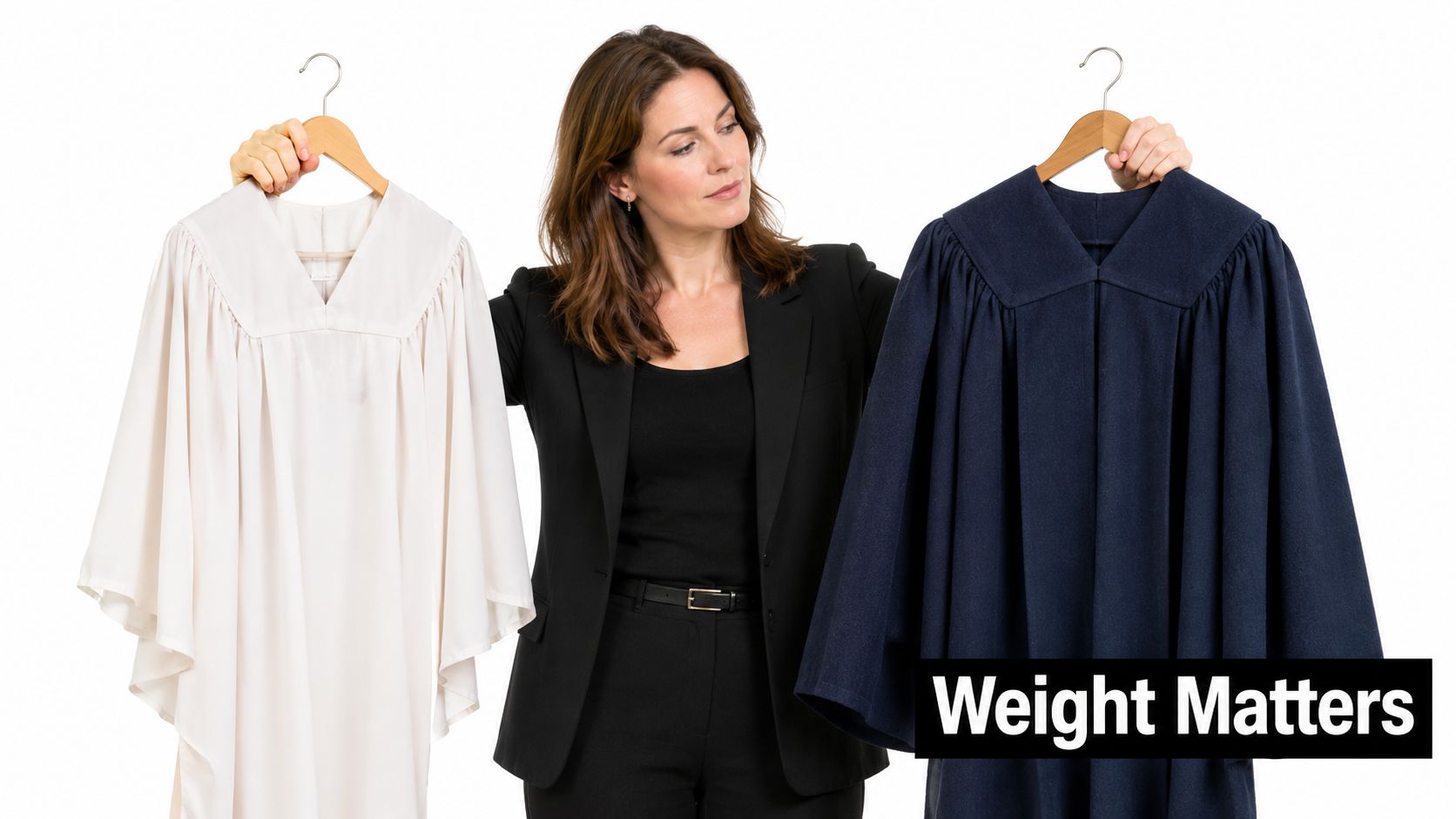
A choir director can feel the difference between two sample robes before a singer puts them on. That comparison matters before a procession, a warm school concert, or a long service. Suitable lightweight choir robes should balance manageable weight with appropriate coverage, fit, and care.
The practical question is not whether a supplier uses the word “lightweight.” It is how the actual finished robe feels and performs in the intended setting. Review available product information, then assess opacity, movement, comfort, and maintenance without assuming low weight guarantees cooling or breathability.
What a Lightweight Choir Robe Really Is
Lightweight is a comparative description, not a universal choir-robe specification. Outer fabric, lining, pleats, trim, fullness, closures, and garment size all affect finished weight.
- Fabric mass: Ask for grams per square metre, or GSM, where available.
- Finished construction: Review lining, pleating, decoration, and actual garment weight.
- Wear behavior: Assess movement, comfort, opacity, and interaction with intended layers.
- Appearance: Check the silhouette under the venue's lighting and camera setup.
The Bledlow Parish choir-history document offers background on ceremonial dress. Historical imagery does not establish the performance or weight of a modern product.
Practical rule: Compare what the singer actually wears, not just the product title or a loose fabric swatch.
For processions, check controlled length and movement. For seated or stationary use, assess the robe in that position. Children and singers with individual comfort needs require their own fitting rather than a generic weight recommendation.
Where the Robe Comes From
Church, academic, and performance dress have overlapping histories. Cassocks and surplices belong to particular church traditions, while standalone choral gowns may carry different institutional associations.
A lighter garment can still create a formal appearance if its cut, coverage, and finish suit the setting. Heavy fabric does not automatically establish greater dignity, just as a thin fabric does not automatically establish comfort.
The history of choir robes provides context for a committee discussion. Confirm the approved garment category and local practice before changing the wardrobe.
Fabric and Weight Compared
Fiber density, fabric GSM, and finished robe weight are different measurements. Fiber density describes material volume, while GSM describes fabric mass per area. Neither alone establishes the weight or comfort of a complete robe.
The textile-material weight discussion provides research context. Use actual product information for the comparison rather than ranking robes from raw-fiber density.
Common Choir Robe Fabrics at a Glance
| Material description | What to compare | What not to assume |
|---|---|---|
| Polyester | Actual weave, GSM, finish, lining, and care | Guaranteed cooling, quick drying, opacity, or easy washing |
| Cotton | Construction, weight, coverage, and instructions | Automatic comfort, breathability, or dimensional stability |
| Polyester-cotton blend | Blend proportions and completed garment | A universal balance of softness, strength, or low maintenance |
| Viscose or rayon | Actual drape, construction, and care | Suitability for every stationary or formal choir |
| Wool | Finished weight, lining, care, and intended use | That all wool robes are heavy or suitable only for cold rooms |
These categories are comparison vocabulary, not confirmation that every material is available in ChoirBuy's catalog.
Ask for fabric weight, lining details, and complete sample weight where available. Compare like sizes, since a larger or fuller cut may use more material.
The choir gown guide offers broader planning context. The finished garment is the most useful reference for the wearer.
Choosing by Climate, Age, and Role
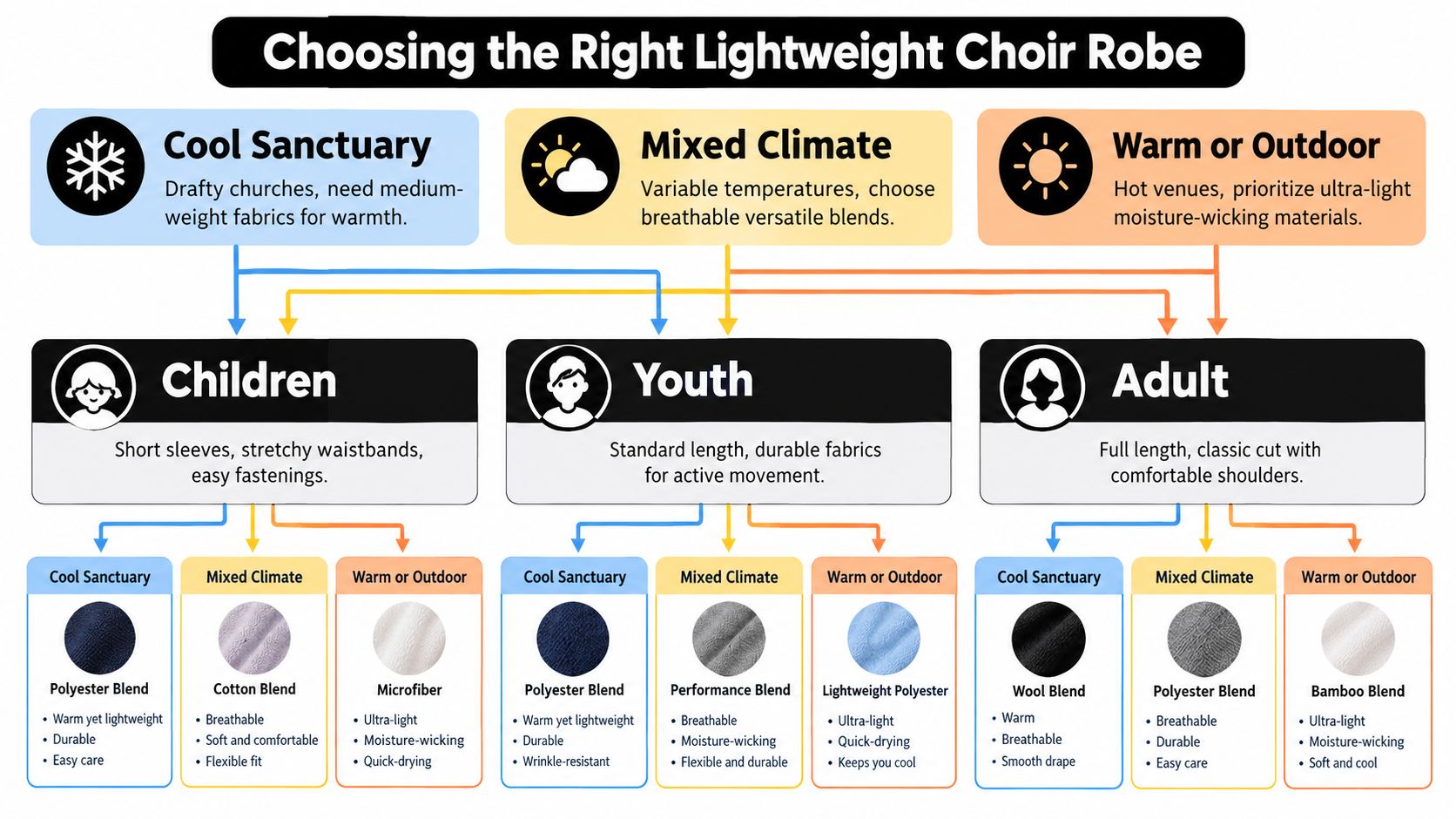
Consider the actual room, clothing underneath, expected duration, and movement. A product label cannot account for every singer or venue.
Climate decisions
- Cool setting: Check comfort with the layers singers actually intend to wear.
- Changing conditions: Review transport, entrances, performance space, and storage.
- Warm setting: Assess the complete robe in representative conditions rather than assuming low GSM or synthetic content guarantees cooling.
Do not assume ventilated yokes, mesh panels, or adjustable features are included or can be added to a standard robe. Confirm actual construction and available options.
For children, prioritize current fit and controlled length rather than automatically adding room for growth. For fuller-fit needs, confirm actual dimensions without assuming larger sizes use the same finished weight.
The youth choir robe guide offers planning context. Assess the Child's Matte White Choir Robe as a specific youth option, not a verified cooling or technical-ventilation garment.
Keep choir apparel distinct from clergy vestments and select the appropriate garment for each role.
Sizing, Customization, and Fit Details
Follow the selected product's measurement method and size options. Do not impose a generic shoulder-to-ankle or sleeve-measurement rule on every design.
- Record the measurements required by the actual product.
- Distinguish body measurements from garment dimensions.
- Confirm available cuts and any unresolved fit questions.
- Check the robe over intended layers in performance shoes.
- Assess breathing, folder use, seated fit, walking, and steps where relevant.
Use ChoirBuy's size and color charts alongside the chosen product instructions. Check individual needs rather than assigning sizes by age or appearance.
For a layered approach where appropriate, review the Classic Round Neckline Choir Surplice with the intended underlying garment. Do not assume layering will be cooler or lighter than a standalone gown.
Confirm any proposed embroidery, trim, or construction change before including it in the specification. Optional decoration can affect drape, weight, and care.
Approve the actual fit and documented care plan, not a general promise attached to a fabric name.
Ask about sample availability and terms. Do not wash, alter, or otherwise test a sample without confirming permission and following its instructions.
Breathability and Moisture Management in Use
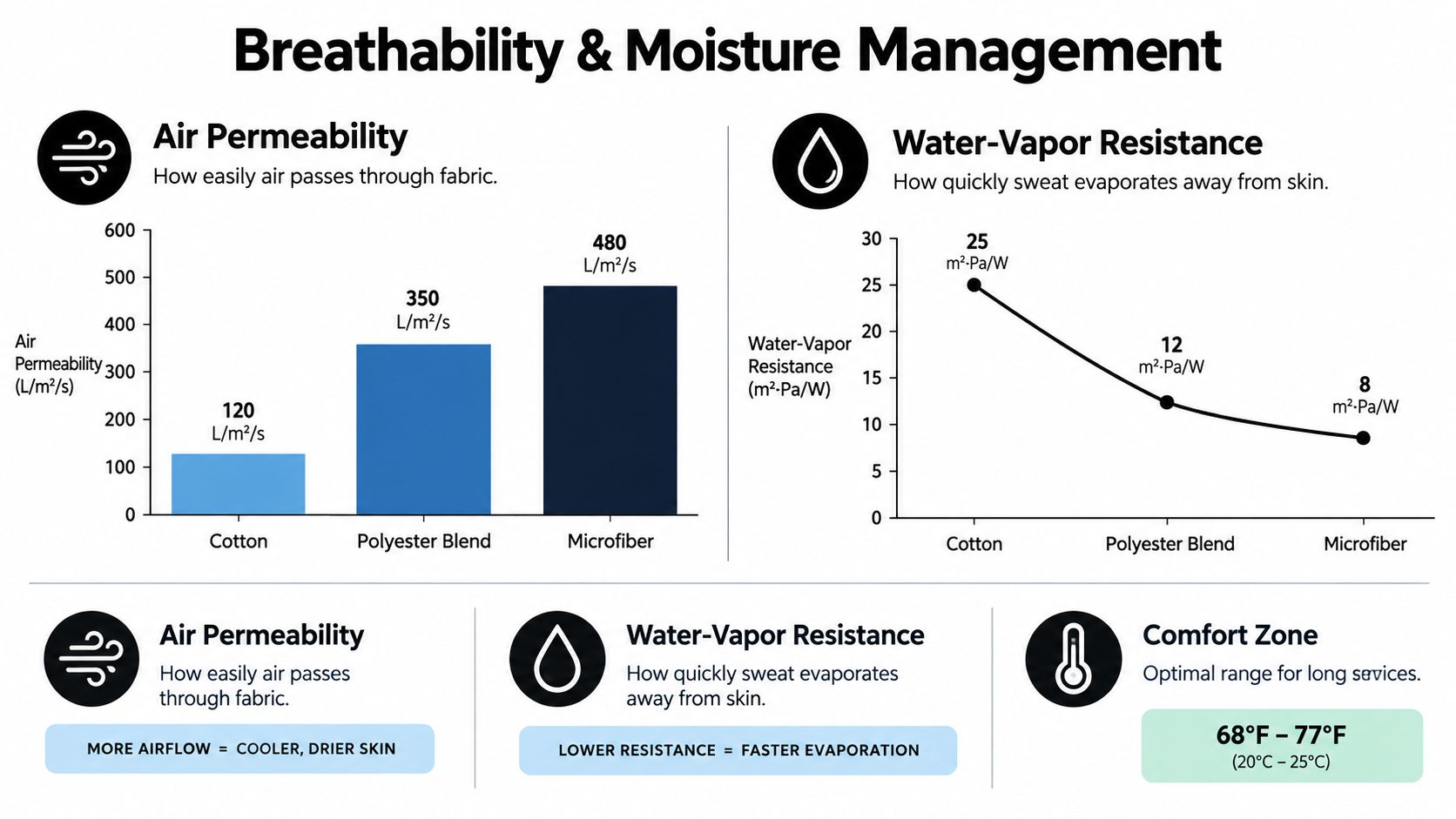
Weight, air permeability, water-vapor resistance, absorbency, wicking, and drying are related but distinct. A result for one does not establish all the others.
The garment performance study compares particular tested materials. Those results do not establish that a ChoirBuy robe contains the same fabric or delivers the same thermal or moisture performance.
Three terms buyers must separate
- Quick drying: A drying property that needs relevant product evidence.
- Absorbent: The ability to take in moisture, not proof of faster drying or cooling.
- Breathable: A broad claim that should be supported by specified fabric or garment information.
The moisture-management research provides technical context. Construction, fit, layers, and conditions also influence what a singer experiences.
Ask for relevant product-specific information where available. Do not treat an illustrative chart or research citation as test certification for the linked products.
Care and Maintenance That Preserve Fit
Lightweight apparel still needs a documented care routine. Follow the completed garment's label, including requirements for lining and decoration.

The laundering and shrinkage study concerns particular materials and conditions. It does not establish a shrinkage percentage or cleaning method for an unrelated robe.
- Read the label: Use only approved cleaning, drying, pressing, and steaming methods.
- Check sample terms: Obtain permission before any laundering trial.
- Record changes: If an approved test is performed, compare dimensions and condition consistently.
- Store appropriately: Use support suited to the construction and avoid crushing decoration.
- Assess marks promptly: Do not assume a stain treatment is suitable without checking.
- Seek guidance: Ask the supplier or a qualified cleaner when instructions are missing or unclear.
No generic fiber description establishes shrink-proof performance. Keep current order terms and issue-reporting instructions with the inventory rather than assuming a guarantee, immediate replacement, or round-the-clock service.
Ordering in Bulk With Confidence
Write down the intended conditions, wearer needs, program, available cleaning resources, and required arrival date. Compare supplier responses against the same specification.
Build the technical brief
- Product data: Actual composition, available GSM or finished-weight information, lining, and finish.
- Construction: Confirm the supplied neckline, sleeves, closures, pleating, and any ventilation.
- Care: Obtain finished-garment instructions.
- Fit: Confirm actual sizes, dimensions, and measuring method.
- Documented claims: Ask for evidence of any specific performance or recycled-content claim relevant to the purchase.
The European Commission's clothing environmental-impact overview provides broader policy context. It does not establish a linked garment's environmental benefit or determine the requirements applicable to an individual purchase.
Review a representative sample where available
Check sample terms, then assess coverage under performance lighting, movement, comfort, and the actual size. If weight data matters, compare complete garments in comparable sizes and conditions.
Record the approved reference and what the supplier has confirmed. Do not assume custom ventilation, pattern changes, or identical future production are available.
For mixed-age or varied-fit groups, representative fittings can reveal questions before the full order. A pilot purchase still requires current pricing, return terms, and later stock checks.
Match the order to the calendar
Confirm actual stock, any approvals or production, shipping arrangements, and the required arrival date. Allow time for inspection and fitting, without assuming an exchange will be available.
The custom choir robe logo guide offers planning context. Confirm current customization availability and its effect on cost, care, and timing for the actual proposal.
Request current quantity pricing and any applicable bulk-order terms. Do not assume free shipping, package discounts, a money-back guarantee, or expedited fulfillment without confirming the order conditions.
- Compare finished construction rather than the word “lightweight.”
- Review actual wear conditions and individual fit.
- Assess opacity, movement, and comfort using permitted sample checks.
- Confirm the documented care routine.
- Keep the final product specification and references.
- Obtain the complete quote, terms, and delivery arrangements.
- Inspect before distribution and retain condition records.
The goal is a manageable garment that meets the choir's actual appearance, fit, coverage, and maintenance needs, not simply the thinnest available fabric.
For specific ChoirBuy options to assess, compare the Matte White Choir Robe, Matte Navy Blue Choir Robe, and Child's Matte White Choir Robe. These links do not establish measured lightweight, cooling, moisture-wicking, or ventilation performance. Review actual specifications and ask about available samples, weight information, sizes, current pricing, applicable bulk-order terms, and delivery before choosing.