

You're looking at a row of choir members whose robes don't quite match, while the Easter schedule waits on your desk. Someone has asked for white, someone else has mentioned seasonal stoles, and the priest wants to know what the choir will wear for Evensong. Before you order anything, you need to know whether those requests concern the singers, the clergy, or both.
What Anglican Vestments Are and Why They Matter
Anglican vestments are a family of garments, not a single prescribed outfit. Their meaning depends on who wears them, what service is taking place, and the church's own practice. Identifying a garment is useful, but identifying its wearer's role is usually the more important first step.
Consider the white garment in your choir cupboard. A singer might wear a surplice over a cassock while taking part in choral worship. A minister might wear a similar garment while leading a service, but the shared appearance doesn't mean that the singer and minister have interchangeable responsibilities. The historical distinction between choral dress and Eucharistic vestments helps explain why similar-looking clothing can serve different purposes.
Start with the person, not the photograph
For a new coordinator, the temptation is to find a photograph of an Anglican choir and copy the whole arrangement. A better approach is to identify what each person is doing.
- Choir member: Begin with the clothing approved for singers.
- Server or reader: Check the expectations attached to that particular ministry.
- Deacon or priest: Leave decisions about ministerial insignia and Eucharistic vestments with the responsible clergy.
The Diocese of London's Communion guidelines on appropriate vesture illustrate this role-based approach rather than prescribing one outfit for everyone.
Practical rule: Ask “Who is wearing this, and for which service?” before asking “What is this robe called?”
Think of the task as preparing clothing for different members of an orchestra. Everyone contributes to the same occasion, but not everyone needs identical equipment. Your aim is a coherent, locally appropriate arrangement, not the most elaborate set of garments you can assemble.
Reformation Roots and Why Practice Still Varies
Anglican vestment history helps explain why apparently straightforward clothing questions can produce different answers. The English Reformation involved an attempt to preserve continuity while changing theology and church governance. Clothing became part of that negotiation, rather than a matter of keeping or discarding every older garment.
The 1549 First Prayer Book provided for a white alb and a vestment or cope for the celebrant at Holy Communion, with albs and tunicles for assisting ministers, as described in the historical legal discussion of Edwardian vestments. These were garments associated with distinct liturgical responsibilities, not a matching uniform for the whole congregation or choir.
What the Ornaments Rubric preserved
The 1559 Act of Uniformity and its Ornaments Rubric directed that church and ministerial ornaments be retained as used in the second year of Edward VI, pointing back to the first Edwardian Prayer Book. The historical account of the Anglican vestments question also records the uneven practice that followed: cathedral and collegiate clergy commonly used copes or surplices, while parish arrangements varied substantially.
The wording continued through later Prayer Books. The statutory history of the Ornaments Rubric traces its appearance in 1604 and its incorporation into the 1662 Book of Common Prayer, including changes to its wording.
That legal history matters because ornaments referred broadly to the church and its ministers. It wasn't a shopping list with an uncontested meaning.
Traditional Anglican dress doesn't necessarily mean the most ornate dress. A restrained arrangement can belong to the tradition just as genuinely as a more ceremonial one.
Why the disagreements continued
The Oxford Movement encouraged renewed use of Eucharistic vestments, but that revival brought conflict. The historical summary of vestment controversies records the 1870 Hebbert v. Purchas judgment, the Public Worship Regulation Act of 1874, and the imprisonment of four clergymen for persistent violations.
These disputes weren't merely arguments about tailoring. Clergy and church authorities disagreed about what clothing communicated about Anglican identity.
For a wider account of choral clothing, our history of choir robes provides useful background. The practical conclusion is simple: a garment can have deep Anglican roots without being expected in every Anglican parish.
Typical Anglican Garments and What Each One Does
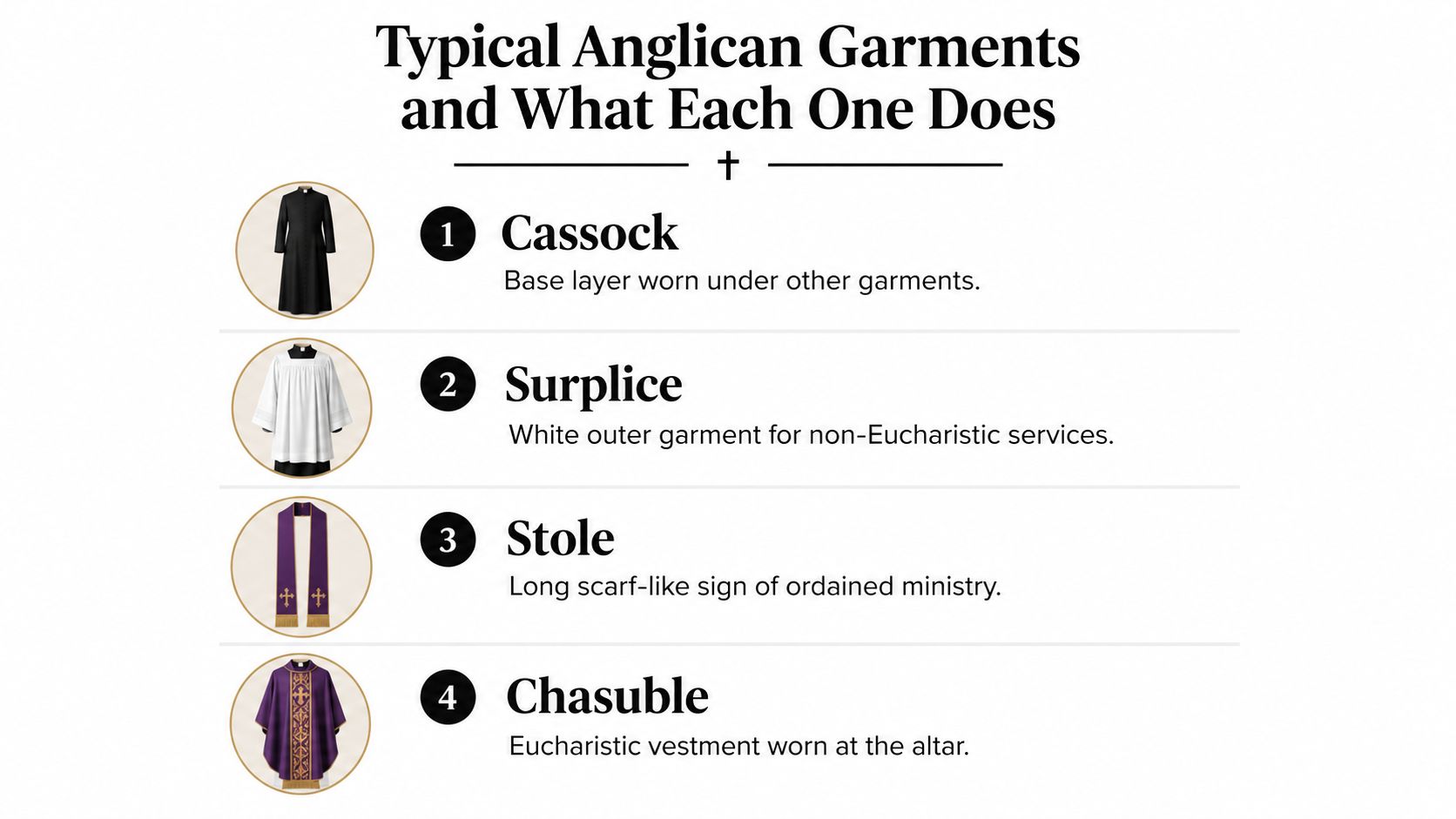
Start with the layers you can see. A cassock is the base garment beneath a surplice in the familiar choir arrangement. The surplice is the loose white outer garment, rather like a generous white apron worn over a dark dress, although its sleeves and full shape make it a tunic rather than an actual apron.
The illustration gives a quick visual reference for several commonly encountered garments.
Recognize the choir layers
Historically, the Anglican surplice was a full white linen tunic, with wide sleeves, pleating from the yoke, and a hem reaching nearly or completely to the feet. The historical description of the surplice explains the recognizable shape behind its later variations.
That generous cut matters when singers process, sit, stand, and hold music. When assessing a surplice, look at how it fits over the cassock, not just over a shirt. A garment that looks roomy on a hanger may feel restrictive once the full outfit is underneath.
A cotta belongs to the surplice family of choir garments. Don't assume that every supplier or parish uses the names identically. Match the approved silhouette, sleeve shape, and length, rather than relying on a product label alone.
Recognize the ministerial garments
The remaining names are easier to remember when you connect each one with its function.
- Alb: A full white garment encountered in Eucharistic dress. It isn't another name for a cassock.
- Stole: A long, scarf-like sign of ordained ministry. A decorative accessory sold as a choir stole shouldn't automatically be treated as an ordained minister's stole.
- Chasuble: An outer Eucharistic vestment associated with the celebrant's role at the altar.
- Cope: A cloak-like ceremonial garment. Its shape differs from the chasuble, even where both appear in the same church's wardrobe.
- Tippet or scarf: An accessory associated with choir dress, distinct from the seasonal Eucharistic stole.
The Edwardian provisions discussed earlier help explain why the alb, chasuble or cope, and assisting ministers' garments have separate names. They weren't conceived as interchangeable robes.
For a closer comparison of the underlying garments, see our guide to the cassock and alb. When you're uncertain, describe the garment's shape and intended wearer to the worship leader before choosing a replacement.
Liturgical Colors Through the Church Year
A liturgical-color chart is a reference, not permission to place an order. The Church of England's rules for the church year and liturgical colors expressly describe the colors as suggested rather than mandatory and allow traditional or local practice.
The calendar also contains exceptions that broad labels such as “Christmas,” “Lent,” or “Holy Week” can conceal. Check the actual service, not just the month or the season printed at the top of a planning sheet.
Liturgical colors by season
| Color | Typical seasons and feasts |
|---|---|
| White | Christmas Day through the Presentation; Easter Day until the Eve of Pentecost; Trinity Sunday; All Saints' Day; festivals of Christ and the Virgin Mary; non-martyr saints' festivals; church dedications; Maundy Thursday Holy Communion |
| Red | Holy Week, except Maundy Thursday Holy Communion; Pentecost; festivals of saints venerated as martyrs |
| Purple | Advent; Ash Wednesday until the day before Palm Sunday |
| Green | The day after the Presentation to Shrove Tuesday; the day after Pentecost to the eve of All Saints' Day, broadly associated with Ordinary Time |
These assignments summarize the Church of England guidance linked above. That guidance also identifies red as suitable for services centered on the Holy Spirit, including Baptism, Confirmation, and Ordination.
Notice the Maundy Thursday exception. If you order solely from a chart that labels all Holy Week red, you could miss the white specified for that Communion service.
Decide where the color belongs
A seasonal color might appear on a priest's stole, other Eucharistic vestments, or altar hangings. It doesn't follow that every singer must wear that color. A parish can keep its choir clothing visually neutral while expressing the season elsewhere.
Before matching garments to the calendar, separate these questions:
- Which service is planned? A festival celebration may need a different decision from the surrounding seasonal pattern.
- Whose clothing changes? Confirm whether the instruction concerns clergy, servers, singers, or furnishings.
- Which local custom applies? Don't assume that another parish's photographs establish your own practice.
Our guide to choir robe color meanings can help with broader visual choices, but it shouldn't replace your parish calendar.
A color can be appropriate to the season without being appropriate for every person taking part.
Historical Anglican discussions also record differences over colors and their use, as the Parson's Handbook discussion of ornaments and colors illustrates. If your church uses an Advent color or festival arrangement that differs from a common chart, record the approved custom rather than trying to correct it through a bulk purchase.
Choir Dress Versus Eucharistic Vestments
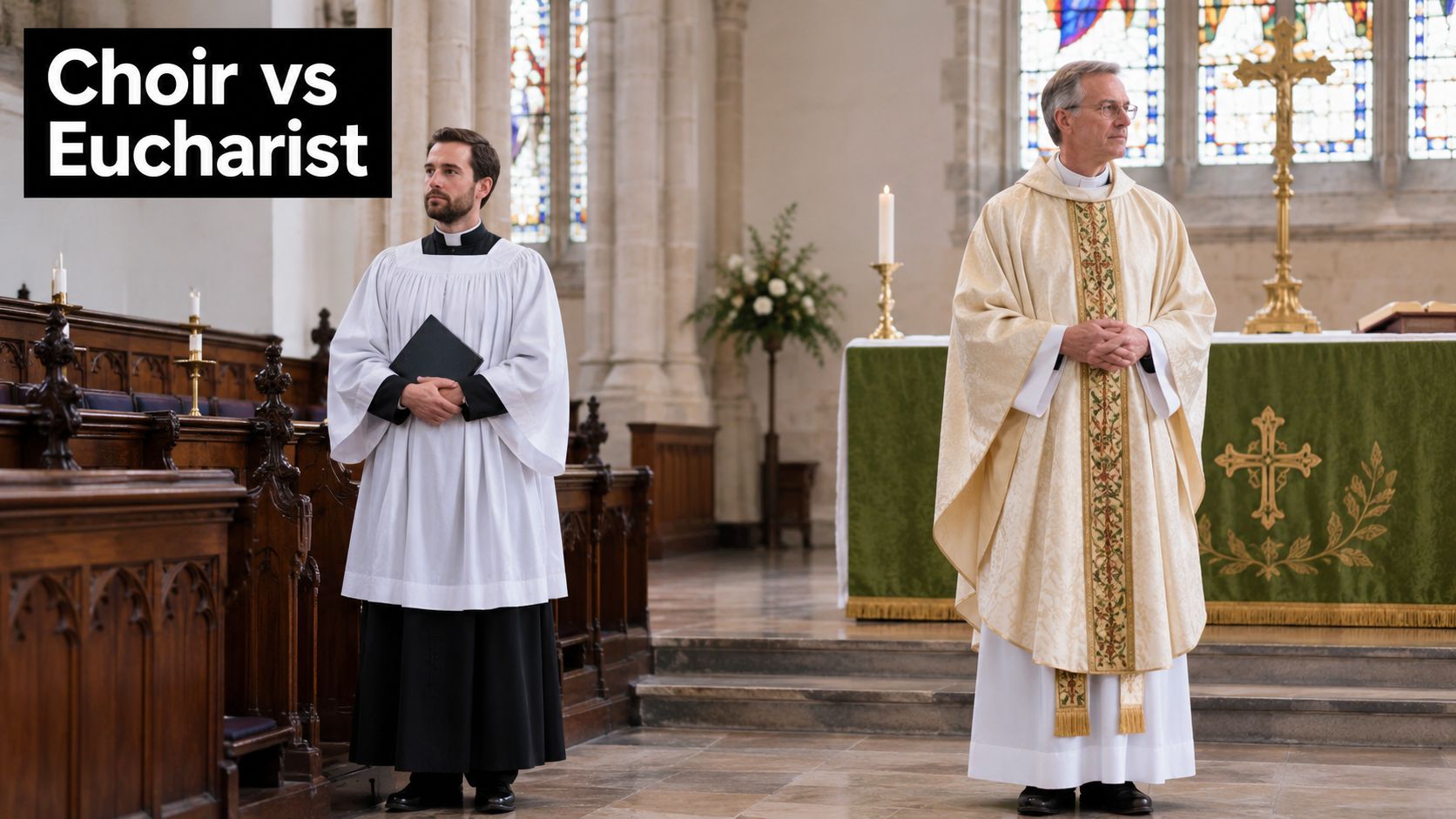
A choir can sing during Holy Communion without every singer adopting Eucharistic vestments. The service and the wearer's ministry are separate considerations. Keeping them separate prevents a common purchasing mistake: treating everything worn near the altar as choir apparel.
This photograph offers a visual prompt for noticing differences between choral and ministerial clothing.
Compare the responsibilities
For non-Eucharistic services, Anglican choir dress commonly includes a cassock beneath a surplice, often with a scarf and, for graduates, an academic hood. The hood historically identifies a degree and university, rather than serving as a freely interchangeable decoration, as explained in the Church Times discussion of academic hoods and surplices.
Eucharistic dress concerns the particular ministries exercised at Holy Communion. Depending on local practice, clergy may use an alb and stole, a chasuble, or another approved arrangement. More ceremonial clothing isn't automatically more correct.
| Purchasing question | Choir dress | Eucharistic vestments |
|---|---|---|
| Who needs the garment? | The singers and others assigned that form of dress | The minister exercising the relevant liturgical role |
| What should match? | Approved choir silhouette, fit, and overall appearance | The parish's authorized ministerial arrangement |
| What needs separate approval? | Choir accessories and any academic dress | Stoles, outer vestments, and seasonal requirements |
A Sunday planning example
Suppose your choir sings Evensong and later supports a Communion service. For Evensong, your immediate task might be replacing worn surplices and correcting inconsistent cassock lengths. For Communion, the choir's approved clothing may remain unchanged while the priest uses different vestments.
That produces separate purchase lists, not necessarily separate wardrobes for every singer. Put choral replacements on one list and clergy requirements on another, with a named approver for each.
A video can provide another visual reference alongside the garments you're discussing.
Don't add academic hoods because they appear in a photograph, and don't assign an ordained minister's stole to singers because the color matches. Both choices require attention to the wearer, not just the appearance.
The useful question for your clergy is concrete: “Will the choir retain its usual dress at Communion, and which additional garments belong to the ministers?” That answer is more actionable than a general request to make everyone look Anglican.
Choosing and Sourcing Vestments for Your Choir
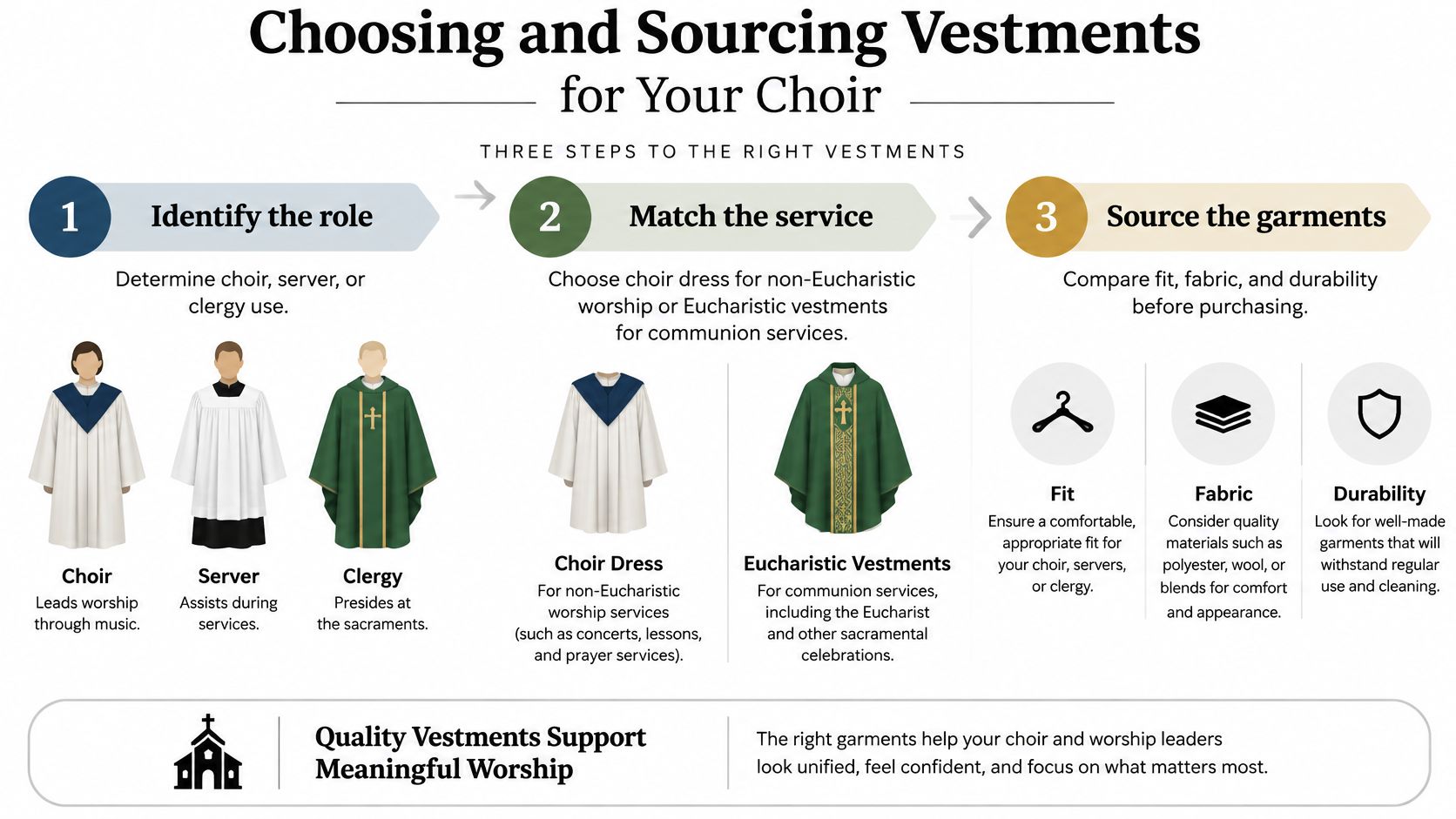
Begin with a written decision, not a shopping basket. An Anglican choir vestment order should describe an approved arrangement clearly enough that another coordinator could repeat it. That means recording responsibilities, service use, appearance, and fit.
The decision path below helps keep those choices in a sensible order.
Turn parish decisions into an order specification
Use a short sequence before comparing fabrics or embroidery.
- Identify the role. Record whether the wearer is a choir member, server, reader, deacon, or priest. Don't combine these under a general label such as “church team.”
- Name the service. Specify Morning Prayer, Evening Prayer, Communion, or another planned use.
- Record parish custom. Use a written description or an approved photograph of the intended arrangement.
- Resolve authority questions. Ask the responsible clergy whether diocesan direction or the requirements of a visiting church affect the choice.
For a choir that sings in different jurisdictions, keep the host church's instructions with the event plan. Don't assume your home parish's approval settles every visiting engagement.
Our church choir robes guide offers further help with ensemble clothing. Use it alongside the liturgical decisions, rather than asking a general robe guide to make those decisions for you.
Compare standard and custom clothing
A standard garment is worth considering when its cut, finish, and available sizes already meet the approved specification. Custom work becomes relevant when the parish needs particular color combinations, dimensions, or identifying embroidery.
We offer choir robes, custom choir robes, children's choir robes, choir stoles, cassocks, surplices and cottas, caps, and cinctures and sashes. Our fabric choices include matte polyester, shiny satin, and lightweight blends; Deluxe Choir Robes use matte fabric with fluting on the arms and back. We also offer black cassocks with white surplices, embroidered surplices with crosses or church emblems, and solid or two-tone choir stoles with embroidery options for crosses, logos, or scripture.
Compare those options against the job the clothing must do:
- Movement: Have the wearer sit, stand, turn, and hold a music folder while dressed in the intended layers.
- Appearance: Examine opacity, sleeve shape, and how the fabric looks beside existing garments.
- Care: Confirm the supplied care instructions before deciding how the choir will manage laundering.
- Mixed ages: Assess children's and adult garments as a coordinated ensemble without assuming identical proportions will suit everyone.
Keep clothing administration separate from other worship communications. If your church also wants to turn sermon material into follow-up content, the option to repurpose sermons with Taja AI belongs in that communications workflow, not in the vestment approval process.
The best sourcing decision is the one you can explain in plain language: this garment fits this person, serves this role, and matches the arrangement the parish has approved.
Next Steps for Ordering from ChoirBuy
Before contacting us, prepare an order note that someone outside your church can understand. Avoid descriptions such as “the usual Easter outfit” or “traditional Anglican style.” Those phrases leave too much room for interpretation.
Write down the intended wearer, service, season, and approved parish custom. Include the existing garments that must remain part of the outfit, especially when you're replacing only an outer layer or adding an accessory.
Prepare your approval record
A concise checklist makes the final conversation more useful:
- Role and use: State who will wear the garment and where it will be used.
- Color approval: Record the worship leader's or clergy member's decision, including any service-specific exception.
- Fit information: Gather the measurements required for the selected garment and identify what will be worn underneath.
- Design details: Provide the intended embroidery text or artwork and confirm who may approve it.
- Order scope: Distinguish replacements, new choir places, and garments intended for clergy.
We offer liturgical choir robes in white, red, green, purple, and gold, with embroidered crosses, doves, and flames. These are available design choices, not a declaration that every color or emblem belongs in every Anglican parish.
Request a quote and mock-up
Custom orders for products such as stoles and gowns can be requested by emailing hello@choirbuy.com. We provide a quote and a mock-up design, so your team can review the proposed appearance before placing the order.
Custom Traditional Choir Stoles have a minimum order of 8 stoles. Our choir stole options include solid and two-tone designs, with custom embroidery for crosses, logos, or scripture. Confirm that a choir stole is the accessory your parish intends, rather than substituting it for ministerial vesture.
Ask the authorized person to review the mock-up against the written order note. Settle questions about color, symbols, and intended wearers at that stage, when you can still make a clear decision without trying to reconcile a finished bulk order.
ChoirBuy offers cassocks, surplices, choir robes, and customizable choir stoles to help you outfit an ensemble in keeping with its Anglican parish practice. Visit ChoirBuy with your approved garment list, or email hello@choirbuy.com to request a quote and mock-up for a custom order before committing to the full ensemble.