

Your singers arrive for dress rehearsal wearing black, but they don't look coordinated. One shirt reflects the lights, another looks faded beside new trousers, and a skirt that seemed long enough at home rises noticeably when its wearer sits on a riser.
Concert black attire is a performance standard, not just a color request. Directors need to specify cut, coverage, finish and care, while leaving singers enough flexibility to breathe comfortably, move safely and reuse their clothing. A clear standard also prevents avoidable spending on replacements, alterations and last-minute substitutes.
Approved Concert Black Garments at a Glance
Approved Concert Black Garments by Cut and Coverage
| Garment | Cut or Length | Coverage or Extras | Source Policy |
|---|---|---|---|
| Dress or skirt | Knee length or longer; mid-calf or below when seated | Opaque black tights or nylons | Lake Mary High School; Madison Symphony Orchestra; Mount Vernon High School |
| Long dress for soprano and alto | Ankle-length or foot-top hemline | Plain black tights or hose | Detroit Concert Choir |
| Full-cut trousers with top | Full-cut ankle-length pants | Black top with sleeves at least three-quarter length | Madison Symphony Orchestra |
| Dress pants with dress shirt | Tailored black pants | Black dress shirt; black jacket or tie optional; tall black socks | Choral Society of Greensboro; Mount Vernon High School |
| Men's suit | Black suit | Black button-down shirt, no visible white undershirt; long black tie | Detroit Concert Choir; Madison Symphony Orchestra |
These are examples drawn from different policies, not interchangeable requirements within a universal dress code. The combined rows show the decisions a director must make before singers buy anything.
Read the Rows as Complete Outfits
For dresses and skirts, choose a standing and seated hemline standard rather than saying “long.” Lake Mary High School uses knee length or longer, while Madison Symphony Orchestra assesses its longer skirt option when seated; Mount Vernon High School supplies the opaque-hosiery requirement.
The long-dress row reflects the Detroit Concert Choir's professional concert-black policy, which specifies an ankle-length or foot-top hemline for soprano and alto attire. A hem should meet the visual requirement without catching beneath a shoe during an entrance.
The full-cut-trouser option gives singers an alternative to a skirt without abandoning a formal silhouette. Madison Symphony Orchestra pairs that option with a black top and defined sleeve coverage, so approving the trousers alone doesn't approve every black blouse.
Dress pants and a dress shirt offer a simpler wardrobe route. Greensboro makes the jacket and tie optional, while Mount Vernon requires tall black socks with trousers, a useful distinction when singers step up or sit down.
The suit row combines Detroit's black button-down shirt and concealed-underlayer rule with Madison's long-black-tie option. Treat it as a complete proposed outfit, not a reason to add a tie to every ensemble's policy.
Practical rule: Approve the outfit in motion, not just the garment on a hanger.
Turn Examples Into Your Own Standard
Check seated coverage, raised arms, folder position and riser steps before approving a cut. If managing separate garments would create too many exceptions, compare the coordinated approach in our black choir robes guide.
Choose an approved row for each singer group, allowing equivalent options where appropriate, and write the complete outfit into the call sheet before ordering.
Items That Break the Look and How to Stay Comfortable
The Choral Society of Greensboro's performance-dress policy defines concert black around an all-black appearance without adornment. That's the useful challenge to the assumption that any black clothing will work: color doesn't cancel casual construction or distracting details.
Use this visual checklist when singers assemble their outfits.
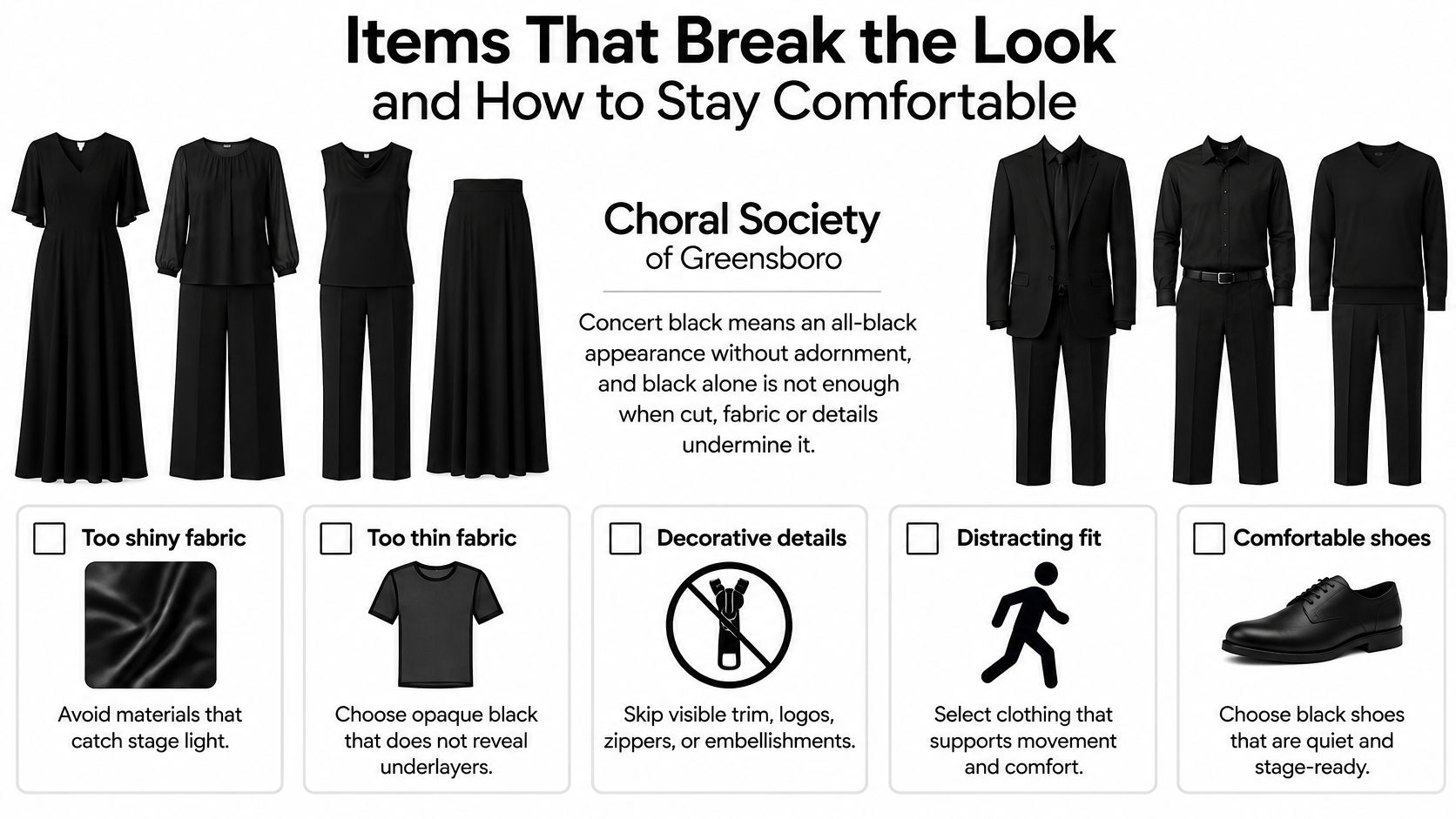
Items That Break a Concert Black Look
| Item | Why It Breaks the Look | Policy Example |
|---|---|---|
| Jeans | Casual texture and color differ from black dress trousers | Choral Society of Greensboro |
| Yoga pants, leggings or sweatpants | Athletic cut and possible sheen | Choral Society of Greensboro; Lake Mary High School |
| Shorts or short dresses | Hemlines fall outside the formal line | Choral Society of Greensboro; Lake Mary High School |
| T-shirts, tank tops or crop tops | Casual neckline and sleeve length | Choral Society of Greensboro |
| Sneakers, sports shoes or flip-flops | Athletic shape, logos or colored stripes | Choral Society of Greensboro; Lake Mary High School |
| Colored sock patterns or bare legs | Break the all-black line from the floor up | Choral Society of Greensboro |
| Reflective jewelry or accessories | Catch light and pull focus | Choral Society of Greensboro; Lake Mary High School |
| Visible white undershirt | Creates a contrast line at the collar | Detroit Concert Choir |
The exclusions above concern stage appearance, not the value or comfort of someone's everyday wardrobe. A comfortable athletic garment still needs replacing if its cut conflicts with the agreed concert standard.
Test Comfort Without Relaxing the Visual Standard
Lake Mary High School Music asks performers to blend into the ensemble when viewed from approximately 30–100 feet. Use that audience-distance test instead of scrutinizing small fashion details that won't register from a seat.
Choose an opaque fabric with a matte surface and enough ease across the ribs and shoulders. Don't assume a thin cloth is breathable or suitable: stretch it gently across the body and check whether underlayers become visible.
Have singers complete a full rehearsal in the proposed outfit. Ask about overheating, rubbing seams, waistbands that restrict comfortable expansion and sleeves that pull when folders rise.
For a video reference during outfit preparation, use the player below.
If a garment is uncomfortable, change its fit or construction rather than accepting a distracting substitute. Check each singer against the exclusion list at the first dress rehearsal, when there's still time to fix a problem.
Shoes, Hosiery and Layers Checklist
A singer's shoes must stay secure and quiet on the route to the stage, not just look right while standing still. Mount Vernon High School Music's concert-black policy calls for black shoes suitable for moving quickly on and off risers. Detroit Concert Choir specifies simple closed-toe shoes, preferably with soft soles.
| Item | Requirement | Source Policy |
|---|---|---|
| Black dress shoes | Closed-toe, preferably soft-soled, suitable for walking quickly on and off risers | Mount Vernon High School; Detroit Concert Choir |
| Shoes with colored stripes or logos | Excluded | Lake Mary High School |
| Black cardigan, jacket or blazer | Matches base garment; stays on through concert | Recommended ensemble rule for the director to approve |
For other footwear exclusions and hosiery requirements, follow the earlier concert-black checklist.
Check the Outfit From the Floor Up
Have singers climb a step, turn and stand in their chosen shoes. Check for slipping heels, loose straps and noisy soles. If an insert is needed, choose insoles by shoe type, then recheck the fit: an insert takes up room inside the shoe.
Hosiery should stay in place through movement, without rolling at the waist or sliding down the leg. Keep a suitable spare with the singer's performance clothing rather than relying on a last-minute replacement.
A layer is part of the costume if the audience will see it.
Approve a lightweight black layer for a cold church, then check its finish, neckline and sleeve bulk against the base garment. If singers may remove it backstage but must wear it onstage, state that rule clearly.
Write footwear, hosiery and layer choices beside each garment option on the call sheet. That gives singers the full purchasing requirement before they order.
Fabrics That Keep Black Looking Uniform
A black fabric sample can look satisfactory in a bright office and uneven under spotlights. Fundamentals of Theatrical Design explains the light-control role of black; for concert clothing, matte surfaces help minimize glare, while shiny surfaces can produce conspicuous highlights.
Our robe fabric preferences distinguish matte for a dull look, shiny for a shiny look, and deluxe for fluting. Choose the intended effect deliberately rather than mixing finishes because every garment is labeled black.
Specify Performance, Not a Color Name
Colorfastness concerns more than fading. The ISO textile-testing catalogue includes ISO 105-C06 for laundering and ISO 105-X12 for rubbing, methods relevant to checking whether black fabric retains color or transfers dye.
Dye loss becomes especially noticeable when a worn garment stands beside a new one. Friction and moisture also matter where dark fabric touches collars, stoles or lighter costume pieces.
Use this procurement routine before committing to a group order:
- Request the tested fabric and method. Ask for the fiber composition, fabric identification, applicable test method and result, rather than accepting a general fade-resistant description.
- Wash-test a representative sample. Use the care process the ensemble will follow, because an impractical maintenance routine won't protect the wardrobe.
- Rub damp fabric against white cotton. Look for staining before the material touches a light-colored stole, while recognizing that this screening check isn't a substitute for laboratory testing.
- Inspect high-friction areas. Examine seams, underarms and waistbands for surface changes, color loss and puckering after washing and wear.
Make Care Part of the Purchase
Issue a shared care sheet specifying the permitted temperature, detergent approach and drying method within the garment's care instructions. Where dry cleaning is required, don't let some singers substitute home washing.
For temperature-sensitive venues, our lightweight choir robes guide can help frame the construction decision. Weight alone shouldn't decide it: assess opacity, drape and room for movement together.
Keep an approved fabric reference with the wardrobe records so replacement garments can be compared before distribution. A cheaper substitute isn't a saving if the director must replace additional garments to restore a coordinated appearance.
Buy for the care routine you can maintain, not the one that sounds ideal on an order form.
Robes and Inclusive Options for Mixed Ensembles
A mixed ensemble can look coordinated without requiring every singer to wear the same type of garment. Robes create a shared outer silhouette across different ages, wardrobes, and worship traditions, while directors still need to consider warmth, sleeve movement, and safe walking.
Concert black developed as formal concertwear in the mid-19th century, with earlier roots in court dress and musicians' service to aristocratic households, according to historical music references. Dress standards have since broadened. The Capital Times' account of concert attire reports that the New York Philharmonic allowed women to wear black trousers with long-sleeved black blouses in 2018, and the Philadelphia Orchestra replaced its tuxedo requirement with concert black in 2021.
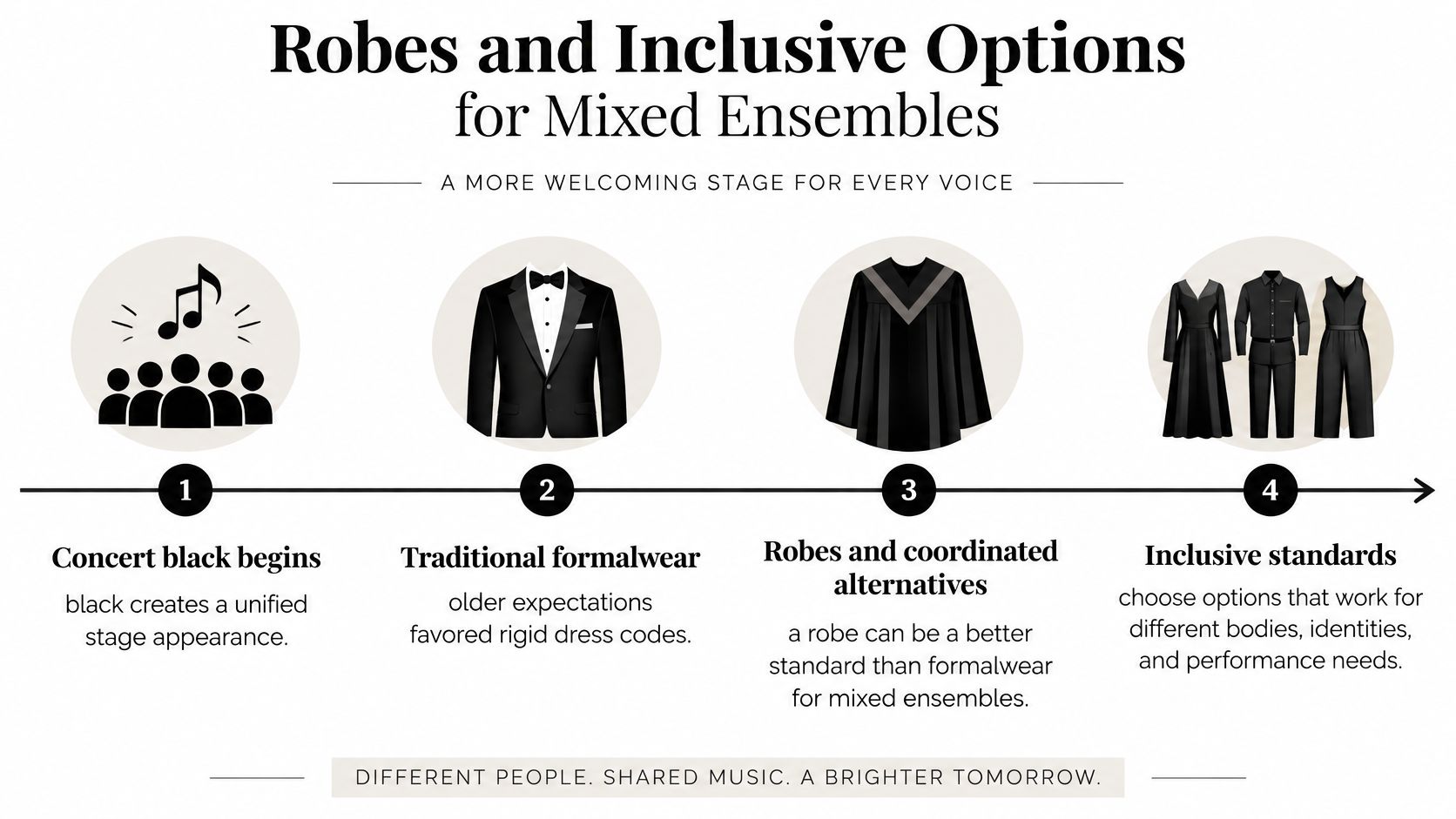
Choose Robes When They Solve the Right Problem
A robe can simplify coordination when singers have different clothing options or the ensemble follows a worship tradition. ChoirBuy offers classic black cassocks paired with white surplices, including embroidered surplices with crosses or church emblems. For a concert-black standard, specify whether the robe itself must be black and whether any white garment will show at the neckline, sleeves, or hem.
Check the product page for listed measurements before ordering a robe or cap. Compare the garment's intended length and sleeve fit with the ensemble's movement needs, and confirm that headwear fits the singers who will wear it. ChoirBuy offers choir caps and tams, including traditional mortarboards and velvet tams, with custom colors.
For church ensembles, ChoirBuy's experience with religious apparel, liturgical colors, and religious practices can help inform garment choices. A worship service may call for a different presentation from a secular concert.
Keep the Standard Firm and the Construction Flexible
The inclusive formal-performance attire specification for choristers allows choices regardless of gender identity or voice part and directs uncertain variations to the artistic director in advance. That approach keeps the visual standard clear while leaving room for different needs.
- Required appearance: Black palette, coordinated formality, sufficient opacity, and safe footwear.
- Flexible garment choice: Dresses, trousers, suits, or robes, with suitable adjustments for sensory needs, pregnancy, mobility, and religious coverage.
- Private approval: Discuss a proposed variation discreetly before purchase rather than during rehearsal.
Tell singers to “choose one approved black option” instead of assigning garments by gender. The plus-size choir robe fit guide can help directors consider garment options across sizes; check the listed measurements for each selection.
Inclusion works best when directors define the audience-facing standard and allow practical ways for singers to meet it.
Measure, Size and Count Before You Order
A correct garment choice can still become an incorrect order. Measure singers in the underlayers and footwear they expect to wear, and record the date so an older entry isn't mistaken for a current fit.
Use a flexible measuring tape and a consistent recorder where possible. Let singers request private assistance rather than requiring measurements in front of the group.
Build a Usable Size Record
- Measure for the garment. Check intended hem placement for dresses, inseam for trousers, sleeve length for tops and shirts, and head circumference for caps. Include seated and movement checks where the chosen standard requires them.
- Match robe sizes to the manufacturer's height ranges rather than age. Use our robe sizing chart guide, then check any additional fit information before selecting an extended-size option.
- Count by size and voice part. Keep the size totals separate from the roster so the purchaser can reconcile quantities without guessing. Add a modest buffer based on likely late joiners and replacement needs.
- Compare the order with the approved specification: palette, finish, fabric requirements, footwear and hosiery. A correct size in the wrong finish is still the wrong garment.
- Resolve exceptions before payment. Send proposed variations to the artistic director while changes are still straightforward, not after garments have been distributed.
Keep Ordering Information Separate From Private Needs
The working order sheet should show the singer's name, selected size, garment option, quantity and approval status. It doesn't need medical details or an explanation of a personal accommodation.
Give the director and designated wardrobe coordinator access to the current shared sheet. When singers join, leave or change sizes, update the record before placing another order.
Keep a separate tally for spare garments so a borrowed robe doesn't disappear into someone's permanent assignment. This small administrative step makes repeat ordering more reliable and reduces unnecessary mismatched substitutions.
Confirm Your Concert Black Standard Before You Order
Write the standard before anyone starts shopping. A usable document should let a singer assemble the correct outfit and let a purchaser approve an order without interpreting phrases such as dressy or appropriate.
Keep it concise enough to use during fittings, but complete enough to prevent avoidable questions.
Complete the Approval Checklist
- Choose the core garment option. Identify the approved outfit and any equivalent alternatives, including the required cut and coverage.
- Set the fabric finish and colorfastness requirement. Record what evidence or sample checks the purchaser needs before approving a substitute.
- List the complete accessories. Include footwear, hosiery and any visible layer, not just the main garment.
- Name excluded items plainly. Don't assume singers will infer the difference between casual black clothing and formal performance attire.
- Match the presentation to the setting. Decide whether robes or coordinated separates better serve the ensemble's worship role, movement and wardrobe needs.
- Test the full outfit under the venue's lighting from the audience sightline. Check entrances and seated positions as well as the standing formation.
Make the Purchase Match the Decision
For budget planning, our matte black robe has a list price of $29.95 and is available for as low as $23.96. Pairing it with the black choir cap can complete a robed group's presentation when headwear is part of the approved standard.
Before purchasing, measure each singer, confirm the quantity needed in each size and reconcile the order against the written specification. Don't let an unapproved replacement enter the order just because it looks similar in a small product image.
This week, share the written standard with singers and set an outfit-approval deadline well before the concert. Leave time for alterations, exchanges and private accommodation discussions, rather than making dress rehearsal the first opportunity to discover a problem.
ChoirBuy offers choir robes, caps and coordinated apparel for adult, youth and worship ensembles, with fabric and sizing options to support a consistent concert-black presentation. Visit ChoirBuy with your approved garment standard and size tally, then check the product details against your choir's performance and care needs before ordering.