

The new choir season is approaching, the robe closet is only partly stocked, and someone has noticed that the existing stoles no longer match. A few are faded, several are the wrong length, and the children's choir has been asked to wear adult accessories that twist and drag on the risers. The budget meeting is tomorrow.
That's where choir robe stoles either solve the visual problem or create a new one. A well-selected stole ties together the robe, the liturgical season, the choir's identity, and the practical demands of laundering and storage. A poorly specified stole exposes every weakness in the order, from unstable dye and awkward sizing to unsafe trim and inconsistent replacements.
The right approach treats a stole as both a liturgical signal and a color-critical textile purchase. You need to know what your tradition permits, which fabric suits your laundry routine, how each singer will wear it, and what documentation the supplier can provide before you approve a bulk order.
Why a Stole Changes the Whole Choir Look
A choir robe creates the foundation, but the stole supplies the visual focus. It frames the face, breaks up a single block of fabric, and gives the audience an immediate cue about season, affiliation, celebration, or leadership. On a crowded riser, that narrow strip of color often does more to unify the ensemble than a small difference in robe cut.
Directors sometimes spend most of the apparel budget on robes and treat stoles as an afterthought. That reverses the visual priority. If the robes are clean, consistent, and properly fitted, a carefully chosen stole can refresh the entire presentation without replacing every garment. A mismatched stole, however, makes an otherwise serviceable choir look assembled from unrelated orders.
Practical rule: Approve the stole as a complete design element, not as an accessory added after the robes are chosen.
The stole also carries more meaning than ordinary choir apparel. In Western religious dress, it represents sacerdotal status, while a choir robe primarily creates visual unity among singers. That difference matters when a church choir uses a stole-like accessory. The accessory may reinforce institutional identity, but the traditional symbolism of the stole comes from ordained ministry and liturgical authority. Encyclopaedia Britannica's account of religious dress traces that distinction through the garment's development.
Start with the job the stole must perform
Before looking at colors or embroidery, write down the role of the garment:
- Seasonal signal: The stole changes with the liturgical calendar.
- Institutional identity: The stole carries a school, church, or choir emblem.
- Group distinction: Different colors identify sections or special occasions.
- Ceremonial finish: The stole adds polish to concerts, festivals, and worship.
- Leadership marker: A different treatment distinguishes a director or section leader.
Don't combine these purposes casually. A choir that needs seasonal color changes should avoid permanent branding that clashes with every liturgical season. A school choir with no calendar requirement may have more freedom to choose school colors, but it still needs a fabric and fit that survive repeated performances.
Buy for the risers, not the product photograph
A stole can look excellent in a studio image and fail under sanctuary lighting. Satin may create distracting glare. Long fringe may shift during movement. Heavy embroidery can pull the fabric forward. A dark color that looks rich beside a computer screen may transfer onto a white surplice after laundering.
Use a physical sample, test it with the actual robe, and view it in the performance space. ChoirBuy's choir stole collection can serve as one reference point while you compare fabric, finish, sizing, and customization against your own choir's requirements.
The strongest order is rarely the most elaborate one. It's the order that keeps the ensemble visually consistent, comfortable on the risers, appropriate to the church tradition, and easy for volunteers to maintain.
From Clerical Vestment to Choir Accessory
A director can't make a sound purchasing decision without understanding why the same scarf-like garment may be welcomed in one choir and questioned in another. The confusion comes from history. The stole began as a clerical vestment, not as ordinary performance clothing, and its visual form developed long before the modern choir robe.
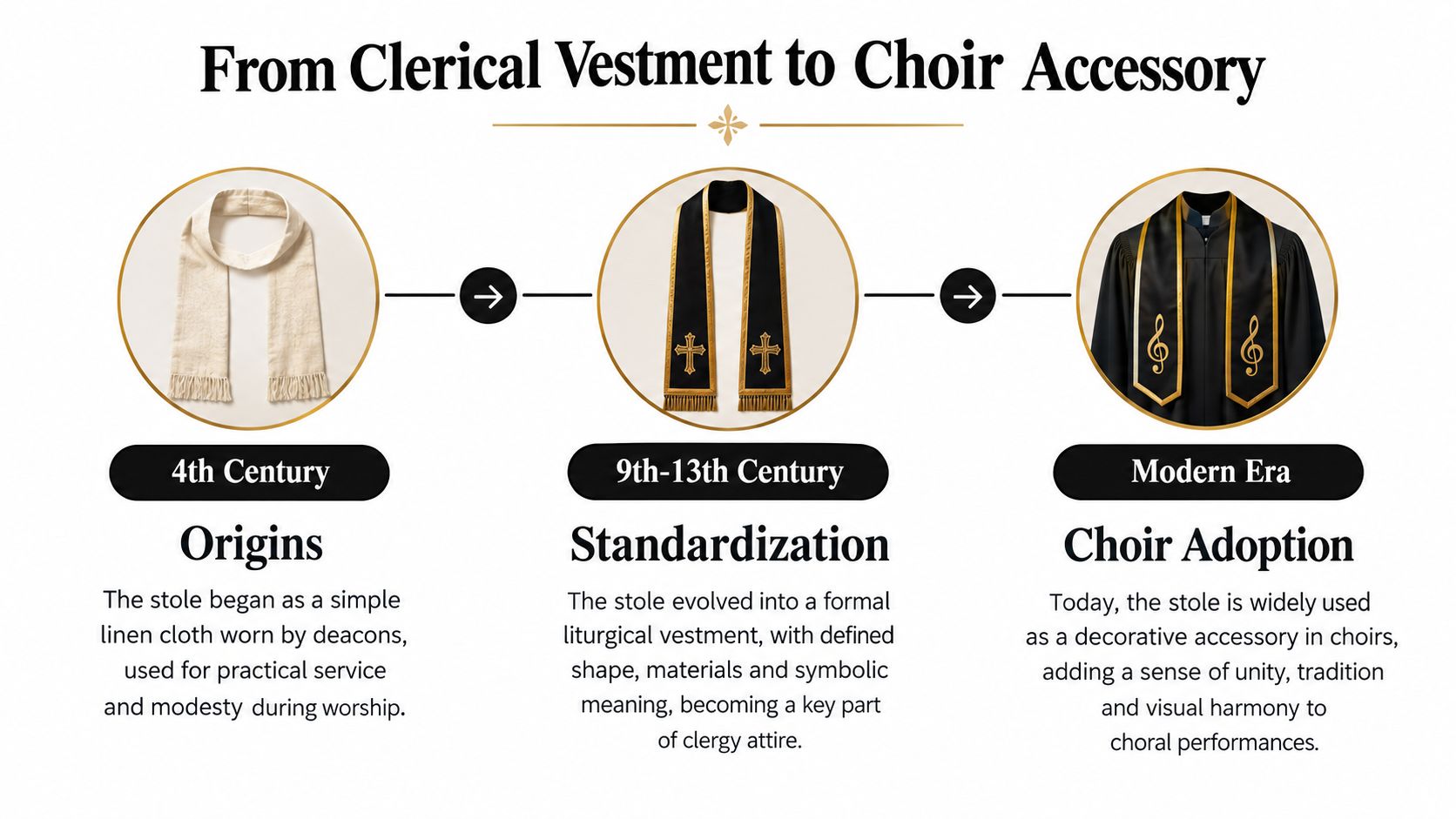
Encyclopaedia Britannica traces the stole's evolution from the draped ancient pallium to a scarf-like form by the 4th century, with the conventions recognizable today established between the 9th and 13th centuries. That makes the standardized Christian vestment more than 1,000 years old, while modern choir dress developed alongside, but not identically to, clerical dress. A historical overview of choir robes helps connect those traditions to contemporary ensemble clothing.
Placement communicates office
Traditional placement isn't a matter of styling preference. Deacons wear the stole from the left shoulder diagonally across the body to the right hip. Priests and bishops wear it around the back of the neck, with both ends falling down the front. Anglican guidance similarly treats the stole as a scarf-like emblem of clergy office, normally worn over the alb for Holy Eucharist. A summary of vestment practice outlines these placement distinctions.
That's why a choir director should avoid presenting a choir accessory as though it automatically carries clerical authority. A choir may wear a decorative stole around the neck for unity, while a deacon's diagonal arrangement remains an office-specific sign. The garments may resemble each other, but their meanings aren't interchangeable.
Check local custom before standardizing
Anglican practice demonstrates how sharply local expectations can differ. Some Church of England discussions treat the stole as a sacramental vestment, while choir members and servers may wear cassocks, cottas, or related choir dress without wearing a stole. The Church Service Society discussion of stole use is useful background for directors working in traditions where vestment boundaries matter.
Ask the priest, pastor, diocesan office, or worship committee three questions before ordering:
- Is a stole permitted for choir members in worship?
- Should the choir accessory follow official liturgical colors?
- Should embroidered crosses or other clerical symbols be reserved for ordained ministers?
A church school choir, community choir, or festival ensemble may have wider latitude. A parish choir serving in a stricter tradition may need to use choir robes without stoles, or reserve stole-like garments for particular services. The supplier can provide the construction, but the church's tradition determines whether the garment is appropriate.
Choosing Fabric, Weight, and Finish
Fabric selection is a maintenance decision disguised as a design decision. The stole must hold its color, hang correctly over the robe, tolerate the choir's cleaning process, and remain comfortable under stage or sanctuary lighting. A fabric that looks impressive for one concert can become a poor purchase if it wrinkles, pills, sheds surface dye, or requires care your volunteers won't follow.
Start by comparing the actual wardrobe environment. Polyester generally offers easy care and useful wrinkle resistance. Satin creates a brighter, more reflective finish, but it demands greater attention to snagging, heat, and light. Polyester-cotton blends can balance hand feel and maintenance. Cotton can feel comfortable, but moisture retention, wrinkling, stain exposure, and drying requirements complicate the natural-fiber choice.
A guide to shirt material types gives useful background on how fiber and construction affect apparel performance. Choir buyers should apply that thinking to the finished stole, not just the fiber label. Trim, embroidery, surface texture, and lining can change how the garment behaves.
Choir Stole Fabric Comparison
| Fabric | Wrinkle Resistance | Color Retention | Laundering | Best For |
|---|---|---|---|---|
| Polyester | Strong | Usually dependable when properly dyed and tested | Gentle machine washing may be suitable, subject to the care label | Frequent services, youth programs, and shared wardrobes |
| Satin | Moderate to low | Can look vivid, but surface finish needs careful handling | Cool hand washing or professional care may be appropriate | Easter, Christmas, concerts, and ceremonial use |
| Polyester-cotton blend | Moderate | Depends on the blend and dye process | Often easier than pure cotton, but follow the label | Choirs balancing comfort with practical maintenance |
| Cotton | Lower | Can be affected by laundering and friction | Requires careful washing and drying to limit shrinkage and wrinkles | Programs prioritizing natural hand feel and manageable cleaning |
| Recycled polyester | Often strong | Depends on construction and dye quality | Follow the supplier's instructions | Buyers with documented sustainability goals and regular use |
The 75% of respondents interested in sustainable clothing, 59% willing to pay more for natural fibers, and 67% associating cotton with comfort in global consumer research published in 2025 are useful signals about buyer preference, not proof that cotton is automatically the right choir fabric. The reported consumer research doesn't eliminate the need to evaluate wear frequency, laundering, repairability, storage, and replacement needs.
Choose finish by viewing conditions
Matte polyester is the safer default for a choir that performs regularly. It photographs cleanly, avoids harsh reflections, and usually supports a disciplined, understated appearance. Satin has a place, especially for major celebrations, but it should be tested under the actual lighting before a group order.
Use a lighter stole for children, singers with sensory sensitivities, and anyone wearing a robe in a warm space. Avoid unnecessary bulk at the neck. The most durable construction is the one your choir can wash, dry, store, and issue consistently.
For fabric sourcing beyond finished garments, keep religious fabric by the yard in your supplier research file. It can help when you need to coordinate repairs, sample trims, or future garment work with an established fabric family.
Liturgical Colors and Seasonal Planning
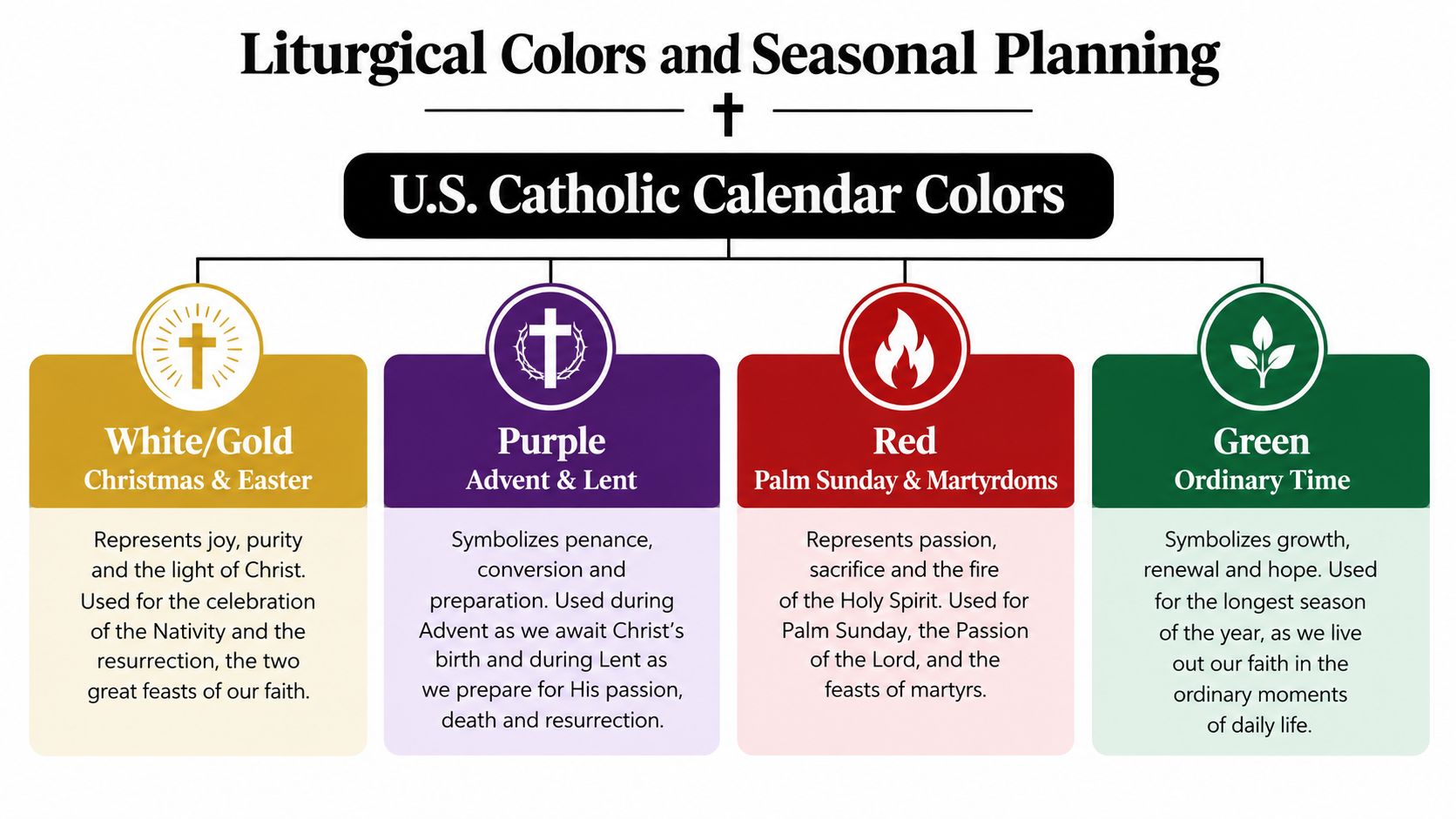
Color planning should follow the church calendar, not the impulse to order one attractive shade and use it for everything. In Roman Catholic worship, the color corresponds to the day's principal celebration. That means a choir using liturgical choir robe stoles needs a reorder plan that respects the calendar and keeps replacement pieces visually consistent.
The U.S. Conference of Catholic Bishops identifies green with Ordinary Time, white with Christmas and Easter and celebrations of Christ other than his Passion, red with Palm Sunday, Good Friday, Pentecost, the Passion, apostles, evangelists, and martyrs, and violet with Advent, Lent, and Masses for the Dead. The USCCB guide to liturgical colors also recognizes rose for selected Sundays, black for Masses for the Dead, and gold or silver for more solemn occasions in the United States.
Build the order around service use
Start with the services your choir sings. Don't assume every color deserves equal stock. Green may support a long stretch of ordinary services, while white may serve multiple major celebrations. Violet and red need to be available at the right times, but the quantity should reflect your choir's attendance and rotation.
Create a simple inventory record with:
- Color name and approved sample: Use the supplier's shade name plus your own retained swatch.
- Fabric and finish: Record whether the stole is matte, satin, blended, or another construction.
- Trim and embroidery: Note thread color, fringe, tip shape, and placement.
- Size distribution: Keep adult, youth, tall, and plus-size quantities separate.
- Service assignment: Mark which colors belong to which season or occasion.
- Replacement status: Record stains, fading, missing pieces, and damaged closures.
The same color name can vary substantially between dye lots and fabric constructions. Approve a physical sample before a bulk order, then retain it in the choir closet for future replenishment. This is especially important for dark red, purple, navy, and black, where fading and color transfer are easy to notice against white robes.
Make colorfastness part of the specification
Ask for evidence relevant to the finished stole, not only the base cloth. Common methods include AATCC 61 or ISO 105-C06 for laundering, AATCC 8 or ISO 105-X12 for rubbing, and AATCC 16.3 or ISO 105-B02 for light exposure. Results commonly use a grey scale from 1, indicating severe change or staining, to 5, indicating no perceptible change.
For choir wear, I'd set a practical floor of 4 or 5 for the tests most relevant to your use, especially laundering and rubbing. That recommendation is a purchasing standard, not a universal legal requirement. It protects the white surplice, collar, and robe from unstable surface dye during repeated use.
Use the choir stoles color guide as a planning reference, then verify your own church's calendar and local custom before placing the seasonal order.
Sizing, Fit, and Accessible Wear
A stole that fits a standing adult may fail completely on a seated singer, a child, or someone with limited shoulder mobility. The accessory can twist toward one side, drag near the feet, catch on a chair, or become difficult to put on without assistance. Those problems are visible from the audience, and they're frustrating for the singer.
Measure with the actual choir robe whenever possible. Check the stole while the singer is standing and seated, then observe the garment during ordinary movement. The ends should remain clear of steps and wheels, and the neckline should lie flat without pulling the robe forward.

Use an adaptable fitting protocol
A group fitting should record more than height. Include:
- Wearer position: Measure standing and seated where both forms of performance are possible.
- Robe neckline: Confirm where the stole will rest over the actual garment.
- Desired endpoint: Choose a consistent visual point that doesn't interfere with steps or mobility equipment.
- Shoulder movement: Ask the singer to turn, raise the arms, and sit.
- Closure preference: Identify whether a head-over style creates difficulty.
- Length category: Assign fixed, adjustable, youth, tall, or plus-size options as needed.
A one-standard-size policy may simplify the purchase, but it often produces less visual uniformity. A properly proportioned stole sits at a similar visual level across the ensemble. An oversized stole on a small singer and a short stole on a tall singer create more distraction than a thoughtful range of lengths.
A practical industry recommendation favors front zippers, snaps, or hook-and-loop fasteners over head-over garments for older people and users with mobility concerns, while also emphasizing tall and plus-size options and accurate measurements. The accessibility-focused apparel guidance supports treating adaptable design as part of uniformity, not as a separate comfort upgrade.
Test the garment on the risers
Try the stole during a real rehearsal. Check whether it shifts when singers turn pages, whether the ends catch on chair backs, and whether the fabric becomes uncomfortable under warm lighting. For children, pay particular attention to excess length and dangling trim.
This fitting video can help volunteers understand how to assist with positioning and adjustment:
The best result is a choir that looks consistent because each singer's garment works with their body and robe. Accessibility and visual discipline reinforce each other.
Customization, Embroidery, and Bulk Ordering
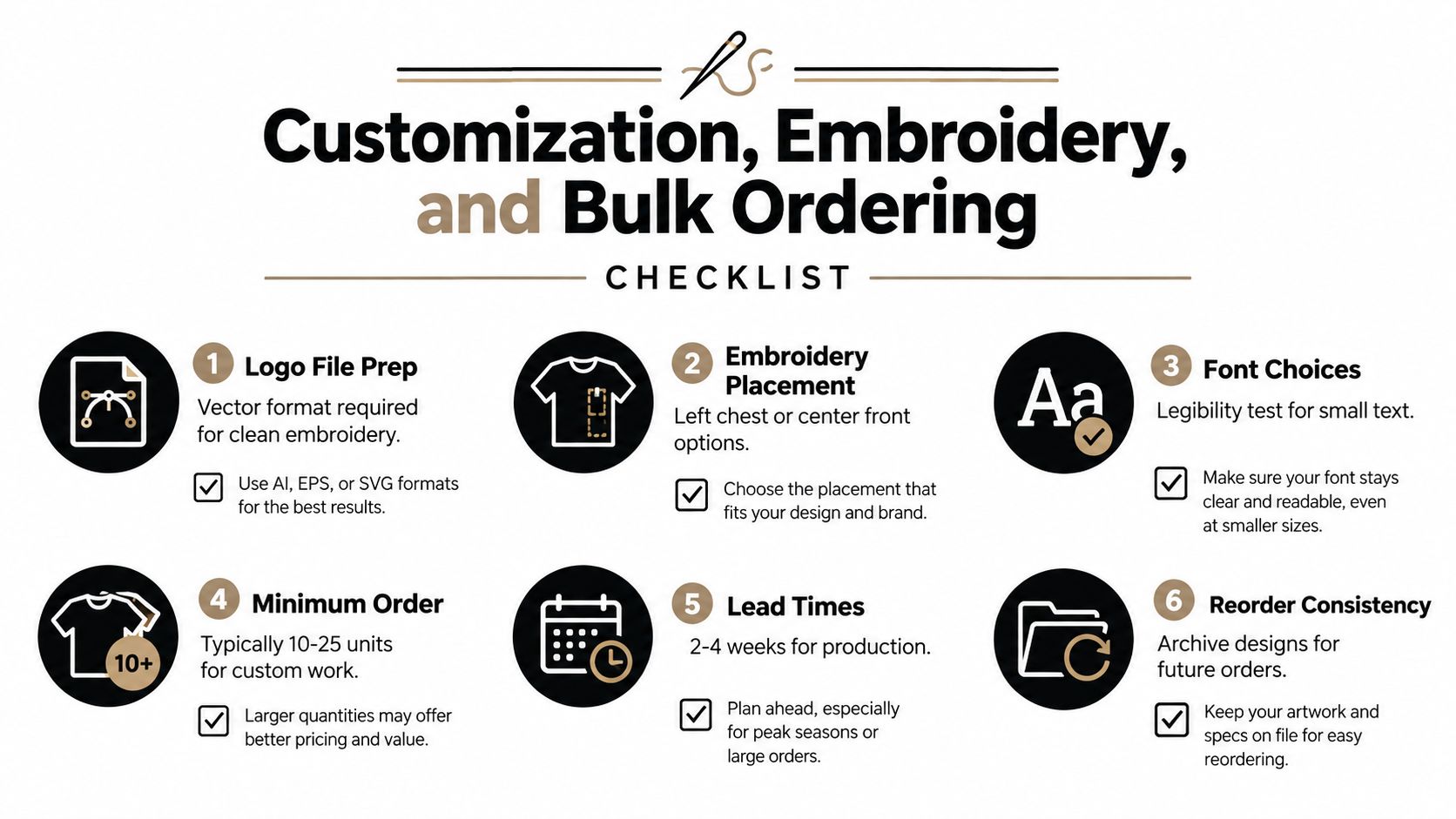
Custom embroidery can turn an ordinary stole into a durable symbol of a church, school, or choir. It can also make a bulk order harder to correct. A small error in logo proportion, thread contrast, placement, or spelling gets repeated across the entire batch, so the approval process matters more than the decoration itself.
Start with a placement diagram. Specify whether the emblem sits near the lower front, on one side, at the center, or on both ends. Then document the artwork file, finished dimensions, thread colors, font, and acceptable spacing. Small text must remain legible from the audience, not merely readable on a supplier's proof.
Approve the physical sample
A digital proof confirms artwork placement, but it doesn't show how the thread behaves on the chosen fabric or how the color looks beside the robe. Approve a physical sample before placing the bulk order, and retain that sample or a reference swatch for future replacements. The same color name can vary between dye lots, so the archived sample is part of your purchasing record, not a souvenir.
Your approval file should include:
- Artwork: The final logo or symbol, with the approved file version.
- Placement: A diagram showing location and orientation.
- Thread: Color references and finish.
- Construction: Fabric, lining, trim, tip style, and closure.
- Sizing: Adult, youth, tall, and plus-size quantities.
- Reorder note: Instructions requiring the same approved construction.
The custom choir robes with logo resource is relevant when you're comparing embroidery options, artwork preparation, and branded garment specifications.
Plan for replacements before you need them
A choir rarely loses every stole at once. Instead, two pieces disappear, one gets stained, and another no longer matches after a later order. Your supplier file should therefore record the original fabric, dye reference, embroidery design, and size distribution.
Don't rely on memory or a product page that may change. Keep the approved sample with the treasurer's purchasing documents, and photograph the front and reverse of the garment. If the choir has seasonal colors, record each color separately rather than assuming a supplier's “red” or “purple” will remain identical.
Bulk purchasing works best when you consolidate predictable needs and leave room for accessible sizes and replacements. A lower unit price isn't a saving if the last-minute replacement arrives in a visibly different fabric.
Flammability, Safety, and Children's Programs
Children's choir stoles deserve a written safety specification. Fiber content alone doesn't tell you how a finished stole will ignite or spread flame. Decorative pile, embroidery, fringe, metallic trim, and backing can alter the behavior of the garment compared with the base textile.
Under U.S. 16 CFR §1610, clothing textiles fall into three flammability classes. Class 1 materials have normal flammability and are acceptable for apparel. Class 2 raised-surface fabrics show intermediate flammability and require caution. Class 3 materials are dangerously flammable and must not be used in apparel. The U.S. Consumer Product Safety Commission's clothing guidance explains the classification.
Put the finished construction on record
For a youth or children's program, ask the supplier to identify:
- Fiber composition: List every primary textile.
- Surface construction: Note pile, raised texture, satin finish, or backing.
- Applied trim: Identify fringe, embroidery, metallic elements, and decorative edges.
- Test documentation: Request apparel-flammability evidence for the finished construction where applicable.
- Care instructions: Record washing, drying, pressing, and storage requirements.
- Replacement control: Require approved construction to remain consistent in future orders.
The CPSC also distinguishes children's sleepwear requirements, including self-extinguishing behavior after removal from a small ignition source. Ordinary choir stoles aren't automatically sleepwear, so don't apply sleepwear rules without checking the garment category. The practical conclusion remains clear: choose low-flammability apparel materials and keep stoles away from candles, stage flames, heaters, and electrical lighting.
Treat trim as part of the safety review
A plain base cloth may be suitable while a decorative addition creates a new concern. Inspect the finished item, not just a swatch of the main fabric. Check that fringe doesn't hang near flames or wheels, that embroidery doesn't create rough edges, and that closures don't loosen during movement.
Give volunteers a short handling policy. Stoles should be issued only after the singer is away from open flames and stored away from heaters between services. For children, adult supervision during dressing and removal reduces both garment damage and avoidable hazards.
Care, Storage, and Replacement Planning
Read the care label before washing, then use the least aggressive process that removes ordinary soil. For most washable synthetics, cool water, mild detergent, a gentle cycle, and air drying are sensible defaults. Satin and heavily embroidered stoles may need hand washing or professional care.
Avoid high heat, direct sunlight, and harsh pressing. Hang stoles with enough space to prevent deep creases, or fold them flat with embroidered areas protected from crushing. Store dark colors separately if the supplier warns about transfer, and keep the approved sample with the inventory record.
Inspect each stole after the performance season. Look for fading, crocking, loose trim, distorted closures, pulled embroidery, and changes in length. Replace garments according to actual wear rather than an arbitrary schedule. A stole used constantly will need attention much sooner than one reserved for major celebrations.
Before reordering, verify the approved swatch, construction, measurements, accessibility needs, and embroidery file. ChoirBuy offers choir stoles, children's options, customization, sizing resources, and bulk-order support that can help directors manage that specification from sample through replacement. Visit ChoirBuy to compare options and begin with the fabric, color, and fitting information your ensemble needs.