

The most popular advice on choir hats is also the most likely to cause trouble: buy a complete matching set for everyone, in the same style and color, and wear it for every service. That sounds tidy. In practice, it's often wrong.
A hat that works for an adult concert choir can look like clergy dress in a liturgy. A cap that's fine for a procession may need to come off for prayer or Communion. A stiff board that photographs beautifully can leave a child hot, distracted, and unable to see the conductor clearly.
Start from a different rule. Match the hat to denomination, age, and local custom first, and to the robe second. Sometimes the right answer is a soft tam. Sometimes it's a mortarboard that's carried more than worn. Sometimes it's no hat at all.
Choir Hat Types Directors Actually Order
Choir hats aren't one cap with several nicknames. They're a family of garments that grew out of schools, cathedrals, academic dress, and regional costume. Buying the wrong family member creates problems no color match can fix.
Choir Hat Styles and Where They Belong
| Style | Construction | Best setting | Handling note |
|---|---|---|---|
| Mortarboard or college cap | Flat square board, often stiffened, soft inner band | School, collegiate, and formal concert dress | Often carried; some schools remove it in rehearsal |
| Tam or velvet tam | Soft square or round crown, fabric, optional tassel | Adult church and community choirs | Worn for procession and performance when local custom allows |
| Biretta | Taller cap with raised ridges from a vertical build | Clergy or a tradition that already specifies it | Easy to confuse with ordained dress; not a default choir piece |
| Canterbury cap | Low, soft, horizontal square | Anglican academic or cathedral dress | Ceremonial; confirm with the rector or director of music |
| Peaked school cap | Peaked crown from historic school uniform | Older British cathedral-chorister dress | Largely phased out; do not assume every youth choir needs one |
| Sailor cap | Soft sailor-style crown | Historic children's or regional costume choirs | Use only when the ensemble costume already includes it |
Read the table as a buying choice, not a dictionary. A mortarboard or college cap gives you a flat, formal silhouette, but singers may carry it through much of a service. A tam is softer, lighter, and easier for adult singers to wear for a full performance. A biretta is the risky row. Its height and ridges read as clergy dress from the congregation's seats, so don't order it to make a lay choir look more formal.
History explains why these styles don't collapse into a single standard. The Historical Clothing site's account of English cathedral choirs reports that everyday uniforms for British cathedral choirs commonly included caps, blazers, ties, short trousers, and knee socks because many choristers were pupils of associated public schools, and that choirs have increasingly abandoned caps as boys now mostly wear long trousers.
What the Old Uniforms Tell a Modern Buyer
That same history separates school identity from choir identity. British cathedral choirs often wore peaked caps as part of a school uniform rather than a distinct choir costume, while some German and other choirs in sailor suits used sailor caps. Mortarboards were still worn in England in the early 20th century but were gradually phased out after World War I, which lasted from 1914 to 1918, and survive only at a few choir schools.
So don't copy a photograph without asking what the cap meant in it. Was it academic dress, a school uniform, or a costume the ensemble already wore? Your answer determines whether a modern version belongs on your order.
Pick the row that matches the singers' age and setting, then confirm whether the hat stays on, comes off at Communion, or stays in the robing room. If you're still deciding between concert dress and service dress, our guide to choir concert attire for formal performances helps you separate a performance look from liturgical vesture before you spend anything.
When a Hat Belongs in Worship
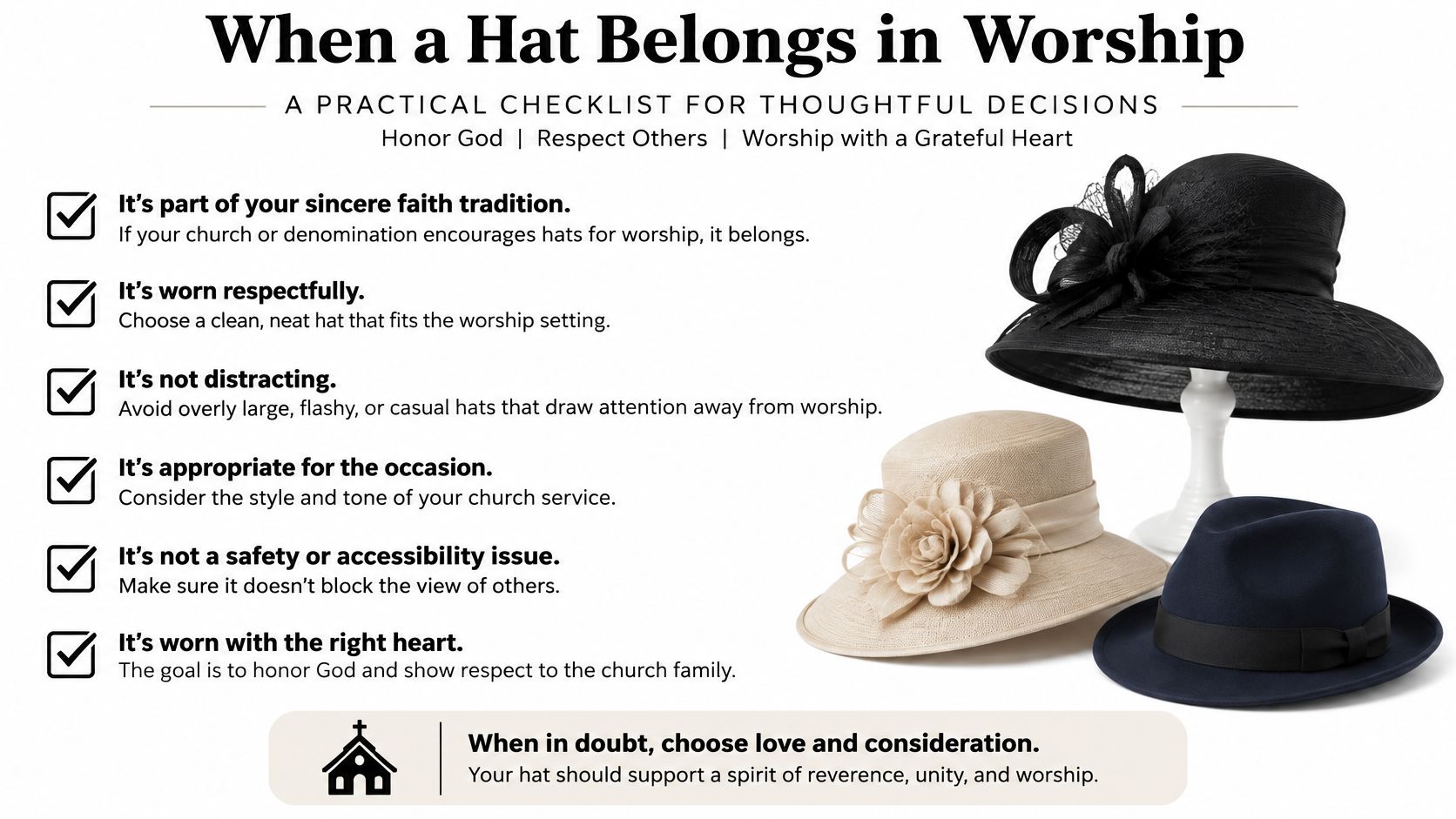
There's no single rule that settles this for every church. The Guild of Church Musicians guidance on running a choir states that there is no canon law governing what choir robes may or may not look like, while practice varies widely across traditions and schools.
That variation is the point. Anglican and collegiate settings may keep hoods and historic academic dress as part of established choir dress. Other school choirs explicitly require singers to remove hats and hoods during rehearsals. Neither approach proves the other wrong. They're governed by different institutions.
In Coptic Orthodox practice, female choir members may wear head coverings as part of an appropriate prayer uniform. The same approach warns that a choir uniform shouldn't resemble clergy or deacons' liturgical garments. That distinction matters for any tradition. A head covering chosen for modesty or custom is not the same purchasing decision as a tall cap chosen to look ceremonial.
Questions to Take to Your Rector, Priest, or Pastor
Don't ask for a vague yes or no on hats. Ask questions that produce a usable instruction for the robing room.
- When is it worn: Only in procession, throughout the service, or not during worship at all?
- When does it come off: For Communion, prayer, a benediction, or another named moment?
- What does it resemble: Could the congregation read it as a biretta, hood, or other ordained garment?
- Who wears it: Adults only, or children too, and is a child wearing it for a full service or only for a photograph?
- What does it match: A cassock, robe, or stole that's already approved, rather than a new color introduced by the hat?
A fuller uniform is not automatically a more appropriate one. Visual conformity can conflict with theological symbolism, local custom, or what's reasonable to expect of children.
Separate settings make the decision easier. At a concert, pageant, or outdoor carol service, a tam or mortarboard functions as costume or concert dress. In a liturgy, it's subject to the service itself, and it may need to come off at named moments even if it was approved for the entrance.
Get that approval in writing before you order in bulk. Our overview of appropriate worship attire for church settings gives directors a starting point for the conversation, but your own rector, priest, pastor, or diocesan authority makes the final call for your congregation.
How Square Caps and Birettas Are Built

Two square caps can look alike and still follow different construction principles. One lies low and flat; another rises with visible ridges. The difference comes from how each style shapes and supports the crown.
The Ritual Notes history of the biretta explains that in the 14th century, cap makers changed the earlier pileus by sewing four fabric sections together instead of seven or eight. The four-panel construction formed a square, with seams meeting in a cross-shaped pattern.
Over time, the shape developed in different directions. English styles emphasized a horizontal crown and later used cardboard to stiffen the cap, leading toward the academic mortarboard. Continental styles emphasized vertical height, producing the biretta. The modern Canterbury cap belongs to the low, horizontal family.
The Specification You Send a Supplier
A useful order specifies three construction choices, whether or not you use technical terms.
- Panel layout: Four panels create the square form and cross-shaped seams. Ask how the inside seams are finished, since rough edges can press against the head during a service.
- Orientation: A horizontal crown reads as a mortarboard or Canterbury-style cap. A taller, vertical crown reads as a biretta. The names describe different shapes.
- Stiffener: The crown may use a board, light interlining, or no stiffening. That choice affects weight, warmth, and how well the cap holds its form when carried.
Material should suit the construction. A soft matte poly-blend or felt crown is light and gives slightly against the head. A velvet tam has a formal appearance, though velvet can mark or crush if handled roughly. A rigid shell or board keeps a consistent silhouette across a choir and holds its shape when carried, but can feel warmer and press more on the forehead.
Before approving a sample, check that the seams are secure, the lining feels smooth, and the crown has some ventilation. If there is a tassel, ask whether it can be removed for cleaning. Gently fold and release a soft tam to see whether it recovers its shape; check a stiff cap for corners that flex or creak.
Choose the construction for how the cap will be worn and handled. A cap worn briefly and carried for much of an event may need different support from one worn throughout a concert.
Sizing Fit and a Clear Sightline
A cap that shifts during a bow or presses through a long anthem distracts its wearer. Start with fit, then check whether the singer can see the conductor clearly.
A Measuring Method That Takes Two Minutes
- Wrap a soft tape just above the ears and across the forehead, where a cap band sits.
- Measure with the singer's usual hairstyle. Thick braids, a bun, or a head covering underneath can change the fit.
- Record the measurement in inches beside each singer's name. Measurements are more useful than guessed labels such as small, medium, or large.
- Try a sample on singers with different head sizes. ChoirBuy's standard caps are one size fits all with elastic. Check the fit before ordering for the whole group.
For youth and children's choirs, choose headwear sized for the singers rather than relying on an adult crown. An oversized square cap can tip forward and obstruct the face. If the cap will be carried as well as worn, balance a stable outer shape with a comfortable fit against the head.

Why Brim Geometry Affects Sound and Sight
A choir hat usually leaves the mouth uncovered, so it is unlikely to affect singing in the same way as a mask. Still, research on singing masks illustrates how material near the face can affect sound. The Acta Acustica study of singing masks found that woven fabric produced attenuation of up to approximately 5 dB, while transparent plastic shields attenuated frequencies above 2.5 kHz by as much as 30 dB, with frequency-dependent effects through 16 kHz.
For a choir hat, prioritize a clear opening around the face and avoid a stiff brim projecting in front of it. Dense panels or heavy ornaments near the temples may also distract singers or obstruct their view. Soft or porous trim where the cap meets the sides of the head keeps the design less intrusive.
Run a two-person rehearsal check: the singer can see the conductor's ictus without tilting the head back, and the cap stays in place through a bow, a page turn, and sitting down.
A robe's sizing and a hat's fit are separate decisions, so record each singer's robe size and head measurement independently. The Deluxe Maroon Choir Robe is made from maroon 100% poly-blend matte fabric, with a lightweight construction, fluting along the shoulders and yoke, traditional full sleeves, and pressed pleated detailing at the front and back. Check its product page for the available size options before ordering.
Colors That Match Robes and Stoles
Match the cap to the largest color on the robe, not to every piping line, button, or embroidered detail. From the back row, the congregation reads one dominant color per singer. A hat in a minor accent color looks like a mistake, however exact the dye match is up close.
Cap Color Beside Robe and Season
| Occasion | Usual robe color | Cap guidance |
|---|---|---|
| Christmas, Easter, and major feasts | White or gold | Match the robe; do not add a dark tam unless the gown is dark |
| Pentecost, martyrs, confirmation | Red | Use a red cap only when the robe is red |
| Advent and Lent | Purple or violet | Match purple only if the choir already vests in it |
| Ordinary Time | Green | Green cap only with green robes; otherwise stay neutral |
| Funerals and memorials | Black or white, by parish custom | Follow the parish color; do not invent a third hue |
| Concert, school, or pageant | Navy, royal blue, maroon, black, emerald, silver | Match the largest robe panel, not the calendar |
Treat the table as custom, not law. Many parishes never change robe color with the season at all, and a choir that vests in black or navy year-round shouldn't buy purple tams for Lent just because the altar frontal changed. White or gold belongs with feast robes for Christmas and Easter. Red belongs at Pentecost or confirmation only when the robes are already red. Purple or violet is vesture for Advent and Lent, not a default tam color for solemn music.
Funerals need the most restraint. Parishes follow their own custom, often black or white, and the cap shouldn't introduce a third color into a service where families notice every detail. Ask the officiant rather than assuming your concert black is automatically right.
For concerts, pageants, and school choirs, you're working with ensemble colors rather than calendar colors. Navy, royal blue, maroon, black, emerald, and silver identify the group. On a two-tone or velvet-panel robe, take the cap color from the bigger panel and let the stole carry the contrast. Add piping or a contrasting tassel only when the stole already uses that second color.
One ensemble, one dominant color, seen from the back row.
Before you approve a custom dye lot, photograph the sample cap against the actual robe in daylight, not under robing room fluorescents. Our choir robes color guide for matching ensembles walks through robe color choices in more detail, and a physical swatch beside your existing gowns settles arguments that a screen can't.
Care Storage and Bulk Ordering Checks
A choir hat can be the wrong purchase even when it matches the robe: local custom, age, and how the cap is stored all matter. Check those needs before ordering. A firm mortarboard and a soft tam need different storage, so follow the construction guidance above rather than treating every style alike.
A Numbered Checklist for Storage and Ordering
- Store mortarboards flat or hung to help prevent warping. Keep heavy robes off stiffened caps.
- Lightly stuff soft tams with tissue. Keep removable tassels in a labeled bag and red caps separate from white ones to avoid color transfer.
- Spot-clean the fabric and let the cap dry fully before returning it to a closed box. For general background on water-based and dry-cleaning methods, see garment cleaning choices for Toronto households.
- Count current singers, then add spares for guests, new members, and growth in a youth section.
- Separate adult, youth, and children's orders so each group can be fitted appropriately.
- Order a sample in the intended robe color and check it on singers before placing the full order.
ChoirBuy offers choir caps and tams, including traditional mortarboards and velvet tams, in custom colors. Standard caps are one size fits all with elastic, so try a sample on the intended singers before ordering for a mixed group. The Red Choir Cap lists at $24.95, with a quantity discount bringing it as low as $19.96.
Bulk Ordering
For an ensemble outfit, compare the cap with the robe and stole before settling the order. ChoirBuy's guide to church choir outfits and coordinated ensembles covers planning these pieces together. A sample cap beside the actual robe can help confirm the combination; product examples include the Shiny Silver Choir Robe and Shiny Light Blue Choir Robe.
Allow time for custom colors or coordinated orders before a major service or concert. Ask about the current ordering window, then check the delivered caps for quantity, color, and secure tassels. A brief written note on who wears the hat and when it is worn can help keep the choir's practice consistent.
Choir Hat FAQs for Directors and Buyers
Should a Choir Keep Hats on During Communion
Ask the worship leader to specify whether hats are worn during communion and when they should be removed. A general approval to wear hats for an entrance may not cover the rest of the service.
Can a Youth Choir Wear a Biretta Style Cap
Use a biretta only when it is already part of the choir's tradition. Its distinctive shape can carry associations beyond ordinary choir dress, so a different cap may suit a youth group better.
How Many Spares Should I Order
Allow for guests, new members, and expected growth instead of ordering to the exact head count. For a youth choir, consider whether membership may change between the start of the season and a later performance.
What if a Concert Uses Hats but a Service Does Not
Set separate expectations for concerts and worship. A hat chosen as part of a concert costume does not automatically belong in a service.
We offer choir caps and tams in traditional mortarboard and velvet styles with custom colors, alongside robes, stoles, and children's choir apparel you can coordinate as one ensemble. Tell us your tradition, your singers' ages, and your robe color, and we'll help you choose a hat that fits the service as well as the singer. Visit ChoirBuy to order a sample cap in your robe color before your next bulk order.