

It's Thursday rehearsal. The anthem is nearly ready, but a dozen singers are restless, the altos drift flat, and the sopranos still can't hold their entry. You repeat the passage, add more piano, and sing their line again. They manage it with help, then lose it when you stop.
The problem is rarely the repertoire alone. Singers may need to hear the interval differently, feel the rhythm away from the page, or practice holding a part without the whole choir around them. Another complete run-through won't necessarily address any of those needs.
Useful youth choir ideas connect an activity to a musical problem and give you a way to hear whether it worked. A clapping game should improve the anthem's pulse. A student-led sectional should produce a more secure entrance. A themed concert should give singers a reason to communicate the text, not just add decorations to the platform.
Before changing the program, choose the immediate need:
- Pitch security: Help singers hear and reproduce relationships between notes.
- Ensemble independence: Teach members to keep their line while listening across the choir.
- Participation: Give hesitant singers manageable ways to contribute.
- Performance readiness: Rehearse entrances, transitions, and audience communication alongside the music.
The rehearsal and performance systems below combine setup, skill practice, and a clear trade-off. Choose what fits your singers, staffing, and calendar rather than adding activities to keep everyone busy.
1. Solfège Hand Signs and Kodály-Inspired Warm-Ups
When a choir can copy a melody but can't reproduce it independently, make pitch relationships visible. Kodály-inspired solfège warm-ups pair sung syllables with hand signs, giving singers a physical reference before they tackle notation.
Keep folders closed initially so singers watch the gesture rather than search the page.
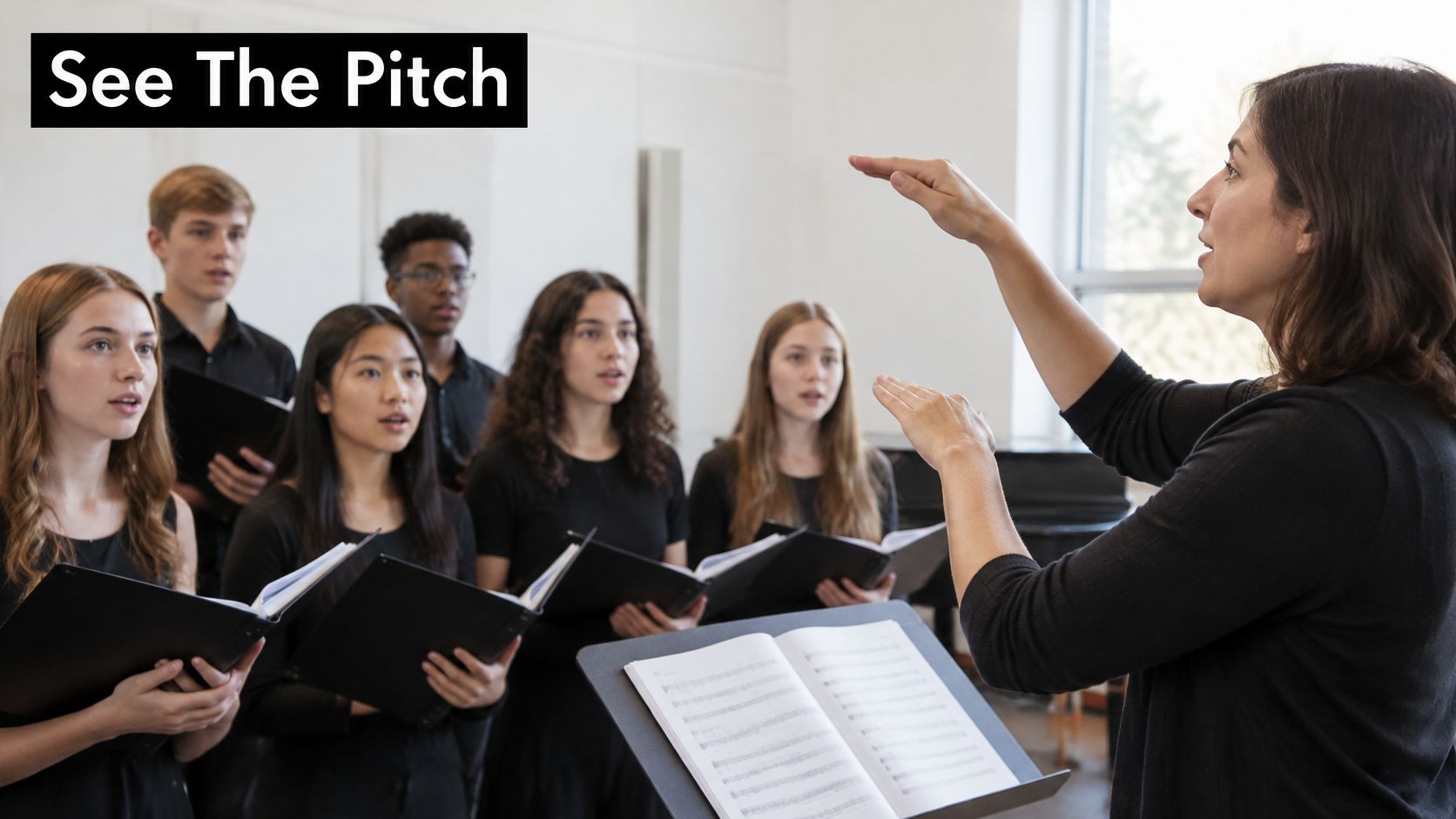
Build the Pattern Around a Problem Passage
Establish a comfortable tonic, then sing so-mi-do with matching hand signs. Ask singers to echo it, show the signs themselves, and repeat without your voice. Keep the tone light and choose a starting pitch that doesn't push changing voices.
Next, borrow an interval from the anthem. If an entry falls from so to mi, practice that movement on solfège, then on the repertoire's vowel, and finally with its text.
- Remove support gradually: Stop singing before you stop showing the signs.
- Test inner hearing: Sign the pattern, then cue the choir to sing it.
- Check transfer: Return to the actual passage without doubling the melody on piano.
For a school choir learning a descending refrain, this sequence separates pitch learning from pronunciation and page-reading. You can hear whether the difficulty lies in the interval or in coordinating everything together.
Practical rule: A warm-up earns its place when singers can use the skill in the music that follows.
The trade-off: Hand signs require teaching, and older beginners may feel self-conscious. Explain their purpose, avoid turning them into a memory contest, and offer smaller or seated gestures where needed. Keep drills brief rather than repeating them after attention has gone.
2. Orff Schulwerk Body Percussion and Movement Games
Put the anthem aside when singers rush through rests or lose the beat during a syncopated phrase. Orff Schulwerk-inspired body percussion lets them practice the rhythmic structure without also managing pitch and lyrics.
Leave enough room for comfortable movement, with a seated version available.
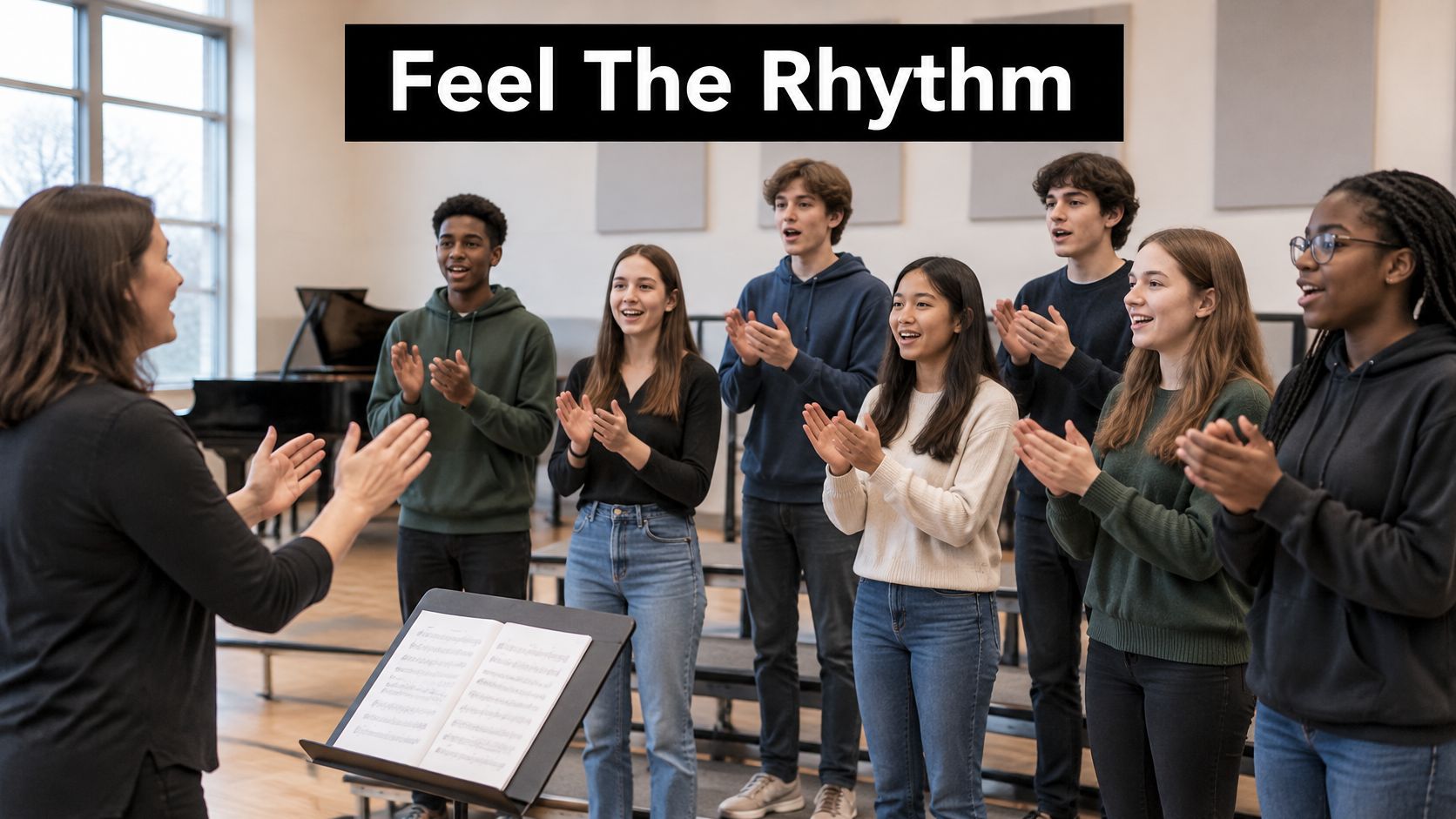
Establish a raised-hand stop signal before anyone starts. Teach a steady thigh-pat pulse, add a contrasting clap pattern, and only then introduce the spoken text. Use a pattern from the concert music so the activity prepares something singers actually need.
Add Layers Without Adding Confusion
For a refrain with an offbeat entrance, let a supporting group maintain the pulse while another speaks the entry. Swap roles before everyone sings. Rotate student pattern leaders, but keep the stop cue with the director until the group can reset reliably.
Teachers building related classroom activities can find music for class time, then connect the listening or movement task to the choir's current rhythmic challenge.
Watch movement activities with a specific question in mind: can singers maintain the pulse when the leader changes?
The trade-off: Noise and excitement can overwhelm the musical task. Replace stamping with fingertip taps when necessary, and don't require snapping or standing from everyone. If movement will remain in performance, rehearse it in concert clothing; this guide to lightweight choir robes addresses attire considerations.
Finish by singing without percussion. If the rhythm collapses, simplify the pattern rather than adding another layer.
3. Virtual Choir Projects for Remote and Hybrid Youth Ensembles
A virtual choir project works best as a carefully bounded recording assignment, not a substitute for every benefit of singing together. Members record separately against a shared guide track, and an editor assembles the submissions into a combined performance.
Use it when travel, illness, or scheduling keeps members apart, or when singers need to hear their own preparation clearly.
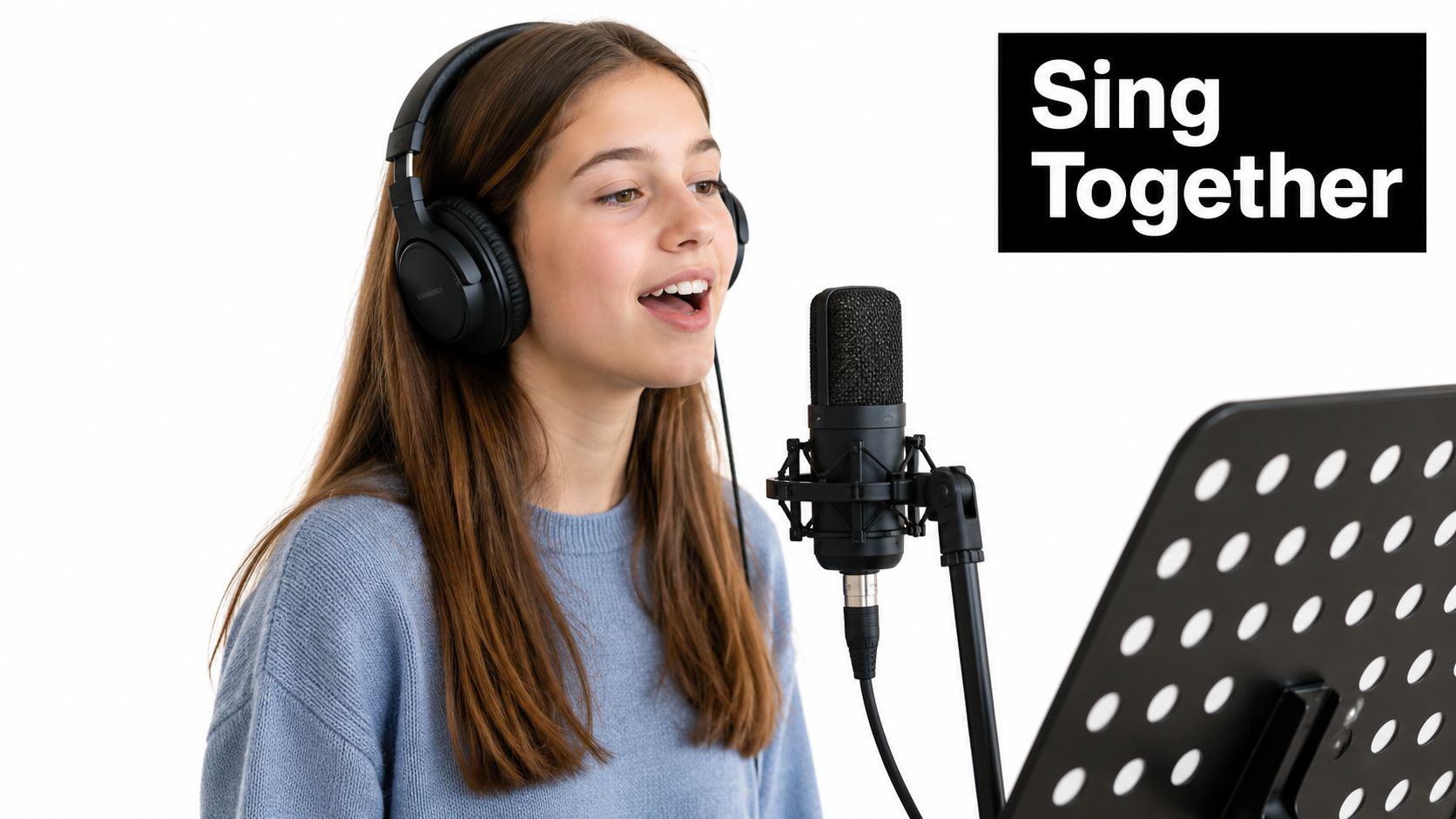
Prepare the Recording System Before Assigning It
Choose a short, secure piece and appoint the editor before collecting files. Create a conductor video with an audible starting cue, a reference accompaniment, and a clear final cutoff. Keep tempo and interpretation identical across every practice resource.
Give families concrete recording directions:
- Use headphones: The guide track shouldn't play into the recording microphone.
- Choose a quiet location: Turn off nearby televisions and avoid noisy ventilation where possible.
- Keep framing consistent: Place the camera at eye level with the singer's face clearly visible.
- Submit a test clip: Check sound, file access, and framing before the complete performance.
A hybrid church choir might prepare a familiar blessing for members who can't attend a seasonal service. Offer an on-site recording opportunity so participation doesn't depend on having suitable equipment or space at home.
The skill focus: Independent preparation, precise consonants, and matching a conductor's gestures without nearby singers.
The trade-off: Editing takes substantial adult time, and isolated recording can make confident ensemble singers anxious. Permit retakes and private feedback. Secure guardian permission, explain where the finished video will appear, use an approved submission channel, and check the music's recording and publication permissions before proceeding.
4. Seasonal and Cultural Themed Concerts with Coordinated Attire
Choose a theme that helps you select and explain music, not one that requires elaborate scenery. Winter light, Easter hope, songs of welcome, or music connected to a particular place can give a youth choir concert a coherent shape.
A church choir might connect an Easter cantata through spoken reflections. A school ensemble might explore songs in different languages, using accurate pronunciation guidance and brief context rather than treating cultures as costumes.
Plan the Musical Arc and the Practical Details Together
Choose the theme early enough to secure music, teach unfamiliar language, and fit clothing without rushing. Balance familiar repertoire with new challenges, and rehearse transitions while singers are still learning the pieces.
- Give each selection a purpose: Identify what it contributes musically or thematically.
- Keep staging simple: Practice entrances, standing positions, and movement routes before adding lighting changes.
- Explain the context: Use concise program notes that credit composers, languages, and traditions accurately.
- Plan inclusive attire: Check comfort, mobility, sensory needs, and family cost before setting requirements.
This choir concert attire guide can support the clothing-planning stage. Record measurements and selected sizes, schedule a fitting, and keep a shared order list rather than relying on families' recollections.
Use the full concert arrangement during a dress rehearsal.
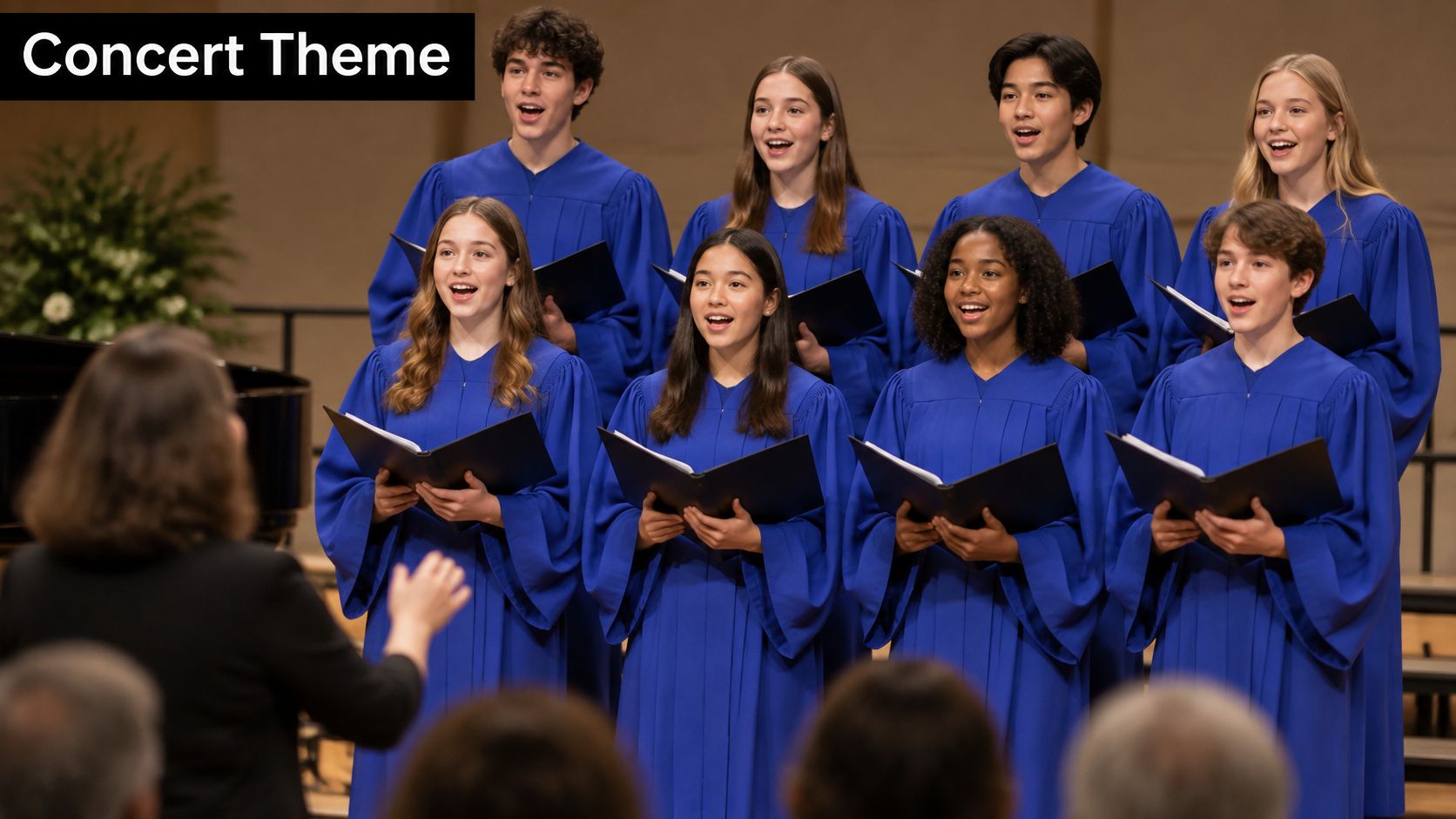
The skill focus: Text communication, stylistic contrast, stage discipline, and sustained performance concentration.
The trade-off: Themes can encourage directors to choose unsuitable music just because the title fits. Reject pieces that exceed the choir's comfortable range or preparation capacity. A clear musical program with simple staging serves singers better than an ambitious concept held together by under-rehearsed transitions.
5. Call-and-Response and Improvisation Games for Rehearsal
A hesitant singer doesn't need an unexpected solo. Start with a response the whole choir can deliver, then offer voluntary ways to make it more individual.
Sing a short phrase on a comfortable interval and ask the choir to echo it. Keep rhythm, pitch, and dynamic predictable until everyone understands the cue. Then change a musical feature and ask singers to identify what changed before responding.
Give Improvisation Useful Boundaries
For a youth choir struggling with phrase endings, sing a question that rises and invite a response that settles toward the tonic. Demonstrate possible answers without presenting them as the only acceptable choices.
Use a simple progression:
- Echo together: Everyone copies the same phrase.
- Choose together: A small group selects between a rising or falling answer.
- Invent voluntarily: Willing singers create a response within the established pitch set.
- Apply immediately: Sing the repertoire phrase with the same attention to direction and release.
Make participation predictable before asking singers to be inventive.
For a community performance, you can adapt this into a rehearsed audience-response refrain. Teach the audience's part clearly and keep the choir's cue unmistakable.
The skill focus: Aural memory, phrasing, responsive listening, and confident musical decision-making.
The trade-off: Open-ended improvisation can favor outgoing singers and leave others watching. Offer partner responses, group answers, or a rhythm-only contribution. Don't mistake reluctance to solo for lack of musicianship.
End with a specific observation rather than general praise: the choir matched the release, maintained the tonal center, or answered without waiting for the piano. That tells singers what to repeat.
6. Rounds, Canons, and Part-Singing Challenges
If singers can manage a melody only while everyone sings it together, a round is a useful bridge into harmony. They already know the material; the new challenge is keeping it while hearing something different.
Begin with a secure unison performance of a familiar round such as Row, Row, Row Your Boat. Check breath points, tuning, and the ending before introducing staggered entries. Familiar words don't guarantee a shared version of the tune.
Separate Entry Practice From Continuous Singing
Divide the choir into groups and point clearly to each entrance. Let the opening group establish its phrase before cueing the next, then stop while the sound is still organized.
For a younger ensemble, place a dependable singer near each group's center rather than isolating beginners at the ends. Use neutral group names instead of assuming voice parts from gender.
- Rehearse the entry alone: Ask each group to hear its starting pitch internally before singing.
- Practice the cutoff: Agree whether everyone finishes together or completes the melody in turn.
- Change positions carefully: Once secure, adjust spacing so singers learn to listen beyond their nearest neighbor.
A festival-bound youth choir can use the same process with a suitable Renaissance or Baroque canon. Prepare pronunciation and musical style before increasing the independence demand.
The skill focus: Maintaining a melodic line, entering confidently, and listening without copying another part.
The trade-off: Repeated rounds can disguise weak technique if singers become louder to defend their melody. Reduce volume, restore the unison version, and check breath and vowels. Add further entries only when the existing texture stays comfortable and in tune.
7. Community Outreach and Service Performances
An outreach performance should suit the people receiving it. A care-home visit, hospital performance, school assembly, and Easter service each require different repertoire, pacing, volume, and procedures.
Ask the host about audience needs before choosing the program. Confirm accessible routes, available seating, keyboard arrangements, sound restrictions, and whether audience participation is appropriate.
Rehearse the Visit, Not Just the Songs
Prepare a compact sequence of familiar music, contrasting selections, and an optional sing-along. Practice spoken introductions and transitions so singers don't wait for whispered directions between pieces.
For a senior-living visit, a student might introduce a familiar seasonal song while the choir resets. For worship, coordinate every musical entrance with the service leader; these Easter church service ideas can help connect the choir's contribution to the wider service.
Before booking: Confirm supervision, transport, consent, accessibility, and the host's photography rules before promising a performance.
The Diocese of Killaloe youth-choir guidance specifies an adult-to-young-person supervision ratio of 1:8 during practices; treat that as a named policy example, not a universal requirement.
Follow your own institution's safeguarding procedures and applicable local requirements for rehearsals and visits. Assign adults to arrival, dismissal, and other supervision duties rather than assuming the conductor can manage everything while directing.
The skill focus: Audience communication, adaptability, dependable transitions, and performing with a service purpose.
The trade-off: Travel and unfamiliar spaces can consume more energy than the singing. Keep the program manageable, coordinate standard concert attire in advance, and allow singers to sit when needed. Don't measure success only by applause; ask whether the host and audience could comfortably engage.
8. Student-Led Rehearsal Roles and Section Leadership
Give a student leader a defined musical job, not a vague instruction to take charge. Leading a warm-up, checking a sectional entrance, or welcoming a new member requires different preparation.
Choose roles according to readiness and interest, then rotate opportunities. The most confident soloist isn't automatically the best peer teacher.
A University of Utah review of seven studies found that every included study reported a positive association between group singing and stronger social cohesion among youth, while noting differences in populations, methods, and measurement. Make that social purpose concrete by teaching leaders how to include others, not merely correct notes.
Give Leaders a Repeatable Teaching Routine
For a sectional on an uncertain harmony, mark the passage and provide a reliable starting pitch. Ask the student leader to demonstrate, invite the group to sing, identify a specific issue, and repeat with a clear adjustment.
- Model useful feedback: Describe an early entrance or unclear vowel rather than labeling a singer as weak.
- Set boundaries: Students can coach music; adults retain responsibility for discipline, safeguarding, and vocal concerns.
- Share responsibility: Pair developing leaders with experienced peers instead of assigning the same members every task.
- Debrief briefly: Ask what improved, what remained difficult, and what support the leader needs.
For an ensemble building these routines into its calendar, this school choir guide offers related program-planning context.
The skill focus: Musical diagnosis, clear communication, preparation, and ensemble ownership.
The trade-off: Student leadership initially takes more director preparation, not less. Listen in, correct inaccurate teaching promptly, and recognize patient explanation as publicly as polished conducting. Leadership should widen participation rather than create a permanent hierarchy.
How the eight youth choir ideas compare on setup, time, and best use
| Item | Equipment Needed | Typical Rehearsal Time | Best For |
|---|---|---|---|
| Solfège Hand Signs and Kodály-Inspired Warm-Ups | Piano or pitch pipe | 5–10 minutes | Building pitch memory and sight-reading, especially for younger singers |
| Orff Schulwerk Body Percussion and Movement Games | No instruments required | Flexible; allow time to teach and layer patterns | Developing rhythm, coordination, and ensemble listening |
| Virtual Choir Projects for Remote and Hybrid Youth Ensembles | Recording device, headphones, guide track, and editing tools | Multiweek project; allow at least 3–4 weeks for submissions | Including remote singers and creating a shareable performance |
| Seasonal and Cultural Themed Concerts with Coordinated Attire | Coordinated attire; optional staging and lighting | Extended preparation; plan the theme at least 3 months ahead | Creating a unified concert experience and engaging community audiences |
| Call-and-Response and Improvisation Games for Rehearsal | No special equipment; voices and clear cues | Short rounds; flexible | Building listening, responsiveness, and confidence |
| Rounds, Canons, and Part-Singing Challenges | No special equipment; optional printed music | Flexible; short warm-up or rehearsal activity | Introducing harmony and developing independent part-singing |
| Community Outreach and Service Performances | Performance materials and coordinated attire | Flexible; prepare a 20–30-minute program | Building confidence, empathy, and community connections |
| Student-Led Rehearsal Roles and Section Leadership | Role guidelines or feedback scripts | Short leadership segments within rehearsals | Developing singer leadership and peer mentoring |
Choosing Your Next Youth Choir Project
Start with a warm-up and a performance idea this season rather than adopting every approach at once. Pair a Kodály-style pitch exercise with a round at the next rehearsal, then plan a themed or outreach performance once singers understand the routines. Keep the first change small enough that you can tell whether it helps.
Choose the activity from the musical difficulty. If singers lose their entry, practice hearing and cueing that entrance rather than adding unrelated games. If they rush the text, move the rhythm into speech and body percussion before returning to melody. If they're reluctant to participate, offer predictable group responses before voluntary individual contributions.
Judge Progress Beyond the Final Concert
Listen for improvement under reduced support. Can singers enter without hearing their line on piano? Can they maintain a rhythm after the percussion stops? Can a student leader explain a correction without embarrassing anyone?
Track participation alongside musical progress. Notice who volunteers, who remains silent, who misses rehearsals, and who needs a different route into an activity. A private conversation may reveal that transport, sensory discomfort, clothing costs, or uncertainty about expectations is preventing participation.
- Keep what transfers: Retain activities that make the repertoire more secure.
- Adapt what excludes: Offer seated movement, accessible practice materials, and flexible ways to contribute.
- Simplify what overloads: Reduce staging, recording demands, or repertoire before asking singers to work harder.
- Repeat what works: Familiar routines let singers spend less attention decoding instructions and more attention making music.
When a themed concert calls for coordinated attire, we offer youth and children's choir robes in sizes for toddlers, kids, and teens, plus bulk pricing and package options for churches and schools outfitting an ensemble. Compare the Shiny Silver Choir Robe and Shiny Light Blue Choir Robe, reviewing their listed finish, construction, and sizing details before ordering. Keep the fitting process connected to the performance plan so singers can sit, move, hold folders, and watch the conductor comfortably.
The strongest youth choir ideas don't require constant novelty. They give singers a clear task, enough support to attempt it, and a recognizable sign of progress. Build that pattern into rehearsal, and the concert becomes a place to use familiar skills rather than a deadline that dictates every decision.
We offer choir robes, custom robes, stoles, and coordinated apparel for school, church, and community ensembles. Visit ChoirBuy to explore youth sizing and group-order options as you plan your choir's next themed concert or outreach performance.