

On Sunday morning, the choir is already in the narthex, half the singers are in pressed black street clothes, two people are still buttoning unfamiliar robes, and somebody forgot their shoes. The music can be ready, but the visual picture feels unsettled, and that unsettled look changes how the room hears the group. Choir gowns solve that problem by giving the ensemble one calm, readable surface, the same way a frame helps a painting hold the eye.
That idea isn't new at all. Choir dress has roots that reach back to ancient visual depictions of group singers, then through medieval and Reformation-era church clothing, and into the standardized robe traditions many choirs use today (history of choir robes). A useful modern planning lens also appears in a broader apparel guide for teams choosing custom garments, the 2026 custom apparel guide, which is a smart reminder that the outfit has to work as a system, not as a single isolated piece.

A good choir look does three jobs at once. It keeps attention on faces and music, it supports comfort while singing, and it gives the director a repeatable standard for ordering, fitting, and replacing garments. The rest of this guide walks through that decision process in plain language, so you can choose a robe, fabric, color, size, and order plan that fits your ensemble instead of fighting it.
Introduction Why Unified Choir Gowns Still Matter
A choir can sing well and still look unsettled if the wardrobe feels pieced together at the last minute. One singer in a glossy robe, another in soft cotton, and a third in a hem that drags the floor sends the eye everywhere except the music. The audience may not name the problem, but it feels it right away.
Visual unity is part of ensemble discipline
Uniform dress gives singers one shared outline, and that matters in worship spaces and on stage. A historical historical account shows how choir clothing became more standardized as ensembles used dress to signal unity and separate themselves from everyday fashion. Church practice also treated choir dress as regulated attire in formal settings, which helped make the look consistent across a group.
The effect is plain. When the room sees one visual field, it listens more easily. Singers also tend to feel like one team, because they step into a common role instead of presenting individual outfits.
Practical rule: if the clothes are competing with the music, the clothes are wrong.
Tradition and usefulness can live together
Some directors worry that a unified gown will feel stiff, but choir dress has always balanced order with function. As noted in the history of choir robes, the robe carries a long tradition of liturgical and ceremonial use, which is part of why it still reads as right in church, school, and formal performance settings.
The buying side matters just as much. Fabric finish changes how light moves across the group, hem height changes how clean the line looks from a distance, and bulk ordering changes the cost per wear for each singer. A good robe works like a stage light, a frame, and a uniform plan at once. A useful modern planning lens also appears in the 2026 custom apparel guide, which is a reminder that the gown should be treated as part of a performance system rather than a one-time costume purchase.
That is the test for choir gowns. They should help the singers look organized, feel comfortable enough to breathe and sing, and give the director a repeatable way to order, fit, and replace garments without losing the group's visual line.
Understanding Choir Gown Types and How They Work Together
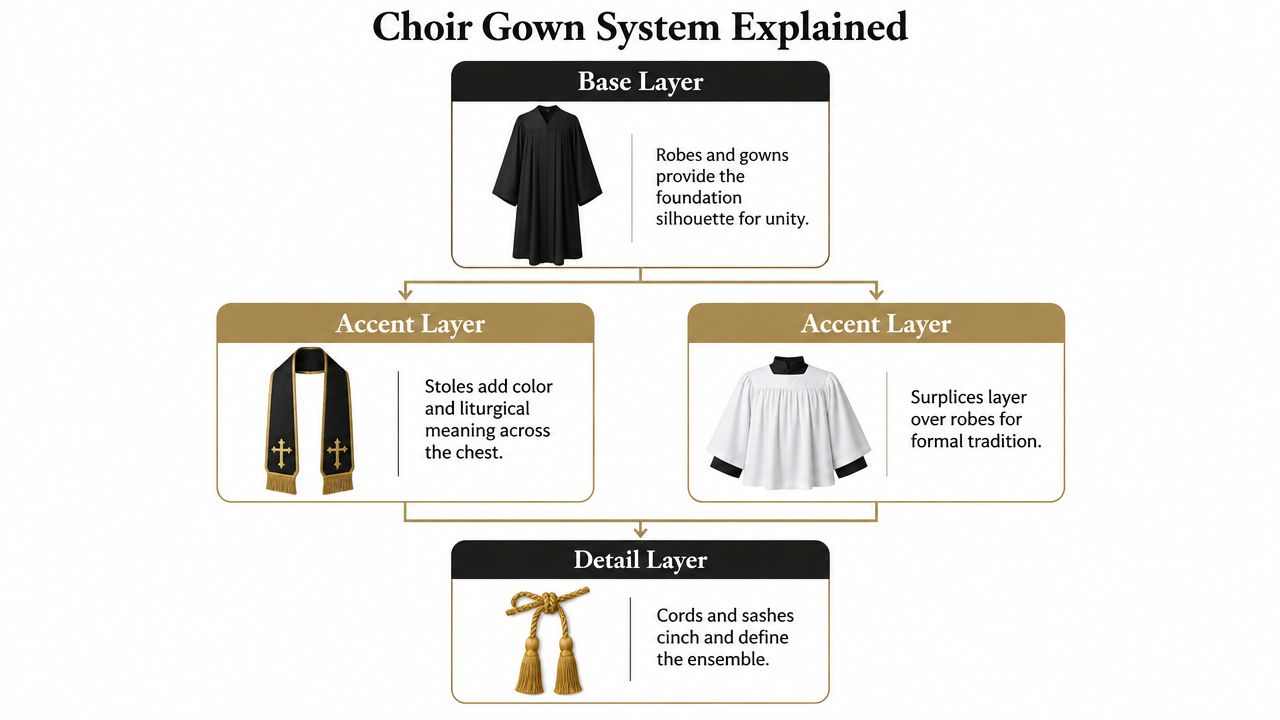
Choir clothing gets confusing because people use the same words loosely. A robe, a gown, a cassock, a surplice, a cotta, and a stole can all show up in the same conversation, but they don't do the same job. They work as a layered system, and each layer affects how the group looks, moves, and reads from the pews.
Start with the base garment
The robe or gown is the foundation silhouette. It creates the long line that unifies the group and hides much of the visual noise from everyday clothing underneath. In many choirs, that single outer garment is enough to establish a clean and consistent look.
Traditional liturgical dress often starts with a cassock under a white over-layer. Church dress has used that pairing for a long time, which is part of why the black cassock with white surplice still reads clearly in church and formal performance settings (choir robe colors history). Historical church practice also shows the surplice in use as a choral or processional garment by the later medieval period (historical overview).
Add accent layers when tradition calls for them
The surplice is the white outer garment that changes the feel of the whole ensemble. A cotta serves a similar role in some settings, especially where a shorter over-garment is preferred. A stole adds liturgical color and meaning across the chest, so it usually appears in seasonal or ordained roles rather than with every singer.
Church publications on Anglican dress often treat the cassock, surplice, and tippet as a complete ensemble, not as isolated pieces (Anglican choir dress overview). That helps explain why some choirs need a layered system and others can stay with a single robe. The right answer depends on the setting rather than on current fashion.
Small details finish the uniform
Cords and sashes may feel secondary, but they define the outline and help groups distinguish roles without breaking visual harmony. In a mixed choir, a subtle accent can signal leadership, section identity, or seasonal emphasis without turning the wardrobe into a patchwork of competing styles.
The cleanest question is simple. Which pieces carry the tradition your group uses, and which pieces only add clutter? If that answer is unclear, the safer route is usually the simpler one. A strong base garment, one appropriate accent layer, and restrained detail often read better than a crowded set of extras.
A short visual note helps here.
Choosing Fabrics Colors and Finishes for Performance
A choir gown works as part of a performance system. The fabric, finish, and color all affect how the group reads from the sanctuary or stage, how comfortable singers feel after repeated wear, and how much work falls on the volunteers who care for the wardrobe. A gown that looks elegant on a hanger can still cause trouble if it wrinkles quickly, throws glare under lights, or fades unevenly after several services.
Compare the fabric choices by how they perform
Matte polyester is a practical baseline for many choirs because it is lightweight, durable, easy to maintain, and usually resists wrinkles while keeping color steady under sanctuary or stage lighting (fabric comparison). That steady behavior matters. Less steaming means less setup work, and consistent color keeps the ensemble unified from the front pew to the balcony.
Polyester blends sit in the middle when a choir wants a little more drape without giving up easy care. Finish also matters, because a matte surface keeps the eye on faces and conductor cues instead of reflections. Cotton blends can feel comfortable and natural, but they often ask for more maintenance, so they fit groups that have the time and support for that extra care.
Practical rule: if the choir wears the same gown often, buy for wrinkle resistance first, then for appearance.
Color still carries meaning
Church dress has long used color with intention. Traditional European practice standardized a black cassock with white surplice, and later vestments carried symbolic colors such as purple for penitence or preparation, white and gold for purity and celebration, green for ordinary time or growth, and red for Pentecost and martyrdom (choir robe colors). Earlier robe history also shows that the first widely used palette was mainly black, white, and blue, with more systematized color coding coming later (historical palette overview).
That history helps explain why many choirs now favor a more unified group look. A recent show-choir costume interview describes a shift back toward whole-group presentation, with brighter fabrics and mixed-gender color variants replacing more individualized character costuming (show-choir costume interview). In plain terms, the ensemble picture is being coordinated more tightly again.
For buyers comparing textures and weight before a full order, the guide on religious fabric by the yard is a useful place to start. A fabric that stays calm under light, holds its color, and honors the tradition your singers serve is the right choice.
Sizing and Measurement Made Simple for Every Singer
Choir robe sizing works better when height, rather than street size, drives the choice. A robe is part of the performance system, not just clothing. If the hem lands well, the line looks clean, singers move without distraction, and the group reads as one unit. If it misses, the eye goes straight to the mismatch.
Measure the way the robe will be worn
Take height in the singer's normal singing shoes, not in socks or barefoot, because shoe height changes where the hem falls. Professional guidance places hem placement about 6 or 9 inches above the floor depending on the fit standard being used (measurement guidance). That small shift matters when singers stand close together, sit, and move through a service or concert.
A current choir size chart helps turn those ideas into workable order sizes. ChoirBuy's size and color charts page shows how robe sizing follows height bands and includes fuller-fit options for larger bodies. The point is not to memorize every code. It is to see that choir sizing is built for real body variation, so one robe can still look orderly across the group.
Check the body parts that affect movement
Children need more than height alone. Measurement guidance also calls for shoulder-to-shoulder, shoulder-to-wrist, and nape-to-floor checks, which reduce sleeve mistakes and help singers lift their arms comfortably (measurement guidance). That matters because a robe has to support singing, directing, and page turning without tugging at the body.
The same guidance notes that some robe systems separate robe size from length. That helps when one singer needs a different hem but the same chest fit. It is especially useful in school and youth settings, where growth patterns rarely line up neatly with age.
Here is a simple workflow that keeps fittings calm.
- Measure height first: use normal shoes and write the number beside each singer's name.
- Confirm chest and sleeves: make sure the robe will not pinch when hands rise to sing.
- Check hem placement: a robe that brushes the floor becomes a trip hazard.
- Flag youth and larger sizes early: do not wait until delivery day to find a fit problem.
For directors handling a group fitting, the internal size and color charts page keeps everyone on the same standard. Once the measurements are clear, the order feels less like guessing and more like a controlled process.
Customization Bulk Ordering Pricing and Lead Times
A choir order rarely fails because the singers are picky. It usually fails because the buyer treated the purchase like a single-garment decision instead of a whole-group budget. Once you add customization, bulk quantity, and delivery timing, the robe becomes a value equation.
Compare cost by wear, not by sticker price
The cheapest robe can become expensive if it pills quickly or wears out under regular use. Apparel guidance aimed at choir buyers frames the smarter question as cost per wear, not just sticker price, and it points toward durable, easy-care blends when groups need long service life (choir uniform value guidance). That's a useful lens for church, school, and youth ensembles buying in volume.
Customization changes that math too. Embroidery, trim, and stole color choices help the group look intentional, but they also affect production complexity. For many buyers, the sweet spot is a robe that feels specific enough for the setting without becoming so customized that it's hard to reorder later.
Use a simple decision matrix
| Specification Tier | Best For | Durability and Care | Pricing Approach |
|---|---|---|---|
| Basic robe in easy-care fabric | Large groups, frequent use, volunteer-led upkeep | Low-maintenance and straightforward to store | Lowest sticker price, but judge by wear life |
| Mid-tier robe or blend with color accents | Mixed-use choirs that need balance | Better drape and consistent presentation | Value-focused bulk ordering |
| Custom robe with embroidery or logo | Named ensembles, schools, special events | More specialized, plan for careful handling | Higher upfront cost, justified by branding needs |
Bulk ordering lowers the unit burden when the sizing list is accurate and the fabric choice is stable. The operational goal is to avoid reorders, returns, and volunteer time spent fixing problems after the garments arrive. A group that buys once, measures correctly, and keeps the spec simple usually spends less time and energy over the season.
Lead time matters as much as design
Seasonal peaks can strain any wardrobe plan, especially around Easter and Christmas. ChoirBuy's own product pages and support tools make it easier to prepare for that cycle, including custom choir robes such as the custom choir robes with logo option, which is worth reviewing if your group wants a visible identity marker.
If you're deciding between cheapest and most durable, choose the one that you can maintain, reorder, and keep visually consistent. That's the spec that saves money over the life of the robe, not just on the purchase order.
Care Maintenance and Sample Policies That Save Time
A robe can look uniform on arrival and drift out of line fast if the care routine is loose. The win is a repeatable routine that volunteers can follow, with a clean garment as the visible result.
Build the care routine around low-maintenance fabric
For polyester gowns, upkeep is the main advantage. Wrinkle resistance cuts down on heavy steaming before services, which matters when the choir room runs on volunteers and limited prep time. Color retention also helps the robes continue to read as one ensemble after repeated use and washing.
Storage matters too. Hanging robes keeps hems straighter and helps prevent deep fold lines. Folding only makes sense when space is tight and the garments are protected. If rehearsal starts soon, a quick steam on the front panel and sleeves usually does more good than chasing every crease.
Use samples before you commit to a full run
Bulk buyers get safer results when they test fit first. ChoirBuy's product samples page makes it easier to order one or two sizes before the full choir order, which lowers the risk of finding a fit problem after every garment has already shipped.
A practical try-on workflow looks like this:
- Pick the most common height bands in the group.
- Order one sample size in each likely band.
- Fit a few singers in normal shoes and rehearsal posture.
- Check sleeve lift, hem height, and chest ease before the larger order goes in.
If a sample feels awkward in rehearsal, it will feel worse on performance day.
Care planning works the same way. Set one person to handle storage, one person to steam when needed, and one person to track missing garments after events. That small division of labor keeps the wardrobe from turning into a hidden weekly burden.
Your Choir Gown Decision Checklist and Next Steps
A solid choir purchase starts with the ensemble, not with the catalog. First decide what tradition you're serving, whether that's a simple unified robe or a layered liturgical dress. Then choose the garment system, the fabric, the color, and the finish that match the room, the light, and the frequency of use.
After that, collect height-based measurements in singing shoes, confirm special sizing needs for children or plus-size singers, and check hem placement before you place an order. Don't sort by street size, and don't assume age tells you anything useful about fit. Those shortcuts are the fastest way to get sleeves that bind, hems that drag, and a line that looks accidental.
A clean final checklist looks like this.
- Define the ensemble standard: church, school, touring, or mixed-use.
- Choose the garment system: robe only, or layered pieces with cassock, surplice, or stole.
- Lock fabric and color: favor the finish that behaves well under your lighting.
- Measure every singer correctly: height first, shoes on, then chest and sleeves where needed.
- Confirm customization: embroidery, trim, or accent colors only after fit is settled.
- Calculate bulk quantity and budget: think in replacement life, not just opening price.
- Verify lead time and samples: don't leave first fittings to the final week.
If you want a smoother order process, start with the measurements and sample sizes before anything else. Then use the charts, color swatches, and package-deal options to lock a spec you can repeat next season without guesswork.
ChoirBuy carries choir robes, cassocks, surplices, stoles, and sizing tools that fit the way real ensembles work, from first fitting to final performance. If you're ready to simplify your next order, visit ChoirBuy and compare the robe styles, fabric options, and size charts that match your choir's tradition.