

The storage closet is where most youth choir robe problems begin. Last year's white gowns come out wrinkled, three collars are visibly stained, and several children have grown enough that their hems now sweep the floor. Meanwhile, a parent wants to know whether matching stoles are required for the December concert, and the church administrator wants one clean quote before approving the purchase.
Kids white choir robes look like a simple uniform purchase. They aren't. You're managing fit, safety, fabric care, customization, volunteers, and delivery timing at the same time. The directors who avoid trouble separate those decisions early, measure every singer properly, and order with the next performance already on the calendar.
Why Outfitting a Youth Choir Feels Harder Than It Looks
A youth choir can include children at dramatically different stages of growth. A six-year-old and an eighteen-year-old may sing in the same ensemble, yet a single age-based size chart won't make them look unified or keep them safe on a riser. The robes need to share the same visual line while allowing different chest widths, sleeve lengths, and body proportions.
White also creates its own maintenance problem. It reflects light beautifully and gives a children's choir a crisp, ceremonial appearance, but it reveals makeup, soil, sweat, food, and storage discoloration faster than darker fabric. That means the lowest purchase price isn't necessarily the lowest operating cost. A robe that wrinkles badly, traps heat, or requires specialist cleaning can consume volunteer time every concert.
The third job is procurement. Directors often coordinate parents who measure at home, volunteers who collect payments, and administrators who approve a purchase order. Those people may be working from different assumptions about fabric, accessories, delivery, and future growth. If you treat the project as one rushed shopping task, the failure is predictable: mismatched lengths, missing accessories, and robes arriving too close to performance day for alterations.
Separate the decisions before requesting quotes
Build three short workstreams:
- Fit: Record each singer's measurements and group them by length, not age alone.
- Performance: Check hem clearance, sleeve movement, stairs, risers, and procession routes.
- Procurement: Confirm fabric, quantities, customization, delivery dates, and who has purchasing authority.
White choir garments have a long connection to church and school choral traditions. Historical accounts describe white surplices worn over darker garments in English and Anglican settings, while formal choir garments developed into recognizable robe families over time, as outlined in this history of choir robes. That tradition explains the visual appeal, but it doesn't solve the practical issues directors face today.
Buyer's rule: Treat the robe, the fit, and the order schedule as separate decisions. You'll get a better result and fewer expensive surprises.
How Kids White Choir Robes Are Actually Sized
Age labels are a poor basis for children's choir robes. Children of the same age can have very different heights, chest measurements, shoulder widths, and arm lengths. Use the vendor's measurement system, then confirm every singer against the actual chart in ChoirBuy's size and color charts.
The reliable approach uses three body measurements. Children's robe guidance commonly specifies shoulder tip to shoulder tip, shoulder tip to wrist, and nape of neck to floor, rather than relying on standard clothing sizes, as explained in these choir robe measurement instructions.
Measure the singer, not the label
- Shoulder width or chest fit: Have the child stand naturally with arms relaxed. Measure across the shoulders or around the fullest part of the chest, depending on the supplier's chart. Don't ask the child to puff out their chest, and don't pull the tape tight.
- Sleeve length: Measure from the shoulder point to the wrist with the arm relaxed. A sleeve that is too short looks unfinished, while an oversized cuff can interfere with hand movement.
- Back length: Measure from the nape of the neck straight down to the intended hem. Keep the child standing flat-footed and naturally upright.
A soft tape measure is essential. Record the measurements immediately in a shared spreadsheet, and write down the date because a child's proportions can change during the season. For directors who need a visual reference for child-sized forms and proportions, Display Guru's child dress form guide offers useful context, though a real measurement remains the final authority.
| Size Label | Chest Range (in) | Back Length (in) | Sleeve Length (in) | Typical Age |
|---|---|---|---|---|
| Small youth | Use vendor chart | Use vendor chart | Use vendor chart | Younger singers |
| Medium youth | Use vendor chart | Use vendor chart | Use vendor chart | Growing singers |
| Large youth | Use vendor chart | Use vendor chart | Use vendor chart | Older children |
| Extra-large youth | Use vendor chart | Use vendor chart | Use vendor chart | Larger or taller youth |
Don't size down to make a robe look neat on ordering day. A little growing room is useful, and fabric can be hemmed when needed. It can't be lengthened easily once the child outgrows it. For mixed-age choirs, group singers into length brackets and expect some minor hemming rather than forcing every child into an age label.
Choosing the Right Fabric for White Youth Robes
For most youth programs, mid-weight polyester crepe is the practical winner. It holds a structured shape, resists wrinkles, and can usually be washed on a cold or gentle cycle. That matters when parents take robes home after a service and when volunteers need to prepare a full set quickly.
Polyester satin creates a more dramatic appearance under stage lighting, but it demands more care. Its sheen can look excellent for a formal concert, while its surface can show snags, handling marks, and uneven laundering. Cotton-polyester blends are more comfortable during long services because they generally breathe better, but they wrinkle more visibly after children sit, kneel, or travel.
White fabric changes the buying calculation. Soil and discoloration are easier to see, so the weave, finish, wash instructions, and stain response matter as much as the fiber name. Guidance for white youth robes emphasizes structured, wrinkle-resistant, machine-washable construction and warns that high heat can cause shrinkage or shine in synthetic fabrics, as detailed in this church garment fabric and care guidance.
Compare the trade-offs honestly
| Fabric | Breathability | Wrinkle Resistance | White-Fabric Care | Approx. Cost per Robe |
|---|---|---|---|---|
| Polyester crepe | Moderate | High | Cold or gentle wash, low heat or air dry | Request current quote |
| Polyester satin | Low to moderate | Moderate | Gentle cycle, protect from snags and heat | Request current quote |
| Cotton-poly blend | Higher | Low to moderate | Wash carefully, expect pressing before performance | Request current quote |
A four-to-ten-performance season doesn't justify buying the most delicate fabric because it photographs well. For regular church services, school concerts, and holiday programs, choose a tightly woven polyester crepe with a matte or restrained finish. If breathability is a serious concern, examine the garment's construction and care instructions rather than assuming a fiber label tells the whole story. Directors comparing yardage and liturgical fabric choices can also consult this religious fabric guide.
Hem Length and On-Stage Safety for Children
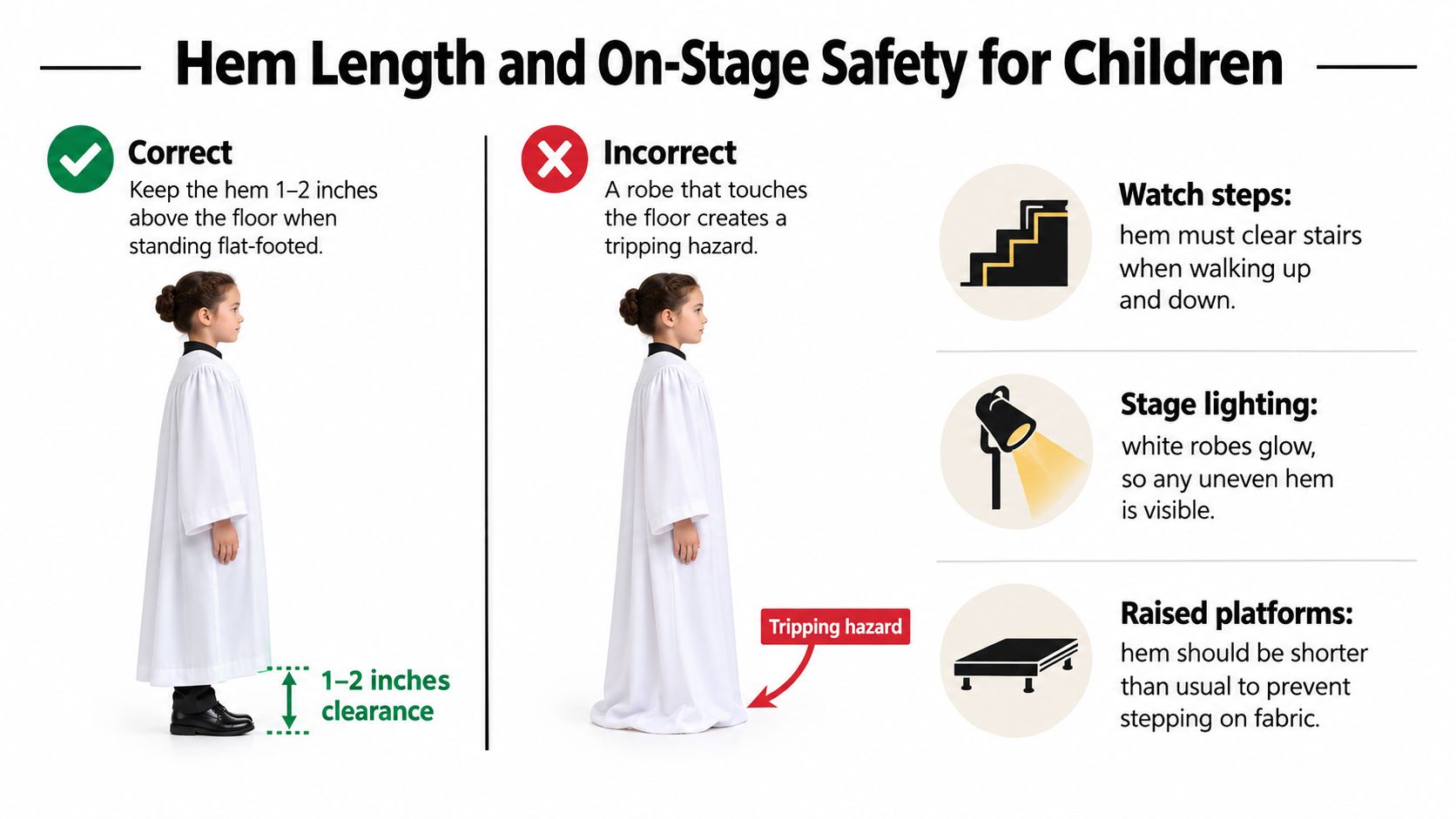
A robe that looks elegant in a product photo can become a tripping hazard on a dark platform. Children step backward, climb risers, turn toward accompanists, and move through doorways while watching the director. The hem needs enough coverage to look formal, but it must not collect under the child's shoes.
Use 1 to 2 inches of clearance above the floor when the child stands flat-footed. Measure from the center back of the hem, not from a side seam, because uneven placement can make one side appear longer under stage lighting. Safety guidance for children's robes also recommends floor clearance and room for breathing, arm movement, stairs, and platforms, as described in this children's choir robe safety guidance.
Run the stage check before approving alterations
- Check stairs: Have each child walk up and down the actual choir risers. A hem that clears a flat floor may catch on a step.
- Check platforms: Raised platforms often require a shorter hem because children need to see their footing.
- Check pathways: Inspect transitions between carpet and hardwood, cords, doorway thresholds, and procession routes.
- Check sleeves: Sleeves should end around the wrist or mid-forearm range used by the robe pattern, without hanging over the child's hands.
- Check lighting: White robes can reflect strong light, making uneven hems and loose cuffs obvious from the audience.
For younger singers, a two-piece arrangement with a separate stole can be easier to manage than a long one-piece gown, especially when the child must move frequently before or after singing. Directors planning a more performance-oriented wardrobe can compare movement requirements with the recommendations in this show choir attire guide.
Customization Options from Stoles to Embroidery
Customization should serve a purpose. A contrasting stole can identify a church season or make a plain white robe feel ceremonial. Embroidery can mark a choir name or emblem, but it also introduces thread, washing, inspection, and delivery decisions that don't belong in a last-minute order.
The most useful options are contrasting stoles, an embroidered choir name or cross on the stole or yoke, monogrammed pockets, and piping along the front panels. Stoles are usually the most flexible choice because directors can change the visual identity without replacing the base robe. Review styles and construction through this choir stole collection.
| Option | Cost per robe (USD) | Added lead time | Typical MOQ |
|---|---|---|---|
| Contrasting stole | Request current quote | Confirm with supplier | Confirm with supplier |
| Embroidered choir name | Request current quote | Usually 2 to 4 weeks | Often 6 to 10 pieces |
| Embroidered cross or emblem | Request current quote | Usually 2 to 4 weeks | Often 6 to 10 pieces |
| Monogrammed pocket | Request current quote | Usually 2 to 4 weeks | Confirm with supplier |
| Front-panel piping | Request current quote | Confirm with supplier | Confirm with supplier |
The 2-to-4-week customization window and 6-to-10-piece embroidery setup range come from the supplied industry guidance, but you should still obtain a written quote for your exact fabric and artwork. Ask for a sample stitch-out before authorizing the full run. Dyed thread can bleed onto white satin during washing, and dense embroidery can make a lightweight robe feel stiff or uncomfortable at the yoke.
Keep the design restrained for children. A small emblem, clean stole, or narrow piping usually looks more polished than several competing details. Confirm thread colorfastness, attachment method, care instructions, and whether customization changes the minimum order.
Bulk Pricing, Lead Times, and Order Strategy
Bulk ordering is procurement, not routine shopping. The quote depends on fabric, color, quantity, available stock, embroidery, accessories, and whether the supplier can ship the entire group together. White is often a stocked shade, but that doesn't guarantee that every size or style is available when you need it.
Ask suppliers to quote the same specification at 12, 24, and 50 units. Those quantities are useful comparison points because a larger order may change the unit price, while a smaller order may preserve flexibility when the roster is still changing. Don't compare a plain robe from one supplier with an embroidered robe and stole package from another.
Build the calendar backward
| Weeks before performance | Action to complete |
|---|---|
| 10 weeks | Confirm roster, budget authority, fabric, robe style, and accessories |
| 8 weeks | Collect measurements and request comparable quotes |
| 6 weeks | Approve the purchase order and customization artwork |
| 4 weeks | Confirm production status and prepare alteration plans |
| 3 weeks | Receive, inspect, sort, and begin fittings |
| 1 week | Complete hem checks, stain inspection, and stage walk-through |
For available stock, supplier guidance may quote 3 to 7 business days for shipping. Made-to-order runs may take 4 to 8 weeks, while custom-embroidered orders may take 6 to 10 weeks. These are planning ranges, not promises, so request the actual ship date in writing and leave time for exchanges and hemming.
Order above the current roster when the budget permits. The supplied planning guidance recommends 10% to 15% above current roster size for growth and replacements. That reserve is particularly useful when children join after the original fitting or when a robe is damaged during a meal, transport, or outdoor event.
Procurement rule: One purchase order, one approved sample, one delivery date, and one person responsible for inspecting the shipment.
Caring for White Robes So They Last Seasons
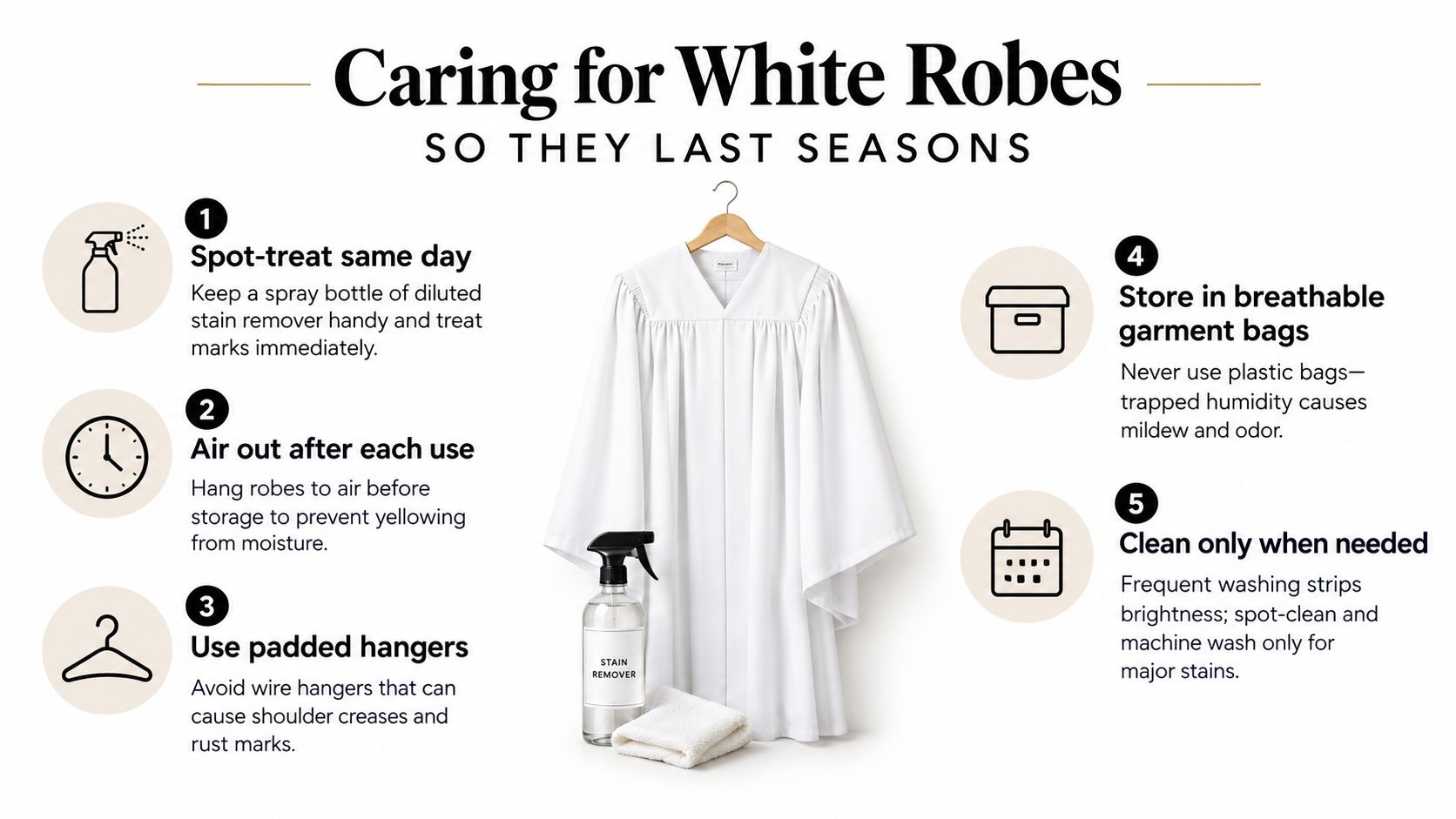
White robes usually fail early because the ensemble stores them badly, not because the fabric cannot survive performance use. Establish the care routine at the robing area, while the stains are still fresh and the volunteer still knows which singer wore the garment.
Use a spray bottle with diluted oxygen bleach or another approved stain treatment for collars, cuffs, and hems, but confirm the product is compatible with the robe's care label. Wash in cool or warm water with phosphate-free detergent, and avoid hot water. Chlorine bleach can yellow polyester blends over time, so don't reach for it just because the garment is white.
Use a routine volunteers can follow
- Spot-treat immediately. Focus on the neckline, cuffs, and hem as soon as the robe comes off.
- Air the garment out. Hang it before storage so moisture doesn't remain trapped in the fabric.
- Protect details. Place embroidered robes and garments with stole hooks in a laundry bag.
- Dry gently. Use low heat or hang dry. High heat can create shine, shrinkage, or heat-set wrinkles in synthetic materials.
- Store correctly. Use labeled hangers and breathable garment bags, never plastic dry-cleaning wrap.
For delicate pieces or heavily soiled garments, understand what a professional service does before sending the full inventory. Tumble Laundry's explanation of how dry cleaning works can help volunteers distinguish solvent-based cleaning from ordinary machine washing.
Keep robes away from fluorescent light and store them in a stable room rather than a damp basement or hot attic. Rotate garments by service date so the same robes don't absorb every stain and the same few pieces don't receive all the wear. The supplied care guidance states that a quality white robe can deliver five to eight active seasons when directors maintain it properly, but that result depends on fabric, storage, handling, and timely stain treatment.
A Simple Ordering Checklist for Youth Directors
A robe order succeeds when one coordinator owns the process. Don't send a long email thread asking parents to choose sizes, volunteers to collect money, and church staff to interpret supplier terminology. Give everyone one checklist, one spreadsheet, and one deadline.
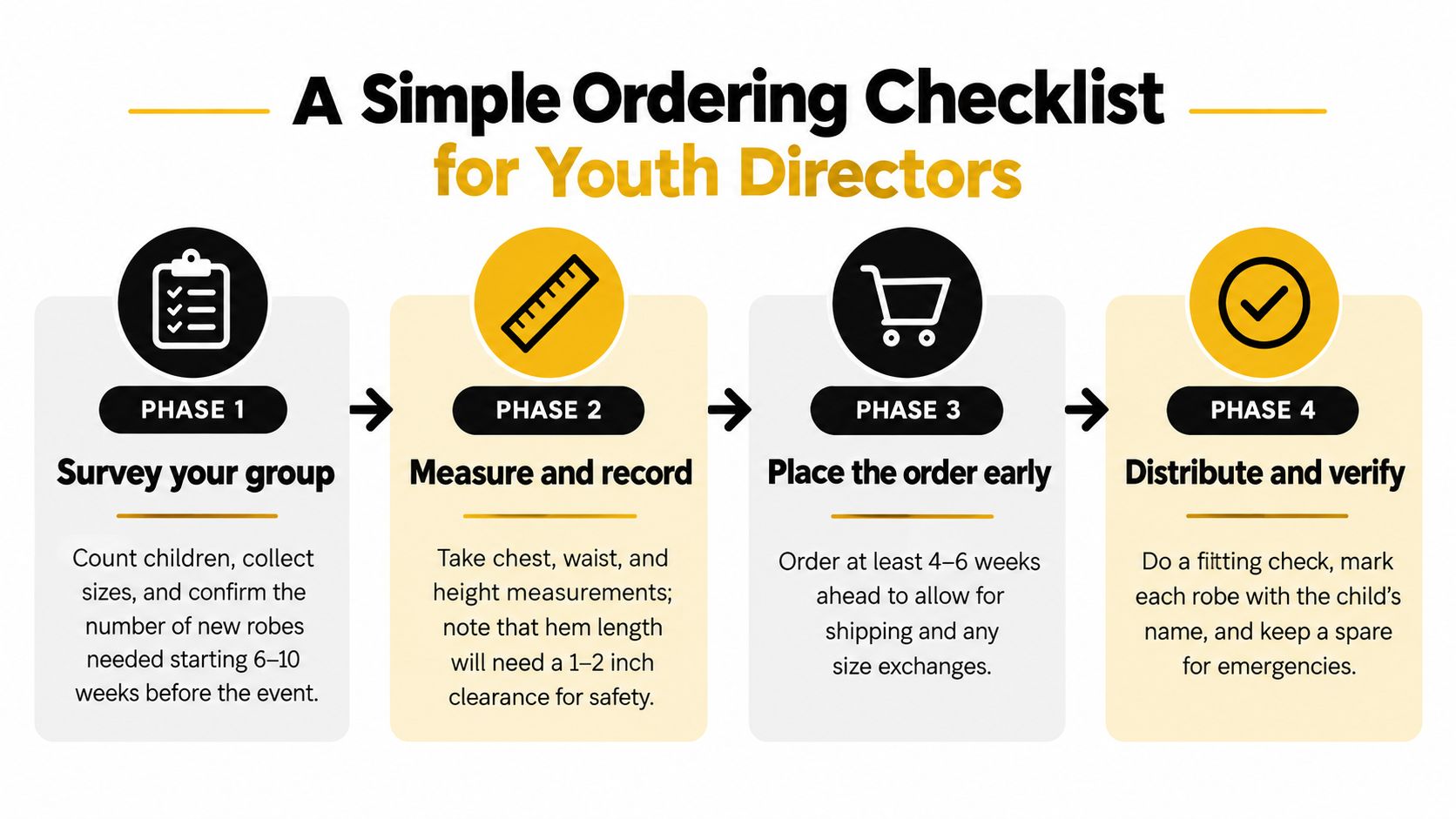
Start 6 to 10 weeks before the event by surveying the choir. Count current singers, identify likely additions, list damaged or missing robes, and ask whether the group needs stoles, embroidery, or a separate accessory package. The supplied ordering guidance recommends this early survey window because it leaves room to measure, quote, order, and correct fit problems.
Put one person in charge of each handoff
- Survey the group: Record singer names, current measurements, expected additions, and replacement needs.
- Measure and record: Use the supplier's required measurements, then note the intended hem and stage conditions.
- Freeze the specification: Choose fabric, finish, robe style, stole color, embroidery, and labeling before requesting comparable quotes.
- Approve the purchase: Confirm the minimum order, deposit terms, shipping method, exchange policy, and final delivery date.
- Inspect immediately: Count every robe, check sizes and color consistency, inspect seams and embroidery, and separate anything needing correction.
- Fit as a group: Hold one fitting session instead of relying on scattered parent appointments. Mark hems and sleeves before alterations.
- Label the inventory: Sew a name or number inside each robe so repairs and replacements stay organized for the next director.
Schedule a deposit date, a production check-in around the middle of the quoted window, and an inspection buffer before the first performance. Order at least 4 to 6 weeks ahead when shipping and size exchanges need to be accommodated, and keep a spare available for emergencies. Directors save the most time this way: not by choosing the cheapest robe, but by preventing late changes, mixed specifications, and unidentified inventory.
ChoirBuy offers children's choir robes in white styles, along with choir stoles, customization options, size and color charts, and bulk-order support for youth ensembles. Visit ChoirBuy with your roster and measurements ready, then request a quote that separates robe, accessory, customization, and delivery costs.