

Choir robes communicate shared service, continuity, and ceremonial purpose. Their meaning comes from several traditions, including ancient flowing garments, medieval Christian choir dress, and academic-style gowns, so a robe isn't automatically religious in every setting.
You may be standing in the choir room right now, laying out garments before Sunday worship, a school concert, or a community performance. The robes look orderly on the pews, but the practical question is harder: what will this clothing say to the people who see it? The answer depends on the history of the garment, the style you choose, and the audience in front of you.
Why Choir Robes Still Matter Today
A director learns the meaning of robes in a quiet moment. The music is rehearsed, the service sheet is ready, and the garments are arranged so singers can find the right size without rushing. Once worn, those individual pieces of clothing create one visual ensemble. The congregation sees a group prepared to serve, not a collection of unrelated outfits.
That effect matters because choir robe meaning is communicated before the first note. In a church, the robe may express reverence, modesty, continuity, and participation in public worship. In a school, it may help students look like one ensemble and keep attention on the music. In a community or interfaith choir, it may create focus and equality, but it can also suggest a religious identity that the group doesn't intend.

The audience changes the message
A worship choir usually wants its clothing to support the liturgy rather than compete with it. A public school director may prioritize a neutral, polished appearance. A community chorus may choose a flowing gown because it signals musical formality while avoiding clerical associations.
That distinction is increasingly important. A 2025 study of choral participation reported that 36% of participants identified as having no religion, while 59% identified as Christian. Those figures complicate the assumption that every singer or listener reads a robe as a single theological statement. The same garment can mean ministry in one room, discipline in another, and artistic unity somewhere else. The study information is summarized here.
Practical rule: Choose a robe for the message your specific audience should receive, not only for the tradition your supplier happens to offer.
The rest of the decision follows from that question. First identify the garment family, then consider its history, setting, color, fit, and care requirements.
What Choir Robes Are
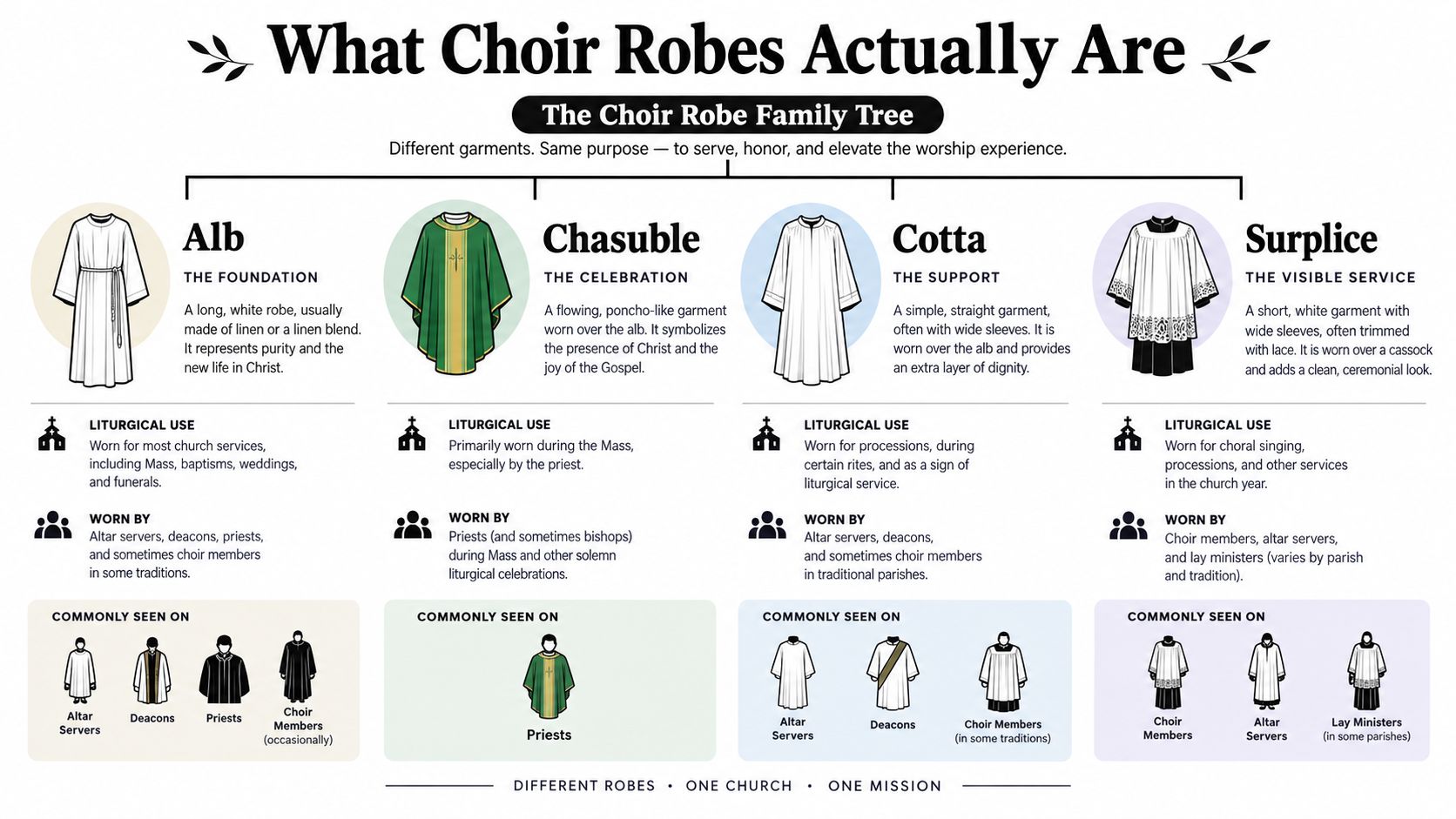
A choir robe is a clothing family, not one exact garment. It gives group singing a shared, ceremonial appearance, while its specific meaning depends on the people watching and the setting. ChoirBuy describes this wider family as including cassocks, surplices, cottas, stoles, and caps.
A buyer may encounter choral gown, choir gown, or academic gown as well. These terms usually describe a long, flowing robe with a simple silhouette. A cassock is a close-fitting, full-length base garment associated with clergy, servers, and some choirs. A surplice is a loose white outer garment with broad sleeves. An alb is another long white garment with liturgical associations. A stole is a narrow strip of fabric worn over the shoulders, usually as an accessory rather than a complete robe.
The academic gown needs careful distinction. Its shape may resemble a choral gown, particularly in Protestant and university settings, yet it commonly signals scholarship, graduation, or institutional achievement instead of worship. A chasuble has a different function again. It is a liturgical vestment and should not be treated as interchangeable with a standard choir gown.
A useful vocabulary for buyers
Use the garment name to clarify the message and role you want the clothing to carry:
- Full-length choral gown: A unified outer garment for church, school, university, or concert ensembles.
- Cassock and surplice: A historically specific combination that connects singing with Christian worship.
- Alb: A long white liturgical garment with a role distinct from a simple concert robe.
- Cotta: A shorter outer layer with a lighter, less enveloping appearance.
- Stole: A colored or decorated accessory that can mark a season, event, or institutional identity.
- Academic gown: A robe associated with education, credentials, and formal ceremony.
The shared purpose is visual framing. A robe reduces differences in everyday clothing and presents singers as one organized body. In a worship service, that unity may support the liturgy. In a public school or interfaith ensemble, the same design may need to read as musical formality without implying a religious identity. Cut, layering, color, and setting determine the message.
A Brief History of Choir Robe Meaning
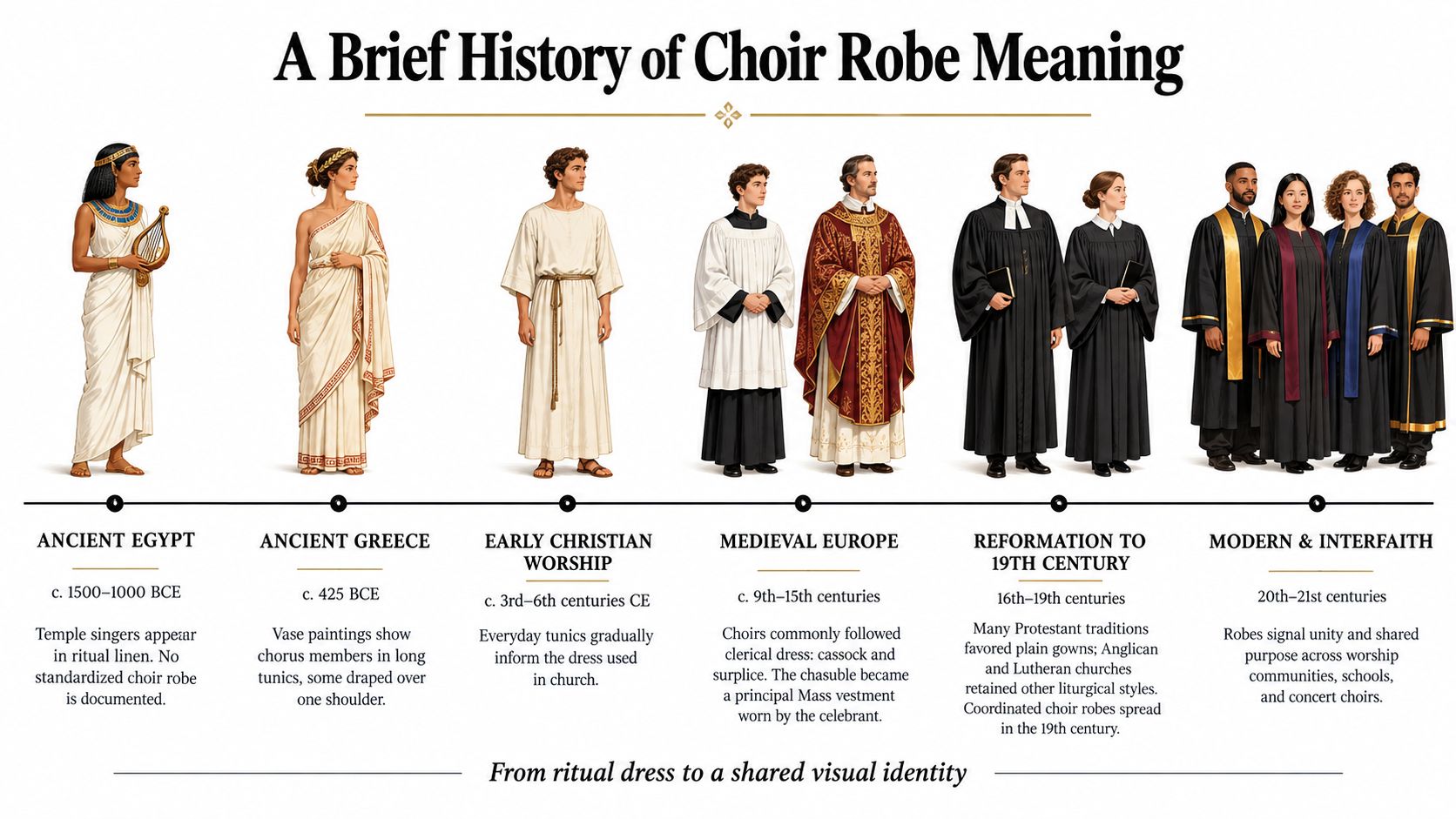
The story begins before the modern choir gown. Visual evidence places an early group of singers in ancient Egypt at approximately 2700 BC, and a fragment of Greek pottery dated to about 425 BC depicts singers and musicians wearing similar flowing garments. These images don't establish one continuous uniform tradition, but they show that flowing clothing has long helped distinguish ceremonial performers from everyday crowds. This historical overview provides the visual references.
Medieval Europe gave choir clothing a more specific institutional language. Christian choirs adopted garments associated with clergy, especially a dark, ankle-length cassock under a white, loose-fitting surplice. The arrangement made singing visibly part of public worship instead of treating it as ordinary entertainment. The dark layer created a disciplined silhouette, while the white outer garment identified participation in choral or processional service.
From surplice to choral gown
The surplice has a particularly important place in this history. Britannica records that it entered Christian use during the Middle Ages as a development of the alb, and its role as a choral or processional garment was established by the 14th century. Its loose cut supported movement and layering during long services, while its white color separated liturgical dress from ordinary clothing.
The modern flowing choir gown also reflects Reformation-era academic dress. The Geneva style was associated with academic credentials and was later adopted by Reformed churches. That history helps explain why some robes look more like university gowns than like a cassock and surplice. They belong to overlapping traditions, not one universal design.
For a fuller visual account, directors can consult the history of choir robes. The important lesson isn't memorizing every garment name. It's recognizing that a robe carries inherited signals about service, learning, modesty, and group identity.
What Choir Robes Communicate in Modern Settings
A robe communicates differently depending on who is wearing it and who is watching. Its Christian roots are real. Modern choir dress developed from formal secular clothing used in the Roman Empire and later became clothing for clerics during public prayer and church services outside Eucharistic celebration. The historical development of choir dress is outlined here.
That origin gives church robes a vocabulary of worship, continuity, and shared ministry. It doesn't force every modern choir to use the garment in exactly the same way.
Sunday worship
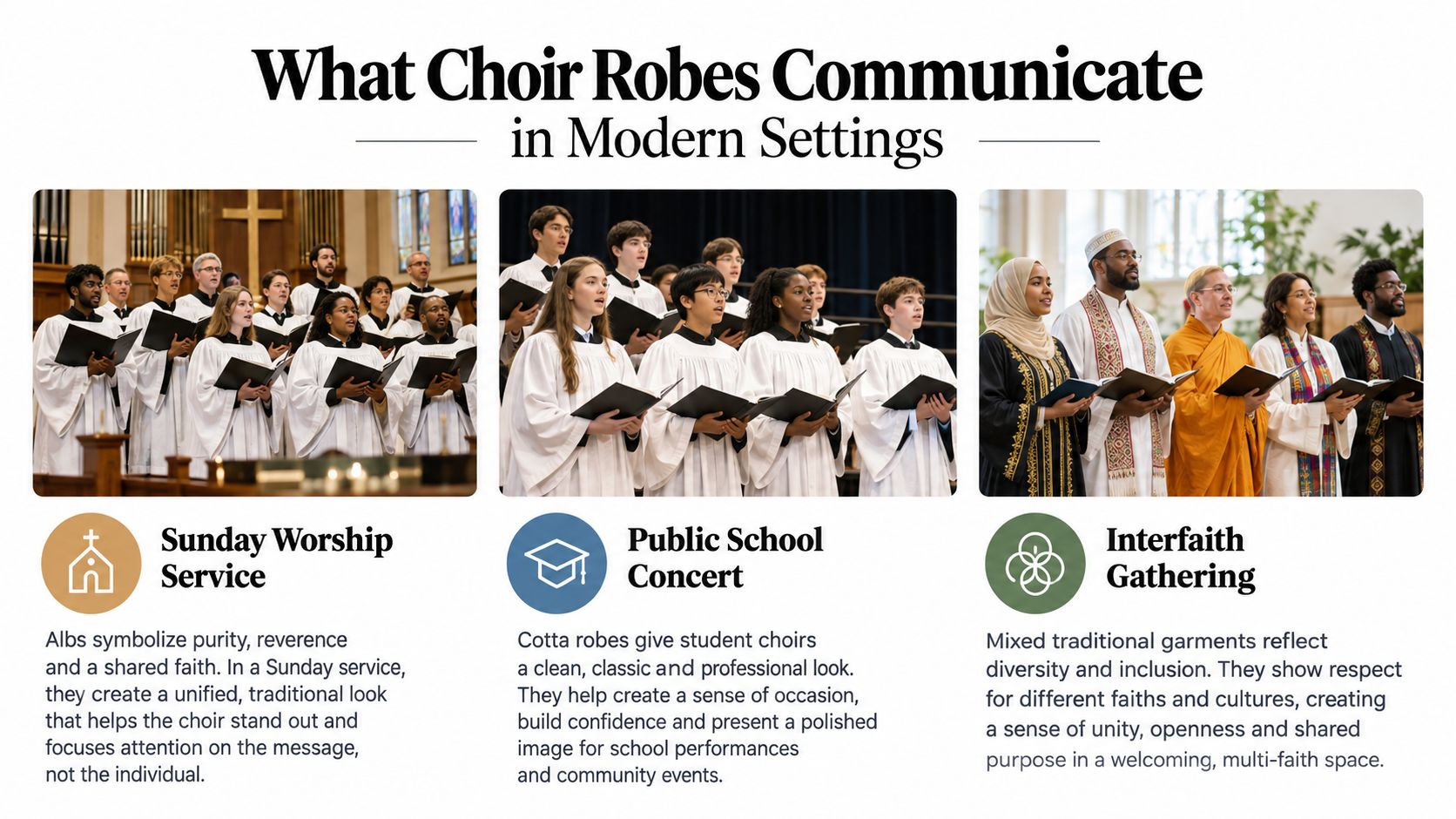
In a Sunday service, matching robes can express that singers are participating in worship rather than presenting a standalone show. The clothing supports unity, modesty, reverence, and musical focus. A cassock and surplice makes that meaning especially clear because it belongs to a recognizable liturgical tradition.
A full-length choral gown can communicate the same shared purpose more clearly, especially in churches that don't use formal vesture. The director should still check local custom. A robe that feels appropriately reverent in one denomination may seem overly clerical in another.
Public school concerts
A school choir usually needs a garment that looks formal without implying that the school is conducting worship. A simple choral gown or cotta can reduce visual distraction and help students appear as one ensemble. Neutral colors, practical fabrics, and easy sizing often matter more than historical layering.
The director should explain the purpose plainly to students and families. The robe is a performance uniform that supports ensemble identity. It isn't a statement about the student's personal religion.
Interfaith and community choirs
An interfaith or community choir needs the most deliberate conversation. A robe may support equality because it prevents expensive personal clothing from determining who stands out. It may also create distance if its cut strongly resembles clergy attire or if singers interpret it as requiring religious affiliation.
Before ordering, ask: Will this garment make participation feel more open, or will it make some singers feel represented inaccurately? If the group wants formality without a specific theology, a contemporary gown, coordinated stole, or carefully selected color palette may work better than a traditional cassock-and-surplice arrangement.
For groups building a less formal program around familiar repertoire, a resource such as gospel karaoke songs to sing can help directors think about musical participation separately from vestment tradition.
The robe should clarify the ensemble's role. If listeners spend more time wondering whether singers are clergy than listening to the music, the chosen style may be communicating the wrong thing.
Common Choir Robe Styles and Garment Types
A choir's setting should guide its garment choice. A worship service may call for a style that supports a visible ministry role. A public school may need a neutral uniform that does not imply religious affiliation. An interfaith or community ensemble may prefer formal clothing whose meaning remains open to singers and listeners.
Directors commonly compare the full-length choral gown, cassock and surplice, cotta, and academic-style gown. Each creates a different relationship between tradition, movement, and institutional identity.
The full-length choral gown offers a consistent silhouette for church choirs, schools, universities, and concert ensembles. A cassock-and-surplice combination signals a more specific ceremonial tradition, especially when the choir participates visibly in worship or processions. Because the surplice is an outer layer, it should be cut full enough to hang over the cassock sleeve. A fitted cut defeats that purpose.
The cotta is a shorter outer garment. Its lighter shape can suit servers, youth ensembles, or singers who need more freedom around the legs. An academic-style gown has a similar flowing form but may suggest education, commencement, or another formal institutional event.
| Garment | Typical Setting | Visual Effect |
|---|---|---|
| Full-length choral gown | Church, school, university, concert | Unified, formal, and adaptable |
| Cassock and surplice | Liturgical worship and processions | Strong contrast, historical, service-oriented |
| Cotta | Choirs, servers, youth groups | Shorter, lighter, and easier to move in |
| Academic-style gown | University, formal concert, institutional event | Scholarly, ceremonial, and structured |
Read the product listing carefully
The label “choir robe” can refer to several constructions. Check whether the garment is one piece or a layered set, whether sleeves are open or closed, and whether the length leaves room for clothing underneath. A contemporary guide to choir robes can help directors compare current designs while considering how each garment functions.
Fabric and cut affect rehearsal as much as appearance. A long hem may catch underfoot, while a narrow sleeve can make holding music uncomfortable. Ask singers to walk, sit, carry folders, and move through a procession before placing a large order.
The right style supports the ensemble's real work and communicates its role clearly. A robe should help listeners focus on the shared music, not leave them guessing whether the singers represent clergy, students, or a concert group.
Choir Robe Colors and Liturgical Symbolism
Color can coordinate a choir with the worship calendar, but the rules usually apply most directly to liturgical vestments and accessories rather than to a permanent set of full choir gowns. Many ensembles keep a consistent base robe and change stoles, collars, or other accents for particular seasons.
In traditions that follow formal liturgical colors, green is used on Sundays and weekdays of Ordinary Time, white is used during Christmas and Easter seasons and on feast days, red is used for Palm Sunday, Good Friday, Pentecost, and martyrs' feasts, and violet is associated with Advent and Lent. The liturgical color calendar is explained by the Diocese of Lincoln.
Use the calendar as a coordination tool
A church may keep black, white, or another consistent robe color for the choir while rotating colored stoles. That approach protects visual unity and avoids requiring a complete wardrobe for every season. It also makes the color change legible to the congregation without changing the ensemble's basic identity.
Two less frequent colors have defined uses as well. Black may be used for funerals and Masses for the dead, while rose is reserved for Gaudete Sunday, the third Sunday of Advent, and Laetare Sunday, the fourth Sunday of Lent. These choices belong to traditions with formal color rules, so directors should follow denominational and local guidance rather than treating the palette as universal.
| Color | Common liturgical association |
|---|---|
| Green | Ordinary Time |
| White | Christmas, Easter, and feast days |
| Red | Palm Sunday, Good Friday, Pentecost, and martyrs' feasts |
| Violet | Advent and Lent |
| Black | Funerals and Masses for the dead |
| Rose | Gaudete Sunday and Laetare Sunday |
The color should reinforce the service rather than become a costume change. This guide to choir robe color meaning offers a useful starting point, but the church's own calendar and customs should make the final decision.
Choosing, Sizing, and Caring for Choir Robes
Once the symbolic purpose is clear, purchasing becomes much easier. Start with the ensemble's setting, then select a style that supports that setting. A church choir may need layered garments, while a school group may benefit from a simpler, washable gown. A youth choir needs room for growth and movement, but an overly long hem can create a safety problem.
Fabric changes the experience. Matte material tends to look restrained under bright sanctuary or stage lighting. A smoother finish may create more visual presence, but it can also draw attention through reflected light. For frequent use, prioritize comfort, durability, and care instructions over decorative detail.
Measure the person, not the average
A reliable sizing process should account for:
- Chest and shoulder room: Allow enough ease for shirts, sweaters, or a cassock underneath.
- Sleeve proportion: Sleeves should permit music handling without covering the hands excessively.
- Hem length: Full-length garments should remain clear of the floor when singers walk.
- Youth sizing: Check children individually rather than ordering from age alone.
- Inclusive fit: Offer a broad range of sizes so every singer can participate without being singled out.
A mismatched hem or sleeve can weaken the unified appearance that gives robes much of their meaning. Consistency doesn't require identical bodies or identical under-clothing. It requires a deliberate fit standard.
Sizing principle: A robe should disappear as a distraction while remaining visible as a shared symbol.
Create a supplier checklist
Before placing an order, confirm the available color range, fabric choices, size chart, customization options, replacement policy, and expected fulfillment time. Ask whether the garment is machine washable, whether it needs pressing, and how embroidered elements should be cleaned.
For church directors comparing church choir robes, the practical details deserve as much attention as the photograph. Keep robes on sturdy hangers, follow the care label, and store them in a clean, dry place. Repair loose hems and damaged closures promptly. Well-maintained garments continue to communicate care and order, while stained or poorly fitted clothing can undercut the reverence the ensemble intends to convey.
Bringing It All Together and Quick Answers
The most useful definition of choir robe meaning is not a fixed symbol. It's a communication decision. Ask what the audience should understand, then match the garment family, color, layering, and fit to that purpose.
A worship choir may choose cassocks and surplices because the combination identifies choral service. A public school may choose a neutral choral gown because it supports ensemble identity without theological implication. An interfaith group may choose a contemporary style that preserves unity while leaving room for different beliefs.
Quick answers for directors
Are choir robes the same as clergy vestments?
No. Some choir garments come from clerical dress, but a choir robe isn't automatically a priest's vestment. A cassock, surplice, alb, stole, and chasuble can each signal different roles.
Should a secular choir wear robes?
Yes, if the group wants a unified ceremonial appearance. The director should explain the garment's purpose and avoid styles that imply religious authority when that isn't intended.
How can a choir tell that its robes no longer fit its identity?
Listen to the singers and audience. If members feel misrepresented, or if listeners consistently mistake the ensemble for clergy, reconsider the cut, layering, and color. The garment should support participation, not create confusion.
Review your next service or concert from the audience's perspective. If the clothing makes the choir look prepared, united, and appropriately placed in the event, it is doing its job.
ChoirBuy offers choir gowns, choir stoles, cassocks, surplices, cottas, and caps in options suited to church, school, youth, and community ensembles. Visit ChoirBuy to compare styles, sizing, colors, and customization choices before outfitting your choir.