

A familiar problem appears every year in music ministries. The choir arrives for a seasonal service, the robes are mostly coordinated, but the stoles vary in width, length, fabric, and color. One singer wears last year's purple stole, another has a bright red piece that belongs to Pentecost, and the youth section is swimming in adult-sized fabric. The ensemble may sound excellent, yet the visual presentation tells a confused story.
Stoles for choir robes need more planning than a quick accessory purchase. A stole can identify a season, reinforce a choir's shared identity, or unintentionally suggest an ecclesiastical role that the wearer doesn't hold. The right buying decision separates symbolic compliance, what your denomination or institution requires, from aesthetic coordination, what looks unified on a platform or concert stage.
The Historical and Liturgical Role of Choir Stoles
A music director usually notices the practical problem first. The choir needs matching apparel before the next service, the storage cabinet contains several shades of purple, and nobody can remember which pieces belong to the adult choir or the children's group. That situation feels like a purchasing mistake, but it often reflects a deeper issue: the stole has been treated as decoration instead of as a visual statement about the ensemble's place and purpose.
The stole has a long ecclesiastical lineage. The Metropolitan Museum of Art's overview of vestments identifies specialized stoles in the late-antique church by the fourth century, with the deacon using the orarion and the bishop using the omophorion. The priestly stole, called the epitrachelion in the Greek tradition and also used by bishops, appears in written records several centuries later.
That history matters when a choir chooses embroidered crosses, denominational symbols, seasonal colors, or clergy-like styling. The garment developed as a visible marker of office and responsibility, not as ordinary clothing. Its lineage spans approximately 1,600 years, connecting modern ceremonial apparel with established systems of rank, worship, and textile symbolism.
Choir apparel is not clergy vesture
The distinction protects both tradition and the choir. Historical accounts describe choir gowns, academic robes, clergy robes, and judicial robes as related categories that developed from academic regalia, while also noting that a stole can be worn over a robe. A choir stole may therefore function as an added visual layer over choir apparel, but that doesn't make the singer ordained or place the singer in a clergy office.
The broader vestment system also grew from late-antique clothing. The tunic developed into the sticharion or alb, while the Roman paenula became the western chasuble. By the late Byzantine period, dated 1261–1453, embroidered decoration on plain silk was common, and patterned silks made specifically for liturgical use became more prevalent in the post-Byzantine period, as documented by the Met.
Practical rule: Let your local church tradition decide how much ecclesiastical symbolism belongs on a choir stole. A polished appearance isn't worth creating confusion about ordination, office, or authority.
A church choir should ask its priest, pastor, diocesan office, or worship committee before adding crosses, titles, or designs strongly associated with clergy. A school, community, or concert ensemble has more freedom to use school colors, musical motifs, or a crest, but should still document what the stole communicates.
This same administrative discipline applies to the people managing the garments. If volunteers handle robe distribution, seasonal changes, or youth participation, churches may also want a consistent policy for volunteer background checks for nonprofits. Apparel administration and safeguarding are separate responsibilities, but both benefit from clear ownership and written procedures.
Navigating Liturgical Colors and Seasonal Planning
Every choir does not need a complete wardrobe of liturgical colors. That assumption creates unnecessary storage pressure, ties up funds in rarely used pieces, and leaves volunteers managing colors that may no longer match the congregation's worship practice. A documented capsule collection usually serves a mixed-use ensemble better than an indiscriminate full set.
Catholic liturgical practice provides a clear reference point. The General Instruction of the Roman Missal assigns white to the Christmas and Easter seasons and celebrations associated with Christ, the Virgin Mary, angels, and non-martyr saints. Red is used for Palm Sunday, Good Friday, Pentecost, Christ's Passion, apostles, evangelists, and martyrs. Green belongs to Ordinary Time, while violet or purple is used during Advent and Lent and may also be used for Masses for the Dead, according to the United States Conference of Catholic Bishops' liturgical color guidance.
That system can guide planning, but it doesn't create a universal rule for every choir. Some Anglican traditions use blue during Advent, while other traditions use violet. Rose or black may be permitted in particular rites or local practices. Confirm the custom before ordering a color set, especially if your choir serves more than one congregation.
Choose the system before choosing the colors
Separate the question “What must we wear?” from “What would look good?” A church choir may need colors that align with a church calendar, while a concert-only ensemble may need a neutral stole that coordinates with its robe and school or organization colors. A choir performing both worship services and community concerts may need a small liturgical set plus one neutral option, rather than every seasonal color.
| Strategy | Best For | Pros | Cons |
|---|---|---|---|
| Full seasonal set | Churches with established color protocols and frequent ceremonial use | Supports regular seasonal changes and clear symbolic compliance | Requires more storage, labeling, laundering, and replacement planning |
| Neutral base with seasonal accents | Mixed-use choirs and institutions with changing worship practices | Reduces waste and works across services, concerts, and ceremonies | May not satisfy traditions that expect a specific liturgical color |
| Reversible stoles | Ensembles with limited storage and carefully chosen paired colors | One garment can serve more than one visual purpose | Reversibility can complicate embroidery, care, and color consistency |
| Capsule collection | Most volunteer-managed choirs | Keeps procurement focused on colors the choir actually uses | Requires written decisions so volunteers know when each color applies |
For a practical reference on the meaning and coordination of seasonal choices, use this choir stoles color guide, then verify the final decision with your denomination or institution. Label every stole by color, size range, fabric, and approved use. The label should answer a volunteer's question without requiring a music director to be present.
Planning principle: Symbolic compliance belongs to the worship authority. Aesthetic coordination belongs to the ensemble director. Don't spend for one when you only need the other.
Record whether the stole matches the presider, complements the robe, identifies a choir section, or serves only as concert apparel. That single note prevents a future committee from assuming that every color must be repurchased when membership changes.
Sizing Specifications and Proper Drape Techniques
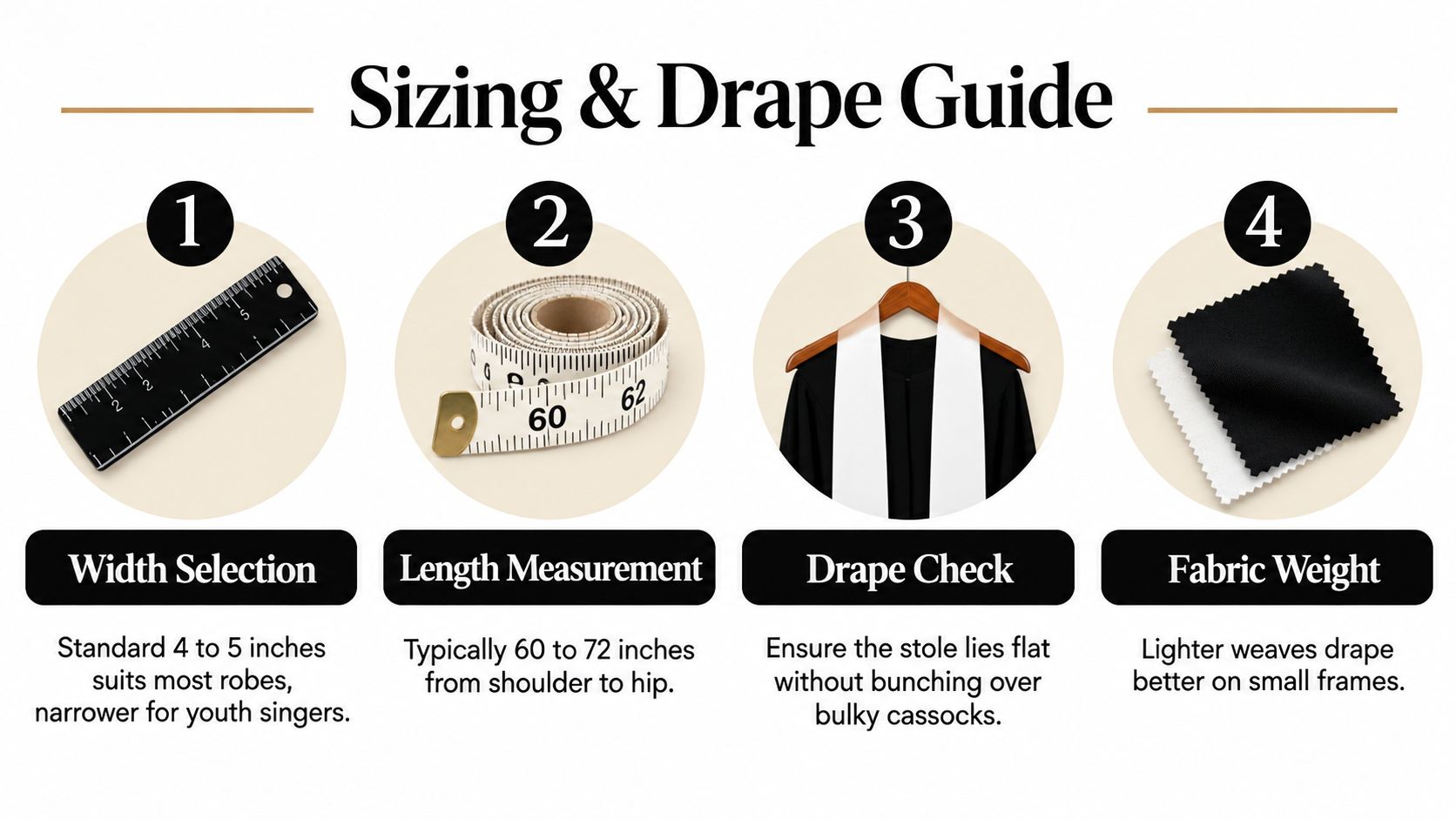
A stole that overwhelms a youth singer looks careless. One that disappears over a bulky cassock looks accidental. Measure the stole with the actual robe, cassock, or surplice in mind, and specify the wearer's role before asking a supplier to produce a group order.
Reference dimensions for ecclesiastical stoles are approximately 2–4 inches (5–10 cm) wide and about 8 feet (2.4 m) long, as summarized in the reference guide to the stole as a vestment). These dimensions describe a narrow, extended garment that distributes fabric over the front panels while remaining visually distinct from a choir robe. They aren't a universal one-size-fits-all instruction for every singer.
Measure the wearer and the role
Start with the stole's intended position. In Roman Catholic practice, a priest generally wears the stole over both shoulders, while a deacon wears it diagonally across the body. Those positions change coverage, balance, and the amount of fabric visible, so the same pattern won't necessarily suit every user.
For a choir, measure a singer while wearing the robe that will appear in performance. Mark the point where the ends should finish, then record whether the design needs centered embroidery, a plain center, pointed ends, or straight ends. A youth choir may need a narrower or shorter proportion, while an adult ensemble in a full cassock may need more visible width and length.
Use this bulk-order checklist:
- Width: Specify the finished width, not a general description such as “standard.”
- Length: Record the finished end-to-end length and the intended endpoint on the body.
- Center placement: State whether the center back is plain, embroidered, trimmed, or shaped.
- End shape: Choose pointed or straight ends and keep the choice consistent across the group.
- Role and drape: Identify choir singer, director, clergy, deacon, or another wearer.
- Size grouping: Separate adult, youth, and clergy measurements instead of forcing one length across the ensemble.
The guide to how to wear a stole can help your team standardize the drape before the order is finalized. Have one person photograph or sketch the approved position, then keep that reference with the inventory records.
Check the whole ensemble
Lay sample stoles over the robe fabric and inspect them from the back of the room, not only from a fitting mirror. Check for bunching at the neckline, uneven end points, twisting, and embroidery that disappears into folds. Fabric weight also matters. A heavy stole may sit well on a large adult robe but pull a smaller singer's neckline out of shape.
A uniform appearance doesn't require identical dimensions for every person. It requires proportional sizing, consistent placement, and a documented drape that volunteers can reproduce.
Evaluating Fabrics and Colorfastness Standards
The most damaging fabric failure is often invisible at the time of purchase. A red or dark purple stole may look excellent under showroom lighting, then bleed onto a white surplice after laundering. Perspiration, repeated washing, stage lighting, and contact with light-colored robes can also fade fabric or transfer dye.
Treat colorfastness as a purchasing specification, not a marketing adjective. Polyester, rayon, silk blends, satin, and other fabrics can behave differently under washing and handling. A supplier should be able to identify the fabric composition and explain the care method that protects both the color and the embroidery.
Ask what the test actually measured
AATCC TM61 is an accelerated laundering method. Depending on the selected option, the test exposure is designed to approximate the color and surface change associated with about five home or hand launderings, according to the AATCC TM61 method presentation. One cool-water hand-laundering option uses approximately 27 ± 3°C for 20 minutes, while a vigorous-wash option uses approximately 60 ± 3°C. Chlorine-containing variants add bleaching stress.
Those conditions don't guarantee identical field performance. They do give buyers a standardized basis for comparing fabrics before placing a large ensemble order. Ask for the tested method, water temperature, detergent or bleach conditions, and the evaluated color-change or staining grade.
Ask for the test conditions, not just the word “colorfast.”
That request matters most when bright red, purple, or dark blue stoles sit against white or gold robes. A test result for one fabric and one wash condition shouldn't be treated as proof that every color or care routine will perform the same way.
Match fabric behavior to the setting
A matte fabric can provide a restrained appearance and reduce glare under strong stage lighting. A shinier fabric can create more visual emphasis for a festive service, but it may also show wrinkles, folds, or uneven drape more clearly. The correct choice depends on the robe, venue, care capacity, and the amount of handling the garments will receive.
Before approving a bulk order, request a swatch or sample stole. Wash it according to the proposed care instructions, place it against the lightest robe, and inspect the result after drying. If you need fabric by the yard for coordinated repairs or future additions, review the available religious fabric by the yard options alongside the stole fabric rather than assuming a later replacement will match.
Record the approved fabric name, color reference, trim, and care method in the inventory file. That record protects consistency when a new volunteer takes over or when replacement pieces are ordered in a later season.
Customization Options for Embroidery and Trim
Customization should serve the ensemble's identity, not compete with it. A church crest, school emblem, treble clef, cross, or choir name can turn a plain stole into a meaningful part of the group's tradition. The design must remain legible at performance distance and appropriate to the wearer's role.

Start with the base fabric and its weight. A dense embroidered design can stiffen a lightweight stole, distort the drape, or pull the fabric around the stitching. A design placed too close to a pointed end may also become difficult to read once the stole turns or folds.
Approve the design before production
Request a digital proof showing the artwork's size, position, thread colors, and relationship to the stole's trim. Check the proof against the actual robe color, not against a screen alone. Metallic gold or silver thread may look different under sanctuary lighting than it does in a digital preview, while low-contrast thread can disappear across a large room.
Use a simple decision framework:
- Identity: Choose a crest, name, or symbol that the institution can use for years.
- Authority: Avoid titles or insignia that could imply ordination when singers are not clergy.
- Visibility: Favor clean shapes and readable lettering over intricate detail that vanishes at distance.
- Repeatability: Make sure the design can be reproduced on replacement pieces.
- Cost control: Apply elaborate embroidery to leadership or milestone pieces when a full set would strain the budget.
For a made-to-order option, review the custom stole specifications and confirm the available size, trim, tip, text, and image choices before sending artwork. Ask whether the minimum quantity, proofing process, and production schedule fit your ensemble's needs.
The schedule deserves the same attention as the artwork. Seasonal services create a fixed deadline, and a delayed proof can push production into a difficult window. Keep one approved proof, one physical sample, and one written record of the thread and fabric choices with the inventory documents.
A short video can help volunteers understand how a handmade or embroidered finish is created:
Customization becomes worthwhile when it improves recognition, preserves tradition, and can be maintained across future orders. It becomes wasteful when the design is too fragile, too specific to one event, or impossible to reproduce.
Ordering Logistics and Bulk Procurement Strategies
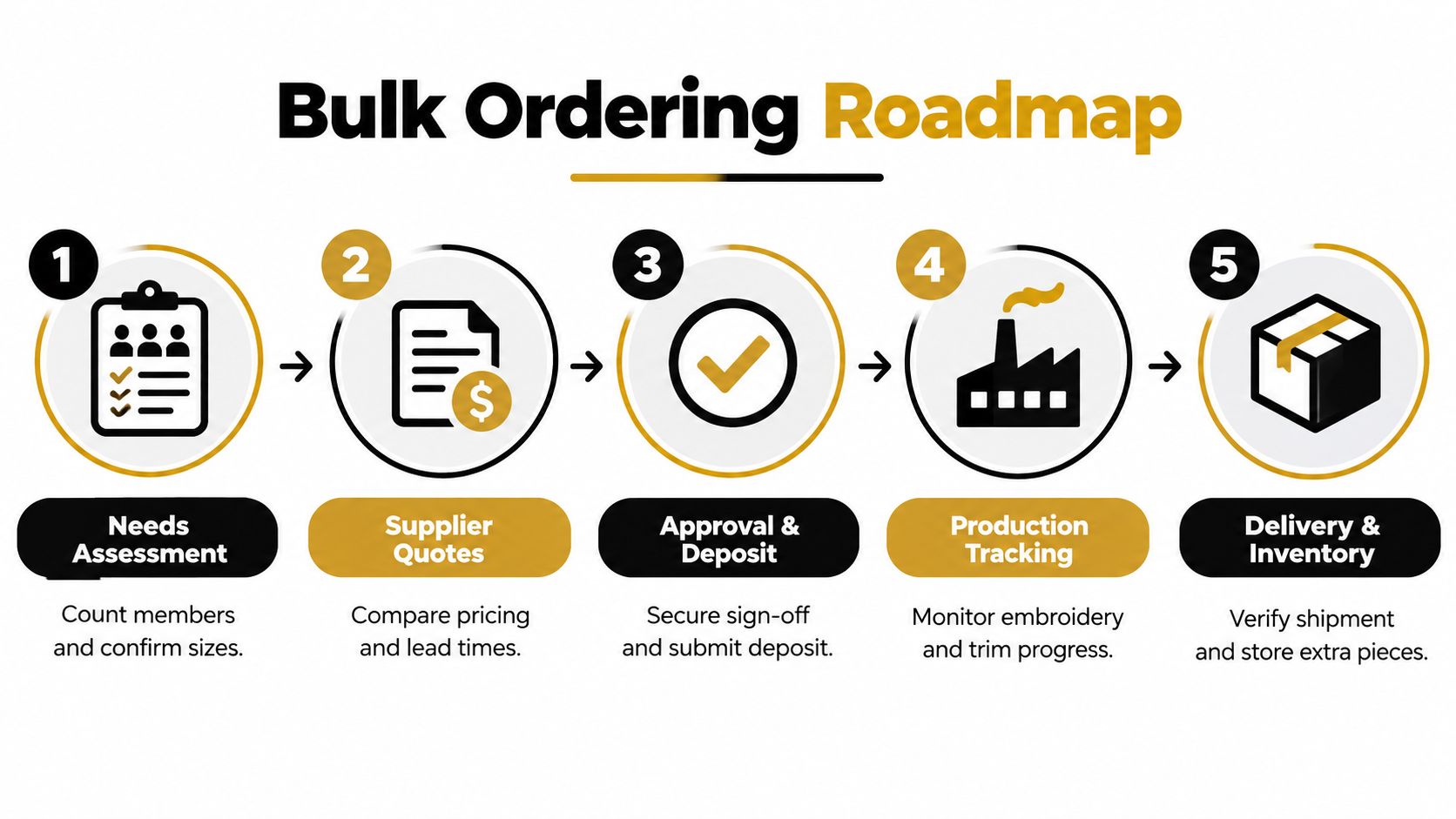
A successful bulk order starts before anyone requests a quote. Count the robes, identify the actual wearers, check the storage space, and decide which pieces need replacement rather than automatically ordering a new set. Volunteer organizations lose time when one person chooses colors, another submits artwork, and a third discovers that the sizes were never confirmed.
Use one approval file
Create a single order file containing the approved color, fabric, dimensions, embroidery proof, trim, size quantities, care instructions, delivery address, and named approver. Don't rely on scattered emails or verbal decisions made during rehearsal. A supplier can only produce what the final specification communicates.
Follow this sequence:
- Assess needs: Count singers, directors, clergy, youth members, spare pieces, and replacement pieces. Confirm the role and drape for each category.
- Request quotes: Ask for comparable pricing, sample availability, customization charges, package options, and production or fulfillment timing.
- Approve and authorize: Obtain the church, school, or organization's sign-off before submitting a deposit or approving production.
- Track production: Confirm that the approved fabric, embroidery, trim, and size breakdown are being used.
- Receive and inspect: Check quantities, color consistency, stitching, measurements, and visible defects before distributing anything.
Bulk purchasing may create package savings or volume discounts, but the lowest unit price isn't automatically the lowest total cost. A full color set can create unused inventory, while a smaller documented collection may leave you with fewer pieces to store, clean, and replace. Compare the purchase price with the administrative work and storage demands that follow.
Procurement rule: Never approve a group order until one person has compared the physical sample with the robe, the approved proof, and the written size list.
Build a contingency plan for roster changes. Keep a record of spare sizes, identify which pieces can be reassigned, and ask the supplier whether replacement stoles can match the original fabric and trim. Fast fulfillment can help with an unexpected addition, but it shouldn't replace proper sampling and approval.
For volunteer-led organizations, assign one apparel coordinator and one independent checker. The coordinator manages communication and inventory, while the checker verifies the final proof, quantities, and delivery. That small separation catches errors before a seasonal service exposes them.
Care Maintenance and Long-Term Storage Solutions
A stole survives its service life through routine handling, not through the purchase decision alone. Volunteers should inspect each piece after use, treat marks promptly, follow the fabric label, and record damage before returning garments to storage. A clean, labeled system protects the appearance of the ensemble and reduces frantic searching before the next service.
Compare cleaning methods carefully
Start with the care label and the supplier's fabric instructions. Durable polyester may tolerate a gentle machine wash with cool water and mild detergent, while satin or delicate materials may require careful hand washing or professional dry cleaning. Embroidered pieces should be protected from snagging, and a mesh laundry bag can help reduce abrasion during an approved wash cycle.
Spot cleaning works well for a small fresh mark when the fabric instructions permit it. Apply a mild, color-safe treatment to a hidden area first, then dab rather than scrub. Heat can set stains, distort fabric, or damage trim, so air drying is the safer default unless the care label says otherwise.
A professional cleaner is the better choice for delicate, lined, heavily embroidered, or uncertain fabrics. Machine washing may be more convenient for a durable, repeat-use fabric, but convenience doesn't justify using a cycle that the label forbids.
Store by season and size
Hanging storage keeps stoles accessible and reduces deep fold lines. Use suitable hangers, avoid crowding, and keep the garments away from direct sunlight. Flat storage can work where closet space is limited, but place clean protective tissue between pieces and avoid stacking damp or recently worn garments.
A church with a large robe inventory may benefit from a dedicated closet, rolling rack, or other vertical storage for uniforms. The storage format matters less than the system around it. Each section should have a clear label for color, season, size, fabric, and approved use.
Use a simple inventory sheet with these fields:
- Garment identity: Color, fabric, trim, and embroidery description.
- Sizing: Adult, youth, clergy, or other approved group.
- Seasonal use: Advent, Lent, Easter, Pentecost, Ordinary Time, concert, funeral, or neutral use.
- Condition: Ready, needs cleaning, needs repair, or retired.
- Location: Rack, shelf, garment bag, or storage container.
- Last review: Date and initials of the person who inspected it.
Store only clean, fully dry garments. Separate colors that may transfer dye, protect delicate embroidery from abrasion, and keep replacement pieces with the matching documentation. When volunteers can find the correct stole without guessing, the inventory remains useful even as directors and committee members change.
ChoirBuy offers choir stoles, custom options, multiple fabrics and colors, inclusive sizing, package deals, and bulk-order support for adult, youth, school, and liturgical ensembles. Review the available options and ordering resources at ChoirBuy, then request samples and confirm your documented color, sizing, customization, and care plan before committing to a seasonal inventory.