

Sunday service is coming, the spring concert is close behind, and the same question keeps landing on the music director's desk: should the choir wear red?
That decision sounds simple until you picture the moment. A robe that looks rich and reverent in the sanctuary can turn overly shiny under stage lights. A color that feels perfect for Pentecost might seem too strong for a school performance. And when you're ordering for a full ensemble, the practical questions arrive fast. Will the red read evenly across different sizes? Will the fabric feel warm halfway through a long service? Will the choir look unified in photos instead of patchy or mismatched?
Red choir robes do two jobs at once. They carry meaning, and they create visual order. A choir in everyday clothing can still sing beautifully, but the eye has to work harder. Matching robes pull everyone into one visual line, much like a hymnal puts many voices onto one page. Red adds another layer. It doesn't sit in the background. It signals purpose.
For some churches, red is tied directly to the worship calendar. For others, it also serves concerts, holiday programs, pageants, and special commemorations. That's why first-time buyers often need more than a quick explanation of symbolism. They need a decision framework that connects season, setting, fabric, finish, and fit.
Introduction to Red Choir Robes and Their Impact
A choir can sing the same anthem in the same room and still create a very different impression once the robes change. Red is a clear example. A bright red robe in a sunlit sanctuary can feel warm and celebratory. The same robe under strong stage lighting can look sharper, glossier, and far more commanding.

Why red changes the room
Red draws the eye quickly. That matters in worship and performance because choir attire does more than cover the group. It helps organize what people see. Matching red robes can make a choir look unified from the back pew, across wide risers, and in photos taken after the event.
Red behaves differently from quieter robe colors. Black steps back. Navy stays restrained. Red comes forward, almost the way a solo trumpet line stands out inside a full hymn arrangement. Used well, that extra presence helps the choir read as one body instead of a collection of individuals. Used carelessly, it can overpower nearby visual elements such as altar cloths, banners, floral displays, or a decorated concert shell.
That is why first-time buyers usually need more than a symbolic explanation. They need a practical filter for deciding where red belongs on the calendar and where it fits the room.
What red robes need to accomplish
For many choirs, a red robe has to solve several problems at once:
- Match the occasion. A red robe may be right for Pentecost, ordinations, commemorations, holiday music, or selected concert programs, but not for every appearance on the schedule.
- Behave well in the setting. Matte red often looks calmer in bright lighting, while shinier finishes can reflect more and appear louder from the audience.
- Look consistent across the full ensemble. Shade, cut, and drape need to read evenly across adult, youth, tall, petite, and plus sizes so the choir looks coordinated rather than patchy.
- Stay useful beyond one event. Many directors want one red option that can serve both worship and performance without feeling locked to a single day.
If you are still comparing colors, ChoirBuy's guide to choir robe color meaning gives a helpful overview of how red differs from other common robe choices.
A good buying decision starts with a simple question: where will these robes be worn most often?
If the answer is mostly liturgical, calendar fit matters first. If the answer is mostly concerts, lighting and fabric finish move to the front of the list. If the answer is both, you need a middle ground. That usually means a red tone with enough depth to feel appropriate in church, a finish that does not glare under lights, and sizing options broad enough to keep the whole group visually balanced.
Red can be beautiful and practical. The key is choosing it with the room, the season, and the full choir in mind.
What Red Means in Choir and Liturgical Tradition
A choir can wear the same red robe and have it mean slightly different things in different rooms. In one church, red points straight to Pentecost. In another, it signals a patronal feast, a day honoring martyrs, or a long-standing choir custom tied to school, cathedral, or parish identity. That difference matters for buyers, because the right red robe choice starts with knowing whether you are dressing for the calendar, the institution, or both.
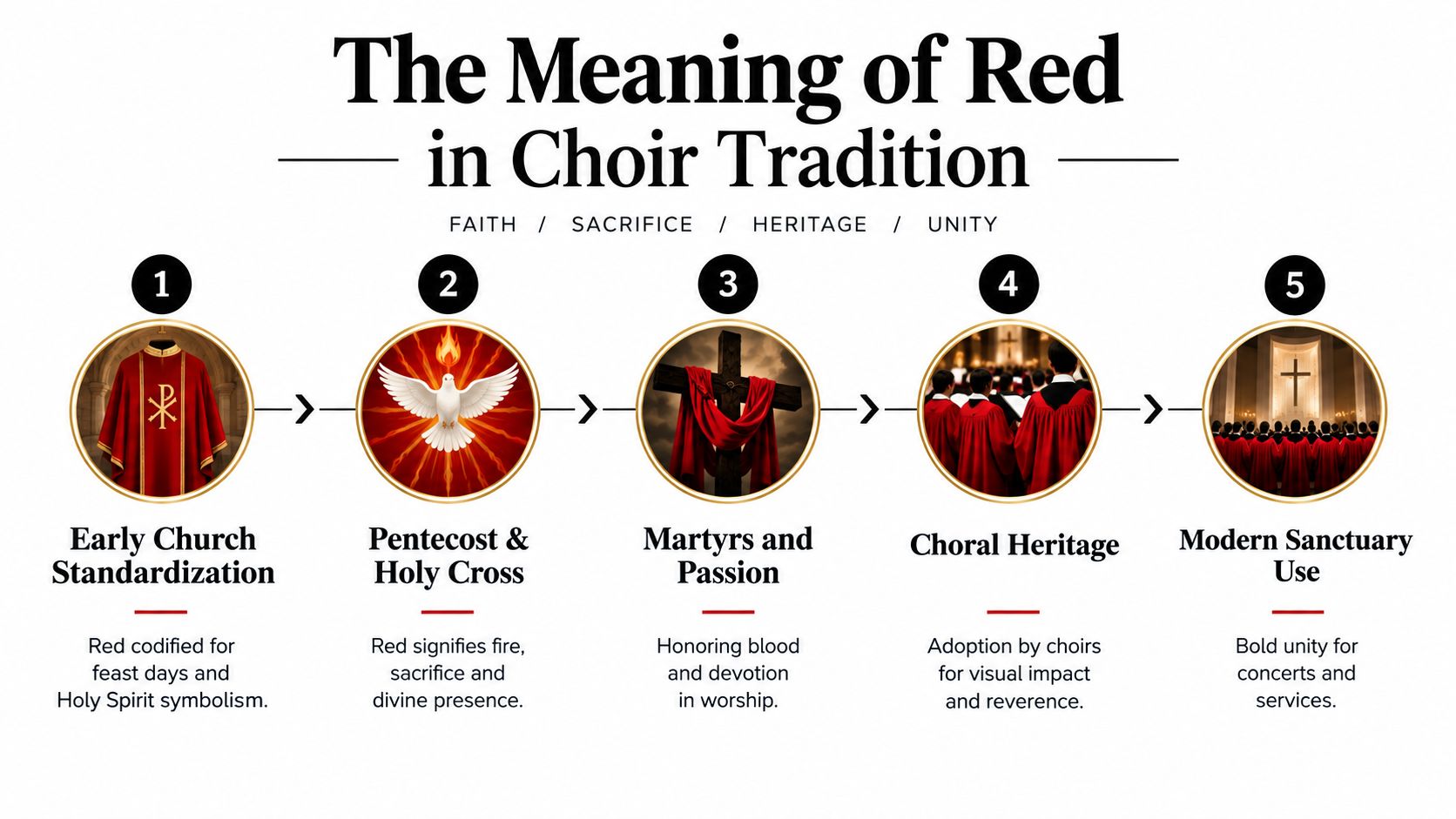
How red entered the liturgical color system
Red has deep roots in Western liturgical color use. Historians of church vesture trace formal color patterns through medieval practice, later clarified in the Roman rite. In that tradition, red became associated with Pentecost, the Holy Cross, martyrs, apostles, and certain feast days such as St. Stephen's Day (brief history of liturgical colours).
For a first-time buyer, the simple takeaway is this: red is not just a bold color. It is a calendar color. It often appears on days meant to feel intense, public, and full of witness.
That is why red can feel immediately appropriate in worship, even to people who could not explain the history in detail.
Why Pentecost comes to mind first, but should not be the only reference point
Many choir directors hear "red robes" and think "Pentecost robes." That instinct makes sense. Pentecost is one of the clearest and most widely recognized uses of red because of its connection to the fire of the Holy Spirit.
Still, buyers should use a wider lens. Red also carries meanings tied to sacrifice, courage, testimony, and proclamation. In practical terms, that gives churches a useful decision framework.
If your choir mainly sings on the liturgical calendar, ask which red days appear on your schedule each year. If your ensemble serves a school chapel, cathedral foundation, civic service, or holiday concert series, ask whether red reflects the group's identity even when the church calendar is not the main driver. Those are two different reasons to choose the same color.
How choral custom shaped modern red robes
Church use is only part of the story. English choral practice gave red another layer of meaning, especially in ecclesiastical and royal contexts. Percy Dearmer described how scarlet became visible in certain serving and chapel traditions, and later custom helped spread that look beyond one narrow setting (Percy Dearmer on robes and English custom).
Many new buyers get tripped up. They expect one fixed rule for every choir. In reality, red works more like a family resemblance. One choir wears it because the liturgical day calls for it. Another wears it because the institution has worn red for decades. A third chooses it because it reads clearly from the nave or stage and still feels rooted in church tradition.
Red can be traditional without being identical everywhere.
If you want more background on how vesture developed across different choir settings, ChoirBuy's article on the history of choir robes gives helpful context.
A calendar-based and setting-based way to read red
Buyers usually make better decisions when symbolism is tied to actual use. A robe closet works like a calendar and a floor plan at the same time. You need the color to fit the date, and you need the robe to fit the room.
| Period or setting | What red usually signals |
|---|---|
| Pentecost and related observances | Fire of the Holy Spirit, proclamation, celebration |
| Feasts of martyrs or apostles | Witness, sacrifice, courage |
| Cathedral, chapel, school, or royal-style choral tradition | Heritage, status, institutional identity |
| Concert or civic performance with sacred repertoire | Formality, visibility, dramatic presence |
This is also why shade and finish matter even at the meaning stage. A deep wine red in a stone church can feel solemn and rooted. A bright scarlet under strong stage lighting can feel ceremonial and highly visible. Both are red. They do not communicate exactly the same way.
For choirs ordering in bulk, one more point is easy to miss. Red needs to read consistently across the full group. If the color shifts noticeably from petite to tall cuts, or the robe style sits awkwardly on fuller sizes, the message of unity weakens. In liturgical dress, fit supports meaning. A choir that looks balanced helps the color do its job.
Choosing Fabrics Styles and Finishes for Red Choir Robes
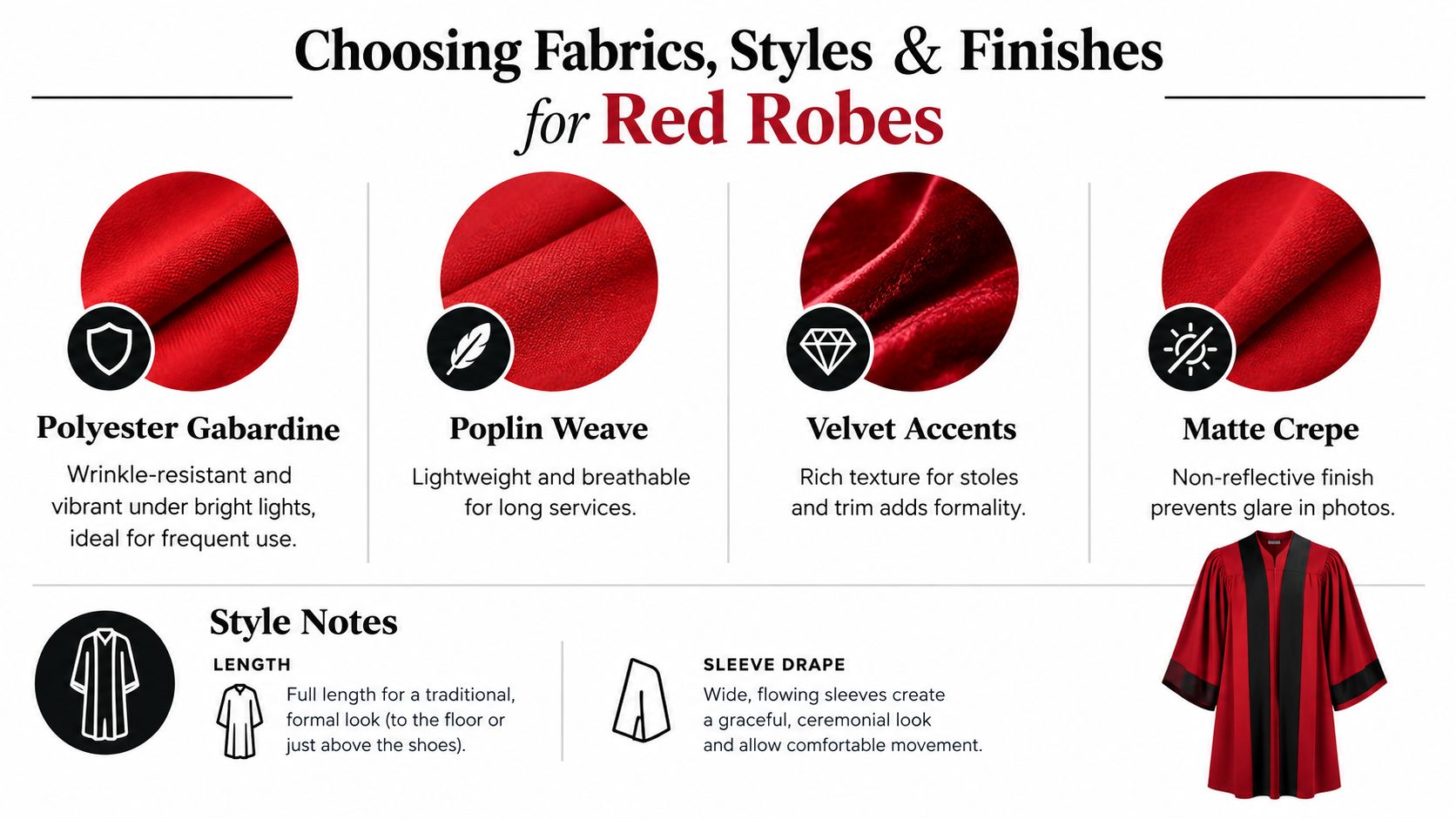
Fabric choice matters more with red than many first-time buyers expect. A red robe doesn't just show color. It shows texture, sheen, folds, sleeve shape, and hem consistency. A small difference in finish can change the entire look from dignified to flashy.
What red does under light
Think of red like glossy paint on a wall. If the finish is reflective, every light source shows up. If the finish is matte, the color looks steadier and the surface appears smoother from a distance.
That's why many choirs prefer matte or low-sheen robe fabrics for bright sanctuaries and stage use. Modern apparel trend summaries also point to performance gear with matte finishes, moisture-wicking properties, and reduced heat retention, while many traditional robe pages still ignore comfort and glare. That gap is especially important with red, because buyers often need one color to function in both worship and performance settings (practical gaps in red robe buying advice).
A video walkthrough can help you picture how fabric movement and drape affect the final look:
Comparing common robe fabric directions
The market has also been shifting away from generic ceremonial robes toward more performance gear, with specific concern about heat retention in polyester and stronger interest in practical design. That's one reason buyers now ask not just “What does red mean?” but “How will this fabric feel after an hour?” (commentary on choir uniform direction)
Here's a simple comparison to keep your options straight.
Red Choir Robe Fabric Comparison at a Glance
| Fabric | Look Under Lights | Comfort and Heat | Safety Note |
|---|---|---|---|
| Polyester gabardine | Holds color well and often appears crisp | Can feel warmer during long services | Synthetic fabrics vary, so check venue needs |
| Poplin weave | Lighter visual effect with less bulk | Often feels easier for longer wear | Good for mobility, but confirm opacity in red |
| Matte crepe | Reduces glare in photos and bright lighting | Usually chosen for a softer drape | Matte finish helps visual consistency |
| Wool or wool-rich options | Rich, substantial appearance | Can feel warm, depending on weight | Wool has strong natural flame resistance |
Safety without overcomplicating it
In crowded worship or performance spaces, fabric safety matters. Wool-based red choir robes have a technical advantage in flame-risk settings because wool is reported to have the highest natural fire resistance among untreated textiles, with a limiting oxygen index around 25.2% and an ignition temperature of roughly 570–600°C. Unlike polyester, wool does not melt, so it chars and self-extinguishes after the flame source is removed, reducing melt-drip burn hazards (textile flame resistance findings).
A separate fire-safety resource notes that 100% polyester, nylon, wool, and silk are harder to ignite and tend to self-extinguish, while cotton, cotton/polyester blends, rayon, and acrylic are relatively easier to ignite and burn rapidly (fire-safety discussion of fabric behavior).
Choose robe fabric the way you'd choose kitchen flooring. You want it to look right, feel right, and behave sensibly in the room where it will actually be used.
For buyers comparing trims, linings, or robe cloth before ordering, ChoirBuy's guide to religious fabric by the yard can help translate textile terms into practical choices.
Sizing Customization and Inclusive Fit for Every Choir
The hardest part of ordering red choir robes usually isn't picking the color. It's getting a whole group to look consistent in that color.
Red is less forgiving than darker neutrals. Hemlines that vary too much become noticeable. Sleeves that bunch awkwardly draw the eye. If the fabric is thin, bright lighting can reveal more than the committee expected. That doesn't mean red is risky. It means the fitting process has to be more deliberate.
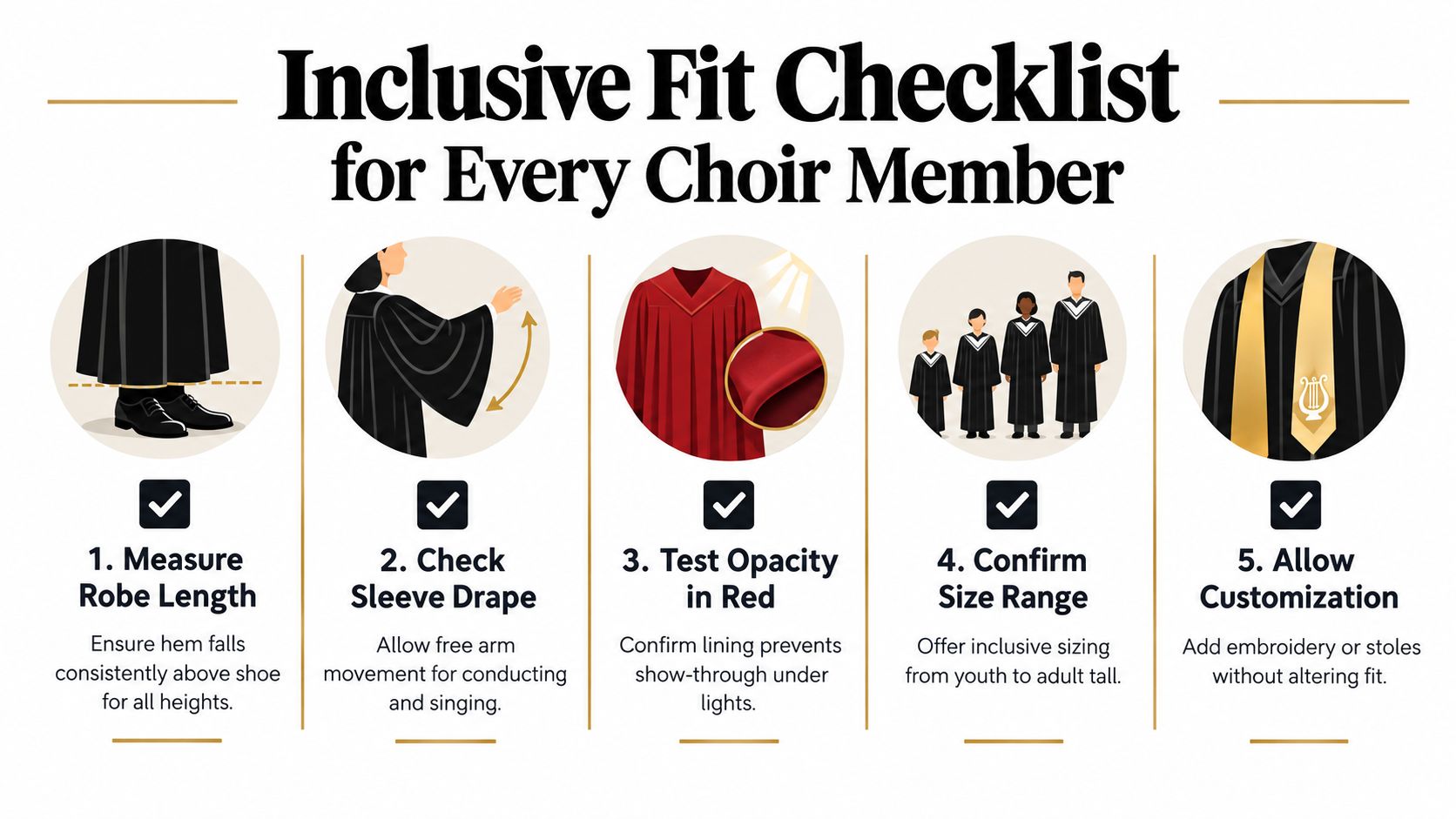
Start with a continuous size range
Inclusive sizing works best when the choir can order from a continuous range instead of treating some singers as a separate category. One industry guide defines inclusive sizing that way, and notes that plus-size fashion is typically above size 14 UK / 16 US, while size-inclusive ranges commonly extend through spans such as XS–5XL+ (size inclusivity glossary).
That approach matters for robes because choirs don't line up by retail department. They stand shoulder to shoulder. A continuous range makes the visual line smoother.
A fitting system that lowers surprises
Use a repeatable measuring process, especially for bulk orders.
- Measure length first. Robe length creates the strongest visual line. Aim for a hem that falls consistently above the shoe across the group.
- Check sleeve drape next. Singers need room to hold folders, sit, stand, and turn pages without pulling the robe awkwardly.
- Test opacity in the actual venue. Red can behave differently under sanctuary spots than it does in a fitting room.
- Separate size from body judgment. Order the size that gives proper drape, not the size label someone wishes they wore.
- Keep a written roster. Track each singer's height, robe length, and cut preference so replacements are easier later.
Fit check: If one singer raises a folder and the whole sleeve line collapses, the cut is too tight for ensemble use.
What buyers often miss with mixed groups
Adult choirs, youth choirs, and combined festival ensembles create a special challenge. The more age ranges you include, the more important consistency becomes in three places:
- Length matching: Children's and adult hems shouldn't look random on the risers.
- Cut selection: Unisex cuts are often practical, but some groups need multiple cuts to keep the front line balanced.
- Interchangeability: Fast-growing youth groups benefit from ordering with future replacement logic in mind.
If you're evaluating red robes as a long-term uniform, ask for clarity on these points:
| Fit question | Why it matters in red |
|---|---|
| Is the size range continuous? | It helps the ensemble look uniform |
| Are youth and adult styles visually aligned? | Mixed groups look less pieced together |
| Is the fabric opaque enough? | Red can show inconsistencies under bright lights |
| Are sleeve and length options clear? | Small fit errors show more in bold colors |
For measuring and color coordination, ChoirBuy's size and color charts are a practical reference to keep at hand during roster planning.
Customization without ruining the line
Embroidery, stoles, piping, and choir insignia can all work with red. The key is placement. If embellishment pulls at the neckline or adds weight unevenly, the robe may hang differently from the rest of the set. A robe should still move as a robe first, and only then serve as a display surface.
That matters most with bulk orders. One altered neckline or one mismatched sleeve width can stand out across the whole front row.
Ordering Samples Bulk Discounts and Fulfillment Made Simple
Most robe delays begin with a rushed decision, not with shipping itself. Directors get busy, a committee chooses a color from a screen, and nobody sees the actual shade or fabric until too late. With red, sampling matters even more because finish and lighting change the final effect.
A timeline that works in real life
Start by deciding where the robes will be used most often. Sanctuary only, concert hall only, or both. That single answer shapes whether you should lean toward a more symbolic red, a more subdued matte red, or a flexible base robe with red accents.
Then move through the order in this sequence:
- Sample first: Confirm the shade, finish, weight, and opacity in your actual room.
- Measure second: Don't collect sizes before you know the final garment cut.
- Approve customization third: Logos, trim, or stole coordination should come after the base robe is settled.
- Place the bulk order early: Choir seasons feel far away until they suddenly aren't.
- Build in exchange time: Even careful rosters need a cushion for a few fit adjustments.
How to compare options without getting lost
When buyers compare red choir robes, they often look only at price and color. A better filter is to compare four things together:
- How the robe looks under your lighting
- How it feels after extended wear
- How easy it is to reorder later
- How clearly the vendor handles sizing and replacement pieces
That last point matters more than many committees expect. A robe program works best when you can add new members later without reinventing the whole order.
One practical buying approach
Some churches buy a full red robe set because they know they'll use it often for Pentecost, special commemorations, concerts, and holiday music programs. Others keep a neutral robe and change the look with seasonal accessories. Both approaches can work.
For buyers who want a ready-made product direction, ChoirBuy lists options such as a Matte Red Choir Robe and a Red Choir Cassock, along with related choir apparel categories for stoles, surplices, and cottas. That kind of catalog structure is useful when a church is comparing a full robe purchase against a layered cassock-and-surplice look.
Questions to settle before checkout
If your committee is debating red, don't ask only “Do we like it?” Ask “Where will this robe live most of the year?”
Use this short checklist before you place the order:
- Calendar check: Which services or events will require red most often?
- Venue check: Do your lights make shiny fabrics glare?
- Roster check: Are children, adults, and new members all covered?
- Storage check: Will the robes hang for long periods between uses?
- Replacement check: Can you match future additions without visible variation?
A calm ordering process usually produces better results than a clever last-minute one.
Styling Red Choir Robes for Different Ensembles and Seasons
This is the question many buyers really mean to ask: when are red choir robes appropriate beyond Pentecost?
The answer depends less on abstract symbolism and more on calendar fit and setting fit. Some uses are strongly liturgical. Others are performance-oriented. Confusion starts when those two categories get blended.
A calendar-based way to decide
Recent guidance shows red used not only for Pentecost but also for Holy Week, ordinations, installations, and martyr commemorations, while many general choir-attire guides still default to black, navy, royal blue, maroon, and deep purple for broader use because those colors create visual weight without competing with the altar area. That's why buyers often need a seasonal decision rule rather than a generic explanation of symbolism.
A workable framework looks like this:
| Setting | Red as primary robe | Red as accent |
|---|---|---|
| Pentecost service | Strong fit | Also works with white robe and red stole |
| Martyr commemoration | Strong fit | Useful if full red feels too intense |
| Holy Week or special observance | Depends on local tradition and sanctuary design | Often easier to adapt |
| Ordination or installation | Can work well in churches that use red ceremonially | Good for mixed vesture traditions |
| Concert or pageant | Works if the program is energetic or seasonal | Better if the room already has strong color |
| General weekly use | Often too specific for some churches | Usually the more flexible choice |
Sanctuary symbolism and stage visibility aren't the same thing
A red robe can be liturgically correct and still visually awkward in a room. That's not irreverent to say. It's part of planning.
If the altar frontal, banners, and flowers already carry strong red, a full red choir can flatten the visual field. In that case, red accents may frame the service better than head-to-toe red. On the other hand, in a neutral concert hall with soft backgrounds, red can give a choir shape and warmth from the back row to the front pew.
Ensemble type changes the answer
A small parish choir, a school chorus, and a gospel ensemble won't use red the same way.
- Traditional church choir: Red works best for specific observances or with layered vesture such as cassocks, surplices, and stoles.
- School or youth choir: Red often reads as festive, confident, and easy to see from the audience.
- Holiday or pageant ensemble: Red can support the event mood even when the use is more seasonal than liturgical.
- Large combined chorus: Matte finishes usually help the group read as one body rather than as many separate reflections.
A robe can honor the church calendar and still need stage discipline. Both questions matter.
If your choir needs one all-purpose solution, many groups do better with a neutral base robe and red accessories. If your calendar includes repeated red observances and concert use, full red may be worth the investment. The better choice is the one your choir will wear often, not the one that sounds most dramatic in a meeting.
Caring for Red Choir Robes to Keep Color Vibrant
Red rewards careful storage and punishes neglect faster than many darker colors. Dust shows. Creases show. Fading shows. A simple care routine keeps the robes looking rich instead of tired.
Daily and seasonal care habits
Start with the label instructions for the specific fabric. Then build a routine around gentle handling.
- Hang robes promptly: Don't leave them folded in bins after a service.
- Use proper spacing: Packed garment racks can crush sleeves and create hard wrinkles.
- Steam carefully: Light steaming usually restores drape better than aggressive ironing.
- Spot-clean early: Small marks are easier to remove before they set.
- Store away from strong light: Direct light can affect color over time.
For buyers comparing fabrics with long-term color stability in mind, this guide by Lewis and Sheron Textiles gives helpful general background on fade-resistant materials and what to watch for.
Match care to material
Wool, polyester, and blended robe fabrics don't all respond the same way to heat, washing, or storage. If your robes were selected partly for flame behavior or structured drape, careless laundering can undo those advantages. Keep the care method as conservative as the garment requires.
A good rule is to treat choir robes more like custom eventwear than like everyday uniforms. They may be worn often, but they still need shape retention, color protection, and careful hanging.
Keep a small robe plan on file
Maintain a simple care sheet for volunteers and robe managers. Include approved cleaning methods, steaming notes, storage layout, and a checklist for inspection before major services. That one page prevents a lot of last-minute scrambling.
When red choir robes are chosen well, fitted carefully, and stored properly, they can serve both worship and performance beautifully for years.
If you're narrowing down options for red choir robes, cassocks, stoles, or mixed-size bulk orders, ChoirBuy offers product categories, size charts, and ordering tools that make the process easier to manage. Visit ChoirBuy to compare robe styles, review fit resources, and plan a coordinated look that works in your sanctuary, on stage, and across the church calendar.