

Four weeks before Advent, the roster is still changing, the budget meeting is Tuesday, and someone has just asked whether the existing robes can survive another season. You need purple choir robes that fit children and adults, look consistent under sanctuary lighting, support the right liturgical use, and arrive before the first service. A color chart alone won't solve that order.
Treat the purchase as three decisions at once: liturgical planning, fabric performance, and ensemble distribution. Choose the shade and meaning first, test the material second, then build the order around actual singers rather than street sizes.
Planning Your Purple Choir Robe Order Before You Browse
Start with the date of the first service where the robes must be worn. Work backward from that date and write down the approval deadline, measurement day, sample review, production window, shipping buffer, and inspection date. A late robe order doesn't just create inconvenience. It forces singers into mismatched garments, rushed alterations, or an avoidable emergency purchase.
Create a roster by voice section, such as SATB or unison, and mark every singer who needs special attention. Include children, plus-size singers, tall or petite members, wheelchair users, and anyone who may need a modified hem, sleeve, or closure. Don't order one robe per expected singer and hope the distribution works out. Your size range is part of the order specification.
Lock down the order brief
Before browsing, record:
- Ensemble count: Separate confirmed singers from likely additions.
- Liturgical use: Identify Advent, Lent, special services, concerts, and any occasion requiring a different stole or accent.
- Replacement status: Decide whether you're replacing an aging set, adding to an existing collection, or outfitting a new choir.
- Complete budget: Include robes, stoles, cinctures, embroidery, alterations, shipping, and possible replacement pieces.
- Firm delivery date: Use the first wearing date, not the date of the budget meeting.
Decide whether stoles, cinctures, and embroidery will come from the same supplier. Purple dye lots can vary between production runs, so sourcing accessories separately can create a visible mismatch. If you must split the order, request fabric samples and compare them in the actual sanctuary.
Check storage before approving quantity
Robes need room to hang. A narrow closet packed shoulder-to-shoulder will wrinkle garments quickly, especially when singers return robes before the fabric has aired. Measure the available rail space, decide whether breathable garment bags are practical, and establish who will check robes in and out.
For vendor comparisons, use a practical resource such as the guide to choosing where to buy choir robes, then send the supplier your roster profile, measurements, fabric preference, customization needs, and deadline. A vendor can quote accurately only when you provide the information that affects production and fulfillment.
Why Purple Is the Liturgical Color of Choice
Purple carries more than visual drama. In many Christian traditions, it identifies Advent and Lent, the seasons of preparation, reflection, repentance, and solemnity. Purple became associated with penance and royalty, giving choir garments both a devotional function and a formal presence.
The tradition is old. Purple appears in Roman Catholic religious dress as far back as the 5th century, when color indicated hierarchical rank and bishops, archbishops, and other prelates wore purple while ordinary clergy wore black, as documented in this history of choir robes and ecclesiastical color. Medieval choir-robe practice also developed from 13th-century monastic clothing, and Trinity Church in Boston recorded choir-robe use in the United States in 1859. Purple choir robes are therefore part of an established visual language, not a recent fashion choice.
Confirm your denomination's convention before ordering. Purple or violet is standard for Advent and Lent, but some traditions use blue for Advent, while red commonly signals Pentecost or martyrdom and white marks major feast days. Rose provides a traditional midpoint exception on Gaudete Sunday in Advent and Laetare Sunday in Lent, a joyful interruption within the purple seasons, as explained in this guide to choir robe color meaning.
| Color | Typical Seasons | Symbolic Meaning |
|---|---|---|
| Purple or violet | Advent and Lent | Preparation, penitence, repentance, humility, royalty |
| Rose | Gaudete Sunday and Laetare Sunday | Joyful pause within a penitential season |
| White | Major feast days | Celebration, purity, and joy |
| Red | Pentecost and martyr observances | Fire, the Holy Spirit, and martyrdom |
| Green | Ordinary Time | Growth and ongoing life |
Ask your pastor whether the choir must match clergy vestments exactly or harmonize with them. A deep, cool royal purple generally feels more formal, while a warmer violet can suit less formal settings. Approve a physical swatch before committing. Sanctuary lighting can turn a screen preview into a shade that feels too blue, too red, or too dark once the whole ensemble is standing together.
Fabric and Finish Options for Purple Robes
Fabric determines the robe's movement, maintenance, color behavior, and overall presence. For most working choirs, polyester or a polyester-rich fabric is the sensible starting point. Woven polyester typically shows shrinkage under 1% in normal processing, while quality woven apparel often targets 2% to 3% maximum wash shrinkage, according to this fabric shrinkage guide. Cotton-rich materials can move 5% to 8% before finishing controls reduce the change, so don't approve a pattern without knowing the exact fabric.
Compare the practical choices
| Fabric Type | Weight and Drape | Care Requirements | Best For |
|---|---|---|---|
| Lightweight polyester | Fluid drape, low wrinkle burden, stable color | Controlled washing and low-heat care | Touring choirs and frequent laundering |
| Mid-weight polyester or poly-cotton | Softer hand, often matte, structured presentation | Gentle washing, possible pressing | Weekly worship and school ensembles |
| Wool or wool-blend gabardine | Rich formal appearance and substantial drape | Usually more demanding care, often dry cleaning | High-feast services and formal ceremonial use |
| Satin or shiny polyester | Reflective surface with strong stage presence | Careful handling because wrinkles and seams show | Concerts, celebrations, and accents |
| Matte polyester or eco-lite fabric | Even appearance with restrained reflection | Straightforward routine care | All-purpose use and low-impact positioning |
A matte finish is usually the better default for a church choir. It photographs evenly, hides minor handling marks, and doesn't compete with faces or sanctuary furnishings. Shiny satin can work beautifully for a concert or festive stole, but it catches every wrinkle and seam under directional lighting. Velvet offers depth and formality, yet it brings a heavier maintenance burden.
For a broader comparison of choir gown construction and use, consult this choir gown reference. Choose the closure with the singers in mind. Full-length zippers are quick, hook-and-loop closures simplify independent dressing, and button-and-loop designs create a traditional appearance but demand more time during changing.
Disperse-dyed polyester generally retains purple well when the dyeing process is controlled. Technical benchmarks describe dye exhaustion of 92% to 96% at 130°C for about 45 minutes and wash fastness of Grade 4 to 5 on ISO 105-C06, as outlined in this technical overview of polyester properties. Ask for documented wash and light fastness, not a promise that the color is permanent.
Practical rule: Approve the fabric lot, shade, finish, and care label together. Purple shade alone tells you almost nothing about how a robe will wear.
Measuring and Sizing a Mixed Choir
Street-clothing sizes are a poor basis for choir robes. Singers need room to breathe, lift their arms, stand on risers, and move safely without excess fabric underfoot. Use height and body measurements, then check the supplier's chart. Public sizing guidance also emphasizes height, chest measurement, arm movement, breathing room, and hem safety rather than casual size labels, as discussed in this choir robe sizing guide.
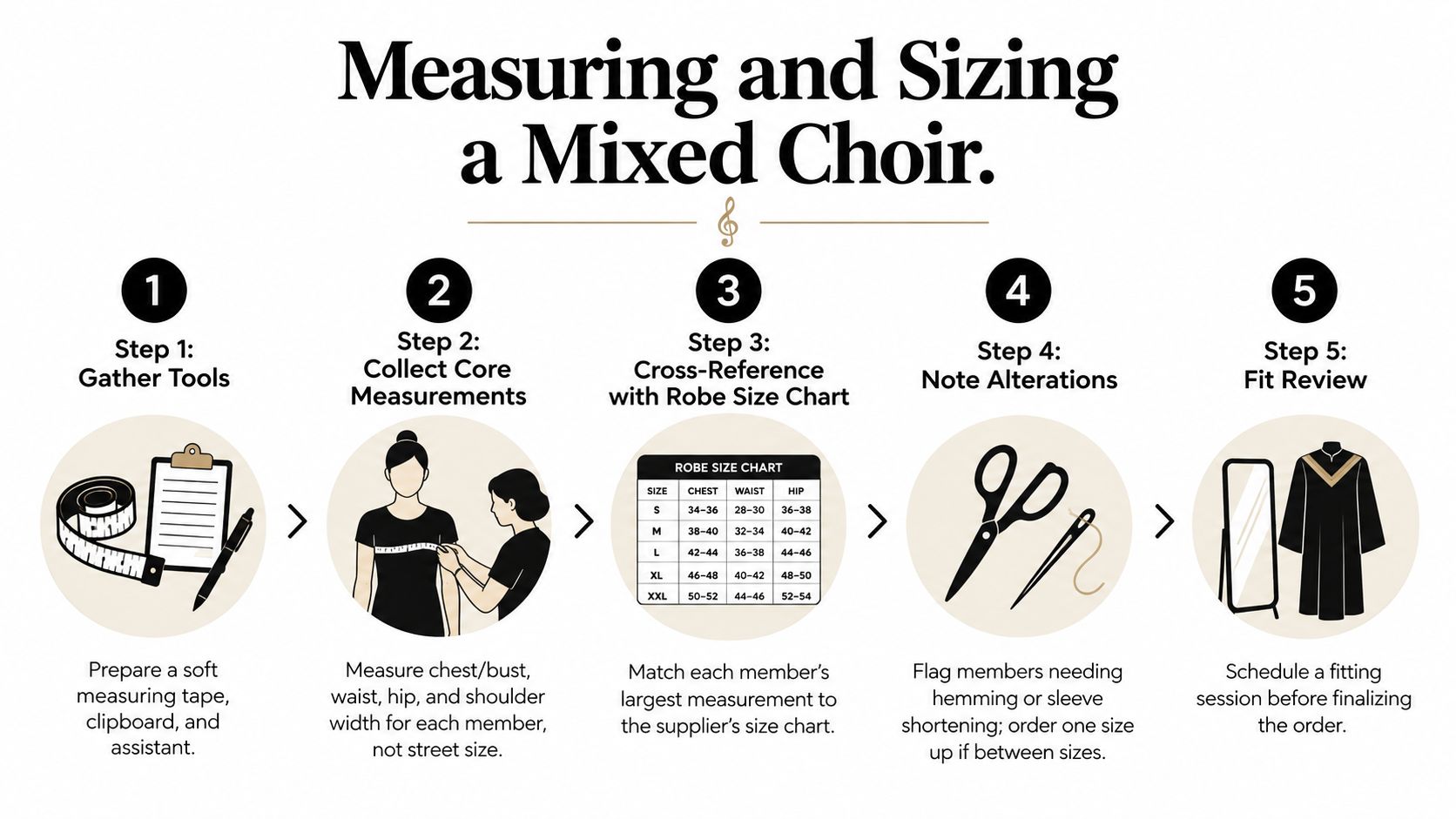
Run one supervised measuring session
Schedule a group fitting day. Use a soft tape, clipboard, roster sheet, and a helper who can measure consistently. Record the singer's name, section, age group, measurements, preferred footwear for fitting, and alteration notes.
Gather these core measurements:
- Back length: Measure from the nape to the desired hem.
- Shoulder span: Measure across the shoulders to check movement and yoke fit.
- Chest circumference: Measure around the fullest area without pulling the tape tight.
- Sleeve length: Measure from the shoulder point to the wrist or intended cuff.
Two singers with the same height may need different robe lengths. Posture, shoulder position, footwear, and the preferred hem break all affect how the garment hangs. A robe that reaches correctly on a barefoot fitting can become unsafe with formal shoes or a riser step.
Separate distribution from tailoring
Divide the roster into grade-school, adult, tall, petite, and plus-size groups. Flag members who need sleeve shortening, a hem adjustment, side let-out allowance, wheelchair-friendly length, or a closure that can be managed independently. If someone falls between sizes, follow the supplier's chart and leave enough material for a professional alteration rather than forcing a narrow garment.
Keep the final roster sheet permanently. Record the selected size, actual measurements, alteration outcome, and robe identification if available. That record makes future additions and replacements match the original ensemble instead of restarting the process from memory.
Use the ChoirBuy size and color charts while preparing the order, and request a sample robe for a fitting group when the purchase is large or the singers vary widely in age and body shape.
The fitting video below provides another visual reference for organizing the process.
Bulk Ordering Customization and Delivery Timelines
Large robe orders fail most often at the approval stage, not because a supplier can't sew a garment. Directors approve a purple shade from a screen, submit incomplete measurements, add embroidery late, or forget that accessories may come from another dye lot. Build a written approval trail before production begins.
Request a woven or finished-fabric sample and view it in the sanctuary, classroom, or performance venue. Screen colors vary by device, and stage lighting changes how matte, satin, and velvet surfaces read. If gold piping, a contrasting yoke, or a stole will be included, inspect the complete color combination rather than approving purple in isolation.
Make customization decisions in the right order
Set the visual system before discussing decorative extras:
- Yoke style: Choose a plain, contrasting, or shaped yoke based on the choir's tradition and desired silhouette.
- Closure type: Select zipper, hook-and-loop, or button-and-loop according to dressing time and accessibility.
- Trim and piping: Specify the exact accent color, placement, width, and finish.
- Embroidery: Approve the artwork, thread color, size, and placement on the chest, sleeve, yoke, or stole.
- Coordinated accessories: Decide whether stoles, cinctures, and other pieces will match the robe fabric or intentionally contrast with it.
Keep the design restrained. A single consistent accent usually looks more professional than several competing borders, logos, and symbols. If the choir will use the robes for both worship and concerts, choose a base garment that remains appropriate without requiring every singer to wear a special accessory.
Build a timeline with checkpoints
Plan the order at least 10 to 12 weeks before first wear. That lead time should include:
- Sample and shade approval.
- Measurement collection and verification.
- Final artwork and customization approval.
- Production check-in.
- Delivery inspection and fitting.
- Alterations, exchanges, and replacement requests.
Domestic custom production may simplify communication, returns, and replacement coordination. Overseas bulk pricing may look attractive, but duties, transit uncertainty, return logistics, and the availability of replacement stock can change the cost and risk. Ask whether the supplier can reproduce the same shade and construction for later additions.
When the shipment arrives, photograph the cartons, labels, and every robe before distributing anything. Check quantity, size, shade, closures, embroidery, trim, seams, and stains. Keep the photographs and packing documents with the order record so a missing or damaged item can be reported promptly.
Caring for Purple Robes Through the Seasons
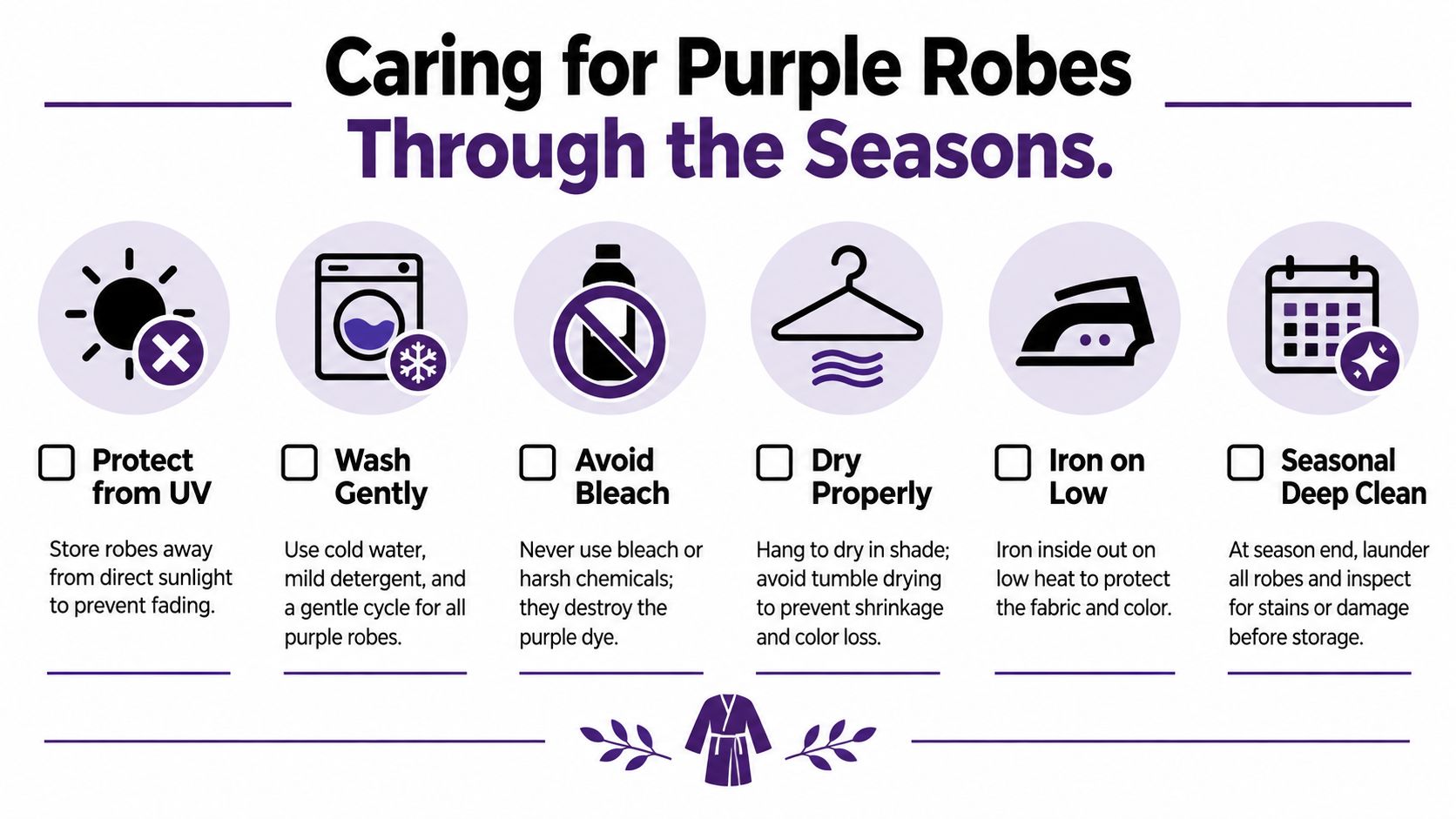
Purple fabric has two persistent enemies, ultraviolet exposure and aggressive cleaning. Store robes away from direct sunlight, avoid harsh detergents, and don't treat every material as if it can tolerate the same heat. The care label for the specific garment takes priority, especially for wool blends and specialty finishes.
Wash by fabric, not by habit
For polyester purple choir robes, use cool water, a gentle cycle, and a pH-neutral, color-safe detergent. Wash them separately from white albs and black cassocks when possible. Dark garments can release lint or loose dye, while white garments can pick up purple fibers and residue.
Polyester is dimensionally stable when processed well, but thermal relaxation and excessive finishing heat can change the garment. A single high-heat laundering cycle can shrink polyester by roughly 3% to 5%, according to the technical fabric guidance cited earlier. Keep water and dryer temperatures controlled, and hang the robes promptly after washing.
For stains, work cold. Blot candle wax after it hardens, lift residue carefully, and avoid pressing it deeper with a hot iron. Dab makeup and incense residue with a mild, compatible cleaner after testing an inconspicuous area. Wine should be blotted immediately, then treated with cold water and mild soap according to the garment's care instructions.
Protect shape during drying and storage
Hang polyester in shade to reduce heat-set wrinkles and avoid unnecessary color stress. Cotton and wool blends may require different drying instructions, so follow the label rather than applying one universal rule. Iron only when necessary, use low heat, and turn the robe inside out to protect the visible surface.
Use wide padded hangers to support the shoulders. Store garments in breathable bags, not sealed plastic, and place cedar blocks nearby instead of mothballs. Before each Advent and Lent cycle, inspect hems, closures, trim, embroidery, and stains. A short inspection catches damage while a tailor or cleaner still has time to correct it.
Storage rule: A robe closet should be cool, shaded, dry, and organized by size. Don't compress clean garments into a dark plastic bin and expect next season's presentation to look polished.
Director Checklist and Purple Robe FAQ
A good robe program is easier to manage when the director treats it like an inventory system rather than a one-time purchase. Keep the shade approval, fabric specification, measurements, alterations, accessories, and care routine in one file. That record protects consistency when singers join, bodies change, or a single robe needs replacement.
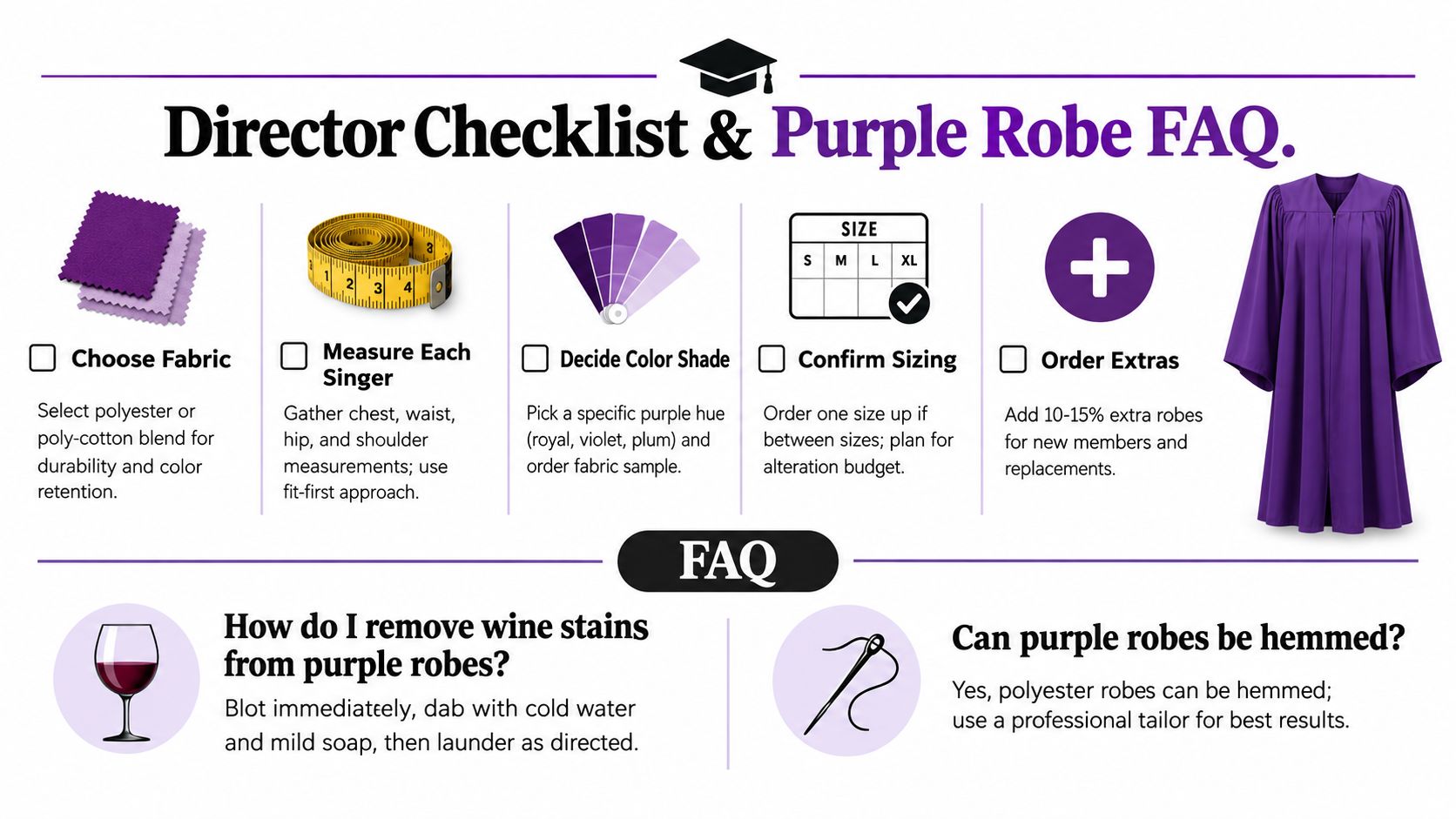
Use this final order check
- Confirm liturgical use: Verify Advent, Lent, concert, and special-service requirements with the pastor or worship leader.
- Approve the shade: Compare a physical purple sample with clergy vestments, stoles, altar colors, and sanctuary lighting.
- Choose fabric: Select polyester or a blend for regular use, and document care, shrinkage, and colorfastness expectations.
- Measure singers: Record chest, shoulder span, back length, and sleeve length for every member.
- Plan alterations: Mark hems, sleeves, side adjustments, wheelchair-friendly lengths, and accessibility needs.
- Order accessories together: Coordinate stoles, cinctures, trim, and embroidery whenever possible.
- Set the inspection date: Photograph the delivery, verify every piece, and schedule a fitting before first wear.
Questions directors ask
Can purple robes be worn for non-liturgical concerts? Yes. A choir can use purple for concerts, school performances, pageants, and community events when the color supports the ensemble's identity. For a liturgical service, follow the denomination's calendar and local worship guidance.
How should new stoles match older robes? Never rely on a product photo. Send a physical robe or swatch to the supplier, compare dye lots under venue lighting, and accept that an older garment may have faded. Reusing the robe with a deliberately contrasting stole can look better than forcing an imperfect match.
Where should embroidery go? Chest placement is visible and formal, while a stole or yoke can carry a larger emblem without crowding the robe front. Outsourced embroidery is acceptable when the vendor provides a proof and confirms thread color, scale, and placement before production.
What if a singer joins at the last minute? Keep the roster sheet, order a spare in a central size range only after reviewing your actual distribution, and ask whether the supplier can reproduce the original shade and trim. Don't assume a later order will match automatically.
ChoirBuy offers wholesale purple choir robes, including matte and shiny options, children's styles, choir stoles, size and color charts, and customization for ensembles with varied needs. Review the available options and use the ChoirBuy ordering tools to compare fabric, sizing, and coordinated accessories before your next seasonal deadline.