

A church choir robe isn't just a uniform—it's a powerful symbol of unity and shared purpose that can truly elevate a worship service. When everyone is dressed in harmony, the focus naturally shifts from individual attire to the collective voice of the ministry. Think of it as an investment in your choir's presence and a key part of the worship experience.
Your Guide to Selecting the Perfect Church Choir Robes
For any choir director or church committee, choosing the right robes is a big decision. It's a real balancing act between honoring tradition and finding something practical, making sure they look great without sacrificing durability, and, of course, working within a budget. This guide is designed to be your trusted companion, walking you through every important consideration for purchasing your next church choir robe.
We'll cover everything from the rich symbolism behind different robe styles and liturgical colors to the nitty-gritty details of fabric and sizing. The goal here is to give you the confidence to make an informed choice that will serve your choir beautifully for years to come. We'll also get into things like custom embroidery and how you can save money by ordering in bulk.
To get started, let's look at a quick overview of the key decision points we'll dive into. This table breaks down the most important factors to help you begin thinking about what matters most for your unique choir.
Key Decision Factors for Your Church Choir Robe
| Decision Factor | Key Considerations | Why It Matters for Your Choir |
|---|---|---|
| Styles & Garments | Traditional robes, cassocks, surplices, and stoles. | The style you choose sets the visual tone for your choir and should align with your church’s specific worship tradition, whether it's formal or more contemporary. |
| Fabric & Durability | Polyester blends, matte vs. satin finish, fabric weight. | The right fabric is everything—it ensures your choir is comfortable, the robes resist wrinkles, and your investment lasts for the long haul. |
| Sizing & Inclusivity | Height and chest measurements, standard vs. plus-size options. | Proper sizing is crucial for a polished, uniform look and, more importantly, helps every single member feel comfortable and included. |
| Color & Symbolism | Liturgical calendar colors, versatile primary colors. | Color can powerfully reflect the church season, enhance the worship atmosphere, and forge a strong visual identity for your group. |
| Customization | Embroidery of logos, crosses, or church names. | Personal touches turn a standard church choir robe into a unique garment that proudly represents your specific faith community. |
| Budget & Bulk Pricing | Cost per robe, package deals, and quantity discounts. | Smart budgeting and taking advantage of bulk pricing allow you to get high-quality robes while being a good steward of church funds. |
With these key areas in mind, you're ready to start building a clear picture of the perfect robes for your choir.
Exploring Different Choir Robe Styles and Garments
The world of choir apparel is more diverse than you might think, with each garment carrying its own history and purpose. Choosing the right look isn't just about picking a color; it’s about speaking a visual language that fits your church's tradition and elevates the entire worship experience. Whether your services are contemporary and high-energy or deeply traditional, understanding your options is the first step toward a unified, inspiring look for your choir.
The foundation for any choir's uniform is, of course, the church choir robe. It’s the single piece that instantly creates unity, shifting the focus from what everyone is wearing as an individual to the collective group. Even here, you have some important choices to make.
The Classic Choir Robe
For most churches, the go-to choice is the traditional fluted choir robe. You'll recognize it by the elegant pleats—called fluting—that flow down from a sturdy shoulder yoke. This design gives the robe a full, graceful appearance that brings a real sense of dignity to the choir.
On the other hand, many modern choirs lean toward open-sleeve or bell-sleeve designs. These styles have a more contemporary feel and offer a bit more freedom of movement, which can be a big plus in more dynamic worship settings. You can explore a variety of simple choir robe styles to see what foundational look feels right for your group's comfort and needs.
Building a Complete Liturgical Look
Beyond the main robe, you can layer other pieces to create a more formal and historically rich look. This is where garments like the cassock and surplice come into the picture.
- The Cassock: Think of this as the base layer. It's a full-length garment, usually in black, red, or white, worn under other vestments to provide a solid block of color and a formal shape.
- The Surplice: This is a shorter, white tunic with wide, flowing sleeves that is always worn over the cassock. The contrast of the white surplice against the colored cassock creates a classic, timeless combination seen in countless liturgical traditions.
Putting these two pieces together—the cassock and surplice—results in a distinguished look that echoes centuries of church history.
Distinct choir garments are far from a modern idea. Church choir robes actually trace their roots back to medieval Europe. By the 12th century, clerical garments like cassocks and surplices were worn to symbolize humility and unity in worship, and they had evolved into standard choir attire by the 1800s.
The Finishing Touch: Choir Stoles
Finally, the choir stole is what really adds that pop of color and meaning. A stole is a long, decorative band of cloth, almost like a scarf, that is draped over the robe or surplice. It's more than just an accessory; it serves a few key roles.
First, stoles are a fantastic way to mark the liturgical season. Your choir could wear purple stoles during Lent and Advent, then switch to white ones for Easter and Christmas. This lets you adapt your look to the church calendar without having to buy entirely new sets of robes.
Stoles are also the perfect canvas for customization. Adding an embroidered cross or your church’s logo gives your choir a unique, identifying touch. They can even be used to signify specific roles or honors within the group, making them a wonderfully versatile and meaningful part of the uniform.
2. Choosing the Right Fabric and Color
The fabric and color of your choir robes do more than just create a look—they set the tone for your ministry. They affect everything from a singer's comfort during a two-hour service to the powerful visual message your choir presents to the congregation. Getting this right means your investment will not only look stunning but will also hold up for years to come.
Most modern choir robes you'll find are made from high-quality polyester or polyester blends, and for good reason. These fabrics are true workhorses. They're fantastic at resisting wrinkles, keep their vibrant color wash after wash, and are built to last. For a busy choir director, that translates to less time worrying about maintenance and more time focusing on the music.
Fabric Finishes and Weaves
Even within the world of polyester, the specific finish can dramatically change the robe's personality. Think about your church’s worship style—is it more traditional and reflective, or contemporary and celebratory?
-
Matte Finish: A matte fabric offers that classic, understated elegance with absolutely no shine. It’s the go-to choice for traditional sanctuaries, creating a sense of dignity and reverence that keeps the focus squarely on worship.
-
Satin or Shiny Finish: On the other hand, a fabric with a bit of sheen catches the light beautifully. This creates a more festive, vibrant feel that can bring a wonderful sense of energy to your choir's presentation.
Don’t forget about the fabric's weight. A breathable, lighter-weight material is a must for keeping your choir members comfortable, especially if your church is in a warmer climate or services tend to run long. A comfortable singer is a focused singer.
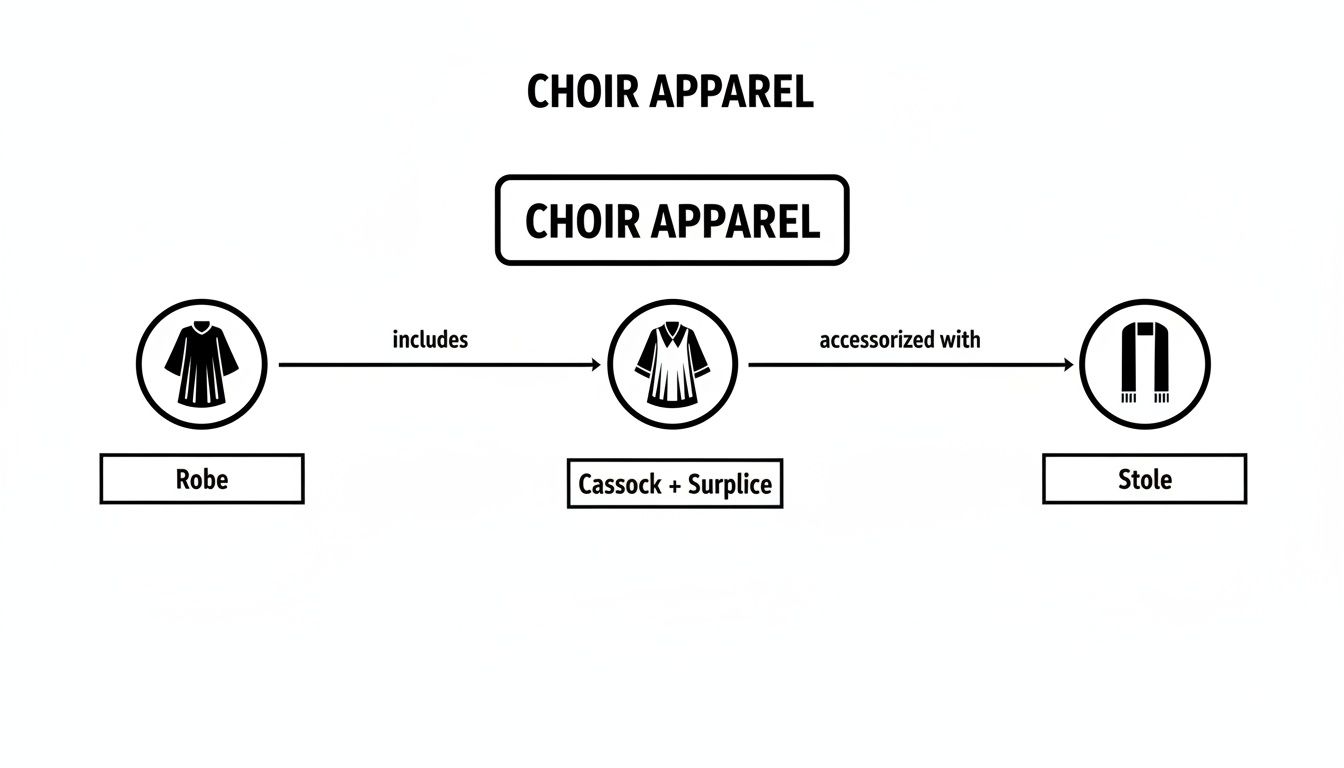
As you can see, the robe serves as the foundational garment. From there, you can layer pieces like cassocks, surplices, and stoles to build a complete and traditional liturgical uniform.
To help you navigate the options, here’s a quick comparison of the most common fabrics you'll encounter.
Comparing Popular Choir Robe Fabrics
| Fabric Type | Key Characteristics | Best Suited For | Care Instructions |
|---|---|---|---|
| Matte Polyester | Lightweight, wrinkle-resistant, non-reflective, highly durable. | Traditional worship settings, choirs wanting a classic and subdued appearance. | Machine wash cold, tumble dry low. |
| Satin Polyester | Shiny, light-catching finish, elegant drape, wrinkle-resistant. | Celebratory services, gospel choirs, contemporary settings wanting a vibrant look. | Machine wash cold on a gentle cycle, hang to dry or tumble dry low. |
| Poplin | Crisp feel, durable plain weave, often a cotton/poly blend. | Choirs in warmer climates seeking breathability and a more structured look. | Machine wash, may require light ironing for a crisp finish. |
| Peachskin | Soft, suede-like feel with a beautiful, fluid drape. | Premium robes where comfort and a luxurious appearance are top priorities. | Often requires gentle cycle or hand washing; check manufacturer's label. |
Ultimately, the right fabric feels as good as it looks and makes life easier for everyone involved in the music ministry.
The Symbolic Power of Liturgical Colors
In a church setting, color is so much more than a design choice—it's a form of visual ministry. The colors your choir wears can connect directly to the liturgical calendar, visually support a sermon's theme, and foster a powerful, unified atmosphere for worship.
Every color carries rich symbolic meaning rooted in centuries of Christian tradition. Choosing a versatile primary robe color like black, white, or deep blue is often a practical choice for year-round use. But understanding the language of liturgical colors can elevate your choir's role in the service.
Choosing the right colors for your choir's robes can connect your music ministry directly to the heart of the liturgical season. It’s a way to visually echo the spiritual journey the congregation is on, from the anticipation of Advent to the celebration of Easter.
For example, certain colors are deeply tied to specific seasons on the church calendar:
- Purple: Often used during times of preparation and penitence, such as Advent and Lent.
- White or Gold: Signifies purity, light, and immense joy. This is the color for major celebrations like Easter and Christmas.
- Red: Represents the fire of the Holy Spirit, sacrifice, and the blood of martyrs. You’ll see it used for Pentecost, ordinations, and services honoring saints.
If you want to dive deeper, you can learn more about the profound meaning behind different choir robe colors and how to best use them. A very smart and common strategy is to invest in a neutral-colored primary robe and then use accessories to bring in the liturgical colors. Colorful choir stoles are a perfect, budget-friendly way to adapt your look to the church calendar without needing to buy multiple sets of robes.
Getting a Perfect Fit for Every Choir Member
A truly unified choir isn't just about matching colors and styles. It’s about making sure every single church choir robe fits beautifully. A robe that’s too tight in the shoulders or dragging on the floor isn't just a visual distraction; it can make a singer feel self-conscious and uncomfortable. That’s the last thing you want when they should be focused on worship.

Let's walk through a simple process for getting those measurements right. It’s easier than you think and ensures every member of your choir feels confident, allowing their voices—not their attire—to take center stage.
The Two Most Important Measurements
Good news: you don't need to be a professional tailor to size your choir. Robe fitting is designed to be straightforward, boiling down to just two key measurements.
-
Height (Head to Toe): This is the big one, as it determines the robe's overall length. The trick is to measure the person while they're wearing the shoes they’ll likely wear during a service. This little step makes a huge difference and prevents any surprises with robes that are too short or too long.
-
Chest Size: This measurement makes sure the robe closes properly and gives the singer enough room to breathe and move. You'll want to measure around the fullest part of the chest. Keep the tape measure level with the floor and snug, but not constricting.
With just these two numbers, you can find a great fit for almost everyone.
Using a Standard Choir Robe Size Chart
Once you have everyone's height and chest size, you’re ready to match them to the right robe. Most suppliers have a simple chart to make this easy. To get a feel for how it works, check out our choir robe size and color charts. You'll see how height and chest measurements translate directly into specific sizes, taking all the guesswork out of the process.
A well-fitting robe is a key part of creating an inclusive environment. When every singer, regardless of their body type, has a garment that fits them properly, it reinforces the message that they are an equally valued member of the collective ministry.
Plus Size and Full Fit Options
Many choirs have members who need a bit more room for a truly comfortable fit. That's where "Full Fit" or plus-size options are essential. Standard robes are based on an average chest-to-height ratio. If a choir member has a larger chest measurement for their height, a standard size will likely feel tight and restrictive.
Full Fit robes solve this by adding extra fabric—usually 4-6 inches more—through the chest and shoulders without making the robe longer. This simple adjustment ensures a flattering fit for every body type, maintaining that polished, uniform look you're after.
Practical Tips for a Smooth Sizing Process
Getting everyone measured doesn't have to be a headache. With a little planning, you can make it a quick and easy task.
- Host a "Sizing Day": Set aside 15 minutes before or after a rehearsal to get everyone measured at once. This beats trying to track people down one by one.
- Work in Pairs: It’s always faster and more accurate to have members measure each other. Self-measuring can be awkward and often leads to incorrect numbers.
- Keep Confidential Records: A simple spreadsheet with each member's name and measurements is a lifesaver. Keep it private, but have it handy for future orders or when new members join. You'll be glad you did when you don't have to remeasure the entire choir for a single new robe.
Adding Custom Embroidery and Ordering in Bulk
A standard choir robe gets the job done, but customization is what transforms it from a simple garment into a true symbol of your church’s identity. Adding a personal touch with embroidery creates a distinctive, polished look, while ordering in bulk makes you a good steward of your ministry's budget.
These two ideas—personalization and financial wisdom—really go hand-in-hand. Let's look at how you can get the best of both worlds.
Adding a Personal Touch with Embroidery
When it comes to customizing choir apparel, embroidery is the gold standard, and for good reason. Screen printing can crack and fade over time, but high-quality embroidery offers a durable, elegant, and textured finish that looks sharp for years to come. It just adds a touch of class that elevates the whole look.
Some of the most popular embroidery options include:
- Church Logos: Placing your church's logo on the yoke or chest creates an immediate visual connection to your specific ministry.
- Religious Symbols: A timeless cross, a descending dove, or another meaningful symbol can be beautifully stitched onto the robe or stole, reinforcing the choir’s purpose.
- Choir Names or Initials: Adding the choir's name or the church's initials is a fantastic way to build a sense of belonging and group identity.
When you're deciding on a design, think about something that's both meaningful and easy to see from a distance. Often, a simple, bold design has a much greater impact than one that's overly complicated. To get more ideas for creating the perfect look, check out our guide to custom choir robes with a logo.
The Financial Wisdom of Ordering in Bulk
It’s just like shopping at a wholesale club—ordering robes for your entire choir at once unlocks some serious savings. Suppliers typically structure their pricing to reward larger orders, so the cost per robe drops as the quantity goes up. This is easily the most effective way to stretch your budget without ever having to compromise on quality.
Ordering in bulk isn't just about saving money; it's about ensuring absolute consistency. When all robes are produced from the same dye lot of fabric at the same time, you guarantee a perfect color match across the entire choir—a subtle but crucial detail for a truly uniform appearance.
Many suppliers offer tiered discounts that kick in at certain quantities, like for orders of 12+, 25+, or 50+ robes. It never hurts to ask about these price breaks when you're getting a quote.
Also, keep an eye out for bundled packages that include a robe and a matching stole. These package deals often offer better savings than buying each piece separately. Customization is a huge part of this market. For example, popular items like embroidered choir stoles can sell 887 units a month at a retail price around $14.17, but their wholesale cost can be as low as $3.18. This just goes to show the massive value you can get from buying in bulk.
By planning ahead and ordering for the whole group, you can achieve that distinguished, unified look while making a truly sound financial decision for your church.
Putting It All Together: A Practical Checklist for Ordering and Care
You've navigated the world of styles, fabrics, and custom details. Now, it's time to bring it all home by placing your order and setting up a simple care plan for your new robes. This final stretch is all about logistics, but a little planning here ensures a smooth process from purchase to performance. Getting these last few steps right will protect your investment and keep your choir looking sharp for years to come.
First things first, let's talk timelines. Always, always check the lead times, especially if you're ordering anything custom. If you've got your heart set on debuting the new robes for Easter or Christmas, you'll want to order well in advance. Production schedules get packed and shipping can slow down during those peak seasons, so building in a buffer is a smart move.
And before you hit that final "confirm order" button, take a minute to read the fine print on the supplier's shipping and return policies. Knowing the deal with shipping costs, delivery windows, and what happens if you need to make a return or exchange will save you a world of headaches later on.
Your Pre-Order Sanity Check
To make the actual ordering part a breeze and catch any last-minute mistakes, run through this quick checklist with your team. Having everything organized and signed off on makes the whole thing feel less like a chore and more like the exciting final step it is.
- Budget Approved? Make sure the final quote—including taxes and shipping—has the green light from your church's finance committee or leadership.
- Final Size List? Do one last pass on your list of choir member measurements, comparing it against the supplier’s size chart. Count and re-count the quantities for each standard and "Full Fit" size.
- Custom Details Verified? Look over the proof for any embroidery. Is the spelling correct? Are the colors and placement of the logo exactly what you wanted? Now's the time to be picky.
- Contact and Shipping Info Correct? Double-check that the contact person’s details and the church’s shipping address are perfect to avoid any delivery snafus.
Keeping Your Robes Looking Great
Once those boxes arrive and you see your beautiful new robes, the focus shifts from buying to preserving. Honestly, proper care is the single most important thing you can do to extend the life of your robes and keep them looking their best. The good news? It’s not complicated.
It's a huge market out there. In the U.S. alone, thousands of churches have active choirs. Industry stats show that over 80% of global suppliers target North America, with manufacturers in China's Zhejiang and Guangdong provinces producing robes at wholesale prices as low as $9.49 each. You can learn more about the market and the best choir robes available.
Proper maintenance is more than just cleaning; it's an act of stewardship. Taking care of your robes ensures that the investment your church made continues to serve your ministry beautifully for many years, honoring both the garment and the person wearing it.
Just follow these simple tips to maintain your robes:
- Washing: For most modern polyester robes, a cold, gentle cycle in the machine is perfect. It's a good idea to wash them with similar colors and turn them inside out to protect the fabric and any embroidery.
- Drying: High heat is the enemy! It can seriously damage the fabric. Tumble dry on the absolute lowest heat setting, or better yet, hang them up to air dry right after the wash cycle finishes.
- Storing: Don't just cram them in a closet. Always use sturdy, wide-shouldered hangers to keep the yoke from getting misshapen and to prevent wrinkles. Store them in a cool, dry closet with plenty of space between each robe so the fabric can breathe.
Common Questions About Outfitting Your Choir
When you’re tasked with outfitting a choir, a few questions always seem to pop up. Let's walk through some of the most common ones I hear from choir directors and church committees to help you navigate the process with confidence.
How Far in Advance Should We Order Our Robes?
My best advice? Give yourself plenty of breathing room. For a standard order, you'll want to plan for at least 4-6 weeks from the day you order to the day they arrive. That usually covers production and shipping without any nail-biting.
However, if you're planning on custom embroidery or ordering during the busy seasons—think Easter and Christmas—it’s smart to extend that timeline to 8-10 weeks. Trust me, that extra buffer is a lifesaver when production queues are long, ensuring your choir looks sharp for those big services without any last-minute panic.
What’s the Best Way to Store Robes to Keep Them Looking New?
The secret to making robes last for years is all in how you store them. As soon as they've been cleaned, get them onto sturdy, wide-shouldered hangers. This is crucial for keeping the yoke—the part that sits on the shoulders—from getting stretched out or misshapen.
Find a cool, dry closet with good air circulation. The goal is to hang them with a bit of space between each one, which prevents wrinkling and lets the fabric breathe. For an extra layer of protection against dust, I'm a big fan of breathable garment bags. They keep the robes pristine and ready to go.
Can We Get a Sample Robe Before Buying for the Whole Choir?
Absolutely, and you definitely should. Any good supplier will be happy to send you a sample so you can see the quality for yourself before committing.
Think of it as a small, smart investment. A sample lets you feel the fabric, see how the color really looks under your sanctuary's lighting, and inspect the stitching up close. It’s the ultimate peace of mind before you place a large order.
This simple step ensures there are no surprises and you'll be completely happy with the final product.
How Should We Handle Sizing for a Constantly Growing Youth Choir?
Sizing for a youth choir is a unique challenge, but the key is to plan for the inevitable growth spurts. I always suggest choosing robes with a slightly more generous cut. For kids who look like they’re about to shoot up, ordering one size larger is a smart move.
Another great strategy is to order a handful of extra robes in a mix of larger sizes. Having these in the closet means you’re always prepared for new members or when a young singer suddenly outgrows their robe. It saves you from the headache and higher costs of placing small, rushed orders all year long.
Ready to find the perfect robes that will make your choir shine? At ChoirBuy, we have a huge selection of styles, fabrics, and custom touches to match your church’s spirit and budget. Take a look at our collection and find the ideal look for your ministry. You can start exploring at https://www.choirbuy.com today.