

The robes are ready, the service is approaching, and the choir is considering headwear. Before buying for a photograph, decide whether hats belong in the ensemble's approved dress and whether the actual products work for the singers.
Why Church Choir Hats Need a Real Buying Plan
Church choir hats need a plan covering local practice, wearer role, fit, appearance, care, and cost. A catalog image cannot establish comfort, stability, or suitability for worship.
Start with the actual roster rather than an assumed typical choir size. Record who needs headwear and which questions remain unresolved before requesting a group quote.
Practical rule: Buy for the ensemble and approved program you have, not an idealized catalog photograph.
Common Outfitting Scenarios and Their Core Risks
| Scenario | What to review |
|---|---|
| Volunteer choir | Local approval, available fit, and a manageable budget |
| Larger ensemble | Individual fit needs and accurate quantities |
| Formal service | Role-appropriate design and actual lighting |
| Youth choir | Comfort, sightlines, movement, and suitable dimensions |
| Mixed-tradition ensemble | Different cultural, religious, and institutional requirements |
Decide whether headwear is required, optional, or unsuitable for the setting before choosing a shape. A coordinated appearance does not require overriding a singer's appropriate religious covering or individual access needs.
Ask what works through dressing, rehearsal, movement, and the service itself. Record the answer rather than assuming a formal-looking cap is automatically appropriate.
Where Church Choir Hats Come From and Why It Matters
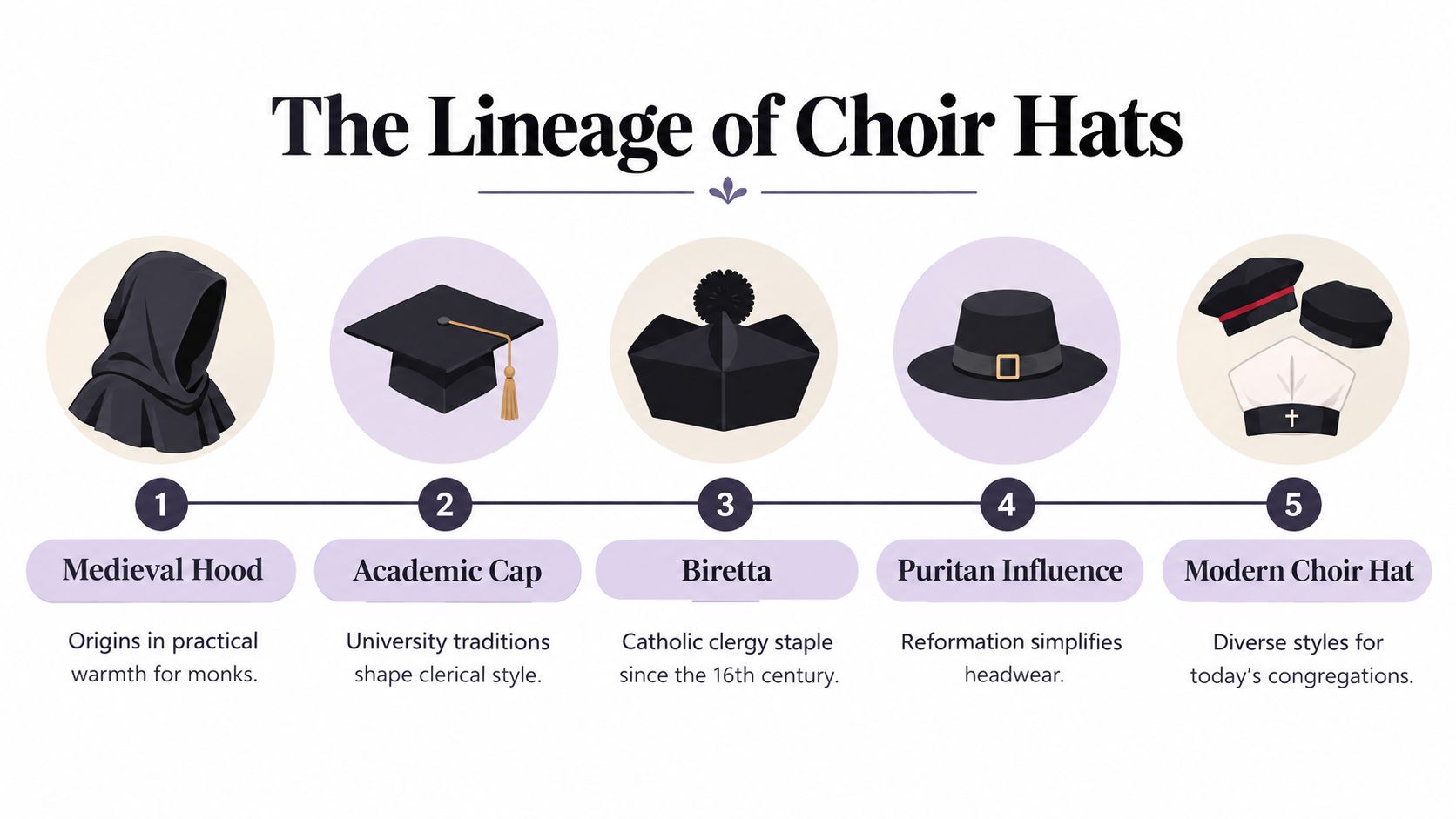
Church and academic headwear have varied histories. A hood, academic cap, biretta, skullcap, and modern choir cap should not be treated as stages of one universal choir-hat tradition.
Some garments communicate a particular role, qualification, or church convention. Historical associations do not establish present-day permission for every singer.
A hat can communicate more than coordination. Confirm its role before choosing its decoration.
The history of choir robes provides broader context. Review headwear alongside the whole outfit and current local practice rather than as an isolated fashion purchase.
Matching Hat Style to Choir Role and Denomination
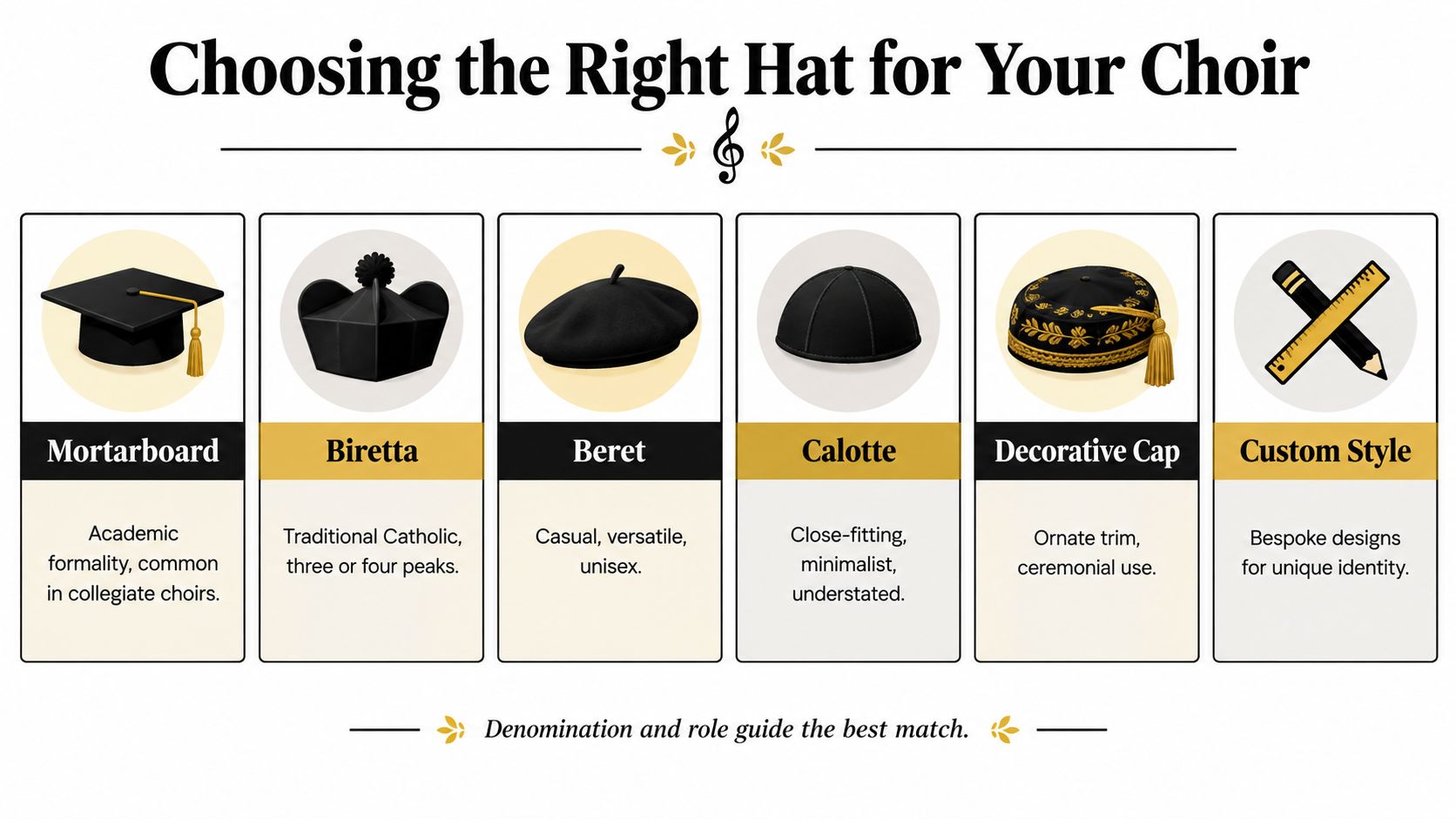
A product name or silhouette does not settle whether headwear is appropriate. Clergy and academic garments can have specific conventions that should not be transferred to ordinary ensemble apparel.
Choir Hat Styles Compared
| Style | General association | What to confirm |
|---|---|---|
| Academic cap or mortarboard | Educational and ceremonial dress | Institutional requirements and the actual event |
| Biretta | Particular clerical or ecclesiastical traditions | Role-specific permission and current practice |
| Beret-style cap | A soft-cap design that varies by product | Actual construction, fit, and local approval |
| Skullcap or calotte | Meanings vary by tradition and garment | Do not select it as a generic choir accessory without guidance |
| Choir cap | Ensemble headwear where appropriate | The exact product's dimensions, construction, and intended use |
| Proposed custom design | An institution-specific concept | Whether it can be supplied and is approved for the wearers |
These categories are comparison vocabulary, not confirmation that ChoirBuy supplies every style. Headwear is not universally required for church choirs, and particular requirements must be resolved locally.
Bottom line: Let applicable guidance and wearer needs determine the garment before adding optional decoration.
For specific available listings to assess, compare the Black Choir Cap, Red Choir Cap, and Purple Choir Cap. Their color names do not establish clerical status, adjustable sizing, or a requirement to wear them at particular services.
Fabrics, Colors, and How Hats Coordinate With Robes
Compare the actual cap and robe together. A shared color name does not guarantee matching shades, textures, or finishes, especially under different lighting and camera settings.
A contrast between matte and shiny can be intentional. Do not assume every difference is a mismatch or that an item that looks coordinated in one room will behave predictably under every stage light.
The choir robe color meaning guide provides background. Clergy seasonal colors do not automatically prescribe choir caps; confirm the ensemble's actual dress plan.
Assess the full outfit in the performance space and through the actual camera setup where practical.
Ask about sample availability and terms, then compare physical references where offered. Retain the approved specification without assuming future batches will match exactly.
Sizing, Fitting, and Accessibility for Every Singer
Follow the selected cap's measurement and fit information. Check comfort and stability with the wearer's hairstyle, glasses, hearing devices, religious covering where relevant, and other performance equipment.
Fastening and Construction Questions
| Feature to ask about | What to assess | What not to assume |
|---|---|---|
| Elastic or adjustable band | Actual adjustment range, pressure, and comfort | It is included or suits every adult and child |
| Clips or additional attachments | Whether approved for the product and wearer | They guarantee stability or are suitable for every hairstyle |
| Structured crown | Shape, fit, sightlines, and handling | A stiff shape automatically stays secure |
| Interior finish | Actual seams, labels, lining, and contact points | All caps have smooth or sensory-friendly construction |
These are questions for the proposed product, not confirmed features of the linked caps. Do not improvise pinning or alter attachments without checking suitability.
Review seated and standing use as applicable, including turning, singing, folder use, and processional movement. Confirm that the cap does not interfere with sightlines or equipment.
Ask about actual youth dimensions rather than assuming an adult cap fits a child. Do not automatically order adjustable spares if adjustable construction has not been confirmed.
Fitting principle: The wearer should be able to participate comfortably without repeatedly correcting the headwear.
Base reserves on the actual roster, available fit options, and budget. Check current exchange or return conditions before assuming an unsuitable piece can be replaced.
Customization, Embroidery, and Planning a Bulk Order
Confirm which customizations, if any, are available for the actual cap before planning a crest, monogram, trim, or custom shade. A standard product listing does not establish arbitrary personalization.
Resolve fit and role questions first. If decoration is offered, check the artwork, spelling, scale, placement, colors, and effect on construction and care.
The custom choir robe logo guide offers broader design-planning context. It does not confirm that the same services apply to caps.
Obtain the appropriate institutional approval where headwear or symbols could imply a ministry role. Use a named coordinator and independent checker for the final order.
Ordering rule: Confirm suitability and available sample or proof arrangements before approving the group purchase.
Ask for current quantity pricing and applicable bulk-order terms. Itemize garments, samples, offered decoration, setup, delivery, and any confirmed rush service. Faster shipping cannot resolve unavailable inventory or unfinished production.
A Music Director's Ordering Checklist and Care Routine
Keep a clear specification and maintenance record so future coordinators do not have to reconstruct the order.
- Confirm local practice: Establish whether headwear is required, optional, or unsuitable.
- Identify wearers: Distinguish choir apparel from role-specific garments.
- Check actual fit: Follow product instructions and record individual needs.
- Compare the outfit: Review actual cap and robe shades and finishes. The church choir outfit guide offers broader context.
- Review practical use: Check movement, sightlines, comfort, and equipment clearance.
- Confirm samples and options: Ask what is available and under which terms.
- Obtain the complete quote: Confirm current quantities, pricing, timing, and order conditions.
- Inspect on receipt: Record discrepancies promptly before distribution.
Follow the finished cap's care instructions. Do not infer washability, pressing, steaming, or a storage method from its color or appearance.
Use support suited to the construction, avoid crushing decoration or structured sections, and store items fully dry away from dampness and prolonged direct light. Ask the supplier or a qualified cleaner if instructions are missing or unclear.
Keep current issue-reporting, return, and replacement terms with the order. Do not assume rapid fulfillment, exchange eligibility, or guaranteed replacement before an event.
Common Misconceptions and Your Next Step
Church choir hats are not a universal requirement. Practices vary across communities, and a general history of head coverings cannot establish what your choir should wear today.
Coordination also does not require identical headwear regardless of cultural, religious, accessibility, or fit needs. Review appropriate alternatives with the relevant leaders and wearers.
A more dramatic design is not automatically better. Prioritize approved use, comfortable fit, clear sightlines, and an intentional appearance.
Document the decision, assess the actual products, and confirm complete order arrangements before purchasing.
Compare ChoirBuy's Black Choir Cap, Red Choir Cap, and Purple Choir Cap as specific options. Review their product information and ask about fit, construction, care, current quantities, pricing, applicable bulk-order terms, and delivery arrangements before choosing for your choir.