

The robes are hanging, the folders are packed, and the concert is close. Yet when the choir lines up, the group still looks disconnected. A coordinated accessory may help without replacing every usable robe, provided its design and fit suit the actual ensemble.
Choosing choir sashes involves more than color. Construction, terminology, accessibility, dimensions, attachment, care, and replacement planning all matter. Establish the garment you need before assuming a sash, yoke, decorative choir stole, and clergy stole are interchangeable.
Why Choir Sashes Can Support Ensemble Unity
A repeated shape or accent color can help coordinate an ensemble. The effect depends on the actual garments, placement, lighting, and wearers, not just a matching product name.

Check proposed accessories with existing robes, including those from different production batches. A shared accent can create a design connection, but it does not guarantee that differing shades, fabrics, or cuts will appear identical.
Director's rule: Review the condition and suitability of existing garments before deciding whether to refresh accessories or replace the base wardrobe.
School and concert groups may use accessories over approved formal clothing; church choirs should follow local dress practice. Confirm the combination rather than assuming every accessory is suitable over gowns, cassocks, or surplices.
A different accent may identify a section or organizational role where approved, but it should not imply an ordained ministry office.
The visual effect is practical, not cosmetic
Review the appearance from the audience area and through the actual camera setup. A color that reads clearly nearby may disappear against the venue or robe at a distance.
The choral group uniform guide offers broader design context. Keep the palette and placement deliberate rather than adding unrelated accents.
A restrained design can make inventory and later comparisons simpler. Document the actual accessory, approved placement, and available dimensions.
Understanding the History and Distinction of Choir Sashes
Formal textile bands appear in different ceremonial traditions, but similarity does not establish one direct origin or interchangeable meaning. The Victoria and Albert Museum's stole record provides historical context for a particular vestment, not a universal modern choir-sash specification.
The history of choir robes offers related background. Modern choir accessories should still be selected according to their actual construction and approved purpose.
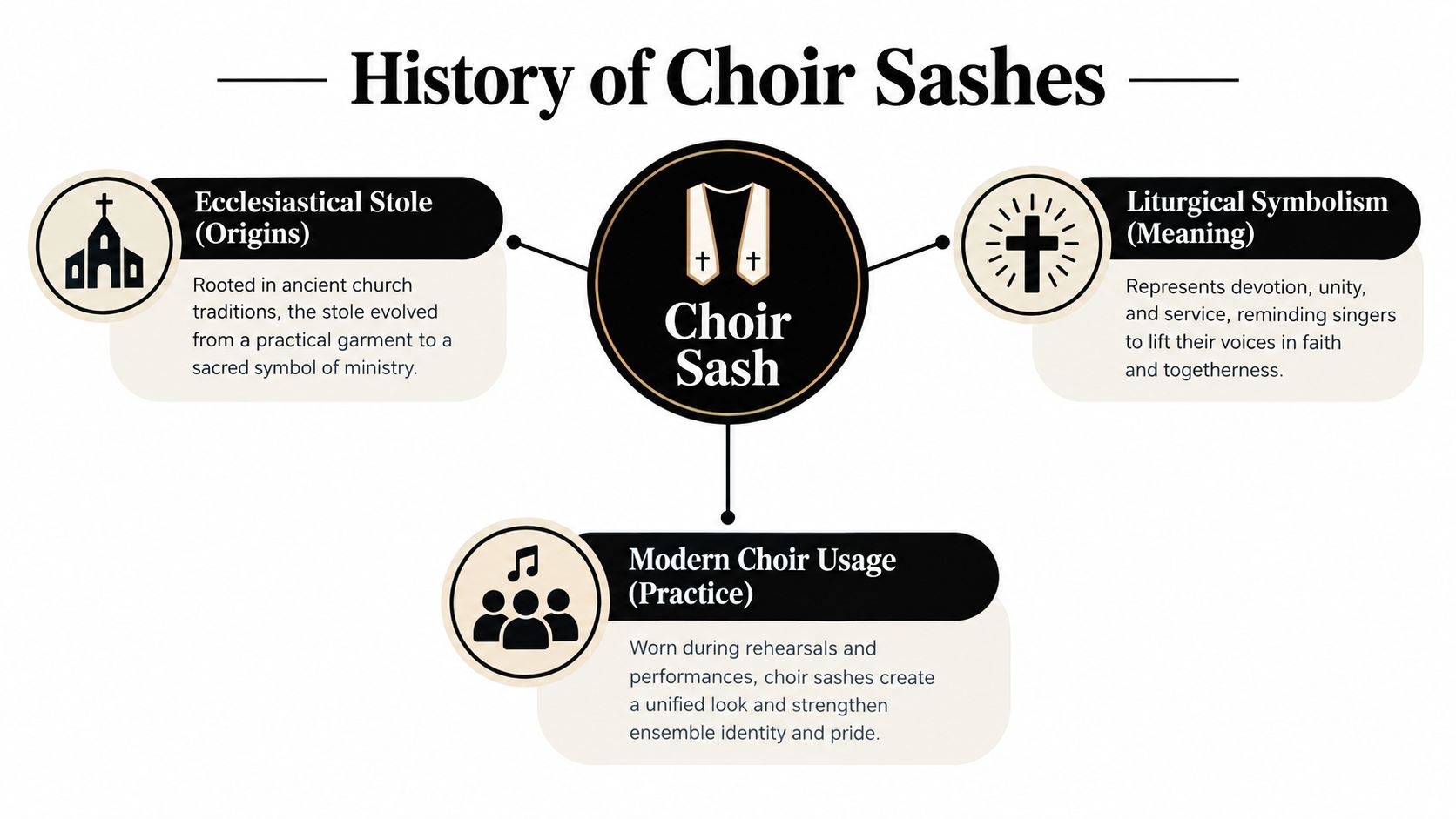
Choir sash versus clergy stole
A decorative choir sash or stole can identify an ensemble where appropriate. A priest's or deacon's liturgical stole has role-specific significance and is not a substitute for, or equivalent to, choir apparel.
The United Methodist vestments guide illustrates terminology and role distinctions in its setting. Confirm current local guidance rather than applying one denomination's rules to every ensemble.
Describe the construction accurately in the order: shoulder sash, yoke, or decorative choir stole as applicable. Do not use the name alone to infer drape, attachment, dimensions, or permission to wear it.
Historic clergy-stole dimensions are not sizing instructions for a modern choir sash. Measure according to the chosen product and assess the actual wearer.
Choosing the Right Fabric and Style for Your Choir
Compare the completed product, including lining, seams, trim, and decoration. Fiber and weave influence handling, but do not by themselves establish durability, washability, or suitability for a particular program.
| Material to assess | What to check | What not to assume |
|---|---|---|
| Polyester satin | Actual reflection, drape, construction, and care | Guaranteed easy care, snag behavior, or suitability for every ceremonial use |
| Cotton twill | Weight, structure, decoration, and finished-garment instructions | Automatically greater durability or suitability for youth inventories |
These are material categories for comparison, not confirmation that a supplier offers both for a particular accessory.
Match the textile to the operating conditions
Consider frequency, dressing assistance, movement, transport, cleaning resources, and storage. Ask about samples and their terms, then compare the proposed accessory with the actual robe and venue.
Inspect edge finishing, seams, attachment areas where present, and any decoration. A particular stitch count or finishing method is not a universal guarantee of strength or suitability.
Let the design serve the ensemble
Check width and decoration on representative wearers. A wider accessory may display an emblem differently, but can also affect neckline comfort and movement.
The religious fabric guide helps with terminology. It does not establish which materials or custom features are available for the proposed garment.
Strategic Color Selection for Voice Sections and Liturgy
Decide whether the palette should communicate one ensemble identity, identify sections, or reflect approved seasonal practice. Combining systems without a clear plan can complicate the appearance and replacement inventory.
The Henry Ford's account of the Eames choral robes provides a design precedent for using color to organize an ensemble. Its history does not establish the lifespan, performance, or appropriate palette of another garment.
Choose a clear color strategy
A single accent may simplify coordination. If section colors serve a real purpose, keep a written assignment and review whether the distinctions remain useful as membership changes.
The choir robe color meaning guide offers background. Test actual shades and finishes rather than assuming a color name guarantees contrast or consistency.
For church use, the St Paul's Cathedral discussion of liturgical colors describes its context. Its palette should not be treated as a universal rule or an automatic requirement for decorative choir accessories.
Confirm occasional colors locally
The Diocese of Lincoln's explanation of liturgical colors provides Catholic context, including rose on specific Sundays. That does not mean every choir needs a rose accessory set.
Confirm the actual service requirements and approved dress before ordering. Clergy color conventions do not automatically prescribe choir-sash purchases.
Sizing, Attachment, and Construction Details
Assess the accessory over the actual robe and intended layers. Use the selected product's measurement method rather than street-clothing labels or historic vestment dimensions.
Review standing or seated use as relevant. Check the neckline, shoulder placement, endpoint, and interaction with folders, chairs, steps, instruments, or mobility equipment.
Assess the actual closure with the wearer
Confirm what construction and fasteners are supplied before assuming ties, adjustable closures, or an alternative fastening are available. No single closure suits every wearer.
Research on inclusive apparel design provides general context for reach, dexterity, and mobility considerations. It does not establish that a specific accessory includes adaptive features.
Review comfort and dressing needs with the actual wearer. Any magnetic fastening proposal requires appropriate attention to the user's circumstances and equipment rather than a blanket accessibility recommendation.
Fitting principle: Coordinate appearance without sacrificing comfortable movement or the wearer's dressing needs.
Inspect the actual construction
Check attachment areas where present, seams, ends, and decoration for damage or distortion. A decorative accessory is not a load-bearing strap or protective garment.
Ask whether any changes or repairs are suitable before modifying the product. Do not assume every design can be shortened, reinforced, or fitted with another closure.
Use permitted sample checks and the finished garment's instructions. Do not wash, heat-treat, or alter a sample without confirming permission and terms.
Bulk Ordering, Customization, and Care Tips
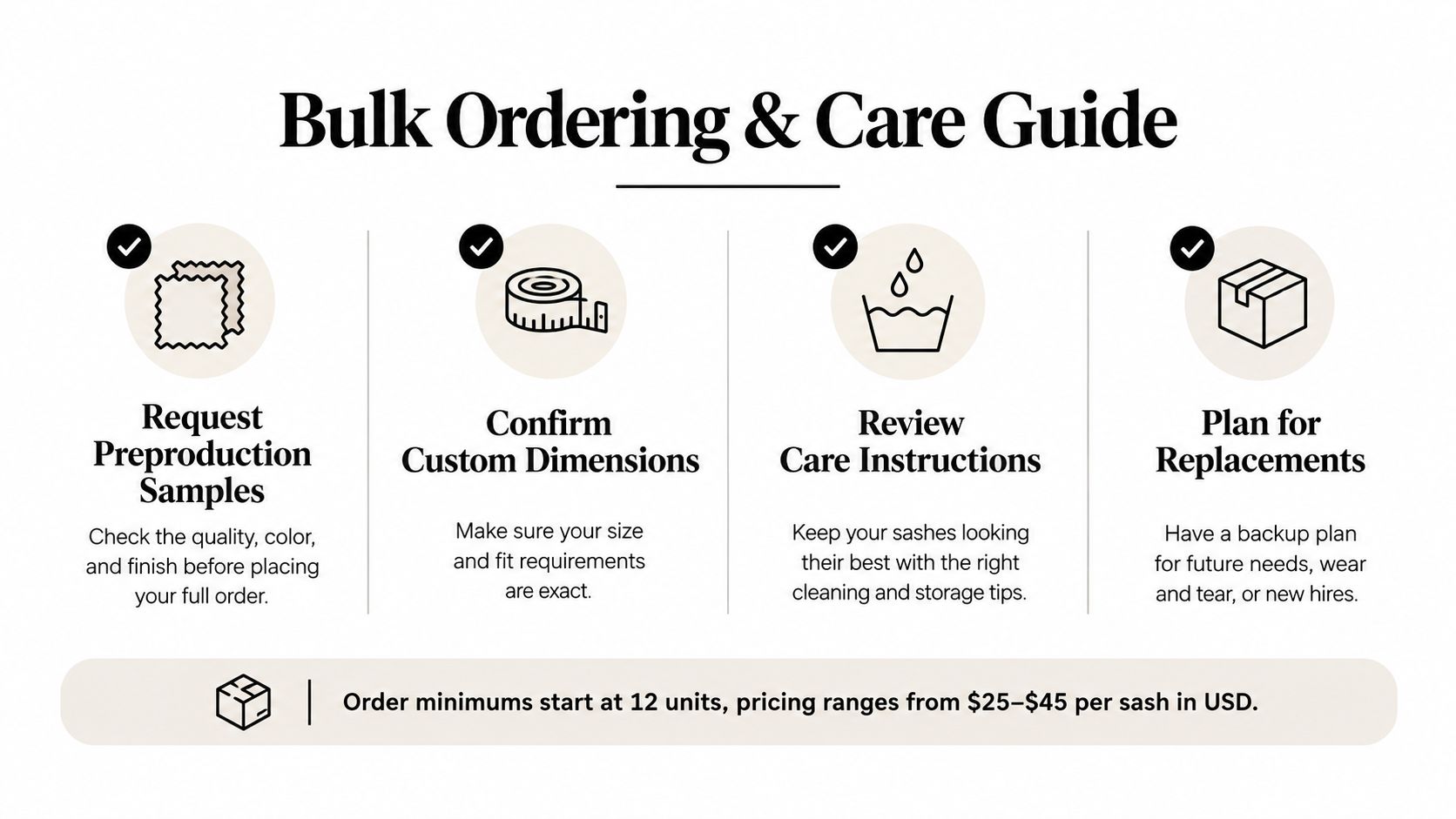
Before the full purchase, confirm product dimensions, quantities, approved colors, construction, availability, and care. Record what has actually been tested and which fit questions remain unresolved.
Calculate lifecycle value, not just purchase price
Choir-dress market reporting provides industry context, not product-specific proof of durability, environmental benefit, or care performance.
Compare actual purchase, maintenance, repair, storage, and replacement needs. Reusing a suitable base robe with selected accessories may be practical, but does not automatically establish a sustainability claim.
- Initial order: Include garments, available decoration, setup, samples, and shipping.
- Maintenance: Plan the documented cleaning process and storage requirements.
- Repair: Assess construction suitability and realistic repair costs.
- Later additions: Confirm current stock and shade coordination rather than assuming exact matching.
Customization should serve a clear purpose
Confirm which changes are available for the actual product before planning embroidery, badges, appliqué, or custom colors. If decoration is offered, approve artwork, spelling, scale, placement, and colors in writing.
Document approved placement and any event-specific dress instructions. Do not transfer another organization's handbook or badge convention to your choir without a reason.
Request current quantity pricing and any applicable bulk-order terms. Keep an itemized quote, current order conditions, final specifications, and confirmed delivery arrangements together.
Build care into the order
Follow the completed garment's care label, including requirements for lining and decoration. A fiber name or finish does not establish whether washing, dry cleaning, pressing, or steaming is appropriate.
If instructions are unclear, ask the supplier or a qualified cleaner before treatment. Store garments fully dry using support suited to their construction, away from dampness, prolonged direct light, and crushing.
If a decorative choir stole rather than a shoulder sash suits your approved design, compare the White Traditional Choir Stole and Gold Traditional Choir Stole. These are related accessory alternatives, not confirmation that ChoirBuy supplies every sash style described here. Review their actual dimensions and care, then confirm quantities, current pricing, applicable bulk-order terms, and timing before purchasing.