

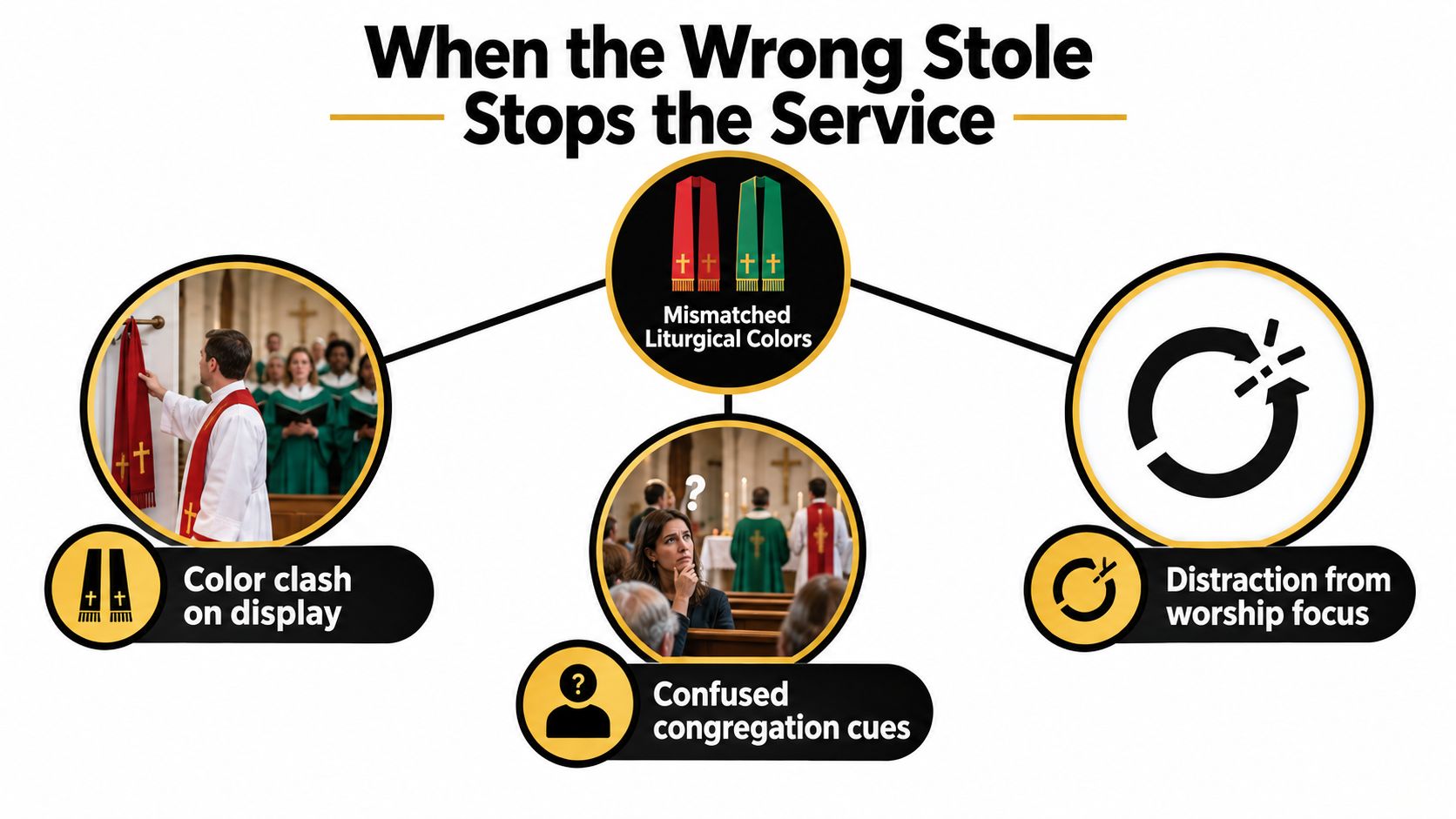
Sunday morning is already moving too fast. The choir is robed, the service sheet is printed, and then a deacon reaches for a red stole while the choir stands in green. A second stole is gold-edged but belongs to another season. Someone searches a vesting room drawer, the altar party waits, and the congregation watches a wardrobe problem become part of the liturgy.
That failure is rarely caused by bad taste. It comes from buying choir robes and stoles as separate accessories instead of managing them as one wardrobe system. A stole can look excellent in a catalog and still be the wrong color, wrong length, wrong construction, or wrong garment for the scheduled service.
When the Wrong Stole Stops the Service
A stole is a long, narrow band of fabric worn around the neck and shoulders. It developed from the Roman orarium, a narrow cloth comparable to a scarf or napkin, and later became associated with ordained or authorized ministry. Think of it as a name tag with ceremonial weight. It identifies the wearer, signals a role, and may mark a season, occasion, or institutional affiliation.
That meaning separates the stole from related garments. A surplice is a loose white outer robe, while a cassock is a close-fitting under-robe. An alb is a white tunic. An Anglican tippet is a scarf-like garment used as part of choir dress, and it isn't the same thing as a stole. These distinctions matter because a choir may properly wear one garment while clergy or liturgical ministers wear another.
The history explains why catalog language can mislead. In the early Christian period, approximately 400–800 CE, clergy continued wearing earlier Roman garments for worship even as secular clothing changed. By the ninth century, the alb, stole, dalmatic, chasuble, and pallium had become established church vestments. By the seventh century, wearing position also distinguished rank, with deacons wearing the stole over the left shoulder, priests crossing it across the breast, and bishops wearing it straight down so it wouldn't cover the pectoral cross. Britannica's history of Roman Catholic religious dress documents this development.
Start with the garment, not the color
Before choosing green, white, or purple, identify who will wear the item and under which tradition. Traditional Anglican choir dress centers on a cassock beneath a surplice, sometimes with a scarf or tippet. The tippet belongs to Anglican choir dress, while the stole is generally associated with sacramental ministry rather than ordinary choir office. A clergy member officiating at the same service may need a stole, but the choir may need a surplice-and-tippet system instead.
If your team is unsure how the garment should sit, use this practical guide to wearing a stole before approving a bulk order. The supplier's product name can't resolve a denominational question for you.
Buyer's rule: Write the wearer, tradition, service, and season on the specification before you discuss trim or embroidery.
By the end of your buying process, you should have a supplier-ready specification covering the robe system, dominant color, intended occasions, fabric, sizing method, customization, and care requirements. You should also have a sample-vetting checklist that tests fit, movement, laundering, color transfer, and attachment points. That paperwork prevents the catalog from making the decision for you.
Choosing the Right Fabric and Construction
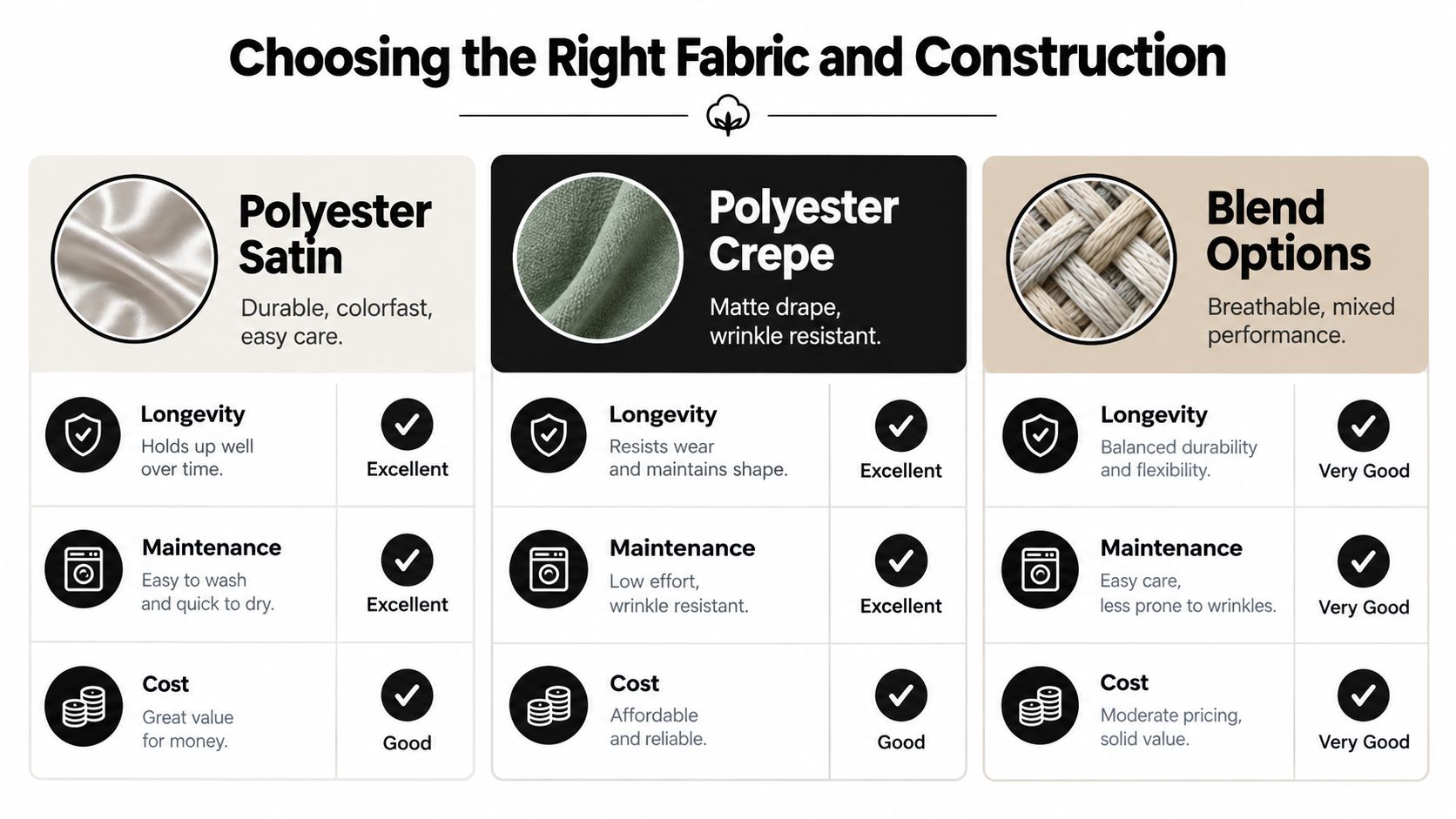
Fabric is a performance decision. Polyester satin gives seasonal stoles a visible sheen, holds dye well, and usually handles repeated institutional use without the fragility of delicate natural fibers. It works for celebratory services, but strong stage or sanctuary lighting can make the shine more prominent than expected.
Polyester crepe or matte fabric is my usual recommendation for a choir that travels, folds garments into cases, or performs under bright lights. Its quieter surface hides handling marks and wrinkles better than satin. Silk or a silk blend offers a premium hand and graceful drape, but it demands a more careful care plan and may require professional cleaning.
Don't compare fabrics only by the price of one stole. Compare cost per wear. A lower-priced stole that survives 200 performances is a better stewardship decision than a higher-priced stole that survives 50. Those figures are a planning example, not a market benchmark, so record your own expected services, concerts, washing cycles, and replacement risk.
Construction details that deserve inspection
Ask the supplier for the fabric weight in grams per square meter. A heavier material may drape better, but it can also add heat and bulk. Check whether edges are fully finished or merely serged, whether a reversible stole has a proper lining, and whether the neck band is reinforced. The neck band receives repeated stress during dressing, removal, and adjustment.
Use a sample protocol before placing a group order:
- Wash the fabric swatch five times using the intended care method.
- Check for color transfer onto a light cloth.
- Measure shrinkage and compare it with the supplier's specification.
- Line-dry the swatch and feel whether it becomes stiff, rough, or distorted.
- Inspect embroidery, borders, and edge behavior if the sample includes them.
Sustainable-uniform guidance recommends colorfastness of at least 4 on ISO 105-B02, shrinkage below 3%, and performance after 50 or more washes. The same guidance says cold washing, line drying, and proper storage can extend garment life by up to 50%. The cited uniform guidance provides those specifications, but your sample test still matters because a supplier's fabric label doesn't tell you how the finished stole behaves.
For fabric yardage and material planning, review religious fabric by the yard alongside the garment specification. Don't approve a material until it works under your lighting, laundering, and storage conditions.
Matching Liturgical Colors to the Church Calendar
Color is a functional specification, not a decoration. A beautiful stole in the wrong dominant color may be unusable for the service where you need it.
The Roman Rite uses white for Christmas and Easter seasons, celebrations of Christ outside the Passion, Marian feasts, angels, and non-martyr saints. Red serves Palm Sunday, Good Friday, Pentecost, the Lord's Passion, apostles, evangelists, and martyrs. Green belongs to Ordinary Time, violet or purple to Advent, Lent, and commonly services for the dead, and rose may be used on Gaudete and Laetare Sundays. In the United States, funeral services may also permit white or black alongside violet. The Roman Catholic color reference sets out these uses.
| Season or Occasion | Roman Rite | United Methodist |
|---|---|---|
| Advent | Violet or purple | Purple or blue |
| Christmas | White | White |
| Lent | Violet or purple | Purple |
| Easter season | White | White |
| Pentecost | Red | Red |
| Ordinary or post-Pentecost season | Green during Ordinary Time | Green for much of the season after Pentecost |
| Funerals | Violet, with white or black sometimes permitted in the United States | Follow the congregation's approved practice |
| Gaudete or Laetare Sundays | Rose may be used | Follow local practice |
The United Methodist Church also identifies white for Christmas, white from Easter through Pentecost, red for Pentecost, and green for much of the season after Pentecost. Its official liturgical color glossary should guide Methodist purchasing committees rather than a generic church-color chart.
Build a usable seasonal set
Start with green, white, and purple. Those colors cover the core recurring stretches of many church calendars. Add red for Pentecost and designated feasts, then rose if your tradition uses it. Specify the dominant field color first. A green stole with a gold border remains a green stole for classification purposes. The border doesn't turn it into a gold vestment.
Avoid the so-called universal stole that combines several colors into one decorative panel. It may appear flexible, but it can satisfy no season properly and may create confusion for ministers and congregants. Use the ChoirBuy choir stoles color guide as a planning reference, then confirm the rule with your denomination or diocese before ordering.
Building a Matching Choir Ensemble Look
A stole can't rescue a robe system that was never coordinated. Before you select a trim, decide whether the ensemble uses surplice-over-cassock, alb-over-cassock, or a single graduation-style choir gown.
The surplice-over-cassock system is common in Anglican and many Protestant choirs. The cassock provides the close-fitting base, while the surplice supplies the loose white outer layer. In traditional Anglican dress, a scarf or tippet may accompany the system. A stole generally belongs to sacramental ministry, not ordinary choir office, so don't automatically place a clergy stole on every chorister.
The alb-over-cassock or single-robe approach is common in Roman Catholic and other traditional settings. Here, a stole may be appropriate for clergy or authorized ministers, while the choir's uniform may remain a robe or alb without that symbol of office. Confirm the local practice before treating a stole as a choir accessory.
Match what the room will notice
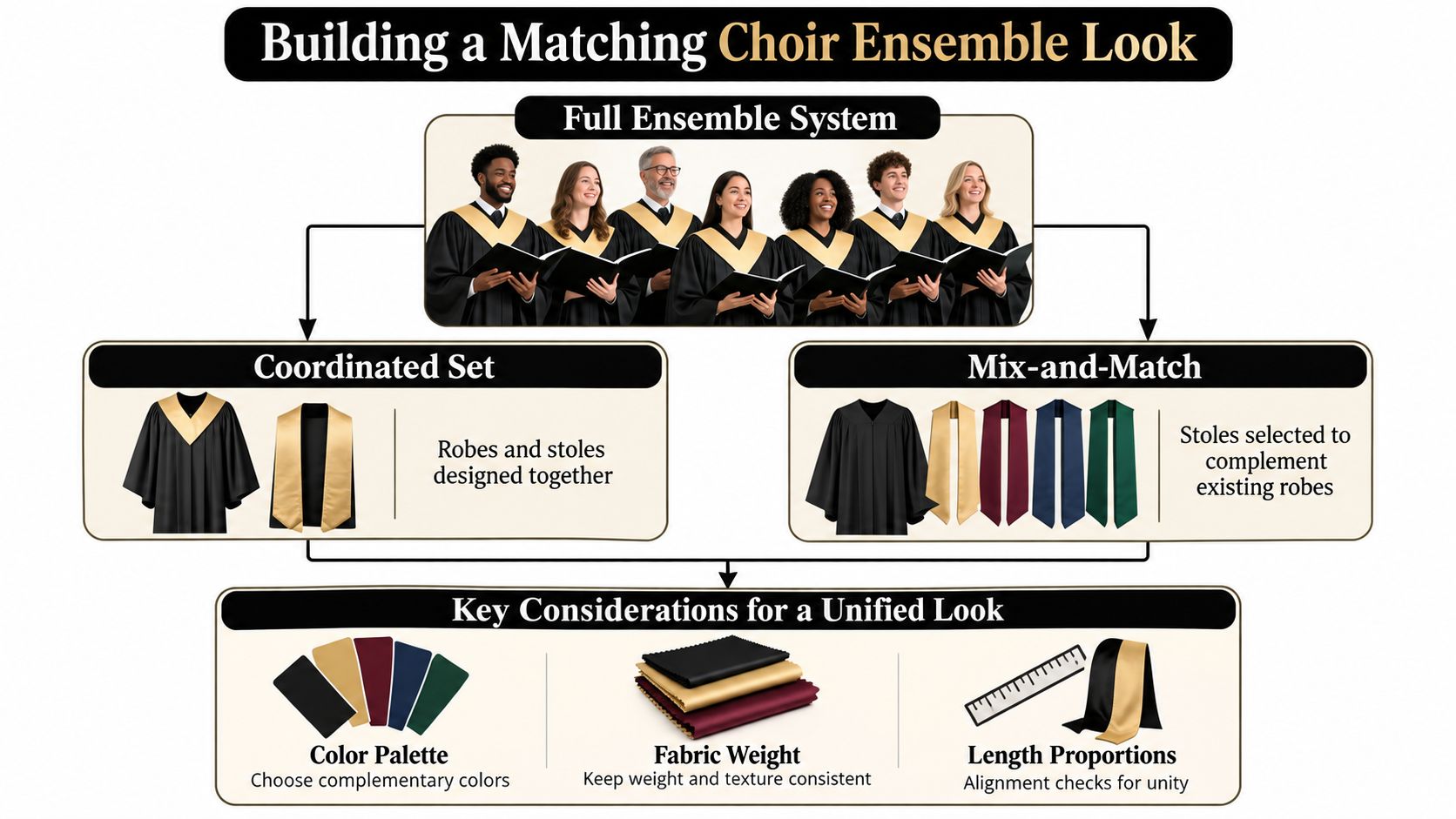
For an existing robe inventory, choose stoles that complement the robe's color family and finish. A matte robe can carry a controlled satin accent. A shiny robe usually needs a quieter stole so the group doesn't look reflective from head to hem. Keep trim width, edge finish, and stole length consistent across the set.
For a coordinated purchase, specify the robes and stoles together. That lets you compare proportions before production rather than discovering that a broad stole overwhelms a narrow neckline. It also prevents the common “three different weddings” effect, where one group wears matte black gowns, another wears bright satin, and a third carries heavy metallic trim.
Pageant and concert choirs need a separate decision. Their robe is often an academic-style gown, so the stole may be the only visual signal of school identity, performance theme, leadership, or celebration. Use contrast deliberately, but keep the same fabric weight and length logic across the ensemble. A school-color stole can communicate affiliation without borrowing a liturgical meaning the choir doesn't intend.
Sizing and Fit for Real Bodies and Real Rooms
Height and chest are starting points, not a fit test. A singer may match the size chart and still be unable to raise both arms, sit comfortably on a riser, or keep the stole centered across the shoulders.
Measure each member's shoulder width, biceps circumference, torso length from shoulder to mid-thigh, and hem clearance above the floor when seated. Keep the performer in the shoes used for services or concerts. For a seated singer, check that the hem doesn't bunch under the legs or catch on a wheelchair footrest or mobility device.
Inclusive sizing isn't a special accommodation. A plus-size choir member is a normal member of the ensemble, and the robe must support movement without pulling across the shoulders or trapping excess heat. Buyers increasingly look for designs that accommodate diverse bodies, but a broader size chart alone doesn't solve sleeve mobility, neckline comfort, seated posture, or stole placement. The available youth-uniform guidance correctly highlights those practical gaps.

Test the robe in motion
Order a fit kit with two adjacent sizes for uncertain members before approving the bulk order. For children's choirs, allow one full size of growth when the program expects the same robe to serve across two seasons, but don't accept a hem that creates a trip hazard now.
Ask for tagless neck labels and seam-free linings where sensory sensitivity makes scratchy construction a problem. Seated singers may need a different stole length, a secure closure, or anti-slip treatment so the band doesn't drift toward one shoulder.
Run this rehearsal test:
- Raise both arms overhead and hold them there.
- Bend at the knees.
- Sit and stand without stepping on the hem.
- Reach across the body.
- Turn, bow, and walk up the actual risers.
- Sing a sustained phrase while moving naturally.
A robe that fits while standing still can still fail the first rehearsal.
Record the results by wearer, size, robe length, and stole length. That record becomes more valuable with every replacement order because it turns individual fitting knowledge into an institutional wardrobe file.
Customization Options That Actually Work
Customization should serve recognition, not clutter. Embroidery on the chest or upper stole gives the audience a clear identity mark from the front. A full back design creates a stronger stage statement but can become visually heavy. An orphrey band provides a traditional vertical accent and works well when the design needs to repeat across a group.
Ask for a physical embroidery sample and wash it five times before approving a large order. Loose digitizing, dense stitches, and poorly secured thread can fail during laundering even when the digital proof looks clean. Approve the washed sample, not just the screen image.
Spend on the details people see and touch
Piping and contrasting borders add structure without making the stole feel overloaded. Use a contrast band only when it supports the robe system and doesn't undermine the governing liturgical color. A narrow edge can create unity. A broad panel in another liturgical color can create a classification problem.
Closures should match the wearer:
- Hook-and-loop: Fast for clergy who vest quickly and practical for supervised children's groups.
- Button: More traditional, but slower and less adjustable.
- Open neck: Simple and flexible, though it can shift during movement.
- Reversible construction: Useful when the same stole must serve two approved color roles.
Lining affects weight, comfort, and reversibility. A reversible stole can provide the seasonal flexibility of two garments at roughly 60% of the cost of buying a second stole, according to the supplied procurement guidance. Treat that figure as a planning estimate and confirm the actual quote, because embroidery, lining, trim, and closures change the calculation.
For logo placement and custom robe coordination, consult custom choir robes with logo. Give the supplier the approved artwork, thread colors, placement diagram, wearer category, and care method in writing.
Ordering, Turnaround, and Sample Policies
A bulk order is a procurement project, even when the item is a garment. Collect four documents before you authorize payment:
- A written quote with itemized unit costs and customization charges.
- A production timeline with the expected ship date.
- A sample or fit-kit record showing what the buyer approved.
- A written care specification tied to the actual fabric and decoration.
Custom embroidered stoles commonly require two to four weeks, while full custom work commonly requires four to eight weeks. Last-minute Holy Week or Easter orders should be placed at least ten weeks ahead. Reserve overnight shipping for a genuine emergency, because faster transport can't fix a production queue or an unapproved design.
Questions that expose weak procurement terms
Ask whether fabric swatches are free or low cost, whether a fit kit can be returned, and whether at least one member per size can test the garments. Request a damage replacement guarantee covering the first 30 days. The policy should state what happens if the wrong size, damaged seam, incorrect embroidery, or wrong color arrives.
Suppliers often offer price breaks at 10, 25, and 50 units, but don't choose by unit price alone. Add shipping, duties, alteration, storage, replacement stock, and rush delivery to the total. The cheapest quote can become the most expensive wardrobe once avoidable replacements enter the ledger.
Keep the approval chain short
Assign one wardrobe coordinator to consolidate questions and one second reviewer to approve artwork and color. Committees should approve the specification, not make separate last-minute changes to individual garments. Send the supplier one final document containing quantity, size breakdown, color, fabric, closure, embroidery, delivery address, and care requirements.
Before you wire funds or submit a purchase order, confirm that the sample in your hands matches the written quote. If it doesn't, stop the order and resolve the discrepancy. A clean paper trail protects both the choir and the supplier.
Care, Maintenance, and Lifespan
Care determines whether a wardrobe remains usable season after season. Start with the supplier's label, then use a conservative routine for washable polyester and decorated stoles: cold water, mild detergent, inside-out washing to protect embroidery, line drying, and low-heat pressing with a pressing cloth.
Spot-clean between services whenever possible. Makeup at the neckline, candle wax, and processional dust don't always justify a full wash. Remove surface soil promptly using a method approved for the fabric, and don't rub aggressively across embroidery or metallic trim. Repeated unnecessary laundering adds wear to fibers, thread, seams, and color.
Wash, dry, and press with discipline
Keep robes and stoles separated by color during cleaning. Fasten closures before washing, place decorated items inside out, and never guess that a fabric is washable because it feels synthetic. Silk or silk-blend garments may need professional cleaning, while a polyester stole may tolerate a gentler home-wash routine. The care label controls.
Line drying is preferable to machine drying for a long-lived choir wardrobe. Once dry, press on low heat through a pressing cloth. Direct high heat can distort synthetic fabric, flatten texture, or damage embroidery. Store each item only when it is fully dry.
Treat flammability as part of procurement
Choir robes and stoles used near candles, processional lanterns, stage lighting, or theatrical equipment need documented textile safety performance. U.S. Consumer Product Safety Commission guidance regulates clothing textiles under 16 CFR 1610 and classifies them into three flammability classes according to burning speed. Apparel must meet Class 1 or Class 2 minimum requirements. ASTM also provides test methods including D1230 for apparel-textile flammability and D6413/D6413M for vertical flame resistance. ASTM's textile standards information also emphasizes care-label compliance and routine inspection of flame-resistant garments.
Don't assume polyester means flame resistant. Request the applicable test basis, fiber information, and care documentation, especially for children's choirs and venues with open flame. Laundering, incompatible detergents, heat, abrasion, and damaged seams can alter textile performance or garment integrity.
Store and inspect before use
Fold garments flat in breathable garment bags when hanging storage isn't practical. Keep them away from direct sunlight, moisture, and overcrowded cabinets. Inspect hems, closures, lining, embroidery, and stole attachment points before each major season and before any service involving candles or processional movement.
Hand the next coordinator this four-step workflow:
- Specify the need: Record the robe system, rite, season coverage, ensemble size, and wearer roles.
- Build the specification: Set fabric, dominant color set, sizing protocol, closures, trim, and customization.
- Validate with samples: Wash-test the swatch, trial the fit kit, run the movement test, and approve washed embroidery.
- Place and care for the order: Retain the written quote, timeline, sample policy, care documents, and inspection record.
A wardrobe is a long-term asset, not a single purchase. A reliable supplier who understands your choir's colors, sizes, traditions, and replacement history will usually cost less over five years than rotating through the cheapest vendor every season.
ChoirBuy offers choir robes, custom choral gowns, choir stoles, cassocks, surplices, cottas, and choir caps with color, fabric, sizing, plus-size, and customization options for church, school, youth, and event ensembles. Visit ChoirBuy with your written specification, sample questions, and seasonal color plan before placing your next order.