

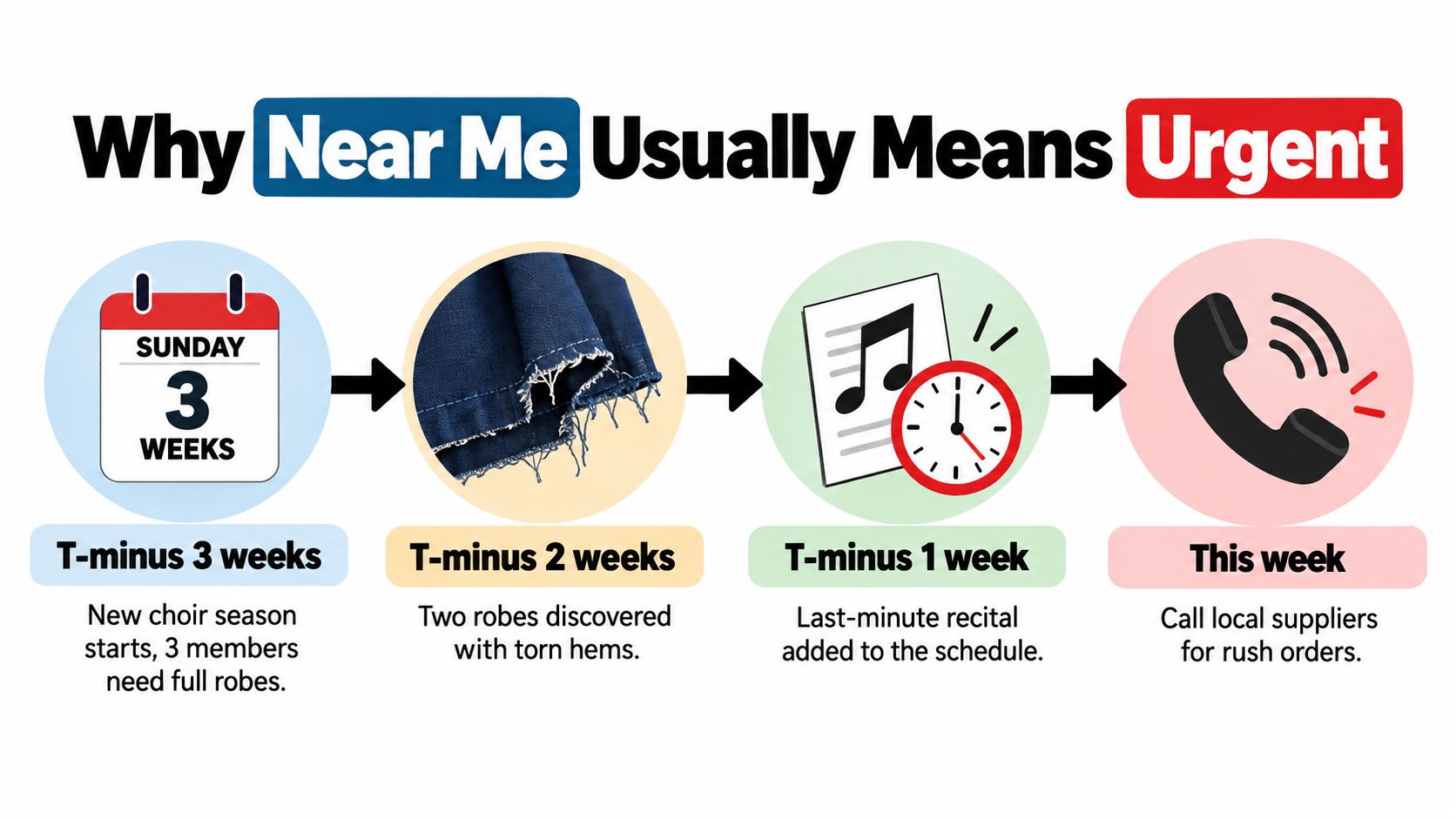
Three weeks before a new choir season, the director discovers that three singers need full robes, two existing gowns have torn hems, and a recital has appeared on the calendar for next week. A search for choir robes near me starts as a location query, but the more urgent question is: who can deliver approved, matching robes before the next service or rehearsal?
A nearby storefront may help, but proximity alone won't solve a sizing problem, a limited color selection, or a production queue. The right decision balances delivery speed, sample access, fit, fabric, returns, and total ownership cost. Sometimes a regional supplier or online specialist with expedited shipping is more practical than a shop down the street.
Why Near Me Usually Means Urgent
The Sunday morning crisis is familiar. A music director opens the robe closet, finds a damaged hem, realizes a new alto still has no gown, and learns that the school concert has moved forward. There isn't time for casual browsing. The choir needs garments that arrive together, fit the people who'll perform, and look consistent under sanctuary or stage lighting.
That changes the meaning of “near me.” It usually doesn't mean a vendor within a specific driving radius. It means available now, responsive, and accountable for the need-by date. A local store with no matching stock is less useful than an online supplier that can send samples quickly, confirm measurements, and offer expedited delivery.
Treat the deadline as the first filter
Write down the performance date, the date when singers must try on the robes, and the latest acceptable delivery date. Then ask every vendor for production time, sample time, shipping method, and the consequences of approval delays.
For bulk apparel, adjacent custom-uniform manufacturing commonly takes 15 to 25 days after sample or mockup approval for simpler garments, while structured uniforms can take 35 to 45 days. Another bulk-apparel provider reports three to four weeks after payment and artwork approval. These benchmarks come from custom-uniform lead-time guidance, so use them as planning references, not promises for every robe order.
Practical rule: Choose the channel that meets the deadline first. Optimize color, customization, and price only after delivery is credible.
Seasonal urgency also affects online searches. Recent choir-apparel coverage describes interest rising toward year-end and peaking in December 2025, alongside continued demand for customizable robes. The implication is simple: holiday ordering creates competition for attention and production capacity, so a “near me” search should begin with a vendor's actual fulfillment plan.
Mapping Your Local Sourcing Options
You have three realistic channels, and each solves a different part of the problem.
A local storefront may be a church supply shop, uniform retailer, or tailor. Its advantages are immediate try-ons, face-to-face advice, and easier alterations. Its limitations are just as practical: small inventory, fewer colors, basic fabric choices, and potentially higher per-unit pricing. A local shop is valuable when one singer needs a replacement or when a hem must be fixed immediately, but it may not be the strongest option for a coordinated bulk order.
A regional supplier usually offers deeper stock and more experience with institutional purchasing. Driving distance can make pickup possible, while a larger operation may handle customization and size exchanges more systematically. Ask whether “in stock” means the exact color and size are physically available, or whether the supplier still needs to order them.
An online specialist with fast shipping can function as a substitute for a true local store. Look for fabric swatches, sample robes, inclusive size options, documented rush production, and a customer-service contact who will review your measurement chart. Resources such as this guide to quality branded goods can also help purchasing teams think beyond appearance and evaluate supplier quality more broadly.
| Channel | Best For | Turnaround | Customization | Typical Price Range |
|---|---|---|---|---|
| Local storefront | Immediate try-ons, single replacements, basic alterations | Same day to supplier-dependent | Usually limited | Quote locally |
| Regional supplier | Bulk orders with pickup or deeper inventory | Supplier-dependent | Moderate to broad | Quote by volume |
| Online specialist | Samples, broad sizing, coordinated group orders, expedited delivery | Shipping and production dependent | Broad, including colors and accessories | Quote by package and quantity |
Start vendor screening with four questions:
- Choir-apparel experience: How long has the supplier handled robes, gowns, stoles, or related liturgical garments?
- Minimum order: Can the vendor supply one replacement, or does customization require a group quantity?
- Sample policy: Can you inspect a robe and fabric swatches before approving production?
- Turnaround guarantee: What date is documented on the quote, and what happens if the order misses it?
For a useful comparison with a nearby church-supply search, review this clergy apparel store resource. Don't choose based on distance until the supplier has answered those questions.
Evaluating Quality Before You Commit
A robe can look acceptable in a product photo and disappoint the choir in person. Fabric hand, opacity, drape, seam finishing, and closure quality become obvious only when someone wears the garment and moves through a rehearsal.
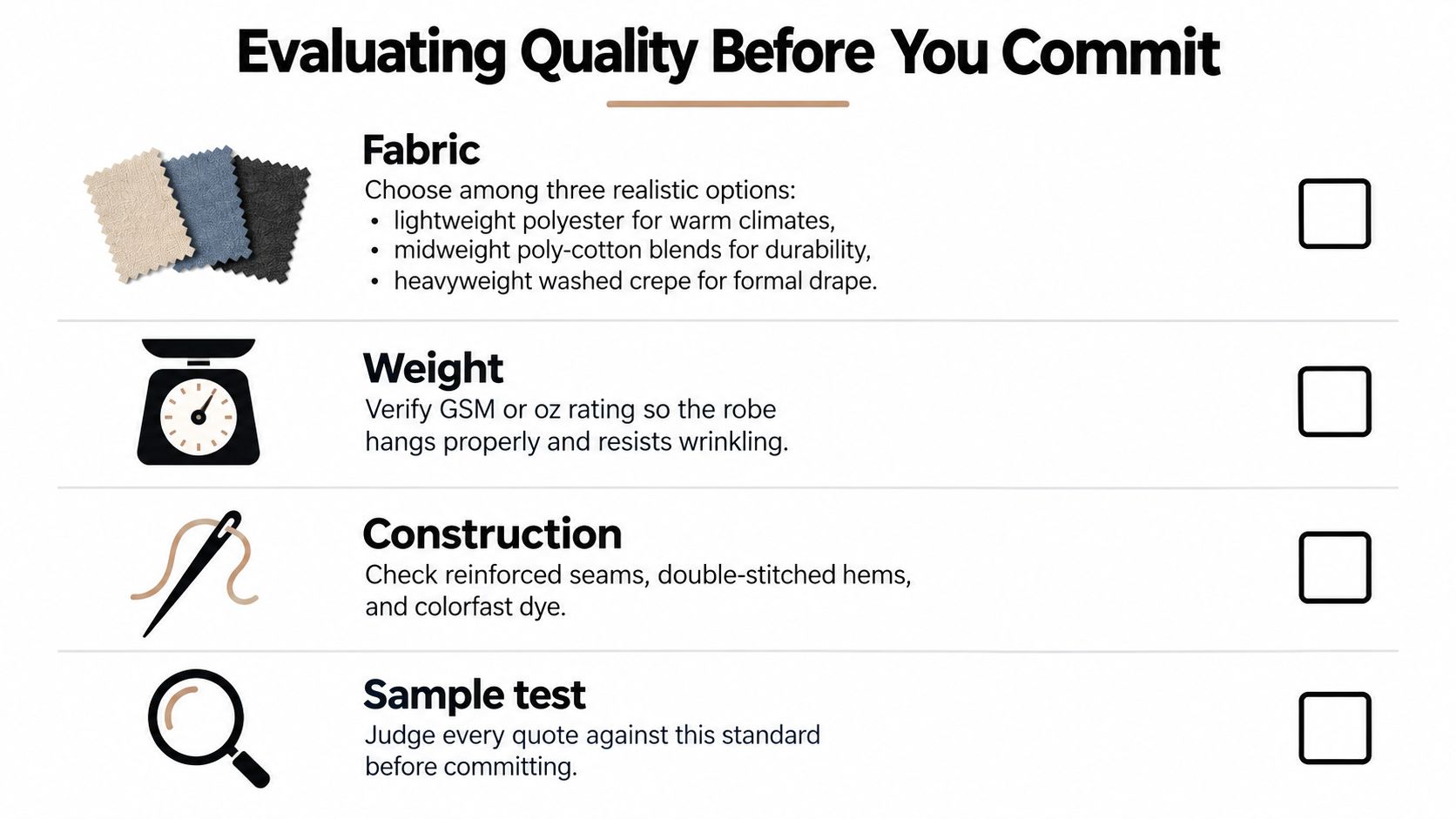
For everyday church use, lightweight polyester is practical for warm spaces, travel, and easy storage. Mid-weight polyester or polyester-viscose blends suit regular services because they balance wrinkle resistance, structure, and durability. For formal concert use, heavier wool blends or premium polyester create a more substantial drape, but they can increase cleaning and storage demands.
The fabric specification should be concrete. Recent choir-uniform guidance suggests 180 to 300gsm polyester blends and shrinkage under 3% as practical performance targets, while independent uniform guidance favors polyester or polyester blends for wrinkle resistance and color retention. Use those benchmarks when comparing quotes, and ask the vendor to identify the actual fabric rather than accepting “premium” as a specification.
Inspect the details that photos hide
Check the hem, seam allowance, shoulder reinforcement, lining, collar roll, and closure. A zipper may be quick to use, hook-and-loop can simplify access, and buttons can support a more traditional appearance, but the attachment must feel secure and easy for singers to manage.
Ask whether decorative components are replaceable or fused permanently. Replaceable stoles, collars, buttons, and trim are easier to maintain than a garment that must be discarded after one damaged detail. A robe intended for repeated institutional use should also have clean seam finishing and a hem that won't unravel after routine handling.
Request a physical swatch before ordering. Rub it lightly, hold it toward a light source, observe how it recovers after folding, and view the color under the lighting used in your sanctuary or auditorium. Screen colors can differ from the way fabric appears under church lighting, so a swatch is not an optional courtesy. It is part of approval.
Directors managing labels and accessories can also use practical references such as how to pick school name tags. For robe-specific comparisons, review the choir robe selection guide, then reject any quote that gives you no meaningful information about fabric weight or construction.
Taking Measurements and Requesting Samples
Don't collect robe sizes from memory or ask singers for their usual clothing size. Choir robes commonly use height, chest, and sometimes additional body measurements, so a bulk order needs one master chart built from the manufacturer's instructions.
Measure height with performance shoes on and take chest measurement at the fullest point. For children, sizing up can allow growth and reduce the risk of reordering. Youth measurements may include shoulder tip to shoulder tip, shoulder tip to wrist, and nape of neck to floor, rather than relying on age alone. One sizing reference also recommends at least 4 inches of floor clearance to reduce tripping risk, while another concert-robe approach places the hem about 1 inch from the floor with concert shoes. Follow the selected vendor's chart consistently, because the correct finish depends on the garment pattern and intended use.
| Measurement | How to Take It | Common Adult Range | Notes |
|---|---|---|---|
| Height | Stand upright in performance shoes and measure from the top of the head to the floor | Vendor chart required | Use the manufacturer's length chart |
| Chest | Measure around the fullest point with arms relaxed | Vendor chart required | Keep the tape level and avoid pulling it tight |
| Shoulder span | Measure between shoulder tips | Vendor chart required | Especially useful for youth and tailored patterns |
| Sleeve length | Measure from shoulder point to wrist | Vendor chart required | Take it in the intended performance posture |
| Robe length | Measure from the relevant upper point to the floor | Vendor chart required | Confirm hem clearance with shoes |
| Ease preference | Discuss movement and layering needs | Vendor chart required | Don't assume one allowance suits every singer |
Build the approval packet
Send the completed chart to each vendor and request a sample robe in a representative size, plus fabric swatches. Test the sample for movement, sleeve reach, neckline comfort, closure operation, wrinkle recovery, and color under actual performance lighting.
Photograph the sample from the front, side, and back. Label each image with the vendor and date so quotes remain comparable. Ask about alterations, exchanges, and the time required to correct a mis-sized garment before you approve production.
For broader apparel measurement and customization ideas, you can browse Caddie Uniform's style guide. Keep your robe order organized through a dedicated product samples resource, and don't release the bulk order until every size, quantity, color, and customization detail has been checked.
Negotiating Bulk Pricing and Package Deals
Begin with the total robe count, not a vague estimate. Include singers who need replacements, likely new members, and any reserve units your program has approved. Vendors price volume differently, and withholding the real quantity prevents them from giving you a useful package quote.
Ask for itemized pricing at these breakpoints:
- 12 to 24 robes: Request the unit price, setup fees, and shipping separately.
- 25 to 49 robes: Ask whether the next volume tier changes fabric, customization, or shipping terms.
- 50 or more robes: Request the strongest package quote and ask whether setup charges can be waived.
| Lever | What to Ask For | Typical Threshold | Trade-Off |
|---|---|---|---|
| Unit volume | Price by quantity tier | 12 to 24, 25 to 49, 50 or more | Larger commitment |
| Accessories | Bundle stoles, cinctures, and bags | Group order | Less flexibility to change items |
| Customization | Waive embroidery or piping setup | Vendor-defined | May require standard artwork |
| Shipping | Reduce or remove rush charges | Firm delivery date | Less room for late changes |
| Repairs | Include spare parts or repair credit | Negotiated | May raise the initial package price |
Request line-item pricing for fabric, tailoring, customization, shipping, and rush charges. That breakdown reveals where negotiation is possible. A lower robe price can lose its advantage after expedited freight, setup fees, and separate accessories are added.
Payment terms matter too. Confirm the deposit, approval point, balance due, cancellation terms, and whether a rush fee can be reduced when you provide artwork and measurements promptly. Put every concession on the written quote. A phone promise won't help when the purchasing committee reviews the invoice.
Check current sale and package opportunities through the choir robes sale collection, but compare the final landed cost, not the promotional headline.
Coordinating Delivery Pickup and Returns
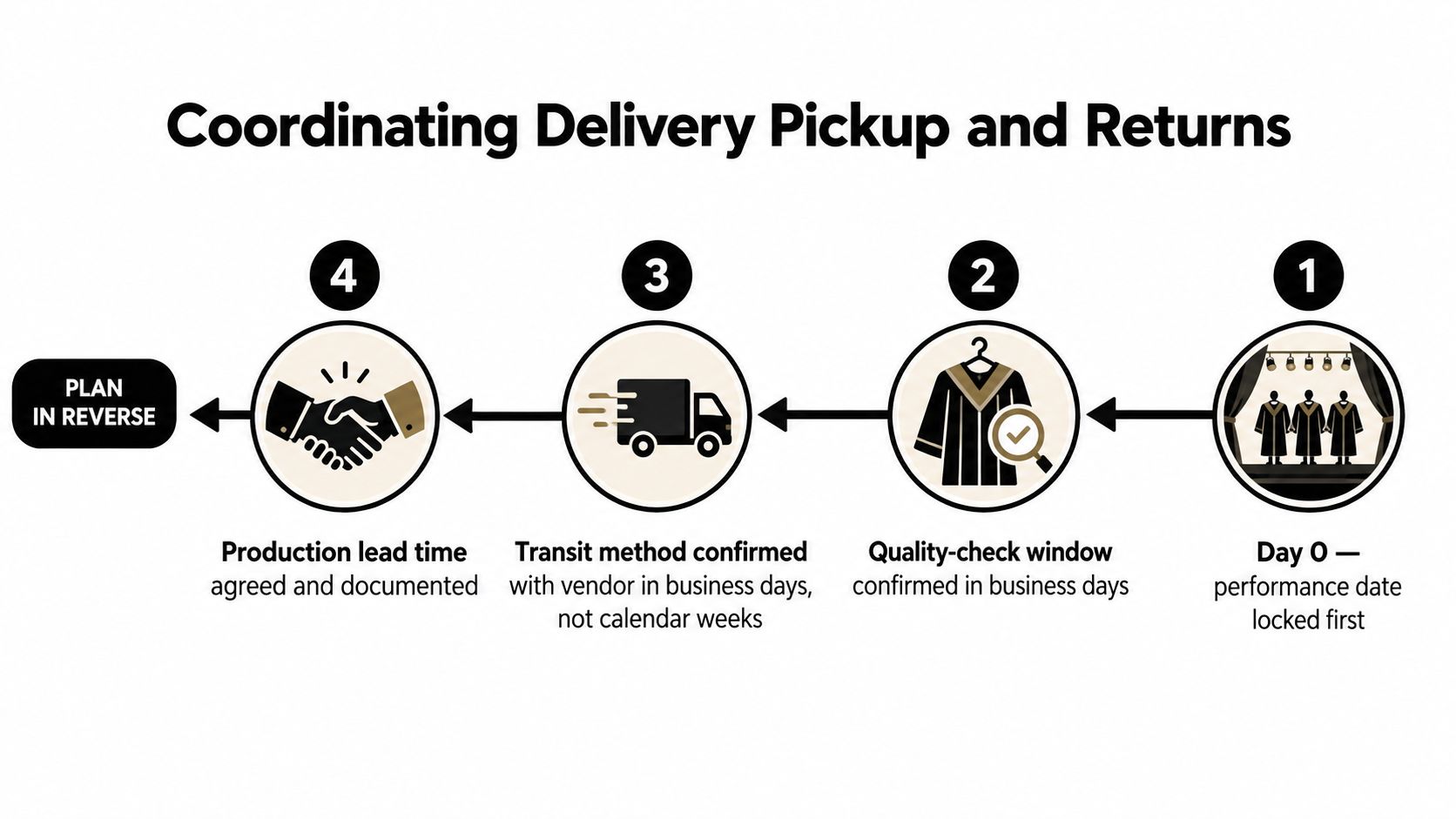
Lock the performance date first, then work backward. Vendors should state production, quality inspection, and transit timing in business days, not vague calendar-week language. A supplier that says “quick delivery” hasn't given you a usable commitment.
Ask whether the shipment travels by insured freight, courier, or a service that allows pickup at a depot near the church, school, or venue. For a genuine emergency, a regional tailor or rental house may offer a fast temporary solution, while an online specialist with expedited shipping can provide the coordinated replacement set a local storefront doesn't have.
Use a receiving protocol
Assign one person to receive and inspect the shipment. Count boxes before opening everything, photograph visible damage, and record shortages or defects within the vendor's stated reporting window. Keep each robe tagged by singer until the first fitting confirms the size.
Before payment or approval, clarify:
- Return window: How long do you have to report a size mismatch?
- Alteration credit: Will the vendor contribute to an approved local alteration?
- Return shipping: Who pays when the supplier sends the wrong size or color?
- Rush replacement: Can a defective robe be replaced before the performance?
Don't store new robes in sealed plastic for long periods. Use breathable garment bags, keep labels attached through fitting, and separate garments by singer or size. That simple organization prevents a second crisis when the choir gathers for the final rehearsal.
Planning for the Total Cost of Owning Robes
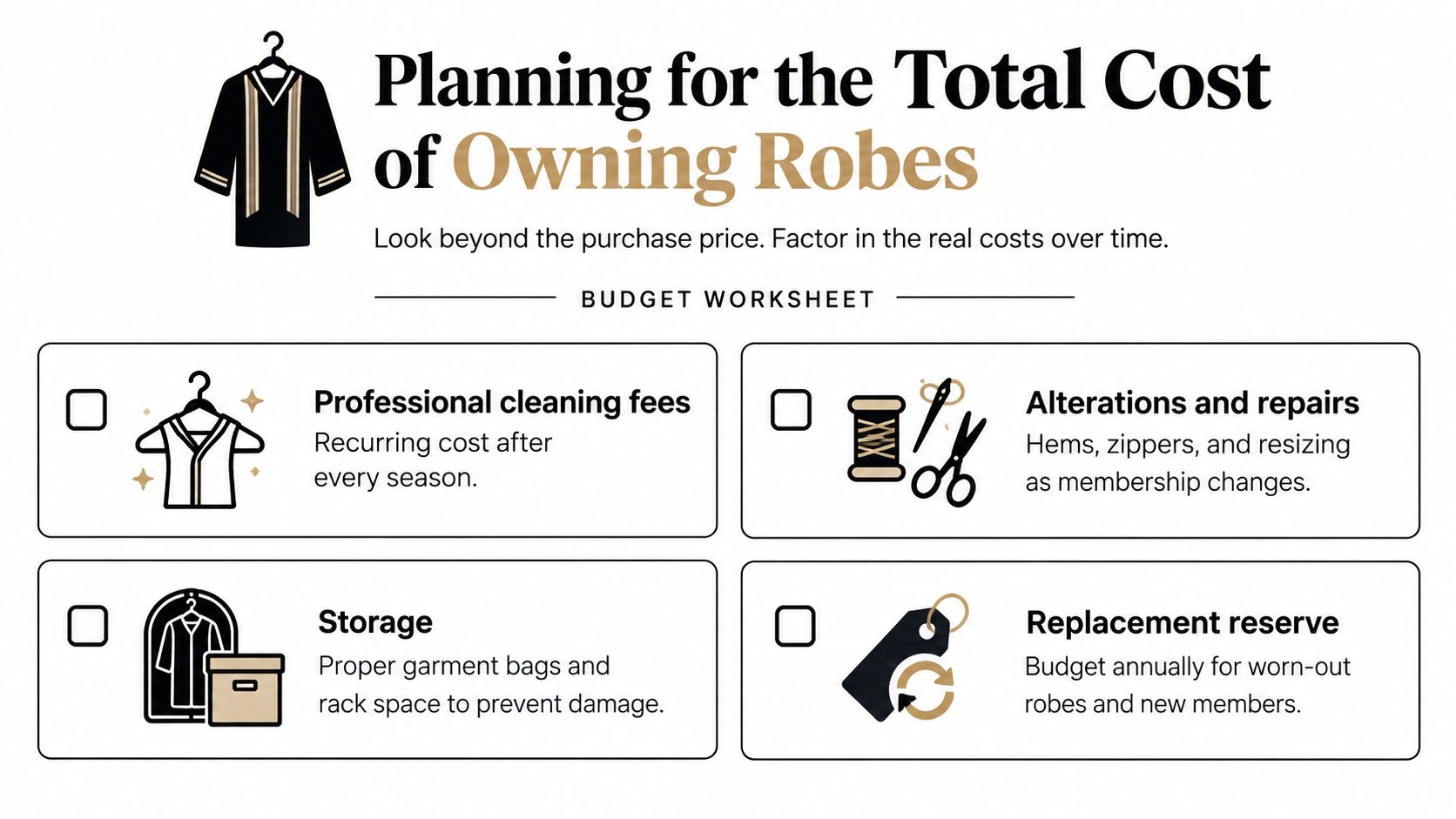
The invoice is only the beginning. A robe program also needs a wardrobe or robing room, regular cleaning, alterations, mending, storage protection, and a replacement plan. A church-focused buying guide emphasizes these ownership requirements because the cheapest garment can become the expensive choice if it demands frequent repairs or creates storage problems.
Cleaning deserves a specific budget line. Heavier fabrics, satin details, embroidery, and mixed-fiber construction may require professional handling rather than routine home washing. Storage needs attention too. Use breathable garment bags and suitable hanging space, and don't treat a choir closet as an afterthought.
Ownership rule: Compare the garment, the care burden, and the replacement risk as one purchase.
A simple worksheet can compare shortlisted vendors over five years. Record the initial garment cost, accessories, shipping, cleaning, storage supplies, alterations, repairs, and replacement units. Then divide total spend by expected years of service and performances to estimate cost per wear. You don't need false precision. You need a consistent comparison that exposes the consequences of a low-quality fabric or poor size policy.
Put these items on the first quote
Ask vendors to price spare buttons, extra stoles, replacement collars, repair credits, garment bags, and any customization setup. Confirm whether the selected fabric can be reordered later, because a replacement robe in a discontinued color creates a visual mismatch across the ensemble.
Run these questions before signing:
- Can the vendor meet the performance date in writing?
- Have singers been measured using the vendor's chart?
- Has someone approved a physical robe and fabric swatch?
- Are returns, alterations, and defective-item shipping documented?
- Does the five-year ownership comparison support the selected tier?
Your next three actions are straightforward. Lock the date and headcount today, send the master measurement chart to qualified vendors, and request itemized quotes with samples and written delivery terms. ChoirBuy offers wholesale and custom choir robes, accessories, sample support, inclusive sizing, and shipping options that can help directors evaluate an online specialist alongside local and regional suppliers. Visit ChoirBuy to compare robe options and start a quote based on your choir's deadline, measurements, and total order needs.