

You can spot the problem before anyone says a word. The sanctuary is ready, the music is marked, and the singers are waiting on a visual plan that still feels half-finished. One robe sample looks too long, the stole color looks right under office light but wrong in the choir room, and nobody wants to approve a bulk order that will be worn for years with a mistake baked in.
That's where choir robes and stoles stop being decoration and start becoming a practical decision. The right combination supports the music, protects theology, and keeps a group from looking mismatched on the platform. The wrong one creates confusion, extra expense, and a lot of quiet second-guessing after the first service.
Why Coordinated Choir Dress Matters
A mixed-voice ensemble can sing beautifully and still look unsettled if the clothing sends the wrong message. Coordinated dress gives the congregation a single visual line to follow, which is one reason churches and schools keep returning to uniform silhouettes, conservative colors, and layered garments. The oldest evidence is striking, too, because coordinated performance dress reaches back into classical antiquity.

A surviving Greek pottery fragment dated to approximately 425 BC shows singers and other performers wearing similar flowing garments, which gives early visual evidence of coordinated performance dress (Bledlow Parish choir robe notes). Earlier Egyptian tomb art from around 2700 BC also depicts groups of singers, although that evidence does not prove a standardized choir uniform. The useful takeaway is simple, coordinated dress has been tied to communal singing for a very long time.
Tradition and function still overlap
In medieval Western Christianity, choir dress became more institutionally defined, especially through the surplice worn over a cassock. That history still shapes modern expectations, because people recognize robes, stoles, cassocks, surplices, and similar layers as signs of order, continuity, and role clarity. A choir in matching apparel doesn't just look neat, it looks like it belongs to a worship tradition or institutional identity.
Practical rule: if the clothing helps the congregation identify who belongs to the ensemble, it's doing part of the musical work already.
This is why choir directors keep returning to coordinated dress even when casual clothing would be easier. A clean visual silhouette lets the music lead, not the wardrobe. It also prevents the common problem where one or two standout outfits pull attention away from the whole group.
Selecting Fabrics and Colors for Your Choir
Fabric choice affects how often you'll be steaming, replacing, or rotating garments, and that matters more than the first invoice. Available market reporting shows polyester remains dominant at 48.1% because of durability, wrinkle resistance, and cost, while cotton accounts for 22.3% of offerings (market reporting on choir robes). Sustainable materials such as recycled polyester and organic cotton are projected to reach 8-12% market share by 2034, and sustainable robes may carry 5-15% premiums in that projection (same market report).
What the fabric choice changes in real life
Polyester makes sense when robes are used often, stored tightly, and worn by different singers across the season. It usually gives a cleaner drape after transport and tends to handle repeat use better in a busy church or school calendar. Cotton can feel appealing when a group wants a softer hand, but that does not automatically make it the lower-impact choice for every choir.
A durable robe that survives repeated laundering and regular rotation may be the smarter stewardship decision than a garment that needs frequent replacement. That's especially true in youth programs, where size turnover can be constant. If you're comparing fiber claims, ask for the content breakdown in writing, not just a product name that sounds eco-friendly.
| Choir Fabric Comparison | ||||
|---|---|---|---|---|
| Fabric Type | Market Share | Durability | Maintenance | Cost Profile |
| Polyester | 48.1% | Strong for frequent use | Usually easier to manage, less wrinkling | Often lower upfront cost |
| Cotton | 22.3% | Comfortable, but less predictable for heavy rotation | Often needs more care | Mid-range, but can rise with upkeep |
| Recycled polyester | Projected growth by 2034 | Depends on construction and finish | Check laundering and repair guidance | May carry a premium |
| Organic cotton | Projected growth by 2034 | Depends on weave and weight | May need more pressing and careful care | May carry a premium |
For liturgical color choices, the calendar matters more than personal preference. Roman Catholic practice uses green for Ordinary Time, white for Easter and Christmas seasons and many feasts, red for Palm Sunday, Good Friday, Pentecost, and martyrs' days, violet for Advent and Lent, rose for Gaudete Sunday and Laetare Sunday, and black may be used for funerals and Masses for the dead (liturgical vestment color guide). If your choir serves more than one tradition, color has to be chosen by rite, not by habit.
For broader color planning, I also recommend reviewing the practical guidance in this choir robe color meaning guide before you lock in a seasonal set. The best robe palette is the one the congregation reads instantly and the maintenance team can comfortably live with.
Matching Stoles to Robes and Liturgical Seasons
A stole can look like a robe accessory on a product page, but it carries a different function. Historically, it is a narrow, scarf-like vestment tied to ordained ministry, not ensemble coordination, and its use has shifted across traditions over time (vestment history note). That distinction matters in purchasing, because choir stoles and clergy stoles often appear interchangeable on general product pages, even though they serve different roles.
Role should decide the garment first
In Anglican choir dress, the usual foundation is a cassock under a surplice, sometimes with a scarf or tippet. In that setting, the tippet belongs to choir dress, while the stole usually signals Eucharistic or sacramental ministry (choir dress reference). For a mixed church purchase, a choir accessory should not imitate a clergy vestment unless local worship policy clearly allows it.
The first question is simple, who may wear it, in what rite, and for what purpose? Catholic reference material distinguishes between the priest's stole and the deacon's diagonally worn stole, while broader vestment references describe the stole as a band that falls from the neck. That variation is why denominational review comes before color matching or decoration.
A choir stole should clarify identity, not borrow authority.
For practical buying, I sort choices into three buckets. Plain stoles work when the ensemble needs coordinated color without clerical symbolism. Logo-based stoles fit school and community choirs that want visible identity. Seasonal stoles make sense only when the denomination and worship calendar already use color as part of the service structure.
If you are building a seasonal set, the choir stoles color guide is a useful planning check before you place an order.
Specifications that prevent mistakes
A commonly reported stole specification is about 7.5-9 feet long and 3-4 inches wide, with ends that may be straight, spade-shaped, or bell-shaped. That range helps, but the wearer's role and the way the stole is worn matter just as much. Catholic, Anglican, Protestant, and other traditions can differ on whether the stole is crossed, parallel, or diagonal, so a bulk order should document role, rite, finish length, width, closure method, embroidery placement, and care requirements before approval.
A practical choir buyer keeps choir robes and stoles in separate categories on the spec sheet. That one habit prevents most of the theological confusion that shows up later in the season.
Measuring and Sizing Choir Ensembles
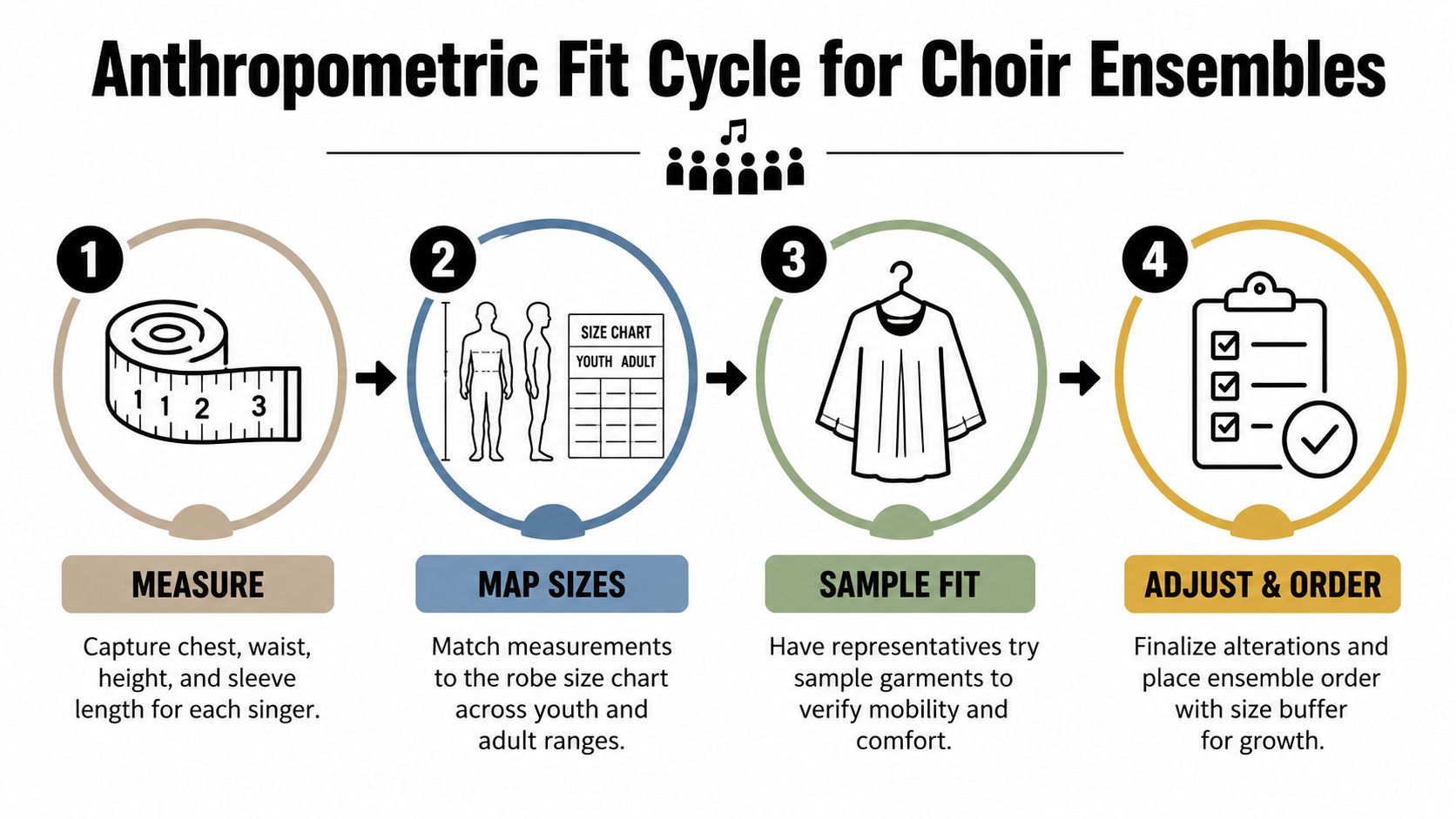
A group order goes wrong when everyone is treated as one size. Height gives a starting point, but it does not tell you enough about chest, shoulder width, sleeve length, or how a robe hangs when singers lift an arm to turn a page. Fit has to be handled as a process, not a guess.
The fit cycle that actually works
Start with standardized measurements, especially stature, chest, waist, shoulder breadth, and sleeve length (Huddersfield fit research). Then sort singers by size and body shape, build in ease for seated singing and arm movement, and test sample garments before placing the bulk order. The sample stage exposes bad assumptions early, while changes are still easy to make.
I test at least one sample in each high-volume size, plus the smallest, largest, and children's sizes. I also measure robe length from the shoulder, not from the neck or the floor, because that keeps hem and trip problems down. The fit check should happen in motion, not just on a hanger.
Use this ordering sequence
- Measure the whole group. Capture chest, waist, shoulder breadth, and sleeve length, not just height.
- Sort by body type. Large adult sizes, youth sizes, and outlier fits need separate attention.
- Allow room for singing. Seated posture and raised arms change how the robe behaves.
- Test the samples in motion. Have singers walk, sit, and lift music folders.
- Adjust before bulk ordering. Fix the pattern or size spread before the final run.
Keep choir robes and stoles on separate lines in the spec sheet. For a practical starting point, use the size and color chart resource alongside your roster notes, then confirm any group patterns before you approve the order. A robe that looks fine on paper but catches at the hem during rehearsal is a problem waiting for service day.
Ordering Timelines and Customization Options
A polished order usually comes from a calm timeline, not a rushed one. When choirs need robes and stoles for Easter, Christmas, concerts, or a new school year, the main pressure point is not design taste. It is whether the supplier can confirm details, review proofs, and keep sizes aligned without last-minute scrambling.
Group orders go off track when size questions, artwork questions, and delivery dates are handled in different conversations. A steady ordering process prevents more mistakes than a late style change ever will.
Custom details that are worth approving slowly
Embroidery placement should be checked against the robe or cassock the singer will wear. Logos, initials, and denominational symbols need to sit where they do not fold awkwardly over a shoulder roll or disappear into a center crease. The same caution applies to color matching, because a shade that looks right on a screen can look off under sanctuary lighting.
For a practical reference on logo placement and garment personalization, the custom choir robes with logo guide is a useful starting point. I would still insist on a physical sample or proof before approving a full run, especially if the choir includes both adults and children.
Practical rule: approve the sample first, then approve the embroidery. Reversing that order usually creates regret.
The fit cycle
The fit cycle should match the calendar. Seasonal churches, school choirs, and festival ensembles all benefit when design decisions happen early enough for revisions, fitting, and delivery. If the schedule is tight, reduce the customization rather than compress the fitting process.
That same timing discipline helps keep robes and stoles aligned as separate items in the order. I also keep fit notes tied to the roster, so final approvals do not drift away from the actual singers who will wear the garments.
Care, Maintenance, and Last Minute Planning
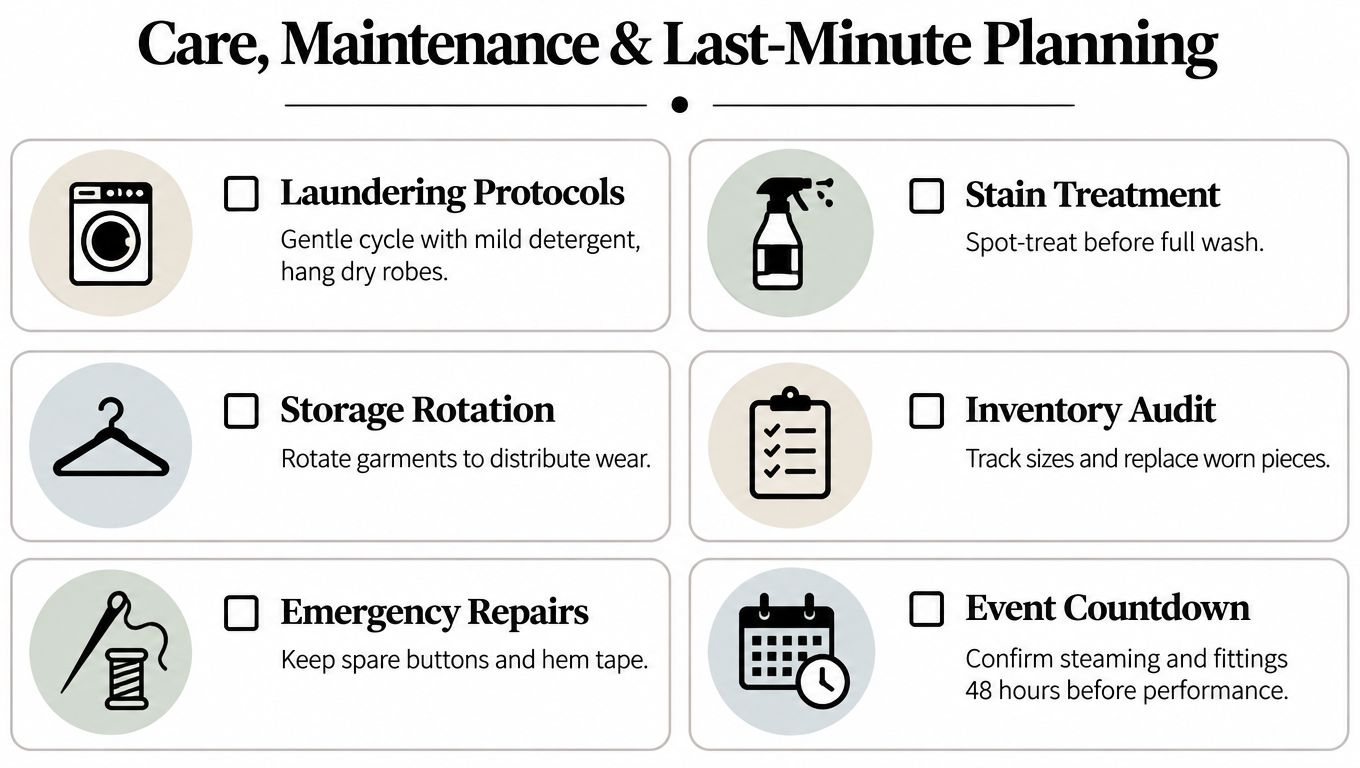
The robe that looks expensive in week one can look tired by month four if it's stored badly or cleaned without a plan. Care matters even more when a choir has multiple size runs, because children outgrow garments and adult ensembles rotate members. The purchase spec should always include laundering instructions, repair expectations, and storage notes, not just the item color.
Storage and laundering need a written plan
A cassock is traditionally a single-breasted, ankle-length garment fastened from throat to feet with buttons, worn as the foundation layer, and a surplice is a loose, white, wide-sleeved garment that normally reaches the knees or below (Anglican garment reference). That layering affects storage, because the underlayer and overlayer need room to hang without crushing each other. For robe closets, I've found it's worth using separate hangers and keeping the garment line breathable so the shoulders don't deform.
For transport and off-season storage, wardrobe boxes are useful when a choir needs to move hanging garments without crushing them. If you're searching for a practical shipping and storage option, this guide on where can I buy wardrobe boxes is a straightforward resource to keep nearby. It's the kind of support item people forget until the week before a move or a sanctuary cleanup.
What to do before the performance window closes
- Check laundering instructions. Separate pieces by fabric and decoration before washing.
- Spot-treat stains early. Wait too long and the mark settles into the fibers.
- Rotate the inventory. Don't leave the same few garments in constant use.
- Keep emergency fixes on hand. Spare buttons, hem tape, and a needle-and-thread kit solve small failures fast.
- Confirm fit 48 hours before the event. Steaming and last fittings should happen before the final rush.
A quick-reference rule helps here. If the robe or stole is easy to repair, document the fix and keep it in circulation. If the garment keeps failing at the same seam or edge, replacement is cheaper than constant patching. For youth choirs especially, inventory rotation and size tracking matter because the useful life of a garment can change faster than the season.
ChoirBuy carries choir robes, choir stoles, cassocks, surplices, cottas, and choir caps for adult, youth, and liturgical ensembles, with size charts, customization, and fast fulfillment built around group ordering. If you're outfitting a choir and need a practical place to compare robes and stoles by role, fabric, and fit, visit ChoirBuy and choose the pieces that match your tradition and timeline.