

You're probably making this decision in the middle of three others. Music folders need replacing, the Advent schedule is changing, and someone just asked whether the choir can look more “unified” this year. That's usually when robe color moves from a vague preference to a practical choice.
Blue choir robes come up often because they solve more than one problem at once. They can feel reverent without looking severe. They work in traditional church settings, but they can also read warm and approachable in school, community, and seasonal programs. The trick is choosing the right shade, fabric, and fit so the robes look intentional from the first row to the back riser.
A good robe order works like good choral balance. The audience notices the whole effect first. Then the details either support that effect or fight it. Color symbolism, fabric finish, sizing consistency, and trim choices all shape that final impression.
Why Blue Choir Robes Still Matter for Modern Choirs
A director often sees the issue before anyone says it out loud. The choir enters. One robe looks too short, another puddles at the floor, and the color that looked fine on a hanger feels flat under sanctuary lights. Before the first anthem begins, the group already looks less unified than it sounds.
That's one reason blue has endured. It isn't a novelty shade that suddenly appeared in modern catalogs. A historical source on choir dress places blue within a long ecclesiastical tradition and notes that at Westminster Abbey servers wore a medium blue, showing blue as a recognized ceremonial color rather than a decorative afterthought in prominent church use (historical robe reference).
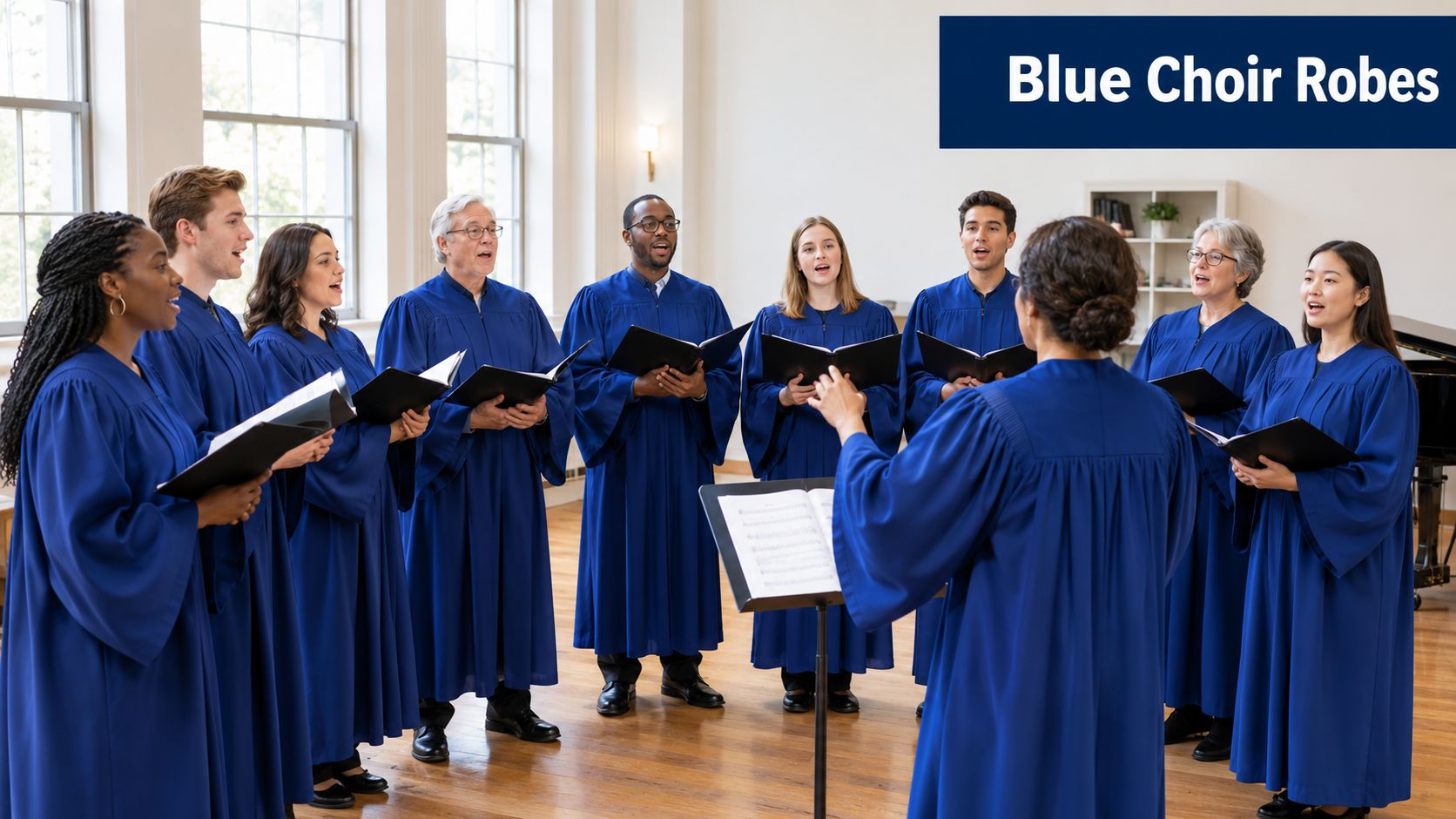
Blue belongs to the robe tradition
Blue matters partly because it was there early. One historical summary notes that, for much of the modern period, choir gowns were offered in only three main colors: black, white, and blue before the market widened later. The same overview also notes parish use where blue remained active for decades, including records that St Aidan's choir cassocks were blue from the choir's formation until the middle of the 1990s (history of choir robes and blue use).
That history still shapes expectations today. When a choir wears blue, many congregations and audiences read it as established, not experimental.
Blue often lands in the sweet spot between solemn black and bright white. It feels grounded, but not heavy.
What directors are really choosing
When you choose blue, you're not just picking a color family. You're choosing how the choir will be perceived at a distance.
Consider how different robe colors behave in a room:
- Black tends to absorb attention into formality.
- White pushes brightness and celebration to the front.
- Blue often creates calm structure. It frames the choir without overpowering faces.
That makes blue choir robes useful for directors who want a polished look across varied events, from regular services to school concerts. They can also soften the visual effect of a large ensemble. In practical terms, that helps the group look cohesive even when singers vary in age, height, and build.
A robe color with emotional range
Blue also carries symbolic range that's easy for people to feel, even if they can't name it. In worship, blue can suggest reflection, hope, devotion, and dignity. In performance settings, it can look confident without feeling flashy.
That combination explains why blue still matters. It brings history, symbolism, and usability into one decision, which is exactly what most first-time bulk buyers need.
Understanding Blue Shades and Their Symbolism
A director ordering blue robes for the first time usually starts with one question and quickly discovers there are three. Which blue looks right in the room? Which blue fits the church year, if liturgical color matters in your tradition? Which blue will still look consistent after months of wear, reorders, and different body types standing side by side?
That is why shade selection deserves more than a quick swatch decision. In choir apparel, symbolism and logistics meet in the same place.
How shade changes the message
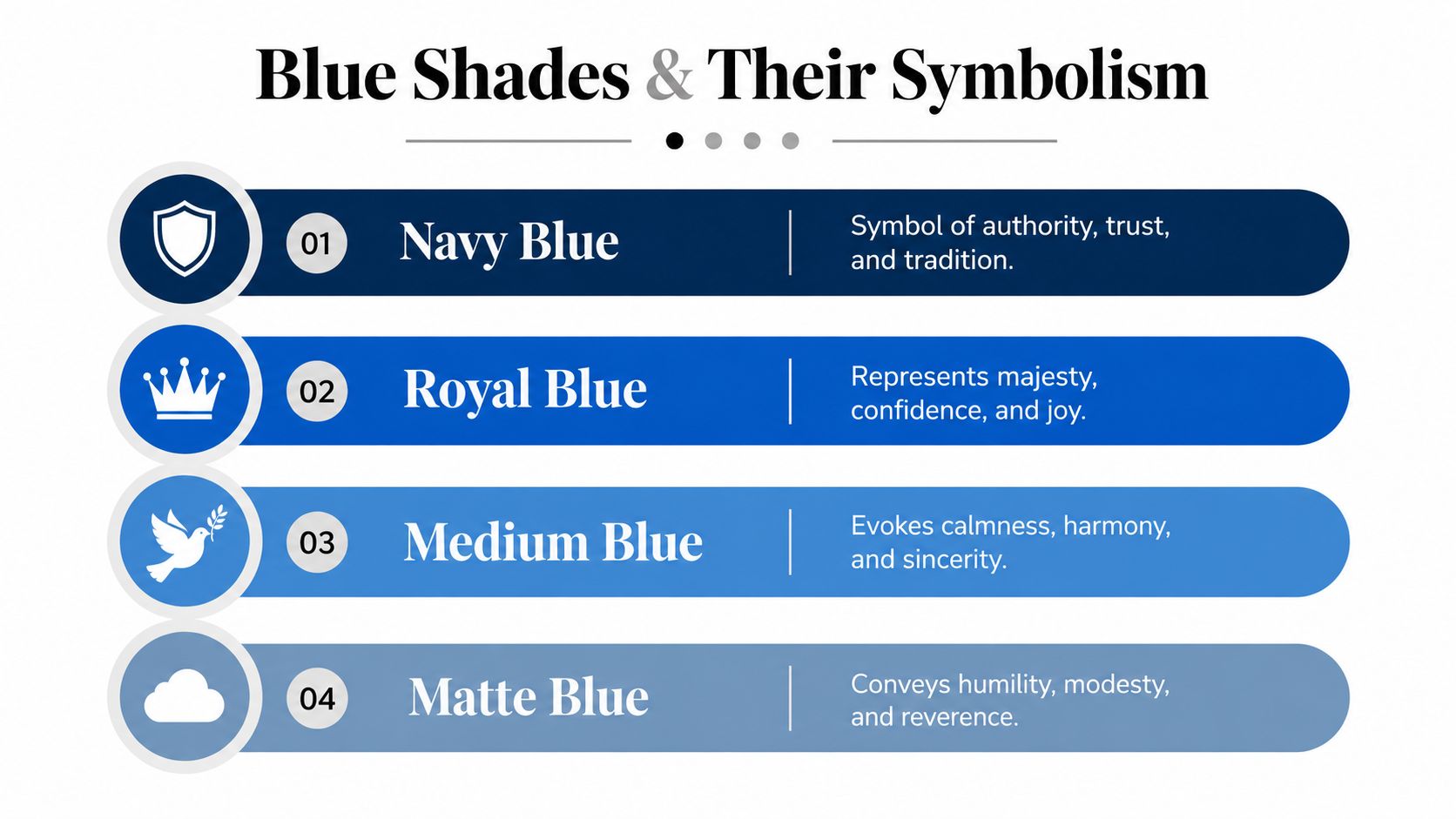
Blue is a broad family, and each branch speaks a little differently. Navy usually feels settled and formal. Royal blue carries more energy across the platform. Medium blue softens the look of the ensemble and often feels more welcoming. Matte blue is less about hue alone and more about surface. It cuts glare and keeps the robe from looking shiny under strong lights.
A useful way to sort the options is to pair meaning with frequency of use. A choir that needs one robe for nearly everything often does well with a darker, steadier shade. A choir buying for seasonal emphasis, youth performances, or brighter celebrations may prefer a clearer, more vivid blue.
Here is a practical reading of the main options:
- Navy blue suits traditional sanctuaries, formal concerts, and repeated year-round use. It reads stable, dignified, and less likely to feel dated after several seasons.
- Royal blue gives the choir more visual presence from the back of the room. It works well for celebratory services, school ensembles, and churches that want the platform to feel more lively.
- Medium blue feels approachable and calm. It often fits community choirs or mixed-use programs where too much formality would feel stiff.
- Matte blue helps in bright rooms, especially where overhead lighting can turn a glossy fabric into a distraction.
If you want a broader reference point for how blue sits alongside other choir colors, this guide to choir robe color meanings gives helpful context.
Liturgical use versus visual preference
Blue often causes hesitation because its role varies by tradition. Some churches use it mainly because it coordinates with the worship space, school colors, banners, or branding. Others need it to align with the church calendar.
An overview of Anglican vestments notes that blue is associated with meanings such as tranquility, hope, devotion, truth, and royalty, and that some Anglican and Episcopal settings use blue for Advent or Marian observances, while other traditions use it less often or treat it as optional (Anglican vestments overview).
For buying decisions, that difference matters. If blue appears regularly in your worship life, a blue robe body may earn its place as the main wardrobe color. If blue shows up only in one season, many directors save money and gain flexibility by choosing a neutral robe body, then adding blue through stoles, trim, or panels.
Decision lens: Match the permanence of the color to the permanence of its role in your calendar.
That one step prevents a common first-order mistake. A beautiful royal blue robe may be perfect symbolically for Advent in one church, yet too specific for weekly year-round use in another.
Choosing a shade by frequency and wear
The smartest shade is not always the prettiest swatch under showroom light. It is the one that still works in your actual sanctuary, on a full range of skin tones, across inclusive size runs, and through future reorders.
| Shade choice | How it usually feels | Practical buying role |
|---|---|---|
| Navy | Formal and enduring | Strong main robe color for broad use |
| Royal blue | Bright and celebratory | Good main robe for energetic ensembles or a strong seasonal statement |
| Medium blue | Calm and open | Useful for community, school, or mixed-use settings |
| Matte blue | Quiet and reverent | Helpful in harsh lighting or understated worship settings |
Color behavior in the room also matters. Navy reads like lower chapel light, quieter and more grounded. Royal blue has the effect of festival-day window light, clearer and more attention-getting. Neither is better. The better choice is the one that supports how your choir serves, how often the robes will be worn, and how easily you can match that shade again when you place the next bulk order.
Comparing Fabrics and Finishes for Blue Choir Robes
A blue robe can look excellent on delivery day and uneven by mid-season if the fabric and finish weren't chosen carefully. That's the part many buyers miss. They focus on the swatch, not on how the blue behaves after washing, perspiration, folding, and seat friction.
What matters more than the swatch
For blue choir robes, color retention matters as much as initial color. Deep shades can show fading, rub wear, and shade drift more clearly than many lighter colors.
One comparative dyeing study found that cotton and cotton-polyester fabrics showed high wash and light fastness, while the polyester sample showed a significant color shift after washing. The reported color-difference values were 5.44 for polyester, 0.35 for cotton, and 0.19 for cotton-polyester, indicating much greater stability in the cotton and blend samples under laundering conditions (fabric dyeing comparison study).
That doesn't mean every polyester robe is a poor choice. It means buyers should ask better questions. Engineered finishes and dye systems matter. So does whether the fabric is matte, satin-like, or cotton-rich.
Blue Choir Robe Fabric Comparison for Color Retention and Wear
| Fabric Type | Drape and Finish | Color Retention | Best Use Case |
|---|---|---|---|
| Matte polyester | Structured, low-shine, tidy from a distance | Can vary by finish and dye system | Frequent church use where wrinkle resistance matters |
| Shiny polyester or tricot | More reflective, catches stage light | Needs careful specification for deep blue shades | Concert choirs, pageants, brighter staging |
| Cotton-rich fabric | Softer hand, often more breathable | Strong potential for stable deep blue when dyed well | Frequent laundering and comfort-focused wear |
| Cotton-polyester blend | Balanced drape and easier care | Performed strongly in the cited wash and light testing | Mixed-use ensembles that want durability and visual consistency |
For directors comparing robe fabrics, this overview of religious fabric by the yard helps translate material names into practical buying language.
Ask about fastness, not just fabric name
A fabric label alone won't tell you enough. Deep blue performance garments need good wash fastness and rubbing resistance, especially at points where robes get handled.
A textile dyeing study found that using a dye fixative plus a wet-rubbing improver on deep blue cotton produced wash fastness of grade 5, dry rubbing at grade 5, and wet rubbing at grade 4 (deep blue dye fixation study). For choir use, those numbers matter at shoulder seams, sleeve edges, lapels, and folded areas where abrasion shows first.
Ask suppliers whether the robe fabric and trim combination has been validated for wash fastness around grade 4 to 5 and wet rub performance around grade 4 for deep blue shades.
A simple way to choose finish
If your choir sings under strong stage lights, a matte robe often behaves like a non-glare music stand. It lets the eye stay on faces. A shinier robe acts more like polished brass. It can be beautiful, but it reflects more attention.
That's why fabric choice should follow setting. A robe isn't only worn. It's seen across distance, under light, and over time.
Sizing and Fit Guidance for Every Choir Member
Sizing is where many bulk robe orders go sideways. A choir can agree on color in five minutes and still spend weeks fixing fit problems because people guessed sizes from street clothing labels. Robe sizing doesn't work that way.
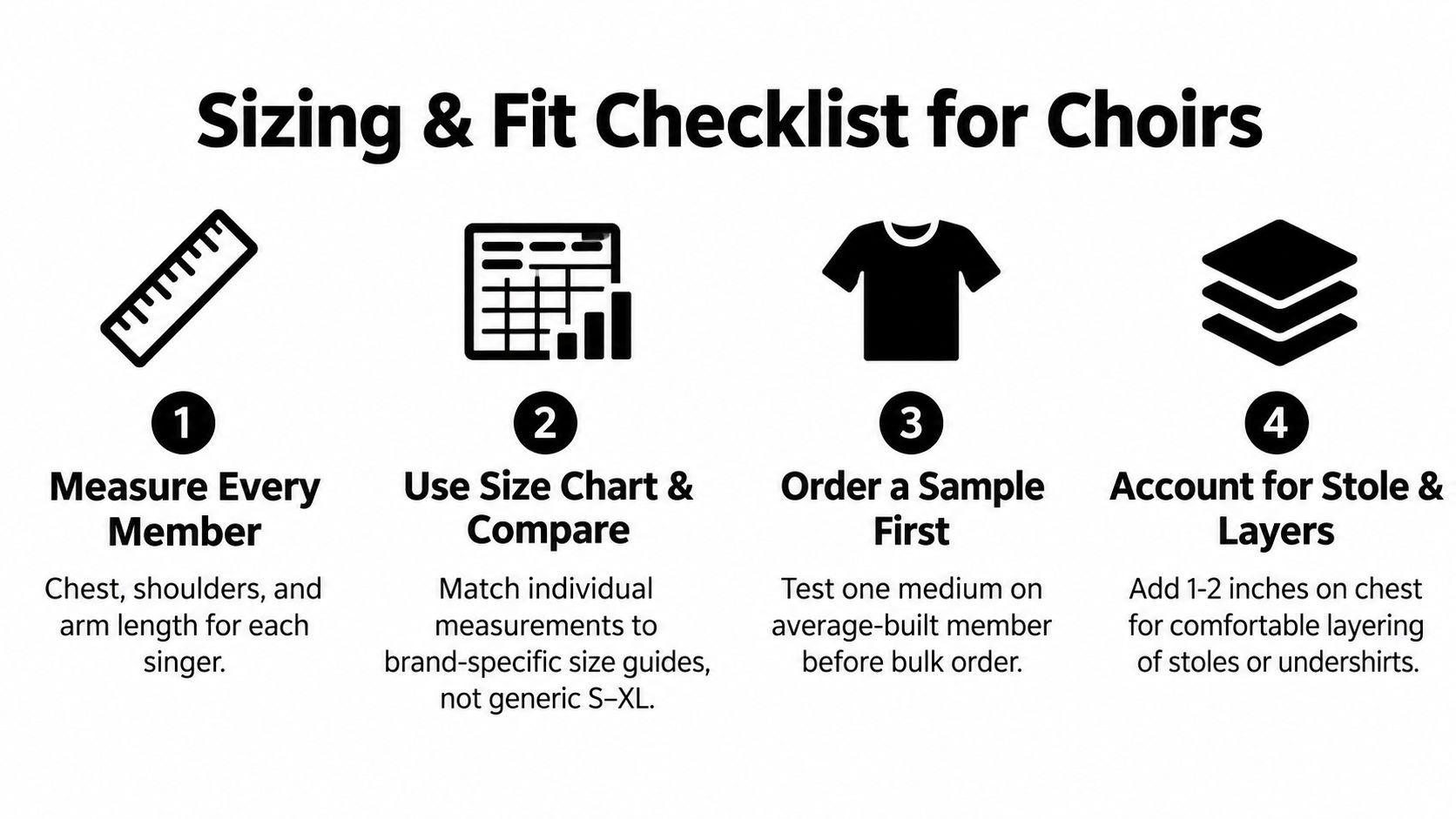
Existing guidance for choir attire repeatedly points buyers toward manufacturer-specific charts rather than street sizes, and notes that custom garments may require height, weight, chest, waist, hip, sleeve, and finished-length measurements (church choir attire sizing guidance). That's especially important for mixed-age choirs, plus-size singers, and children.
Measure people, not assumptions
A robe is more forgiving than a suit, but it still needs structure. Start with the body facts that affect drape and finished length.
Use this checklist:
- Record height first. Height usually drives robe length more than anything else.
- Add body measurements next. Chest, waist, hips, and sleeve matter when a singer is broad-shouldered, full-busted, layered, or between sizes.
- Note shoe height. Choir shoes, heels, and boots change floor clearance.
- Mark special fit needs. Mobility devices, seated singers, pregnancy, children in growth phases, and singers who prefer more arm room should be flagged early.
Floor clearance solves half the complaints
Many robe issues aren't about width. They're about length. A robe that brushes the floor can look elegant while standing still and become a tripping hazard on steps or risers.
A practical rule is to have singers measured in the shoes they expect to wear most often with the robe. Then decide whether you want the hem to fall closer to ankle length or lower, based on your platform, stairs, and procession style.
Practical rule: Consistent hem appearance comes from measuring singers in performance shoes, not from ordering every adult the same “average” length.
Build a bulk workflow that stays organized
The easiest sizing day is the one with a repeatable process.
Try this:
- Use one measurement team. Fewer measurers means fewer inconsistencies.
- Work from a single form. Keep height, chest, waist, hips, sleeves, and notes in one place.
- Group by choir section only after measuring. Don't let soprano, alto, tenor, and bass categories become sizing shortcuts.
- Sample before final approval. If one or two representative singers try sample robes, you can catch issues in sleeve width, shoulder ease, or robe length before the full order.
One useful detail from a ChoirBuy sizing resource is that a custom choral gown chart includes sizes from 39 to 66 along with XL variants such as 45XL, 48XL, 54XL, 57XL, and 63XL, which is the kind of range directors should look for when outfitting diverse ensembles (inclusive custom gown sizing chart)).
That kind of range matters because no choir is built from one body type. A robe program works better when every singer feels included before the first fitting problem appears.
Styling Blue Robes With Stoles Trims and Custom Details
Blue robes become much more flexible once you stop treating the robe body as the whole outfit. The robe is the base note. Stoles, trim, cuffs, piping, and embroidery are the harmony. They can shift the look from daily worship to feast day, from youth ensemble to formal concert, without replacing the core garment.

Pairing blue with accent colors
Blue is cooperative, but not every combination behaves the same way.
Consider these pairings:
- Navy with gold gives a ceremonial feel and often works well for feast days, anniversaries, and formal concerts.
- Royal blue with white or silver feels brighter and cleaner, which can suit youth groups or seasonal programs.
- Blue with purple accents can support Advent use in traditions where blue is liturgically welcome.
- Blue with red trim creates stronger contrast and can read more dramatic than devotional, so it needs careful judgment in church settings.
For directors exploring accessory options, choir stoles are often the simplest way to make one blue robe serve multiple seasons or events.
Use trim to guide the eye
Trim placement changes how the body of the robe reads from a distance. Vertical trim can make a robe look longer and cleaner. Contrasting cuffs draw attention toward hand movement. A shaped yoke can make the upper body look more structured across a full ensemble.
If you're planning custom alterations or sourcing decorative edges separately, it can help to find sewing trim at More Sewing so you can compare styles before committing to a visual direction.
A trim choice should support the choir's identity, not compete with it. If the sanctuary already has strong banners, stained glass, or colored paraments, simpler robe detailing usually ages better.
Custom details that stay useful
Embroidery, logos, and stitched emblems can be meaningful, but they should be chosen with restraint. A church crest at the yoke or sleeve can look timeless. Large front embroidery can limit reuse across shared groups, seasonal programs, or community events.
One practical strategy is to keep the robe body classic and let removable or interchangeable accessories do the seasonal work. That gives the wardrobe longer life.
This video gives a helpful visual sense of how styling choices affect overall presentation:
Different ensembles need different styling restraint
Adult church choirs often look strongest in deeper blue bodies with modest trim. Youth choirs can usually carry brighter royal tones and cleaner contrast. Liturgical teams may benefit from a simpler robe plus a stronger stole choice, especially if the robe needs to function through several points in the church year.
The goal isn't decoration for its own sake. It's visual unity that still gives you room to adapt.
Caring for Blue Robes and Planning Bulk Orders
A blue robe program lasts longer when care instructions are treated as part of the purchase, not as an afterthought. Deep blue can show neglect in subtle ways. Fading at the shoulders, rubbing at the lapels, and uneven shade across replacement pieces are the usual warning signs.
Protect the color from routine wear
Most robe damage happens in ordinary handling. Singers fold robes over chairs, hang them while still damp, or stack them with rough trims rubbing against the body fabric.
Use a simple care routine:
- Wash by fabric guidance. Match detergent, water temperature, and cycle type to the supplier's recommendations.
- Separate rough accessories. Metal pins, textured stoles, and abrasive trim can wear the robe body.
- Hang before long storage. Let robes dry fully and release folds before bagging or stacking.
- Watch friction points. Shoulder areas, sleeve edges, and front panels often show the earliest wear.
The technical benchmark to request from suppliers is straightforward. For deep blues, look for robe fabrics and trims that have been tested for strong wash fastness and solid wet-rub performance, especially if the choir launders robes regularly.
Plan the order like a concert timeline
Bulk robe problems usually come from rushing decisions in the wrong order. Directors often start with color, then quantity, and only later discover that fit review, sample approval, and shipping time were the schedule drivers.
A steadier workflow looks like this:
- Approve the shade under your actual lighting. Sanctuary light, stage light, and daylight don't show blue the same way.
- Review one sample robe if possible. Check drape, finish, seam quality, and hem behavior.
- Lock measurements before the final count. Last-minute choir additions happen, but the main size list should be settled first.
- Reserve extras intentionally. If your choir fluctuates, a few flexible replacement sizes can prevent urgent reorders later.
Prevent shade drift across reorders
The quiet challenge with blue is batch matching. A replacement robe ordered much later can be slightly off in tone or finish, especially if the original fabric line changed.
That's why it helps to keep records for:
- Exact shade name
- Fabric type and finish
- Trim or stole pairing
- Order date and supplier notes
- Any custom embroidery placement
Save one approved swatch or one well-kept robe as the visual standard for future orders. That reference can settle questions faster than a product name alone.
Storage matters too. Keep robes away from prolonged direct light, moisture, and crowded racks that crush collars and yokes. A little discipline here reduces the need for visible replacements later.
Choosing and Sampling Your Perfect Blue Choir Robes
By the time you're ready to order, the biggest question usually isn't whether blue is attractive. It's whether blue should be your main robe color or a seasonal accent. The answer depends on how often your choir will wear it, how formal you need it to feel, and whether your church tradition supports blue beyond a limited part of the year.
When blue should be the main robe
Blue makes sense as a primary robe color when your choir needs a stable, versatile visual identity. That's often true for church choirs that want something softer than black, school ensembles that need a dignified stage look, or groups that sing in a mix of sacred and community settings.
A main blue robe works best when:
- You want broad reuse. One robe should function across many services or performances.
- Your setting favors calm formality. Blue can carry reverence without feeling stark.
- You plan to vary meaning through accessories. Stoles and trim can do the seasonal work.
When blue should stay seasonal
Sometimes the smarter move is a neutral robe plus blue accents. That's especially useful if your tradition uses blue mainly around Advent or specific observances. In that case, a stole, cassock layer, or trim detail may give you the symbolism you want without committing your full wardrobe to a narrower use case.
A small trial order or product sample lets you compare sheen, shade depth, and drape before the choir invests in a full run. If you're weighing options, the ChoirBuy product samples page shows the kind of sample-first workflow directors often use to reduce uncertainty.
What to test before full approval
A blue swatch on a screen is only a hint. Test the material where it will be worn.
Check these conditions:
- Sanctuary lighting versus daylight
- Matte versus shiny finish at choir distance
- Compatibility with existing stoles, banners, and paraments
- How the shade looks across different skin tones and age groups
- Whether the robe still looks unified with your likely size range
Sampling also helps with one practical issue many directors overlook. A rich royal blue that looks striking on a single robe can feel louder than expected when multiplied across a full chancel. A deeper or more muted blue may create better ensemble balance.
Confidence comes from process
The safest robe purchase usually isn't the boldest or the cheapest. It's the one that has been measured, sampled, and viewed under real conditions. If you handle blue that way, it stops being a gamble and starts becoming one of the most dependable choices in choir apparel.
A polished choir look doesn't require guesswork. It requires a clear shade decision, realistic fabric expectations, careful sizing, and one honest sample before the full commitment.
ChoirBuy offers blue choir robe options in multiple finishes, inclusive sizing, and sample tools that can help directors test color and fit before a bulk order. If you're comparing shades, planning a seasonal stole program, or outfitting a mixed-age ensemble, visit ChoirBuy to review robes, accessories, and ordering resources.