

Welcome! More than just a piece of fabric, a pastor's stole is a powerful symbol in Christian worship. It's that long, scarf-like vestment worn over the shoulders, visually representing the yoke of service and the authority that comes with ordination. In a very real way, stoles for pastors are powerful visual communicators, with their colors and designs telling the story of the liturgical season or the specific focus of a worship service. The same vestment appears under several names: priest stole, clergy stole, minister stole, and religious stole. Across Catholic, Orthodox, and Protestant traditions, the stole serves as an official symbol of ordained ministry, a practice documented in historical accounts of Christian liturgical vesture.
Choosing the Right Clergy Stole for Your Ministry
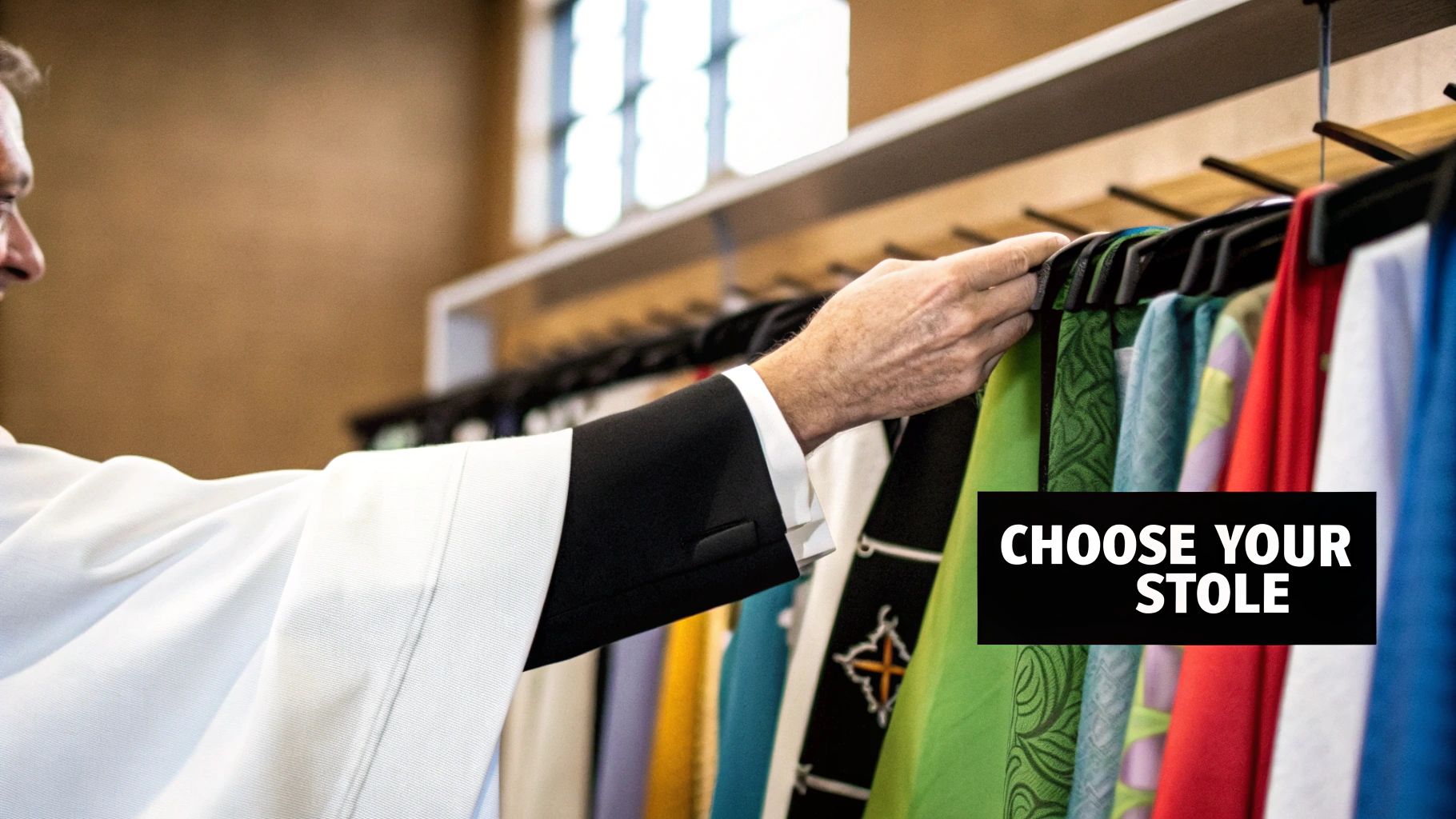
If you’re a pastor, worship leader, or part of a church committee, compare clergy stoles by their intended liturgical use, cut, color, and fit. ChoirBuy offers choir apparel, including Custom Traditional Choir Stoles. These should not be assumed to replace an ordained minister’s stole; confirm the appropriate garment with your church and the supplier.
One thing worth knowing before we go further: this single garment goes by many names. Catholic and Orthodox writers usually say priest stole; the broader term clergy stole works across traditions; Protestant churches often say minister stole or pastor stole. Whether your tradition is Catholic, Orthodox, Lutheran, Methodist, or non-denominational, what you're looking for is the same vestment, and this guide covers how each tradition wears it.
This guide will walk you through every important decision point. Our aim is to help you understand which color matches the season, which fabric survives regular use, and how long the ends should hang. Those are exactly the decisions this guide walks through.
A stole is one of the most fundamental parts of a minister's attire. It signifies the sacred duties and spiritual leadership entrusted to them. When a pastor puts on a stole, they are connecting to a tradition that stretches back centuries, a practice that resonates across countless denominations.
The Stole as a Symbol of Office
In many traditions, wearing a stole isn't just an option; it's a core part of the pastoral role. For instance, a 2014 survey within the United Methodist Church highlighted that newly ordained elders are vested with a stole during their ordination, a powerful moment that physically ties the garment to their new office. Considering that roughly one-third of Christians worldwide belong to liturgical traditions where stoles are the norm, it's safe to say hundreds of millions of people see their pastors wear them every Sunday. You can learn more about these fascinating ecclesiastical statistics and what they mean for the modern church.
A pastor's stole is a visual sermon. Before a word is spoken, the color, fabric, and symbols on the stole begin to tell the story of the day's worship, setting a tone of reverence and expectation for the congregation.
The history behind it is old. The priest's stole developed from a long, scarf-like garment whose exact origin remains uncertain, possibly connected to the Roman or Greek orarium. In Eastern Christianity, the orarion was already worn by deacons during the 4th century, while priests later adopted a related garment called the epitrachelion; in the West, the Latin term stola became established during the 9th century. By the 4th century, worship garments had become distinct from everyday clothing, and the stole had begun serving as an official symbol of the priesthood, a development that accelerated after Christianity's legalization in the Roman Empire in 313 CE, as this overview of vestment history explains.
What This Guide Will Cover
- Decoding Liturgical Colors: How each color corresponds to the seasons of the church calendar.
- Fabric and Style Choices: Comparing materials and cuts to find that ideal blend of comfort, durability, and visual appeal when coordinating clergy vestments with choir apparel.
- Custom Embroidery: Personalizing a stole with meaningful symbols that express your church's identity.
- Practical Considerations: Sizing, care, ordering timelines, and bulk pricing.
How We Evaluate Stole Quality
For a stole intended for regular use, check the following features before ordering:
- Fabric durability. Polyester must withstand gentle machine washing without pilling or losing its shape, while satin and brocade must hold their finish through careful dry cleaning.
- Embroidery stitch quality. Look for even stitching, aligned embroidery, and clear lettering; ask the supplier about the garment’s care requirements.
- Drape and weight. A stole must distribute weight evenly so it does not pull at the neck or crease badly during extended services.
- Colorfastness. Dyes must remain stable across the liturgical calendar, ensuring no bleeding onto albs or uneven fading over time.
- Price per stole at bulk. For congregations outfitting a team, per-unit cost matters. ChoirBuy’s Custom Traditional Choir Stoles list at $29.00 and are available for as low as $23.20; confirm the current minimum quantity and design requirements when requesting a quote.
Just as important is what disqualifies a candidate: fraying seams along the yoke, dyes that bleed in a cold wash, misaligned embroidery, or trim that puckers after pressing. Ask for a replacement or clarification if the delivered garment does not match the agreed specifications.
Priest Stoles, Clergy Stoles, and Minister Stoles: One Garment, Many Names
All of these terms refer to the same long, scarf-like vestment worn over the shoulders, with the naming following the role and tradition of the wearer. When searching for a stole for priest, clergy, or pastoral use, you are looking at the same foundational garment adapted for different contexts.
The word itself traces back to Latin. Stola was the Latin term for a long garment or robe, and it became the established name for this vestment in Western Christianity during the 9th century, as noted in Britannica's entry on the stole. The etymology of the stola reflects its ancient roots in Roman dress, gradually becoming exclusively associated with ordained ministry.
Here's a quick usage map:
- Priest stole is the dominant term in Catholic and Orthodox contexts, where the stole is sacramental vesture reserved to ordained priests (in the East, the priest's version is the epitrachelion, as described in Eastern Christian liturgical references).
- Clergy stole is the neutral umbrella term, useful when a congregation includes pastors, deacons, and chaplains from different traditions, which is why most vestment retailers, including us, use it.
- Pastor stole and minister stole are the terms you'll hear most often in Protestant churches, particularly Lutheran, Methodist, Presbyterian, and non-denominational settings, where the stole signals the pastoral office rather than sacramental theology.
- Religious stole appears most often in ecumenical and academic writing, or when the garment is being discussed alongside graduation and honor stoles.
Whatever the label, the question underneath is usually the same: which cut, color, and fabric fits my role and my tradition? The rest of this guide answers that.
Decoding the Meaning of Liturgical Colors
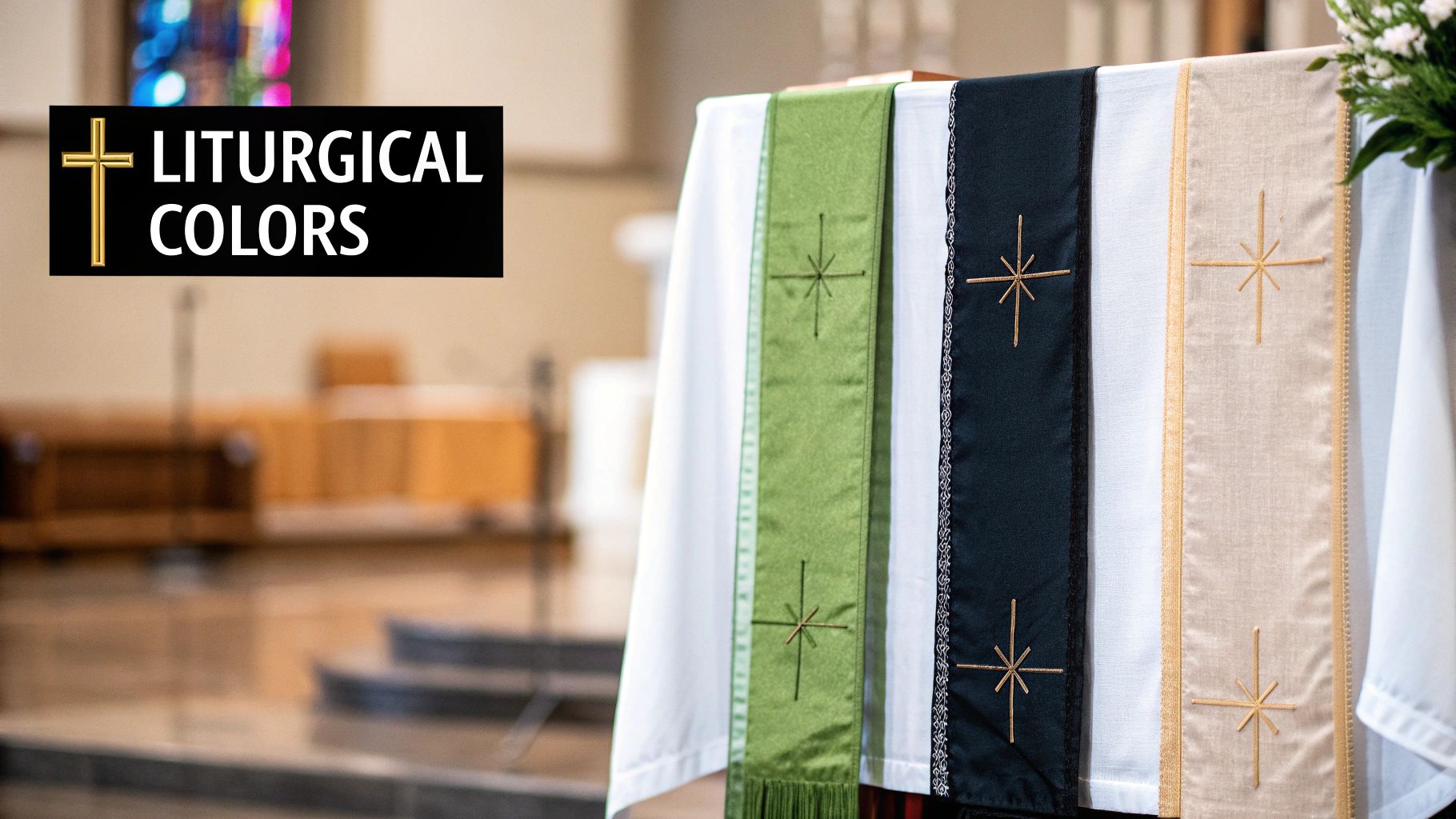
Choosing a stole's color is far more than a style decision; it's a practice steeped in centuries of Christian tradition. Each hue is a visual sermon, connecting the congregation to the rhythm and story of the church year. Think of the liturgical calendar as a sacred map, and the colors are the signposts guiding us through seasons of fasting, feasting, and faith.
This system turns a simple garment into a profound ministry tool. When you align your stoles for pastors with the season, you're visually reinforcing the day's scripture and spiritual focus. It's a quiet but powerful way to communicate the heart of the Gospel before a single word is even spoken.
The Colors of Celebration and Purity
White and Gold are the colors of pure joy, reserved for the highest and most sacred moments in the church calendar. They speak of light, purity, innocence, and the ultimate victory of Christ.
- When to Use Them: You'll see these gleaming stoles during the high seasons of Christmas and Easter. They are also the go-to for weddings, baptisms, funerals, and feast days celebrating saints who weren't martyred.
- Theological Meaning: These brilliant colors represent the glory of God and the triumph of the resurrection. A pastor in a white or gold stole on Easter morning is a walking proclamation of life's victory over death.
Using these colors immediately sets a tone of profound reverence and celebration, marking these days as special and set apart.
The Colors of Reflection and Preparation
Purple is the color of solemnity and preparation. It calls the community to a season of introspection, repentance, and waiting.
The liturgical colors are not merely decorative; they are a form of visual theology. Each color on a pastor's stole helps to weave the narrative of salvation, guiding the congregation through seasons of fasting and feasting, sorrow and celebration.
Purple stoles are the standard for both Advent and Lent. In Advent, the color signifies a royal, solemn anticipation of the coming King. During Lent, it deepens into a symbol of penance and preparation as we journey toward the cross. For many clergy, these are essential stoles for pastors in their collection.
While the symbolism is powerful for stoles, you can also create a cohesive visual theme for your entire worship team by exploring the broader meaning of choir robe colors.
The Colors of Life and Mission
Green and Red are vibrant, active colors that speak to the ongoing life and mission of the church in the world. They represent growth, new life, and the fire of the Holy Spirit.
- Green for Ordinary Time: The longest season of the church year, Ordinary Time, is marked by green. This color symbolizes hope, life, and the steady growth of the church after the major feasts of Easter and Pentecost. It represents the day-in, day-out journey of our faith.
- Red for the Holy Spirit and Martyrs: Red is a potent color with two distinct, powerful meanings. We wear it on Pentecost Sunday to signify the tongues of fire of the Holy Spirit. It is also the color for services honoring Christian martyrs, a stark reminder of the blood they shed for their faith.
Other Significant Liturgical Colors
Beyond the core colors, a few others hold special places in certain traditions on specific Sundays.
- Rose: This color makes a brief appearance just twice a year—on Gaudete Sunday (the third Sunday of Advent) and Laetare Sunday (the fourth Sunday of Lent). Rose signifies a moment of quiet joy and anticipation in the middle of a more solemn season.
- Blue: Some traditions, especially in Lutheran and Methodist circles, use blue for Advent instead of purple. It symbolizes hope and is closely associated with the anticipation of the Virgin Mary.
- Black: Traditionally reserved for Ash Wednesday and funerals, black signifies mourning, mortality, and deep repentance.
This color system was not handed down in a single moment; it standardized gradually across Western Christianity. According to Catholic Encyclopedia's history of liturgical colors, historical accounts state that white was the only liturgical color in use up to the 4th century, and by roughly 1200 the principal Roman Catholic colors were white, red, green, black, and violet or purple — with Pope Innocent III describing four principal colors and noting violet as an occasional use.
Understanding this rich visual language helps you choose a stole that not only looks dignified but also deepens the worship experience for your entire congregation.
A Guide to Liturgical Stole Colors
To make things easier, here's a quick-reference chart connecting the colors to their meaning and use throughout the church year.
| Color | Primary Meaning | Liturgical Season or Occasion | Related Choir Apparel |
|---|---|---|---|
| White/Gold | Purity, Light, Joy, Victory | Christmas, Easter, Weddings, Funerals, Baptisms, Feasts of Saints | White or gold custom choir stoles |
| Purple | Repentance, Preparation, Royalty | Advent, Lent | Purple custom choir stoles |
| Green | Hope, Life, Growth, Mission | Ordinary Time (Season after Epiphany and Season after Pentecost) | Green custom choir stoles |
| Red | Holy Spirit, Martyrdom, Sacrifice | Pentecost, Feasts of Martyrs, Palm Sunday | Red custom choir stoles |
| Rose | Anticipation, Joy | Gaudete Sunday (Advent 3), Laetare Sunday (Lent 4) | Confirm the required shade with your supplier |
| Blue | Hope, Expectation | Advent (in some traditions) | Blue custom choir stoles |
| Black | Mourning, Death, Repentance | Ash Wednesday, Funerals | Black custom choir stoles |
These linked products are choir stoles for coordinating ensemble apparel, not a verified range of clergy stoles. Select ordained vestments according to your church’s requirements.
This chart can serve as a helpful guide when planning your worship services and ensuring your vestments align with the timeless story of the church.
Finding the Perfect Stole Style and Fabric
Once you've landed on the right color for the liturgical season, the next step is choosing the cut and fabric. The practical considerations matter just as much. The physical shape and material of a stole define its character, how it feels during a long service, and how it drapes. It's all about finding that sweet spot where tradition, personal comfort, and visual dignity meet.
Just as suits vary by occasion, stoles for pastors come in different cuts. Each serves a specific liturgical purpose and works with other vestments. Understanding these differences helps you choose a stole that hangs correctly and feels like a natural part of your clerical attire.
Comparing Traditional Stole Styles
The most fundamental difference in stole cuts comes down to the office of the person wearing it—specifically, whether it's for a priest or a deacon.
- Priest or Pastor Stole: This style is worn around the back of the neck, with the two panels hanging straight down the front. It's a beautiful symbol of the yoke of pastoral ministry and is typically worn over an alb or a cassock and surplice.
- Deacon Stole: The deacon stole has a unique look. It's worn over the left shoulder and drapes diagonally across the body, where it's fastened at the right hip. This distinct style represents the Deacon's role as a servant, always ready for action and service to the church and its people.
How a priest wears the stole depends heavily on tradition. At a typical Roman Catholic Mass, the priest's stole hangs straight down over the alb, often crossed over the chest and tucked into the cincture in older practice, though modern use usually lets both panels hang free. In the Orthodox Church, the priest's equivalent vestment is the epitrachelion — a stole whose two sides are sewn together with button loops at the neck, worn hanging straight down the front as the essential priestly vestment for every service.
Protestant pastors adapt the same garment to their own settings. Lutheran, Methodist, Presbyterian, and non-denominational pastors generally wear the stole as Catholic priests do — around the neck, both panels down the front — but over an alb, a cassock and surplice, or even a plain robe or suit, with the color chosen to match the church year. Non-denominational churches often favor simpler crosses or a church logo rather than traditional saints' imagery, which is easy to accommodate with custom embroidery.
These are the time-honored forms, but you'll also find modern variations that offer different aesthetic touches.
Exploring Different Cuts and Designs
Beyond the priest/deacon distinction, the actual shape of the stole's panels can completely change its look. The three main cuts you'll see are straight, tapered, and flared. Each one offers a different silhouette.
You can think of a stole's fabric as its voice. A quiet, matte polyester speaks of steadfast daily service. A luminous satin or a rich brocade sings of high celebration and glorious occasions. The material truly sets the tone.
Straight Cut: This is the most classic and straightforward design. The stole's width stays the same from the neck all the way down to the ends. It gives you a clean, traditional, and understated look.
Tapered Cut: A tapered stole starts narrower at the neck and gets wider toward the ends. This design is great for reducing bulk around your neck, helping the stole lie flatter and feel more comfortable, which makes a big difference during lengthy services.
Flared Cut: This style is similar to the tapered cut but has a much more dramatic widening at the bottom. That extra space makes the flared design a perfect canvas for larger, more elaborate embroidery or symbols. It's an excellent choice for highly decorative or custom stoles for pastors.
Selecting the Ideal Fabric for Your Ministry
Choosing a fabric is where practicality meets personality. Your local climate, how often you'll wear the stole, and your budget will all guide this decision. For a clergy stole, confirm the available fabric with its supplier. ChoirBuy’s Custom Traditional Choir Stoles have a satin finish.
- Satin: With its beautiful sheen and smooth feel, satin is perfect for high holy days and big celebrations like Easter and Christmas. The way it catches the light adds a sense of festivity and grandeur to the moment. For coordinated choir apparel, ChoirBuy’s Custom Traditional Choir Stoles offer a satin finish and color and personalization options.
- Brocade: This is a richly decorative, woven fabric, often with intricate patterns like flowers or religious symbols woven right in. Brocade has a sense of weight, history, and elegance, making it a wonderful choice for stoles that you hope will become cherished heirlooms.
- Polyester: Think of polyester as the workhorse fabric. It's valued for being durable, wrinkle-resistant, and easy to care for. It's a fantastic, budget-friendly option for stoles that will get frequent use during Ordinary Time or for daily services, giving you a dignified look without the fuss.
By balancing these elements—the symbolic cut, the functional design, and the tangible feel of the fabric—you can choose a stole that not only serves its liturgical purpose but also brings you comfort and confidence in your ministry.
How to Measure for a Perfect Stole Fit
Nothing is more distracting during a service than an ill-fitting stole. If it's too short, it looks awkward. Too long, and you risk tripping over it. The goal is a stole that feels like a natural extension of your vestments—something that moves with you and lends a sense of dignity without ever calling attention to itself.
Getting that perfect fit isn't complicated, but it does require a moment of your time to get it right. Taking a quick, accurate measurement is the single best thing you can do to ensure the stole you order hangs beautifully and complements your clerical attire.
Starting Your Measurement
The most important measurement for any pastor's stole is its total length. This determines where the ends of the stole will fall, which is a key part of its visual and symbolic role. To find your ideal length, you just need a flexible measuring tape. It also helps to have a friend or a mirror handy.
Here's the simple, three-step process:
- Find Your Starting Point: Stand up straight and feel for the prominent bone at the back of your neck. This is your C7 vertebra, and it's the perfect spot to anchor your measurement.
- Drape the Tape: Let the measuring tape hang over your neck from that point, just as a stole would, with both ends falling evenly down your front.
- Find Your Length: Look in a mirror and adjust the tape until the ends hang at a length you find appropriate. This is your number!
That one measurement is the foundation for a great fit. It ensures the stole hangs symmetrically and looks proportional to your height.
Fine-Tuning the Stole Length
So, what's the "right" length? While there isn't one strict rule, tradition gives us some excellent guidelines. Generally, you want the stole to end somewhere between your knee and your ankle. The final choice often comes down to the other vestments you'll be wearing, like an alb or cassock.
A well-measured stole is an act of stewardship. It shows care for the tools of ministry and respect for the visual traditions of worship, ensuring that nothing distracts from the sacred moments of the service.
If you're a visual person, it can be helpful to see some standard measurements. We've put together a resource to help you picture how different lengths look. You can explore our ChoirBuy size and color charts to see how standard lengths correspond to different heights.
The infographic below puts this all into perspective, showing that getting the fit right is the final, critical piece of the puzzle after you've chosen your style and fabric.

As you can see, a thoughtful selection process always ends with ensuring a perfect fit.
Common Sizing Mistakes to Avoid
A few common missteps can result in a stole that just doesn't feel right. If you keep these in mind, you'll get a perfect fit on the very first try.
- Measuring Too Short: A stole that ends above the knee can look unbalanced and throw off the dignified, vertical lines of your vestments.
- Measuring Too Long: On the other hand, a stole that's excessively long can become a legitimate tripping hazard or get caught on chancel furniture.
- Forgetting Your Robes: This is a big one. Always take your measurement while wearing the robe or alb you'll have on underneath. The added bulk can absolutely change how the stole hangs.
By following these simple steps, you can confidently order a stole that not only looks flawless but feels comfortable, allowing you to keep the focus exactly where it belongs: on worship.
Making It Your Own: Personalizing Stoles with Custom Symbols
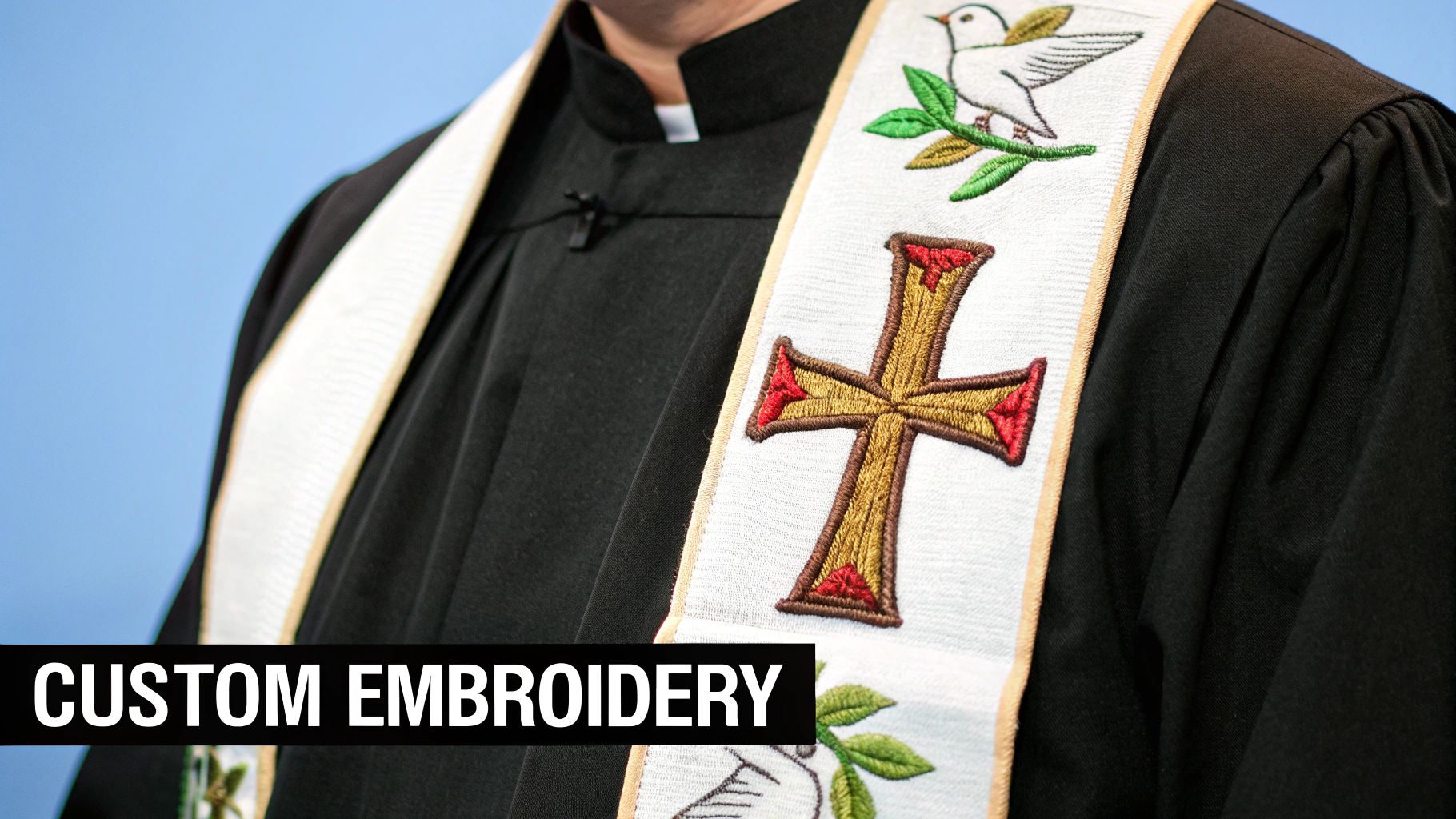
A stole comes to life through custom embroidery, transforming a beautiful vestment into a personal testament of faith. It's a chance to tell a story, turning fabric and thread into a visual sermon that speaks before you say a word.
Personalizing stoles for pastors creates pieces that aren't just worn, but cherished. They become a reflection of a unique ministry journey, your church's identity, or a specific theological message you want to emphasize. It's an opportunity to connect with the ancient, visual language of our faith.
Timeless Symbols and Their Meanings
For millennia, certain symbols have been a cornerstone of Christian art, carrying profound theological weight. Adding one to your stole instantly connects your ministry to this rich history, making your vestment a part of the church's timeless story. Each symbol is a compact lesson in faith, immediately recognizable to your congregation.
A thoughtfully chosen symbol is more than just decoration; it's a teaching tool. It reinforces the theme of a sermon or deepens the meaning of a liturgical season, making the stole an active participant in the act of worship.
Here are symbols often considered for clergy vestments. Related custom choir stoles can help coordinate the ensemble’s appearance; confirm any artwork options before ordering:
- The Cross: The ultimate symbol of our faith, representing Christ's sacrifice, redemption, and the victory of life over death. It's a constant, powerful reminder of the Gospel's core message.
- The Dove: A universal sign of the Holy Spirit, the Dove signifies peace, purity, and God's presence. It's especially fitting for Pentecost, baptisms, or confirmations.
- The Chi-Rho: This ancient symbol is formed by the first two Greek letters of "Christ" (Χ and Ρ). It's a powerful declaration of His identity and lordship, making it a wonderful choice for the Christmas and Epiphany seasons.
- Alpha and Omega: As the first and last letters of the Greek alphabet, they represent God's eternal nature—the beginning and the end. They are a perfect fit for Easter, celebrating Christ's eternal reign.
A custom stole is a legacy piece. The symbols and text embroidered upon it tell the story of a specific time, place, and calling, creating a tangible link between the pastor who wears it and the community they serve.
For those looking to create a unique design, new tools can help bring a vision to life. An AI Bible Art Generator, for instance, can be a great way to brainstorm and visualize fresh artistic interpretations of scriptural themes that you might want to incorporate.
Common Embroidery Symbols and Their Meanings
Choosing the right symbol can feel overwhelming, but understanding their roots makes the process much more meaningful. This table breaks down some popular options and the stories they tell.
| Symbol | Visual Description | Theological Meaning | When to Use It |
|---|---|---|---|
| Dove | A white dove, often shown descending or with an olive branch. | The Holy Spirit, peace, purity, new beginnings. | Pentecost, Baptisms, Confirmations, Weddings. |
| Cross | Ranges from a simple Latin cross to more ornate Celtic or Jerusalem styles. | Christ's sacrifice, redemption, salvation, the core of the Gospel. | Good Friday, Easter, Lent, or general use. |
| Chi-Rho | The Greek letters Chi (X) and Rho (P) superimposed. | An early Christogram representing Jesus Christ. | Christmas, Epiphany, or seasons celebrating Christ's identity. |
| Alpha & Omega | The Greek letters Α and Ω. | God's eternal nature as the beginning and the end. | Easter season, funerals, or themes of eternity. |
| Lamb of God | A lamb, often holding a banner (the "Banner of Victory"). | Jesus as the sacrificial lamb, innocence, and ultimate victory over sin. | Easter, Lent, Communion services. |
| Fish (Ichthys) | A simple two-arched line forming a fish symbol. | An early secret symbol for Christians, representing Jesus Christ. | General use, or for services focused on evangelism. |
| Chalice & Host | A cup (chalice) with a communion wafer (host) above it. | The Eucharist, communion, Christ's sacrifice and presence. | Communion Sundays, Maundy Thursday. |
By weaving these historic symbols into your stole, you're not just wearing a vestment; you're carrying a piece of Christian history and theology with you into the pulpit.
Beyond Symbols: Adding Custom Text
Personalization doesn't stop with images. Adding names, dates, or a favorite scripture verse can make a stole significant, turning it into a treasured keepsake commemorating a milestone in your ministry.
A few ideas include:
- Ordination Dates: Embroidering the date you were ordained is a beautiful way to honor the start of your pastoral journey.
- Church Names or Initials: A stole customized for a specific congregation can powerfully reinforce your connection to the community you serve.
- Meaningful Scripture: A short, impactful verse that has shaped your calling can serve as a constant source of encouragement every time you put it on.
Designing Your Unique Stole
Creating a custom stole is a wonderful process of reflection. Think about the messages you want to convey and the special occasions where it will be worn. The goal is a vestment that is not only beautiful but theologically rich and personally meaningful.
For choir apparel, review the Custom Traditional Choir Stole options, then confirm the artwork, dimensions, quantity, and intended use with the store. For a stole worn by ordained clergy, check the required cut and symbolism with your church and the supplier.
Caring for Your Stoles and Ordering from ChoirBuy
Your liturgical stoles are so much more than fabric and thread; they're a real investment in the visual and spiritual life of your ministry. When you protect that investment with proper care, you ensure they remain beautiful for years of service. With a little practical advice, you can easily maintain the dignity of your stoles for pastors through countless baptisms, sermons, and celebrations to come.
Proper care really just starts with knowing your fabric. Delicate materials like satin need a gentle touch, while a sturdy polyester can handle more. Following a few simple guidelines will go a long way in keeping your stoles' colors vibrant and their embroidery sharp.
Best Practices for Stole Care and Storage
Keeping your stoles looking their best is pretty straightforward. The secret is just consistent, gentle handling after each time you wear them. These simple steps, from cleaning to storing, will protect the material, prevent damage, and keep your vestments ready for worship.
- Cleaning: Use the care label for the specific stole; do not assume that a garment can be machine washed based on its appearance. For anything made of satin, brocade, or with heavy embroidery, hand-washing or professional dry cleaning is strongly recommended. This protects those delicate threads and the fabric's natural sheen. Always stick with a mild detergent and never use bleach.
- Pressing: To get wrinkles out, use an iron on a low to medium setting. It's always a good idea to press the stole on the reverse side. For an extra layer of protection, lay a pressing cloth (a clean cotton towel works great) between the iron and the stole. This simple trick prevents scorching and keeps the fabric from getting shiny.
- Storage: The absolute best way to store a stole is to hang it. A wide, padded hanger is perfect because it supports the weight and prevents that annoying crease you can get at the neckline. If you have to fold it, try rolling it gently with the embroidered side facing out and store it in a breathable garment bag, away from direct sunlight that can fade the colors over time.
Think of caring for a stole as an act of stewardship. Just as a pastor prepares their heart for a service, preparing their vestments ensures that every visual element of worship is offered with intention and respect.
This simple routine prevents the buildup of dust and oils and makes sure your stoles for pastors always look their best.
The ChoirBuy Ordering Process
When you're ready to add a new stole to your collection, we've made our ordering process as clear and simple as possible. We want you to feel confident from the moment you choose a style to the day it arrives at your door.
Our production times are set up to meet your needs. In-stock stoles usually ship out quickly, so you can get a standard vestment without a long wait. For anything personalized, however, planning ahead is key. Custom choir stoles take 12-15 business days for order processing, plus additional shipping time, as our artisans pour a great deal of care into crafting each unique design.
ChoirBuy offers bulk pricing for choir apparel, including packages of robes, stoles, and accessories. Request a quote for the products and quantities your choir needs, and source ordained clergy vestments according to the church’s requirements.
To get started, you can easily find and submit your details through our dedicated ChoirBuy order forms. Our team is ready to help you put together a bulk order that fits your ministry's specific needs and budget.
Ultimately, our goal is to help you confidently select a stole from ChoirBuy that beautifully honors your church's traditions, elevates your worship services, and becomes a cherished part of your ministry for years to come.
Common Questions About Clergy Stoles
Before ordering, confirm the intended use, dimensions, color, care requirements, and delivery estimate for the specific stole. The answers below separate general clergy-vestment guidance from ChoirBuy’s choir-apparel offering.
What is the difference between a clergy stole, minister stole, and priest stole?
Nothing but the name. All three refer to the same vestment — the long, scarf-like band worn over the shoulders — and the wording reflects who wears it. "Priest stole" is the usual term in Catholic and Orthodox contexts, where the stole is sacramental vesture. "Minister stole" and "pastor stole" are what Protestant congregations most often say, and "clergy stole" is the neutral umbrella term that covers deacons, pastors, priests, and chaplains alike.
Does a priest have to wear a stole during confession?
Yes, in Catholic and Orthodox practice the stole is required vesture for administering the sacrament of Reconciliation. Because absolution is a sacramental act reserved to ordained priests, the stole marks the priest as acting in that official capacity rather than as a private counselor, and a priest should not hear confessions without it — a principle covered in diocesan liturgical guidelines regarding sacramental vesture. In cases of genuine emergency where no stole is available, Church law provides for supplies of validity, but the stole remains the norm. Practice varies by denomination among Protestant traditions: some Lutheran and Anglican churches include confession and absolution in their liturgy and may use a stole, while many non-liturgical churches use no vestment at all for pastoral prayer and counsel.
Can you create a custom stole for me?
ChoirBuy offers Custom Traditional Choir Stoles with color, trim, size, and personalization options. Contact the store to confirm whether the requested design is available. These choir products should not be assumed to meet the requirements for an ordained minister’s stole.
How long does a custom embroidered stole take?
A custom embroidered stole is a true work of art, and that kind of detailed work takes time. Custom choir stoles take 12-15 business days for order processing, plus additional shipping time. We always recommend planning ahead, especially if it's for an ordination, a holiday, or another special event.
What's the best way to travel with clergy stoles?
For travel, use a suitable garment bag and follow the supplier’s packing and care instructions. Avoid crushing embroidery or leaving a folded stole under heavy items.
A well-cared-for stole is a sign of respect for the office it represents. Simple travel and storage habits can preserve its beauty and dignity for years of ministry.
When packing, lay the stole flat inside the bag. If you need to save space, you can also gently roll it, starting from the ends and rolling toward the center yoke. This simple technique helps prevent hard creases and protects any delicate embroidery. As soon as you arrive, hang it up to let any minor wrinkles fall out on their own.
Explore ChoirBuy’s choir apparel, including custom choir stoles, robes, cassocks, surplices, and cottas. For ordained clergy vestments, confirm the appropriate cut, colors, and use with your church before purchasing.