

A show choir costume is so much more than a uniform. It's a key part of your storytelling, a visual extension of your performance's theme, music, and raw energy. The best costumes are designed to enhance choreography, not hinder it. They have to withstand incredibly rigorous movement and create a powerful, unified look under those bright stage lights.
Think of them as a wearable narrative, transforming individual performers into a cohesive, unforgettable ensemble.
Translating Your Performance Vision into a Costume
The journey from a creative spark to a stage-ready costume starts long before you even think about fabric swatches. It begins with the big picture: translating your show's core identity—its story, mood, and musical style—into a tangible design concept. This first step is absolutely crucial, as it sets the direction for every single choice that follows.
A great design isn't just about picking pretty colors; it’s about building a visual language that instantly connects with your audience. Is your set a high-energy pop medley that demands vibrant, modern silhouettes? Or is it a classic Broadway tribute that calls for timeless elegance and a touch of sophisticated flair? Nailing this down will guide your entire creative process.

Building Your Design Brief
Before you get lost in the details, pull together a simple design brief to keep your vision focused. This document becomes your roadmap, ensuring everyone involved—from choreographers to students—is on the same page.
Your brief should clearly define:
- The Show's Theme: In just a few sentences, what's the story? For example, "A journey through the decades of rock and roll, from the rebellious 50s to the glam 80s."
- The Emotional Tone: What do you want the audience to feel? Joy, confidence, nostalgia, drama? Use words like "energetic," "dramatic," or "whimsical" to shape the visual direction.
- Key Musical Numbers: Pinpoint the standout songs. A powerful ballad might need a different look or feel than a fast-paced, full-ensemble dance number.
- The Color Story: Brainstorm a color palette that matches the mood. Don't forget to consider how these colors will look under your stage lighting. You might get some great ideas from our guide to modern choir robes, which explores how contemporary designs can breathe new life into traditional looks.
Balancing Visuals with Practical Needs
Let's be real: a stunning design is only effective if it actually works on stage. The most beautiful costume is useless if it restricts a dancer during a complex sequence or falls apart after two shows. Practicality and creativity have to go hand-in-hand.
The real challenge is finding that perfect intersection between breathtaking aesthetics and bulletproof functionality. A performer who feels comfortable and confident in their costume will deliver a stronger, more engaging performance every time.
One of the first things to consider is the performer's range of motion. Show choir choreography is demanding, often involving high kicks, quick turns, and full-body extensions. Your design absolutely must accommodate this movement without tearing or holding anyone back. This means thinking about stretch fabrics, secure fastenings, and lightweight materials right from the start.
This principle is at the heart of custom performance wear. The history of show choir costumes is full of innovators like Faythe Dornink, who started sewing unique outfits for her daughters' school groups back in 1992. Her work grew into a major business, now led by a New York-trained designer, proving that personalized, functional design is what truly works.
Involving Your Team in the Creative Process
Finally, remember that costume design should be a team sport. Bringing students, parents, and other directors into the creative process builds buy-in and gets everyone excited.
Hold brainstorming sessions. Create mood boards together. Most importantly, ask for student input on comfort and style—they’re the ones who have to perform in it!
When performers feel a sense of ownership over their look, they wear it with more pride. This shared investment not only leads to a better outcome but also strengthens the spirit of your ensemble, making the final reveal on stage that much more powerful.
Choosing Fabrics and Colors That Pop on Stage
The materials you choose for a show choir costume are where a design truly comes to life. The right fabric doesn't just look stunning under the lights; it has to hold up to the sweat, strain, and sheer athleticism of a performance. This isn't just about picking a pretty color—it's about selecting textiles that can move, breathe, and make an impact all the way to the back row.
Your fabric choice is a big deal. It dictates everything from the costume's durability and comfort to its overall visual punch. A high-energy, dance-heavy number demands fabric with serious stretch and recovery. On the other hand, a dramatic ballad might call for something with an elegant, flowing drape. The trick is to match the material to the movement.
The Foundation of Performance Fabric
For any show choir costume, some qualities are simply non-negotiable. Durability is at the top of the list. These outfits go through a lot in a single season—quick changes, sweat, and constant cleanings.
Here's what to look for in a workhorse fabric:
- Stretch and Flexibility: There's a reason Spandex, Lycra, and stretch-knits are industry staples. They provide that full range of motion performers need to nail their choreography without feeling restricted.
- Breathability: Let's be honest, performing is hard work. Fabrics that wick moisture away from the skin, like modern performance polyesters, are essential for keeping your choir cool, comfortable, and focused.
- Wrinkle Resistance: Costumes spend a lot of time crammed into garment bags. Choosing fabrics that don't easily wrinkle means less time with a steamer backstage and a more polished, professional look on stage.
Making an Impact with Texture and Shine
Once you have the practicals covered, you can get to the fun part: texture and shine. This is where you inject personality and flair that will really captivate the audience.
Sequined and metallic fabrics are classic show choir choices for a reason—they come alive under stage lighting, creating a dynamic shimmer that magnifies every single movement. For a different vibe, velvet offers a rich, deep texture that drinks in light, adding a touch of luxury and drama that’s perfect for theatrical pieces or slower songs.
The global performance costume market, which includes show choir apparel, was valued at $3,076.33 million in 2021 and is projected to hit $6,342.54 million by 2033. This growth highlights the massive demand from performance ensembles in North America, where the U.S. alone accounts for 76.78% of the regional market share, underscoring the importance of investing in high-quality, impactful costumes. You can dive deeper into the performance costume market trends in this detailed report.
Color Theory for the Stage
Color does more than just look good; it communicates emotion and sets the entire mood for a number. But here’s something every director learns, sometimes the hard way: stage lights can completely change how colors appear to the audience.
Bright, saturated colors—think royal blue, fire-engine red, emerald green—tend to hold their own under intense lighting. They pack a visual punch and create a powerful, unified look for the whole group. Pastels and muted tones, as lovely as they are up close, often get washed out and lose their impact from a distance.
And what about black? It’s a powerful and slimming choice, but an all-black costume can make your performers vanish against a dark stage. If you're set on black, make sure to add contrasting elements. Metallic trim, sequin appliqués, or pops of a bright accent color will ensure your performers stay visible and don't get lost in the shadows. For more ideas, you can explore our guide on the meaning behind different choir robe colors to help build your palette.
Seeing and Feeling Before You Commit
Ultimately, you can’t choose a fabric from a picture on a screen. A photo will never tell you about its weight, how it stretches, or what the color really looks like under different lights.
This is why getting your hands on fabric swatches is a non-negotiable step in the process. We always encourage directors to order swatches to feel the texture, test the stretch, and see the colors in person. Lay them out, hold them under the lights in your auditorium if you can, and make sure they match your vision. It's a simple step that prevents very costly mistakes and ensures the final costume is exactly what you imagined.
Getting an Accurate Fit for Every Performer
A show-stopping costume can fall flat if the fit is off. It’s a simple truth I’ve seen play out time and time again. When a performer is fidgeting with a hemline or feels restricted by a tight shoulder, their focus shifts from the performance to their discomfort. A perfect fit isn't just about looking good; it's about empowering every single member of your choir to step onto that stage with confidence.
Getting a sharp, uniform fit across a whole group can feel like a huge task, but it’s completely achievable with a solid plan. The secret weapon here is consistency—from the measuring tape you use to how you jot down the numbers, every detail matters. This whole process is about setting your choir up for success long before the curtain rises.
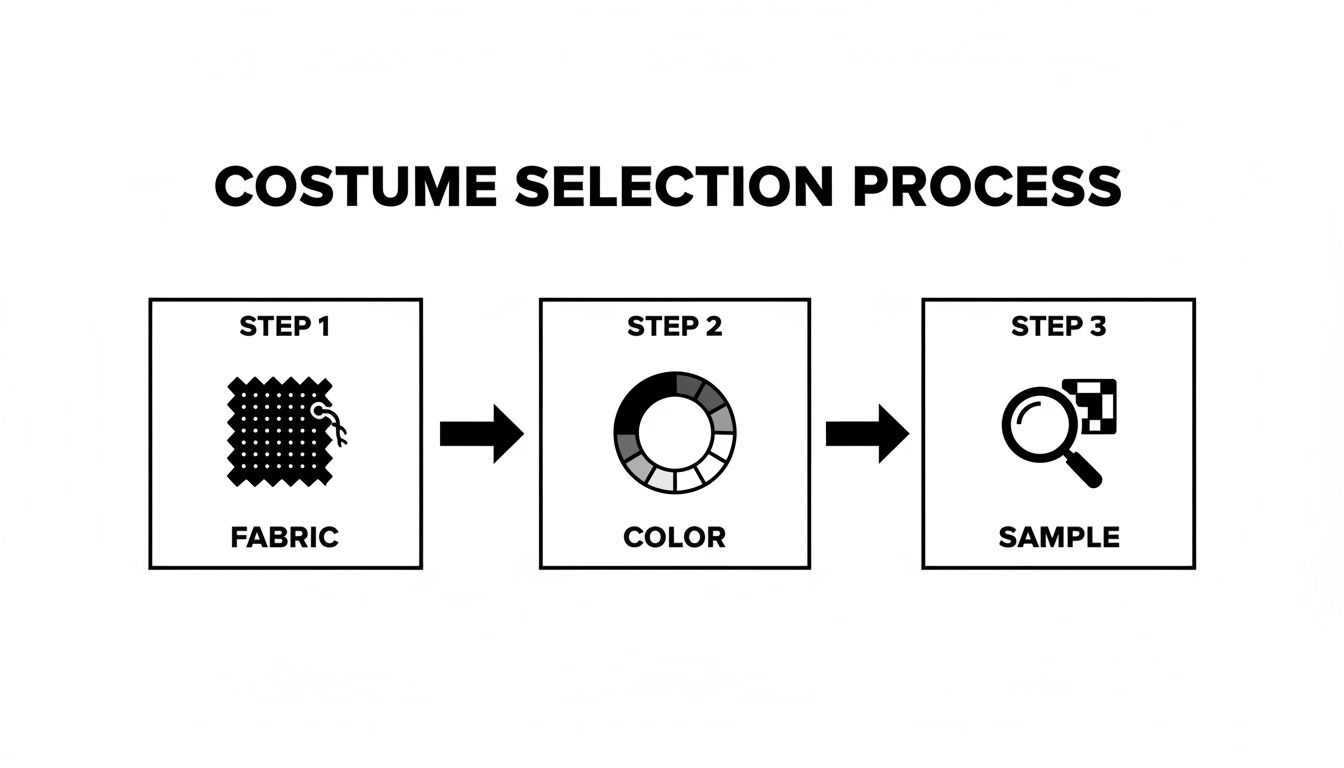
This visual breaks down the journey, reminding us to lock in foundational choices like fabric and color before diving into the nitty-gritty of sizing.
Organizing an Efficient Fitting Day
My best piece of advice? Set aside a dedicated day just for measurements. Don't try to cram it into a few minutes before or after a chaotic rehearsal. A "fitting day" sends a clear message to your performers that this is serious business and an essential part of your preparation.
To keep things running smoothly, think like an assembly line. Set up different stations: one person can handle height and weight, another can focus on chest and waist, and a third can tackle inseams and sleeve lengths. This approach is not only faster, but it also guarantees that each measurement is taken the exact same way for every single person.
Make sure you give everyone a heads-up on what to wear. Form-fitting clothes, like leggings and a tank top or t-shirt, are ideal. If someone shows up in a bulky hoodie and baggy jeans, you’re just not going to get accurate numbers, which inevitably leads to costumes that don't fit right.
Mastering the Essential Measurements
When it comes to the actual measuring, consistency is king. Always use a soft, flexible tailor's tape—never a rigid metal one from a toolbox. The tape should be snug against the body but not digging in.
To ensure you get everything you need for your costume supplier, I've put together a table of the most critical measurements. Getting these right is the foundation of a great-fitting costume.
Essential Measurements for Show Choir Costumes
Use this guide for key measurements to ensure a professional, comfortable fit for every performer when ordering custom choir apparel.
| Measurement Area | How to Measure | Why It's Important |
|---|---|---|
| Chest/Bust | Measure around the fullest part of the chest, keeping the tape parallel to the floor across the back. | Ensures tops and dresses are not too tight or baggy, allowing for deep breaths and movement. |
| Waist | Find the natural waistline (the narrowest part of the torso) and measure around it. | Critical for the fit of dresses, vests, and pants, preventing them from riding up or slipping down. |
| Hips | Measure around the widest point of the hips and seat. | Guarantees that pants, skirts, and dresses fit comfortably without pulling or bunching. |
| Inseam | Measure from the crotch down the inside of the leg to the desired hem. Have the performer wear their show shoes! | Prevents pants from being too short ("high-waters") or dangerously long. |
| Sleeve | With the arm bent slightly at the elbow, measure from the center of the back of the neck, across the shoulder, and down to the wrist bone. | Ensures full range of motion for choreography without sleeves being too short or restrictive. |
Documenting these on a standardized chart for each performer will make your life so much easier when it's time to place the order. Many suppliers have excellent resources, and you can always explore comprehensive size and color charts to see how your measurements line up with their specific sizing.
Addressing Common Fitting Challenges
Let's be real: no two performers are built the same, and that diversity is what makes a group interesting. But it does mean you need a plan. Working with a supplier who offers a wide range of sizes, including plus-size options, isn't just a nice-to-have; it's a must. Every performer deserves a costume that was made for their body.
With younger choirs, you have to account for the inevitable growth spurt.
A performer who might be a youth medium in September could easily need a youth large by the spring competition season. When in doubt, it’s often wise to size up slightly and plan for minor alterations.
You can also build in a little flexibility by choosing designs with features like adjustable waistbands or extra hem length that can be let out later. It’s a small detail that can save you a huge headache down the road.
Finally, never underestimate the power of a backstage fitting kit. A small bag with safety pins, good quality hem tape, and a basic needle-and-thread set is an absolute lifesaver. Those last-minute fixes, like tacking a fallen hem or securing a strap, can make all the difference in a performer's comfort and confidence moments before they step into the spotlight.
Budgeting and Ordering Your Costumes Smartly
Stunning costumes don't have to drain your choir's resources. The secret is a smart financial playbook and a well-managed ordering process. Getting the business side of costuming right is just as crucial as nailing the creative design. Let’s walk through the logistics to help you make the most of your budget and ensure the whole process is stress-free.
First things first: you need a realistic budget. This isn't just about the price tag on each dress or tux. You've got to think bigger—factor in potential customization fees, shipping costs, and always, always have a small contingency fund for those inevitable last-minute alterations or forgotten accessories. A detailed budget keeps surprises at bay and lets you make decisions with confidence.
Making Every Dollar Count Without Sacrificing Quality
One of the best ways to stretch your funds is by taking advantage of bulk discounts. It's simple math—ordering for your entire ensemble at once is far more cost-effective than piecing things together. Most suppliers, including us at ChoirBuy, offer significant savings for large orders.
Here are a few other powerful tactics to get the most for your money:
- Look for Package Deals: Many companies bundle items like a dress, character shoes, and accessories together for a discounted price. This is a fantastic way to streamline your order and save.
- Ask About Early Bird Discounts: Don't be shy! Some suppliers offer incentives if you place your order well before the busy season ramps up. It never hurts to ask when you’re requesting a quote.
- Get Creative with Fundraising: Think outside the box. A "Sponsor a Costume" campaign, a bake sale with treats themed around your show, or even a small benefit concert can directly cover your apparel costs.
To really get a handle on your budget, you also need to understand how custom work is priced. If you're adding logos or unique graphics, looking at a screen printing price guide can give you a solid idea of what to expect. This helps you plan accurately for that show-stopping, one-of-a-kind look.
Mapping Out Your Ordering Timeline
A smooth ordering process all comes down to good timing and clear communication. Once you've locked in a final design and have everyone's measurements, it's time to get the ball rolling. The first step is always to request a detailed quote from the supplier you’ve chosen.
A good quote should be a transparent, itemized list of every single cost. Read it carefully. Look for hidden setup charges for custom work or unexpected shipping fees. A supplier you can trust will be completely upfront about every expense.
Smart financial planning is key to a choir's long-term health. We've seen firsthand how streamlined apparel sourcing can bolster a group's financial stability, especially as many have adapted to recent economic shifts. When you manage costume expenses efficiently, you're contributing directly to your organization's longevity and performance readiness.
Understanding lead times is absolutely non-negotiable. Custom show choir costumes aren't made overnight. Production and shipping can easily take several weeks—or even months—during peak season. You need to place your order far enough in advance to leave a comfortable buffer before your first performance. This gives you plenty of time for distribution, fittings, and any necessary alterations without the stress of a looming deadline.
If you're looking for more tips on finding a supplier who can meet your timelines, our guide on the best place to buy choir robes has some great insights.
Making Your Performance Wear Last All Season
Your show choir costumes are a huge investment. Protecting that investment means thinking beyond the final bow. Proper care, smart storage, and a solid maintenance plan are what keep your performers looking sharp and polished from the first showcase to the final competition. A dedicated approach ensures your group looks just as crisp for their last performance as they did for their first.

This whole process starts the second the show ends. Instead of letting sweaty costumes get tossed into a bag, hang them up immediately to air out. It’s a simple step, but it’s a game-changer for preventing mildew and reducing the need for frequent, harsh cleanings that can wear out delicate fabrics.
Smart Cleaning for Tricky Fabrics
Not all fabrics are created equal, and a one-size-fits-all cleaning approach can lead to disaster. Anything with sequins, velvet, and delicate synthetics demands special attention to keep its color and texture intact.
Always check the care label first. If there isn't one, it's always best to play it safe.
- Sequins and Beading: Keep these far away from a washing machine. The tumbling action will snag and pull off sequins. Your best bet is to spot-clean stains gently with a mild detergent and a soft cloth. For a full cleaning, hand washing in cold water is the only way to go.
- Velvet: This fabric needs a gentle touch to protect its soft pile. Steam is your best friend for getting out wrinkles and refreshing the material between wears. If it needs a deeper clean, professional dry cleaning is highly recommended.
- Performance Spandex: Most of these stretchy fabrics can be machine washed on a gentle cycle with cold water. But never use fabric softener—it breaks down the elastic fibers. Always hang them to dry, as the high heat from a dryer will ruin the material's stretch for good.
Efficient Storage and Organization
How you store your costumes between performances is just as critical as how you clean them. The goal is to shield them from wrinkles, fading, and damage while making them easy to grab when you need them.
The secret to seamless backstage transitions isn’t just choreography—it’s organization. A well-managed costume inventory eliminates that last-minute panic of a missing accessory or a wrinkled garment, letting performers focus on what they do best.
Rolling garment racks are an absolute must-have for any serious show choir. They let you move costumes from the bus to the dressing room without everything getting crushed. Look for sturdy, high-capacity models with heavy-duty wheels that can handle everything from smooth hallways to bumpy parking lots. Storing each show choir costume in its own breathable garment bag will also protect it from dust and fading.
To make sure costume pieces don't get mixed up or lost, especially after lots of use and cleaning, think about using durable iron-on labels. This little trick makes inventory checks a breeze and ensures every performer gets the right pieces every single time.
On-the-Road Repairs and Travel Prep
Even with the best care, things happen. A popped seam, a loose button, or a fallen hem can pop up moments before showtime. Being ready for these small emergencies is crucial.
Put together a "costume first-aid kit" that travels with you to every single event. This kit is your go-to for quick fixes on the fly.
Your Kit Should Include:
- Safety pins in various sizes for temporary hem fixes and securing straps.
- A portable sewing kit with needles, thread in matching colors, and small scissors.
- Double-sided fashion tape, which is perfect for holding necklines in place or tacking up a hem in a pinch.
- A stain remover pen to quickly treat small spills before they have a chance to set.
When you're packing for a trip, always use garment bags. If you absolutely have to pack costumes in a suitcase, roll them carefully instead of folding to keep creasing to a minimum. These simple but effective strategies will protect your investment and ensure your choir's look remains impeccable all season long.
Your Top Show Choir Costume Questions, Answered
If you’re new to outfitting a show choir, or even if you’ve done it a dozen times, questions always pop up. It’s a big job with a lot of moving parts! Getting straight answers from the get-go is the key to a stress-free season and a confident, great-looking group on stage.
I’ve been there, so I’ve pulled together some of the most common questions I hear from directors. Think of this as your cheat sheet for handling everything from timelines to sizing without breaking a sweat.
How Far in Advance Should I Order Costumes?
This is easily the most critical question, and the answer almost always surprises people: You need to start thinking about costumes 4 to 6 months before your first performance. Yes, really.
That might sound like a huge amount of time, but it disappears quickly. Here’s a rough breakdown of why you need that buffer:
- The Creative Part: Just nailing down the final design, colors, and fabrics can take a few weeks of back-and-forth.
- The Sizing Marathon: Scheduling a fitting day and getting accurate measurements for every single student is a project in itself.
- Production Time: Custom garments aren't sitting on a shelf. They have to be made, and lead times can be weeks, especially during the busy fall and spring seasons.
- Shipping & Logistics: You have to account for the time it takes for the boxes to actually get to you.
- The Final Check: Once they arrive, you need a week or two to hand out the costumes, have everyone try them on, and identify any minor alterations needed.
Trust me, starting early is the single best thing you can do to avoid last-minute panic and rush fees.
What Kind of Customizations Can I Actually Make?
Making a costume your own is what brings a show's theme to life. Most vendors have a solid set of options to help you do just that. While every company is different, you can usually count on being able to personalize a few key things.
Most of the time, you’ll be able to pick from a vendor’s library of fabrics and colors to create a unique combination. Many also offer screen printing or embroidery if you want to add a custom logo or lettering. Sometimes you can even ask for small tweaks to a standard design, like changing a neckline, adjusting a sleeve length, or altering a hemline to work better with your choreography.
The secret is to be crystal clear. When you talk to a supplier, come prepared with sketches, inspiration photos—anything that shows them exactly what you’re imagining. It makes the process so much smoother for everyone.
How Do You Handle Sizing for a Big, Diverse Group?
Sizing a large group with a huge range of body types feels like a massive puzzle, but a good system makes it totally manageable. The number one rule? Be consistent. Use the same flexible measuring tape for everyone, and make sure the person (or small team) doing the measuring uses the exact same technique every time.
It's also non-negotiable to work with a company that offers a truly inclusive size range.
Every single performer deserves to walk on stage feeling comfortable and looking great. Finding a supplier with a wide range of sizes, including plus and youth options, is absolutely essential.
Once you have your measurements, carefully compare them to the supplier’s size chart. A quick pro tip: if a student is right between two sizes, always size up. It’s a hundred times easier to take a garment in than it is to magically add more fabric.
Can I Get a Sample Before Placing My Big Order?
Yes, and you absolutely should. Think of it as a non-negotiable quality check. A sample lets you see the color in person, feel the fabric, and check the quality of the stitching before you commit to dozens of them.
Any reputable company will be happy to send you fabric swatches so you can see and feel the materials. Some will even create a full sample garment for you to review, often for a small fee that gets credited back to you when you place your bulk order. It takes all the guesswork out of the equation and ensures you get exactly what you paid for.
At ChoirBuy, our goal is to make outfitting your choir a simple, successful, and even enjoyable process. We provide tons of customizable options, inclusive sizing that works for everyone, and real support to help you create that perfect on-stage look. See what's possible and start designing your show choir costume today.